

Owning a yacht in Florida is one of life’s great privileges, but even seasoned owners are surprised to discover that a simple paperwork oversight can result in a misdemeanor charge before they ever leave the dock. Florida’s registration rules are layered, and the widely held belief that federal documentation alone covers everything is one of the most expensive misconceptions we see. Whether you’re closing on your first vessel or trading up to something more impressive, understanding exactly how registration works, what it protects, and how it affects your investment is the kind of knowledge that pays dividends every time you go to sell.
Table of Contents
- What is yacht registration and why does it matter?
- Florida yacht registration process: Step-by-step
- Federal documentation vs. state registration: A practical comparison
- Registration, financing, and investment: Why it matters for resale
- Expert take: What most yacht owners overlook about registration
- Next steps: Expert guidance and resources for yacht owners
- Frequently asked questions
Key Takeaways
| Point | Details |
|---|---|
| Registration is mandatory | Most yachts in Florida must be registered with state authorities to operate legally. |
| Federal and state overlap | USCG documentation does not always replace Florida state registration, so double-check requirements. |
| Proof of ownership essentials | Gather all required documents like bill of sale and manufacturer’s statement for a smooth registration. |
| Investment impact | Proper registration increases financing options and buyer confidence for resale. |
| Penalties for non-compliance | Operating unregistered yachts can lead to legal penalties and financial setbacks. |
What is yacht registration and why does it matter?
Yacht registration is the official process through which the state of Florida recognizes your vessel, issues proof of legal ownership, and grants you the right to operate in its waters. It’s not optional, and the consequences of skipping it are real. Operating a vessel in Florida without a valid registration is a second-degree misdemeanor, and that charge can follow you into future yacht transactions in ways that complicate financing and buyer confidence.
The state registration process is managed through the Florida Department of Highway Safety and Motor Vehicles (FLHSMV), and applications are typically processed at your county tax collector’s office. The registration certificate and validation decal are both issued to confirm your yacht’s legal status and must be kept onboard whenever you’re underway.
Heads up: State registration and federal USCG documentation are two completely separate systems. Many owners assume one replaces the other. It doesn’t work that way, and we’ll cover exactly why in a later section.
Here’s why proper registration matters well beyond legal compliance:
- Ownership protection: Your registration certificate is official proof that you own the vessel, which matters in disputes and during resale.
- Insurance eligibility: Many insurers require valid registration before issuing a policy, especially for high-value yachts.
- Financing readiness: Lenders routinely check registration status before approving loans or recording liens.
- Resale value: Buyers and their brokers will review your registration history during due diligence. A clean record signals a well-managed investment.
- Peace of mind on the water: You can cruise Florida’s waterways knowing you’re fully compliant and protected.
For a broader look at how ownership, legal status, and financial planning intersect, our Florida boat ownership guide is a resource we recommend reviewing before or after any major vessel transaction.
Florida yacht registration process: Step-by-step
Understanding the importance of registration sets the foundation. Now let’s walk through exactly how to get it done correctly in Florida. The process is manageable when you know what to expect, and having everything organized before you show up to the tax collector’s office saves real time.

Who needs to register? Almost every yacht operated on Florida’s public waters must be registered. Exceptions exist for non-motorized vessels under certain lengths and for vessels used exclusively on private lakes, but these carve-outs rarely apply to the kinds of yachts our clients are buying and selling.
Here is the standard workflow for registering your yacht in Florida:
- Gather your proof of ownership. Florida law requires that proof of ownership be established using an executed bill of sale, builder’s contract, manufacturer’s statement of origin, a federal marine document, or other acceptable documentation.
- Prepare a complete vessel description. The application must include the owner’s name and address, valid identification, and a full description of the vessel including hull identification number (HIN), length, make, model, and year.
- Visit your county tax collector’s office or an FLHSMV service center. Bring originals and copies of all documents.
- Pay the registration fee. Fees are based on vessel length and vary by county; longer yachts carry higher fee tiers.
- Receive your registration certificate and validation decal. Both must be kept aboard the vessel at all times during operation.
- Set a renewal reminder. Florida registrations are renewed annually. Missing a renewal window is a compliance issue that can interfere with upcoming sales or financing.
| Vessel length | Approximate annual registration fee | Renewal period |
|---|---|---|
| Up to 12 feet | $5.50 | 1 year |
| 12 to 16 feet | $16.25 | 1 year |
| 26 to 40 feet | $75.25 | 1 year |
| Over 110 feet | $151.25 | 1 year |
Fees are subject to change. Always confirm current rates with your county tax collector.
Pro Tip: If you’re purchasing a yacht through a formal closing process, make sure the transfer of registration is part of the closing checklist. Our guide to the yacht closing workflow breaks down every step so nothing slips through the cracks, including the registration transfer timing that trips up many buyers.
One more thing worth noting: if you’re new to Florida boating or recently relocated, our Florida yachting guide covers the broader landscape of what to expect as a vessel owner in the state, from anchorage rules to seasonal considerations.
Federal documentation vs. state registration: A practical comparison
Now let’s put state registration and federal documentation side by side. This is the comparison that clears up the most confusion for our clients, and getting it wrong is genuinely costly.
USCG (United States Coast Guard) documentation is a federal system that provides proof of nationality and ownership for eligible vessels. It’s commonly used for yachts over five net tons, which in practice means vessels roughly 25 to 27 feet or longer. Federal documentation carries real advantages, especially if you plan to cruise internationally, as it establishes the vessel’s American nationality and can simplify customs clearance in foreign ports.
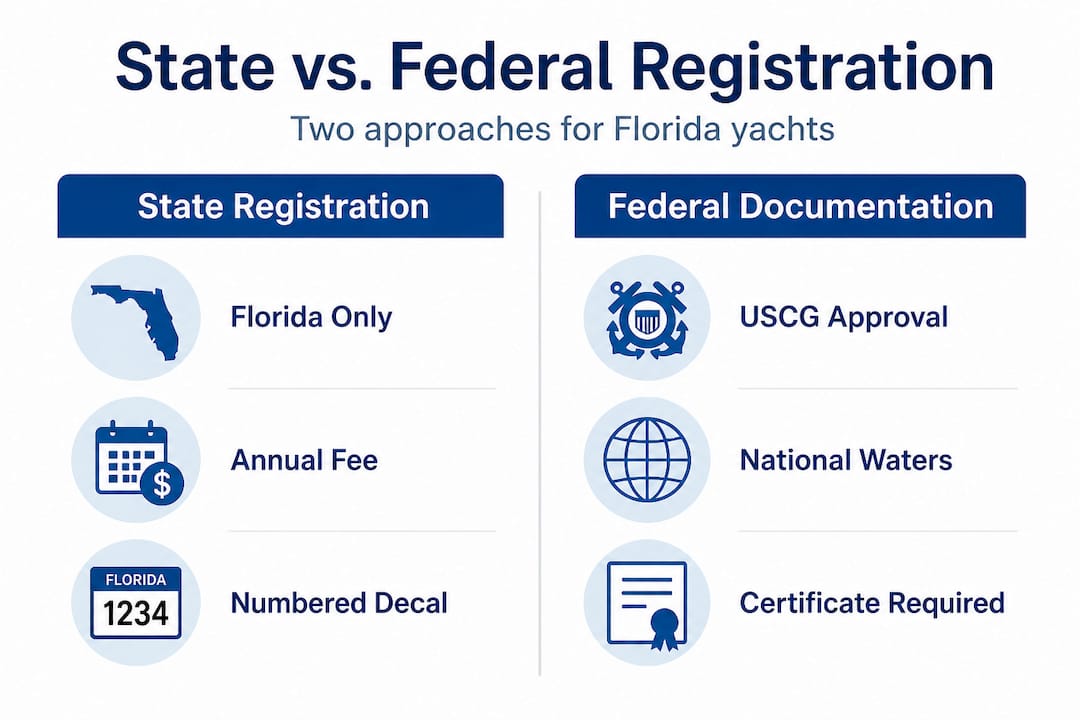
However, as USCG documentation guidance makes clear, federal documentation is an alternative to state registration in many contexts, but not a universal replacement. Florida, in particular, may still require state registration depending on how and where the vessel is used in its waters. This is the layer most owners miss entirely.
Here’s a side-by-side comparison to help you think through which applies to your situation:
| Factor | State registration (Florida) | USCG federal documentation |
|---|---|---|
| Issuing authority | FLHSMV / County tax collector | U.S. Coast Guard (federal) |
| Required for Florida waters | Yes, for most vessels | Not sufficient alone in Florida |
| Proves nationality | No | Yes |
| Needed for international cruising | No | Yes, strongly recommended |
| Required for financing/liens | Depends on lender | Often preferred by lenders |
| Annual renewal | Yes | Yes (via NVDC) |
| Good for vessels under 26 ft | Yes | Less common |
Key takeaways from our experience working with Florida yacht owners:
- Financing often requires both. Many marine lenders want to see federal documentation for lien recording purposes, while Florida expects state compliance separately.
- Coastal cruisers heading to the Bahamas or Caribbean need federal documentation. State registration alone won’t satisfy customs in Nassau or Freeport.
- Documentation does not replace your Florida decal. You’ll still need the state-issued validation sticker displayed on the vessel.
- Letting either lapse creates problems at closing. Buyers’ attorneys and brokers check both systems during due diligence.
For edge case scenarios involving federally documented vessels and Florida’s state requirements, it’s worth reviewing the specifics before assuming your situation fits the standard mold.
Pro Tip: Our team consistently recommends working with an experienced yacht broker’s role professional who understands both the federal documentation system and Florida’s state layer. The overlap between them is where most compliance gaps live, and having someone who knows the terrain prevents expensive surprises.
For yacht owners concerned about the tax implications tied to registration and documentation decisions, our yacht tax guide covers how these choices interact with Florida’s sales tax rules and use tax obligations.
Registration, financing, and investment: Why it matters for resale
Once your registration and documentation are handled correctly, you unlock some real financial advantages that directly affect your yacht’s resale value and your ability to leverage it as an investment asset.
Federal documentation systems are built to track ownership and lien history for the life of the vessel, which is a significant factor during financing applications and during buyer due diligence. When a prospective buyer’s team pulls your vessel’s history and finds a clean, uninterrupted documentation record, it signals a well-managed asset. When they find gaps, expired registration periods, or lien complications, it becomes a negotiation lever that works against you.
Here’s what proper registration and documentation mean for your bottom line:
- Streamlined loan approval. Marine lenders move faster when documentation is clean. Gaps in registration history require explanations that slow down closing timelines.
- Stronger buyer confidence. A federally documented yacht with a full ownership chain history is simply easier to sell. Buyers feel protected, and that confidence translates into offers closer to asking price.
- Accurate valuation support. Appraisers and brokers factor registration and documentation status into their valuations. A vessel with spotty compliance history will appraise lower than a comparable yacht with clean records.
- Fewer legal contingencies. Buyers and their attorneys insert fewer contingencies into purchase agreements when the registration and documentation package is complete and current.
Investment insight: We’ve seen clean documentation shave weeks off closing timelines and add meaningful dollars to final sale prices. It’s one of the highest-return investments a yacht owner can make before listing.
Common pitfalls to avoid as you think about registration as an investment tool:
- Letting federal documentation lapse while the vessel is on the market
- Failing to transfer state registration promptly after purchase
- Assuming a title search covers documentation records (they’re separate systems)
- Overlooking lien releases from prior financing arrangements
If you’re preparing to list your vessel or thinking about the right timing for a sale, our yacht sales process guide walks through every step with Florida-specific detail.
Expert take: What most yacht owners overlook about registration
Here’s the honest truth we share with clients who’ve owned yachts for years: the most dangerous assumption in Florida yacht ownership is believing that federal documentation makes state registration irrelevant. We’ve seen this belief cause real problems at closing, and not just for first-time buyers.
Florida’s registration requirements hinge on use, not just status. A vessel can be fully documented with the USCG and still trigger a state registration requirement based on how many days it’s operated in Florida waters or whether it’s used commercially versus recreationally. These are not hypotheticals. They’re real scenarios we’ve navigated with clients who assumed their federal paperwork was sufficient and discovered the gap at the worst possible moment.
The practical lesson is this: treat federal documentation and state registration as two separate compliance obligations that must both be actively maintained, not as a single checkbox. When one lapses, the ripple effects show up in insurance, financing, and resale conversations.
Our closing experience also reveals that buyers’ attorneys in Florida now routinely request both documentation and registration records as part of their due diligence package. If either is not current, expect delays and price pressure. Sellers who stay ahead of this are the ones who close on their terms.
Working with a knowledgeable brokerage team eliminates most of these risks before they become problems. The details on how professional guidance protects your investment are covered in our piece on yacht brokerage advantages for Florida owners.
Next steps: Expert guidance and resources for yacht owners
Navigating Florida’s registration requirements, federal documentation rules, and the downstream investment implications is a lot to manage on your own. That’s exactly the kind of process we built our team to handle for you.

Whether you’re registering a newly purchased vessel, preparing an existing yacht for sale, or simply making sure your compliance is solid before cruising season begins, we’re here to make it seamless. Our clients consistently tell us that having a dedicated team to manage the details gives them confidence to focus on the joy of owning a world-class vessel. Explore our yacht management setup resources, discover how to boost your yacht’s sale value before listing, and if financing is part of your plan, our yacht financing guide is the place to start. Let’s get you where you want to be on the water.
Frequently asked questions
Do I need both state registration and federal documentation for my yacht in Florida?
In most cases, yes. Florida may still require state registration based on how the vessel is used in Florida waters, so you should not assume federal documentation fully eliminates state requirements.
What documents do I need for yacht registration in Florida?
You’ll need proof of ownership, such as a bill of sale, builder’s contract, or manufacturer’s statement. Proof of ownership can also be established using a federal marine document or other acceptable documentation, along with a completed application and full vessel description.
What happens if I operate a yacht in Florida without valid registration?
Operating a vessel without valid registration is a serious legal matter. Operating without valid registration is identified as a second-degree misdemeanor in Florida and can carry penalties that complicate future transactions.
Does yacht registration affect lending and resale value?
Absolutely. Federal documentation tracks ownership and liens for the life of the vessel, which lenders and buyers review during financing approval and due diligence, directly influencing sale price and closing speed.
Recommended
Request A Call
Featured Listings

2027 Canados
100
Miami Florida

2015 Maiora
$3,750,000
90
Miami Florida

2027 Canados
57
Miami Florida

2019 Silent-Yachts Fair Dinkum
$1,599,000
55
Fort Lauderdale Florida

2026 Canados
49
Miami Florida

2026 Buddy Davis
47
Miami Florida

2020 Grady-White No Name
$610,000
45
Hallandale Beach Florida

2020 Viking Huckleberry
$1,495,000
44
Fort Lauderdale Florida

2027 Canados
43
Miami Florida

2021 Intrepid Dream Faster
$730,000
40
Coral Gables Florida

2016 Edgewater
$299,000
37
Miami, Florida

2022 Avid
$56,900
23
Stuart Florida
Get your yacht value Estimate
"*" indicates required fields