

Transferring yacht ownership sounds straightforward until you encounter maritime liens, jurisdictional quirks, or documentation gaps that can cost you tens of thousands. Whether you’re selling to upgrade or buying your dream vessel, maritime liens can survive a sale if not properly checked, jeopardizing your investment and legal standing. This guide walks you through the entire process, from preparation to closing, with actionable strategies to protect your investment and maximize returns.
Table of Contents
- What is a yacht ownership transfer?
- Preparation: What you need before transfer
- Step-by-step yacht ownership transfer process
- Edge cases and international transfer scenarios
- How to maximize your investment value
- Take the next step with expert yacht support
- Frequently asked questions
Key Takeaways
| Point | Details |
|---|---|
| Preparation is crucial | Having all paperwork and understanding unique scenarios prevents costly delays and legal issues. |
| Use professionals | Brokers, attorneys, and surveyors help avoid risk and maximize your net return during transfer. |
| Check for liens | A thorough lien search is critical as unresolved debts can survive a sale and become your responsibility. |
| Maximize ROI after transfer | Strategically manage and upgrade your yacht to increase resale value or revenue potential. |
What is a yacht ownership transfer?
A yacht ownership transfer is the legal process of moving yacht ownership and registration from one party to another. It’s not just signing a bill of sale. You’re transferring title, updating registration with maritime authorities, and ensuring all liens, taxes, and compliance requirements are satisfied. Some buyers purchase the yacht itself (the asset), while others acquire the company that owns it, each carrying different legal and financial implications.
Why does this matter? A proper transfer protects you from inheriting debt, ensures you can legally operate the vessel, and preserves resale value. Skip a step, and you risk voided insurance, registration delays, or worse, discovering hidden liens months after closing. The 661 superyacht sales totaling $6.1B in 2025 prove this market is active, but only meticulous transfers protect that value.
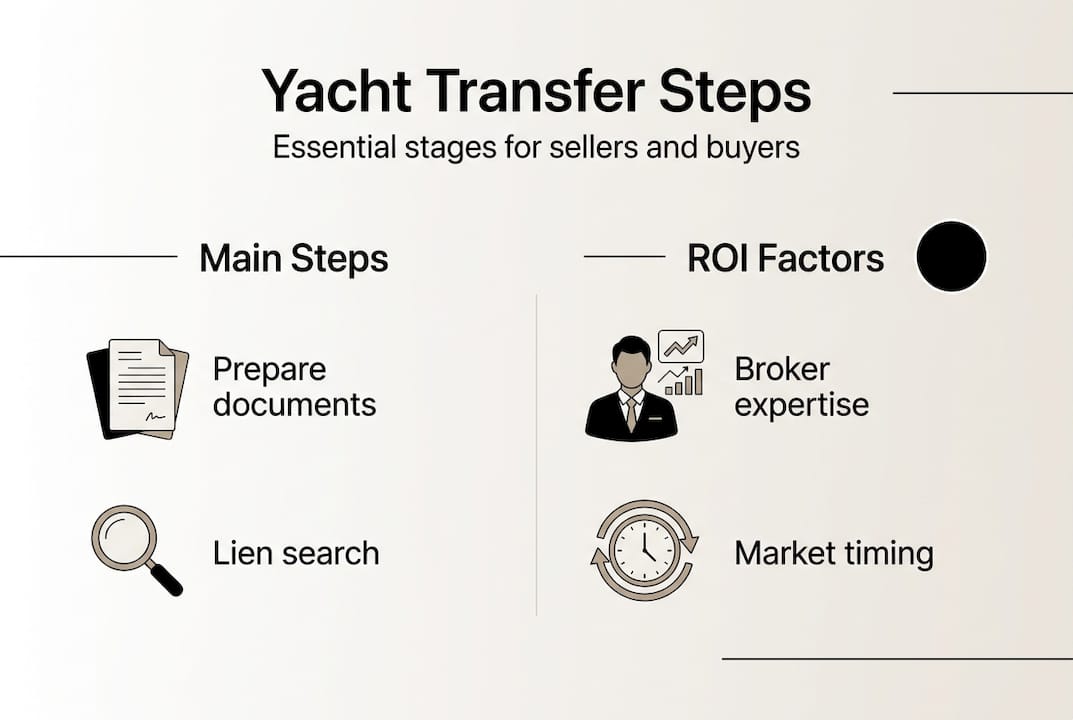
Here’s what the process involves:
- Documentation review: Verify title, registration, and compliance certificates
- Title and lien checks: Confirm no outstanding debts or claims
- Bill of sale execution: Legal transfer document signed by both parties
- Tax and compliance filings: Submit required forms to maritime and tax authorities
- Registration update: Transfer vessel registration to new owner
- Post-transfer actions: Update insurance, mooring agreements, and operational permits
If you’re looking to sell your yacht for maximum ROI, understanding this process from both sides gives you negotiating power and helps you avoid costly mistakes.
Preparation: What you need before transfer
Before you even think about signing documents, gather your paperwork and understand your specific scenario. Standard transfers require a bill of sale, current title, registration certificate, and compliance documents like safety inspections or environmental certifications. But special cases add layers of complexity.
Special scenarios and their requirements:
- Estate sales: Executor forms, death certificate, probate documentation
- Divorce settlements: Court order, property division agreement
- Gifting: Gift declaration, tax forms for gift reporting
- Non-titled states: Bonded title process or alternative documentation
- Repossessed vessels: Lender release, satisfaction of debt proof
Jurisdictional differences matter enormously. In the US, some states don’t issue titles for vessels, requiring alternative proof of ownership. Canada has a 30-day post-death or divorce filing window for transfers. EU countries often require VAT documentation and proof of tax payment. International waters add surveyor reports, GPS logs, and sanctions compliance checks.
| Scenario | Required Documents | Special Considerations |
|---|---|---|
| Standard sale | Bill of sale, title, registration, compliance certs | Lien search mandatory |
| Estate transfer | Executor forms, death certificate, probate docs | 30-day window in Canada |
| Divorce | Court order, property agreement | Legal review recommended |
| International | Surveyor report, GPS logs, compliance certs | Sanctions screening required |
| Bonded title | Bond certificate, alternative ownership proof | State-specific process |
Pro Tip: Always run a comprehensive maritime lien search before finalizing any purchase. Liens can survive ownership transfers and become your financial burden if not cleared before closing.
For a complete walkthrough of the selling side, check our step-by-step guide to selling a yacht. Understanding both perspectives helps you anticipate issues and negotiate better terms. You’ll also want to review yacht investment ROI fundamentals to understand how transfer timing affects your returns.
Step-by-step yacht ownership transfer process
Once your documentation is ready, the actual transfer follows a structured sequence. Each step has a responsible party and typical timeframe. Missing a step or rushing through can void your transfer or create legal exposure.
The complete transfer process:
- Offer and acceptance (Buyer/Seller, 1-3 days): Negotiate price and terms, sign purchase agreement
- Deposit and escrow (Buyer, 1-2 days): Place deposit with escrow agent or attorney
- Survey and inspection (Buyer/Surveyor, 7-14 days): Professional inspection of vessel condition
- Title and lien search (Buyer/Attorney, 3-5 days): Verify clean title and no outstanding claims
- Financing approval (Buyer/Lender, 10-21 days): If applicable, secure yacht financing
- Final walkthrough (Buyer/Seller, 1 day): Confirm vessel condition matches agreement
- Bill of sale execution (Both parties/Attorney, 1 day): Sign legal transfer documents
- Payment transfer (Buyer, 1 day): Release funds from escrow to seller
- Registration filing (Buyer/Broker, 3-7 days): Submit transfer documents to maritime authority
- Insurance and permits (Buyer, 1-3 days): Update coverage and operational permits
| Step | Responsible Party | Typical Timeframe |
|---|---|---|
| Offer acceptance | Buyer/Seller | 1-3 days |
| Survey completion | Buyer/Surveyor | 7-14 days |
| Title verification | Buyer/Attorney | 3-5 days |
| Financing approval | Buyer/Lender | 10-21 days |
| Closing and payment | Both/Escrow | 1-2 days |
| Registration update | Buyer/Authority | 3-7 days |
The typical closing period spans 14-45 days, though superyachts can remain on the market for 12-16 months before finding the right buyer. Larger vessels involve more complex inspections, international compliance checks, and crew transitions that extend timelines.

Pro Tip: Using a professional yacht broker or closing specialist can boost your net proceeds by 15-25% through better negotiation, faster sales, and fewer post-closing issues. Their expertise in documentation and maritime law prevents costly mistakes.
Want to understand why professional representation matters? Read about why using a yacht expert maximizes value and explore negotiation strategies that maximize investment returns.
Edge cases and international transfer scenarios
Most transfers follow the standard path, but certain situations demand extra attention and specialized knowledge. These edge cases trip up even experienced yacht owners, leading to delays, legal disputes, or financial losses.
Complex transfer scenarios:
- Death of owner: Estate executor must provide death certificate, probate documentation, and file within jurisdictional deadlines (30 days in Canada). Heirs may need to establish ownership through probate court before transfer.
- Divorce settlements: Court-ordered property division requires legal documentation showing which party receives the vessel. Both parties typically must sign transfer documents unless court order specifies otherwise.
- Gifting: Donor must file gift tax forms if value exceeds annual exclusion limits. Recipient needs gift declaration and proof of relationship for tax purposes.
- Distressed sales: Lender must provide satisfaction of debt and release of lien. Verify all liens are cleared before closing, as some may survive the sale.
- Buying the company vs. asset: Purchasing the owning company can expose you to hidden liabilities, unpaid taxes, or legal claims against the entity. Asset purchases are generally safer but may trigger different tax consequences.
- International waters: Global transfers require GPS/AIS logs, surveyor reports, and compliance with international maritime regulations. Sanctions screening is mandatory for certain jurisdictions.
- Bonded titles: For vessels without clear title history, some states allow bonded title processes requiring surety bonds and waiting periods.
“Maritime liens can outlast the sale, always perform due diligence. A lien for unpaid repairs, crew wages, or salvage can attach to the vessel itself and transfer with ownership, making you responsible for debts you didn’t incur.”
International transfers add complexity through varying registration requirements, tax treaties, and import/export regulations. EU vessels moving to US waters need customs clearance and may trigger import duties. Flag state changes require de-registration from the original country and new registration in the destination jurisdiction.
For sellers navigating these complexities, understanding the advantages of yacht brokerage becomes critical. Brokers handle jurisdictional requirements, coordinate with international authorities, and ensure compliance across borders.
How to maximize your investment value
Completing the transfer correctly protects your investment, but strategic decisions before and after transfer determine whether you maximize returns or leave money on the table. Smart yacht owners treat their vessels as financial assets requiring active management.
Value maximization strategies:
- Maintain detailed records: Document all maintenance, upgrades, and repairs. Properly documented upgrades yield 70-85% return when selling, while undocumented work adds minimal value.
- Price realistically: Overpricing extends time on market and reduces final sale price. Pricing with professional guidance adds 8-12% to net proceeds through faster sales and better negotiation.
- Use professional representation: Brokers and closing specialists boost net proceeds by 15-25% through market knowledge, buyer networks, and negotiation expertise.
- Consider charter or fractional ownership: Offsetting ownership costs through charter revenue or fractional arrangements can improve overall returns and maintain vessel condition through regular use.
- Optimize ownership structure: LLC or corporate ownership may provide tax advantages, liability protection, and easier transfer processes. Consult with maritime attorneys and tax advisors.
- Time your sale strategically: Market conditions, seasonal demand, and economic factors affect sale prices. Spring and early summer typically see higher activity and better prices.
- Invest in high-ROI upgrades: Electronics, safety equipment, and cosmetic improvements offer better returns than structural modifications. Focus on buyer priorities.
The difference between a mediocre and exceptional sale often comes down to preparation and professional guidance. Sellers who treat the transfer as a business transaction rather than an emotional event consistently achieve better outcomes.
Explore our detailed Florida boat selling tips to maximize ROI fast and learn what yacht brokerage really means for your bottom line.
Take the next step with expert yacht support
Navigating yacht ownership transfers requires expertise across maritime law, tax regulations, and market dynamics. Whether you’re preparing to sell, evaluating a purchase, or managing your current vessel, professional support transforms complexity into confidence.

Our team specializes in guiding yacht owners through every stage of ownership, from initial purchase through eventual sale. We handle documentation, coordinate with maritime authorities, and ensure your transfer protects your investment while maximizing returns. Our personalized approach means you’re never navigating these waters alone.
Ready to explore how professional yacht management enhances your investment? Discover our comprehensive yacht management services in Florida designed to boost investment value. Planning your first purchase? Our luxury yacht investment guide helps you avoid common buyer mistakes. Already own and thinking about selling? Learn how preparing your yacht for sale can boost sale value by 10% or more.
Frequently asked questions
How long does a typical yacht ownership transfer take?
The closing process typically lasts 14-45 days, but larger yachts can take over a year on the market before finding qualified buyers.
What key documents are needed for a yacht transfer?
You’ll need a bill of sale, title, registration, and compliance certificates. Estate sales require executor forms, while bonded titles need surety bonds for undocumented vessels.
Is it safer to buy the yacht or the company that owns it?
Buying the asset (yacht) is generally safer, as purchasing the company can expose you to hidden liabilities, unpaid taxes, and legal claims against the entity.
How do I avoid inheriting debt or liens when buying?
Always perform a thorough lien search and use professionals to review documentation. Maritime liens can survive sales and become your responsibility if not cleared before closing.
Can a yacht ownership transfer be done internationally?
Yes, but expect requirements like GPS logs, surveyor reports, and strict compliance, especially with international waters or sanctions screening for certain jurisdictions.
Recommended
Request A Call
Featured Listings

2027 Canados
100
Miami Florida

2015 Maiora
$3,750,000
90
Miami Florida

2027 Canados
57
Miami Florida

2019 Silent-Yachts Fair Dinkum
$1,599,000
55
Fort Lauderdale Florida

2026 Canados
49
Miami Florida

2026 Buddy Davis
47
Miami Florida

2020 Grady-White No Name
$610,000
45
Hallandale Beach Florida

2020 Viking Huckleberry
$1,495,000
44
Fort Lauderdale Florida

2027 Canados
43
Miami Florida

2021 Intrepid Dream Faster
$730,000
40
Coral Gables Florida

2016 Edgewater
$299,000
37
Miami, Florida

2022 Avid
$56,900
23
Stuart Florida
Get your yacht value Estimate
"*" indicates required fields