

TL;DR:
- Yacht ROI depends on buying, managing, and selling strategies beyond depreciation.
- Proper maintenance, charter programs, and timing can significantly improve investment outcomes.
- Viewing yachts as both financial assets and lifestyle platforms leads to more satisfying results.
Yachts carry a reputation as money pits, and that reputation is not entirely wrong. But calling a yacht purely a depreciating expense misses a much more interesting story. The truth is, return on yacht investment depends heavily on how you buy, manage, and eventually sell your vessel. Owners who treat their yacht like a strategic asset rather than a trophy tend to see dramatically different financial outcomes. In this guide, we break down exactly how yacht ROI works, what drives it, how it compares to other asset classes, and what you can do right now to maximize every dollar you put into your investment.
Table of Contents
- The basics: What does ‘return on yacht investment’ mean?
- Key factors influencing yacht investment returns
- Comparing yacht investments to real estate and other assets
- How to maximize your yacht investment returns
- A clear-eyed perspective on yachts as investments
- Work with experts to unlock investment value
- Frequently asked questions
Key Takeaways
| Point | Details |
|---|---|
| Yacht investment ROI factors | Return depends on charter income, resale value, costs, and personal enjoyment. |
| Costs vs. income | Understand all ongoing expenses and real income sources before buying. |
| Maximizing returns | Professional management, tax planning, and smart timing can greatly boost ROI. |
| Comparison with other assets | Yachts rarely outperform real estate but offer unique lifestyle and networking advantages. |
The basics: What does ‘return on yacht investment’ mean?
Most people think of ROI as a simple math equation: profit divided by cost. For yachts, it is a lot more layered than that. ROI in yachting includes capital appreciation or depreciation, charter income, operational costs, tax advantages, and something harder to quantify: lifestyle value. All of these factors combine to form your true return.
Here is where the misconception lives. Many buyers assume yachts only depreciate, and they write off the entire category as a financial loss. That is a surface-level view. A well-maintained, strategically chartered yacht in a high-demand market can offset a significant portion of its annual costs, and in some cases, generate meaningful income.
The key ROI drivers you need to track are:
- Charter income: Revenue earned when you rent your yacht to qualified guests through a managed program
- Resale value: The price you recover when you sell, influenced by condition, brand, and market timing
- Operational costs: Crew, fuel, insurance, marina fees, and maintenance that reduce your net return
- Tax advantages: Deductions and structures that can legally reduce your ownership burden
- Lifestyle value: The personal enjoyment, networking, and experiential return that no spreadsheet fully captures
“A yacht is not just a vessel. It is a platform for experiences, relationships, and, when managed well, real financial performance.” This is the mindset that separates savvy yacht owners from disappointed ones.
Pro Tip: Track both your financial return and your lifestyle return separately. Many owners are surprised to find that when they assign a realistic dollar value to the experiences they gain, their overall ROI looks far more favorable than the numbers alone suggest.
The moment you start viewing your yacht through this multi-dimensional lens, the entire investment conversation changes. You stop asking “how much am I losing?” and start asking “how much am I gaining across all dimensions?”
Key factors influencing yacht investment returns
Now that you understand what yacht investment ROI means, let’s break down the most important factors that influence your actual returns.
Ownership costs are the first reality check. For a 60-foot yacht, annual ownership costs typically include a wide range of expenses that add up fast. Here is a realistic snapshot:
| Cost category | Estimated annual cost |
|---|---|
| Crew and captain | $80,000 to $150,000 |
| Insurance | $15,000 to $30,000 |
| Marina and dockage fees | $20,000 to $50,000 |
| Maintenance and repairs | $30,000 to $60,000 |
| Fuel | $20,000 to $40,000 |
| Total estimated costs | $165,000 to $330,000 |
On the income side, a well-managed 60-foot charter yacht in a prime market like Florida or the Mediterranean can generate $150,000 to $300,000 in gross charter revenue annually, depending on utilization rates and season. That is a meaningful offset, though rarely a full cover.
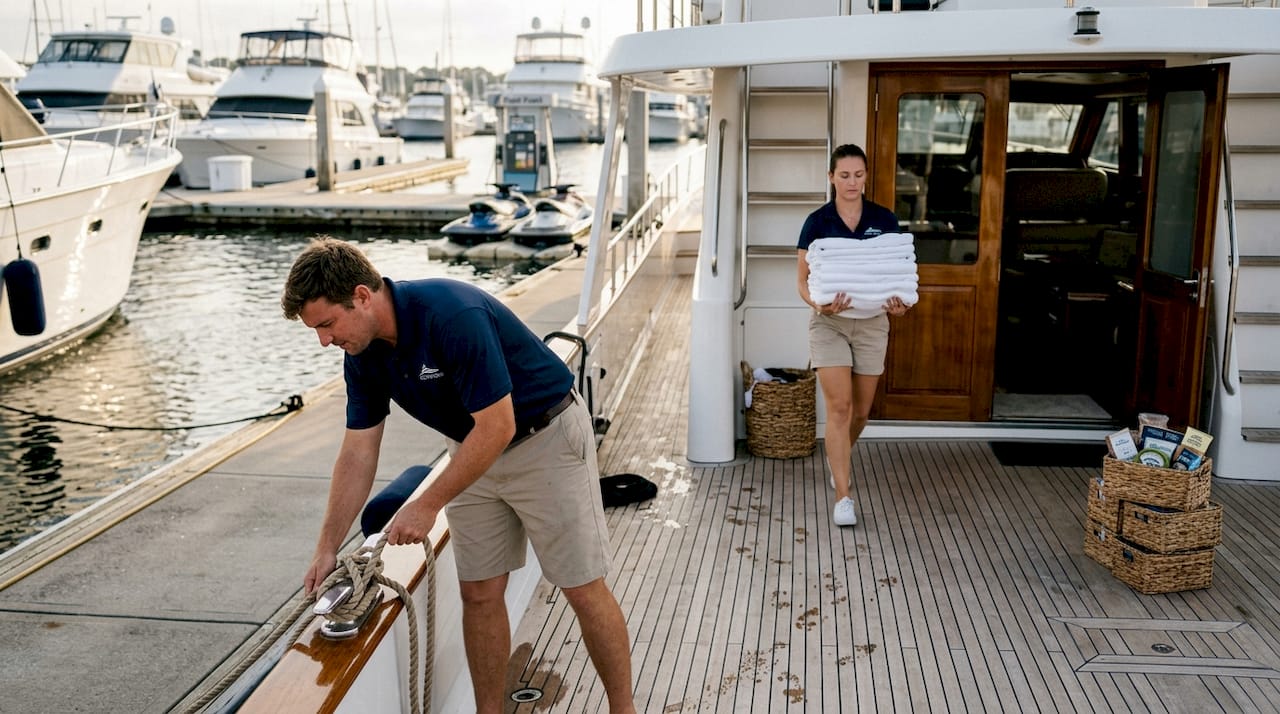
Depreciation is the other major variable. Yachts typically lose 10 to 15 percent of their value in the first few years, then stabilize. How you maintain the vessel dramatically affects this curve. A yacht that is meticulously serviced, with documented records and quality upgrades, holds its value far better than one that is neglected.
Key factors that shape your returns include:
- Purchase price and model selection: Buying the right yacht at the right price is the foundation of a strong ROI
- Charter program quality: A professionally managed charter program maximizes utilization and income
- Location and market timing: Florida, the Bahamas, and the Mediterranean consistently outperform other markets
- Yacht tax benefits: Properly structured ownership can unlock significant deductions
One important statistic: buyers who skip professional guidance make costly errors in 30% of yacht purchases, often overpaying or underestimating operating costs. Getting the numbers right from day one protects your entire investment thesis.
Comparing yacht investments to real estate and other assets
With the drivers of yacht returns explained, let’s compare yacht investments to other popular asset classes.
Yachts, real estate, and stocks each offer a different risk and reward profile. Understanding where yachts fit helps you make a more informed portfolio decision.
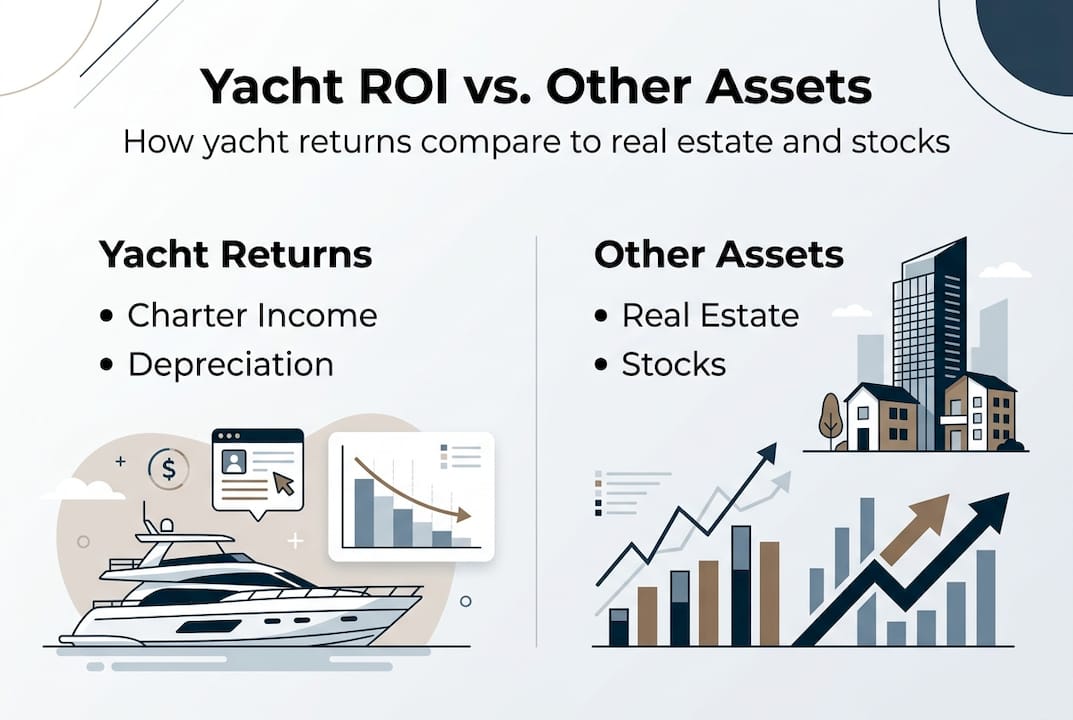
| Characteristic | Yacht | Real estate | Stocks |
|---|---|---|---|
| Appreciation potential | Low to moderate | Moderate to high | High |
| Cash flow potential | Moderate (via charter) | Moderate to high | Low (dividends) |
| Liquidity | Low | Low to moderate | High |
| Lifestyle value | Very high | Moderate | None |
| Depreciation risk | High (early years) | Low | Market-dependent |
| Tax advantages | Significant (structured) | Significant | Moderate |
Real estate in strong markets like Southern California has historically delivered strong long-term appreciation, often outpacing yachts on pure capital gains. Stocks offer liquidity that yachts simply cannot match. So why consider a yacht at all?
The answer is diversification and lifestyle integration. For high net worth individuals, a yacht adds an asset class that generates experiential returns no stock or rental property can replicate. It also opens doors. Business relationships built on the water are uniquely powerful, and many owners report that their yacht pays for itself in deal flow and networking alone.
For yacht management for ROI, the comparison becomes even more interesting. A professionally managed yacht in a charter program functions more like a cash-flowing real estate asset than a pure luxury expense.
The advantages of yacht investment shine brightest when you view it as a complementary asset, not a replacement for traditional investments.
Pro Tip: Use your yacht strategically for client entertainment and business development. Many owners successfully deduct a portion of operating costs as legitimate business expenses, which meaningfully improves the financial return profile.
How to maximize your yacht investment returns
Understanding the comparisons, the next question is: how can you actively improve your yacht investment outcomes?
The good news is that most of the levers are within your control. Here are the proven steps that consistently produce stronger returns:
- Choose the right model from the start. Not all yachts charter equally well. Certain brands and layouts command premium rates and attract repeat clients. Research charter demand before you buy, not after.
- Enroll in a professional charter program immediately. Every week your yacht sits idle is lost revenue. A managed charter program handles marketing, guest vetting, and logistics so your vessel works for you year-round.
- Invest in meticulous maintenance. Documentation matters enormously at resale. Buyers pay a premium for yachts with clean service records, and lenders look favorably on well-maintained vessels too.
- Optimize your tax structure. Work with a specialist who understands maritime tax law. The right ownership entity and location can unlock deductions that dramatically reduce your net cost of ownership.
- Partner with an experienced yacht manager. A skilled manager maximizes charter utilization, controls costs, and protects your asset’s condition. This is not an expense. It is a return multiplier.
- Time your resale strategically. The luxury yacht resale market moves in cycles. Selling in a seller’s market with a well-documented, well-maintained vessel is the single biggest factor in your exit value.
Common mistakes that hurt ROI include buying the wrong size, underestimating operating costs, skipping charter programs, and delaying necessary maintenance. Each of these errors compounds over time.
For accurate yacht valuation before you buy or sell, professional appraisal is essential. Guessing at market value is one of the most expensive mistakes an owner can make.
Pro Tip: The best time to prepare for your yacht’s resale is the day you buy it. Keep every service record, every upgrade receipt, and every charter contract. This paper trail is worth real money when you go to sell.
A clear-eyed perspective on yachts as investments
Here is what we have learned from working with hundreds of yacht owners: the buyers who feel most satisfied are not always the ones who made the most money. They are the ones who went in with honest expectations.
Conventional thinking frames yacht ownership as a binary choice between financial gain and personal indulgence. That framing is too simple. The owners who thrive financially and personally are those who integrate both goals from the beginning. They buy strategically, charter actively, maintain religiously, and enjoy fully.
The yacht investment advantages that matter most are often invisible on a balance sheet: the relationships built, the memories created, the brand equity earned. These are real returns. They just require a different kind of accounting.
What separates successful yacht investors from disappointed ones is almost never the yacht itself. It is the strategy, the team, and the mindset they bring to ownership. When you treat your yacht as a managed asset with clear goals, the financial and lifestyle returns align in ways that consistently exceed expectations. That is the insight most buyers miss, and the one we most want you to carry forward.
Work with experts to unlock investment value
Maximizing your return on yacht investment is not something you should navigate alone. The difference between a well-optimized yacht portfolio and a costly mistake often comes down to the quality of your advisory team.

At Yachting Experts, we offer personalized, hands-on guidance from vessel sourcing through resale, ensuring every decision supports your financial and lifestyle goals. Our team provides in-depth ROI advice, connects you with top-tier professional yacht management, and gives you access to our full investment guide to help you avoid the most common and costly buyer mistakes. This is your moment to invest with confidence. Let’s make it exceptional together.
Frequently asked questions
What is a typical return on yacht investment?
Typical annual yacht ROI ranges from negative to approximately 6%, with most owners valuing the combination of charter income and lifestyle returns over pure capital appreciation.
How can I increase my yacht’s return on investment?
You can boost ROI by enrolling in a charter program, maintaining your vessel meticulously, timing your resale to market conditions, and partnering with experienced managers who know how to maximize yacht resale value.
Do yachts appreciate or depreciate in value?
Most yachts depreciate in the first several years, but strategic buying and upkeep can significantly slow that curve and occasionally create premium resale opportunities in strong seller markets.
Are there tax benefits to yacht ownership?
Yes. Certain ownership structures and locations allow for meaningful yacht tax deductions and deferrals, particularly when the vessel is enrolled in a legitimate charter program and properly documented.
Recommended
Request A Call
Featured Listings

2027 Canados
100
Miami Florida

2015 Maiora
$3,750,000
90
Miami Florida

2027 Canados
57
Miami Florida

2019 Silent-Yachts Fair Dinkum
$1,599,000
55
Fort Lauderdale Florida

2026 Canados
49
Miami Florida

2026 Buddy Davis
47
Miami Florida

2020 Grady-White No Name
$610,000
45
Hallandale Beach Florida

2020 Viking Huckleberry
$1,495,000
44
Fort Lauderdale Florida

2027 Canados
43
Miami Florida

2021 Intrepid Dream Faster
$730,000
40
Coral Gables Florida

2016 Edgewater
$299,000
37
Miami, Florida

2022 Avid
$56,900
23
Stuart Florida
Get your yacht value Estimate
"*" indicates required fields