

Buying a yacht is one of the most exciting financial decisions you will ever make. It is also one of the riskiest if you skip the yacht inspection process. Hidden osmosis, corroded wiring, compromised structural bulkheads — these are the kinds of problems that look invisible during a casual walkthrough but cost tens of thousands of dollars to fix after closing. This guide walks you through every phase of a professional inspection, from the paperwork you need before the surveyor arrives to how you read the final report and use it to negotiate with confidence.
Table of Contents
- Key takeaways
- Preparing for the yacht inspection process
- The three phases of a yacht inspection
- Common red flags and how to handle them
- Reading and using your survey report
- My honest take on the inspection process
- How Yachtingexperts makes your purchase process personal
- FAQ
Key takeaways
| Point | Details |
|---|---|
| Never skip a professional survey | A pre-purchase survey reveals hidden defects that protect your investment before you commit to closing. |
| Plan for all three inspection phases | Haul-out, in-water systems check, and sea trial each expose different condition issues you cannot afford to miss. |
| Red flags require expert interpretation | Survey findings are not simply pass or fail — they require context, cost analysis, and informed negotiation. |
| Survey reports serve multiple purposes | Lenders, insurers, and negotiators all rely on the same report, so understanding it is genuinely worth your time. |
| Attend the inspection in person | Being present during the survey dramatically improves your understanding and confidence in the purchase decision. |
Preparing for the yacht inspection process
Before any surveyor sets foot on a vessel, there is real work to do. Buyers who show up organized get more value out of professional yacht inspections than those who treat the survey as someone else’s responsibility.
Start by gathering documentation. You want the vessel’s title, registration papers, maintenance logs, previous survey reports, service records, and any receipts for major repairs or upgrades. This paper trail tells the surveyor what has already been done and flags any gaps in care. A vessel with meticulous records signals good maintenance culture. One without them raises immediate questions.
Here is what to confirm with the seller and marina before survey day:
- Vessel access: The boat should be clean, all compartments unlocked, and all systems operational
- Haul-out scheduling: Book the boatyard in advance since yard availability varies, especially during peak seasons
- Sea trial arrangement: Confirm that the vessel is fueled, insured, and the captain or owner is available to operate it
- Specialist coordination: Line up a separate engine surveyor if the vessel has large diesel or gas turbine engines, since multiple specialists provide the most impartial coverage of all systems
Choosing the right type of survey matters before you book anything. Pre-purchase surveys are the most thorough and buyer-focused option. Insurance surveys are narrower, focused on immediate safety and coverage eligibility rather than comprehensive condition and valuation. If you are buying, you want a pre-purchase survey. Period.
| Survey type | Primary focus | Who orders it |
|---|---|---|
| Pre-purchase survey | Full condition, systems, value | Buyer |
| Insurance survey | Safety and insurability | Insurer or owner |
| Valuation survey | Fair market value | Owner, lender, or estate |
| Damage/appraisal survey | Specific incident or repair assessment | Insurance adjuster |
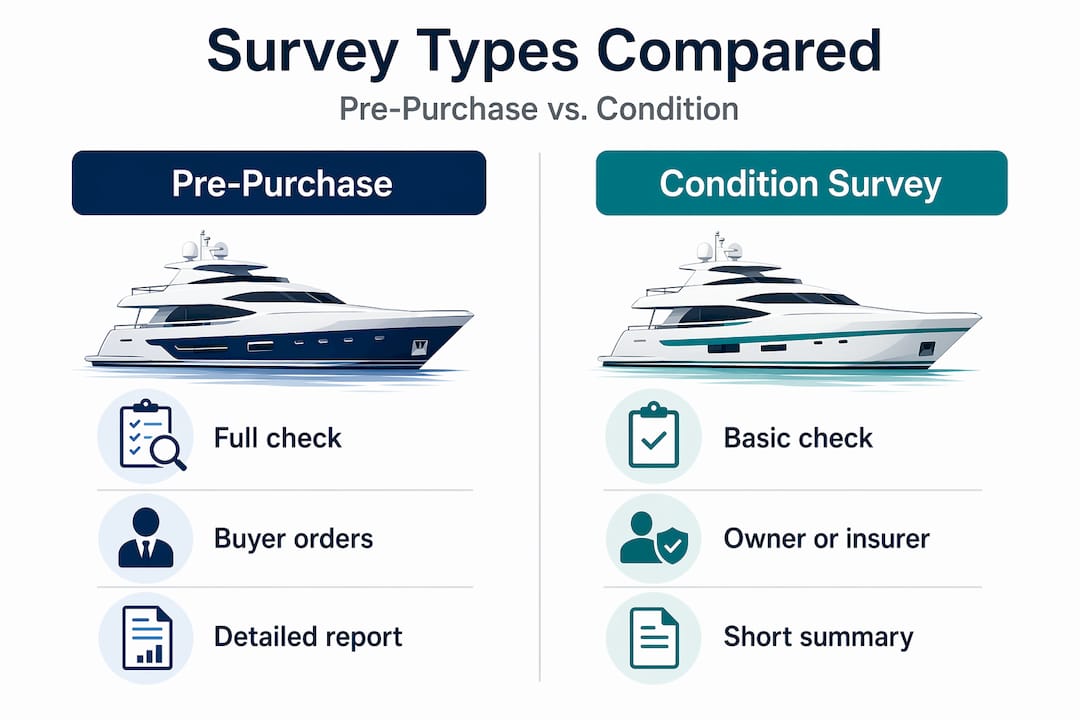
Cost is something to plan for honestly. Survey fees typically run $18 to $25 per foot in the U.S., and for a 40-meter GRP motor yacht, a full inspection can land between $5,000 and $10,000 before haul-out fees and engine specialist charges. Budget for it upfront — it is the cheapest insurance you will ever buy relative to the risk it covers.
Pro Tip: Always hire a surveyor who is a member of SAMS (Society of Accredited Marine Surveyors) or NAMS (National Association of Marine Surveyors). Membership requires continuing education, ethical standards, and peer accountability — qualities that matter enormously when you are trusting someone to protect a six-figure purchase.
The three phases of a yacht inspection
Understanding what happens during each phase of the physical inspection helps you ask sharper questions and catch things that might otherwise slip by in the final report. A comprehensive pre-purchase survey covers the hull below the waterline, all accessible systems, and includes a sea trial. Skipping any of these phases leaves critical blind spots.
Phase 1: Haul-out inspection
The haul-out is where the underwater truth comes out. With the vessel lifted from the water, the surveyor examines the hull below the waterline for osmotic blistering, impact damage, keel attachment integrity, through-hull fittings, propellers, shafts, and rudder condition.
- Tap testing: The surveyor uses a small hammer to tap the hull surface. Hollow sounds indicate delamination or voids in fiberglass construction.
- Osmosis assessment: Blistering on the gelcoat below the waterline signals osmosis, where water has penetrated the laminate. Severe osmosis is expensive to treat and requires full moisture drying and epoxy barrier coating.
- Keel inspection: On sailboats, the surveyor checks keel bolt integrity. Loose or corroded keel bolts are a serious structural concern.
- Running gear: Propellers, shafts, cutlass bearings, and anodes are examined for wear, electrolysis damage, and alignment issues.
- Through-hull fittings: Every seacock is operated to confirm it moves freely. A seized seacock that cannot be closed in an emergency is a real safety problem.
Phase 2: In-water systems check
With the vessel back in the water or while still at the dock, the surveyor moves through the interior. This is the vessel condition assessment phase that reveals how every system functions.
- Electrical systems: wiring condition, panel labeling, battery health, shore power connections, bilge pump operation
- Plumbing: freshwater, raw water, holding tanks, bilge systems, and hose condition throughout
- Safety equipment: flares, EPIRBs, life rafts, fire extinguishers, and their current certification status
- Structural interior: bulkheads, stringers, deck hardware backing plates, and any signs of soft spots or delamination
- Navigation electronics: chartplotters, VHF radios, AIS, depth sounders, and autopilot functionality
Phase 3: Sea trial
The sea trial is where everything gets stress-tested under real operational loads. A sea trial typically lasts 30 to 60 minutes and covers engine performance across the full RPM range, throttle response, transmission shifting, steering systems, and onboard electronics under power.
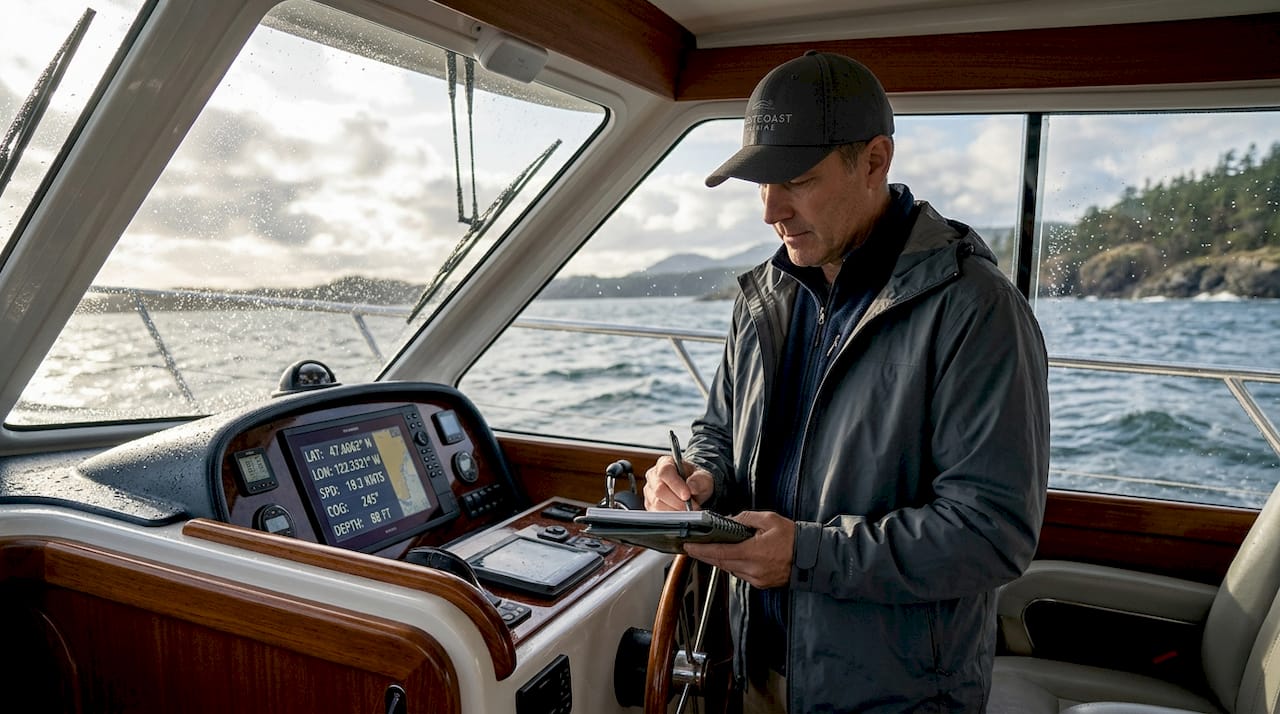
The surveyor watches for abnormal exhaust smoke, excessive vibration, unusual engine temperatures, and steering play. These details rarely show up in a dockside inspection but become obvious the moment you push the throttle forward. Be there for this phase. You will notice things that a written report cannot fully capture.
Pro Tip: Ask the surveyor to run the engines to full rated RPM during the sea trial and hold them there for several minutes. This reveals heat management issues and fuel system problems that surface only under sustained load — not during the gentle idle most sellers prefer.
Common red flags and how to handle them
Knowing what the surveyor finds is only half the battle. Knowing what to do with that information is where buyers either protect themselves or make expensive mistakes.
These are the issues that surface most often in pre-purchase surveys:
- Osmosis and blistering: Common in older GRP hulls. Repair costs vary widely based on severity, from a few thousand dollars for surface treatment to full hull barrier coating jobs exceeding $20,000.
- Soft transoms: Water intrusion into the transom core causes softness that compromises structural integrity and outboard mounting. This is a significant repair involving core replacement.
- Electrical wiring problems: Amateur wiring, overloaded circuits, non-marine-grade wire, and improperly fused connections are fire hazards. Rewiring a large vessel is costly and disruptive.
- Engine anomalies: Milky oil (indicating water intrusion), blue or black exhaust smoke, overheating, and low compression all point to engine problems that can run from minor tune-ups to full rebuilds.
- Deck delamination: Soft spots on the deck around chainplates, stanchion bases, or hatches indicate water intrusion into the deck core.
Survey findings are never just a pass or fail checklist. They are a picture of how a vessel has been cared for and what its future maintenance demands will look like. Every deficiency tells a story about the previous owner’s priorities.
The temptation is to use every finding as a negotiation lever. That can backfire. Some items are genuine safety or structural concerns worth walking away over. Others are routine maintenance items that any vessel of similar age would show. Your surveyor can help you separate these categories, but you also need to understand maintenance culture as a predictor of future reliability. A vessel with 15 minor findings and an impeccable service record is often a better buy than one with 3 findings and no documentation history.
Attending the survey personally changes the quality of your decision-making. You see the surveyor’s body language, hear tone of voice, and get real-time context that does not always translate cleanly into written reports. This is one of the best decisions any first-time buyer can make.
Reading and using your survey report
The report arrives within 24 to 72 hours after the survey and sea trial are complete. Most buyers read it once, use it for negotiation, and file it away. That is a mistake. The report is actually a roadmap for your first three to five years of ownership.
A thorough survey report includes these components:
- Detailed observations: Written descriptions of every system and structural element inspected, with severity rankings from cosmetic to critical
- Photographs: Visual documentation of deficiencies, making it easy to reference specific findings when getting repair quotes
- Repair recommendations: Prioritized guidance on what needs immediate attention versus what can be monitored over time
- Fair market valuation: An independent assessment of the vessel’s current market value, which often differs from the asking price
- Compliance notes: References to USCG and ABYC standards where applicable, with flags for non-compliance
Lenders and insurers both rely on this document. Most insurers require a condition survey for vessels over 10 to 20 years of age, with renewal surveys every 3 to 5 years thereafter. Marine lenders use the appraised value from the survey to determine loan eligibility and amount. If the appraised value comes in below the purchase price, you either renegotiate or walk.
One concept that trips up many buyers: a survey is a snapshot in time. It cannot guarantee future component reliability. What it does reveal is the maintenance culture behind the vessel, which is the single best predictor of future health. A vessel that has been professionally serviced on schedule tells a very different story than one where the owner “handled it himself.”
Pro Tip: Get repair quotes from a qualified boatyard before negotiating based on survey findings. Walking into a negotiation with three written estimates gives you specific, credible numbers to work with instead of guesswork that sellers can easily dismiss.
Buyers who underestimate post-purchase repair costs are among the most common casualties in yacht ownership. Build a realistic repair budget based on the survey findings before you sign anything. The Florida buyer’s survey guide at Yachtingexperts breaks this down further if you want region-specific cost benchmarks.
My honest take on the inspection process
I have watched buyers fall in love with a boat in the first ten minutes and spend the rest of the survey making excuses for what the surveyor finds. It happens more than you would think, and it costs people serious money.
In my experience, the inspection is not the obstacle between you and your yacht. It is the thing that makes sure the yacht you are buying is actually the yacht you think it is. I have personally seen deals where the survey revealed osmotic damage so extensive that a full hull treatment would have cost more than the boat’s depreciated value. Without that inspection, the buyer would have owned the problem with no recourse.
What I have learned from attending dozens of surveys is that the surveyor’s tone and body language on the haul-out often tells you more than the written report does. When a surveyor goes quiet and starts making longer notes, pay attention. When they call you over to look at something closely rather than just documenting it, that is your signal to take the finding seriously.
My biggest piece of advice: resist the urge to hire a surveyor recommended by the selling broker. Find your own, pay the fee yourself, and make sure there is zero financial relationship between the surveyor and anyone with a stake in the sale. Independence is the only thing that makes the report trustworthy. And trust is exactly what you need when you are spending this kind of money.
— Jason
How Yachtingexperts makes your purchase process personal
At Yachtingexperts, we know the yacht inspection process can feel overwhelming, especially for first-time buyers managing surveys, sea trials, specialist reports, and negotiations all at once. We are thrilled to offer a genuinely personalized experience that takes that weight off your shoulders.

Our team coordinates yacht inspection services on your behalf, connecting you with accredited marine surveyors, engine specialists, and boatyard contacts so that nothing slips through the cracks. We walk alongside you from the first viewing through the final survey report, helping you interpret findings, build repair budgets, and negotiate from a position of real knowledge. Whether you are looking at your first vessel or maximizing your yacht investment returns on a trade-up, our brokerage team brings the market insight and personal attention that most buyers never experience. Ready to move forward with confidence? Connect with our team today and let us make this one of the best decisions you have ever made. 🛥️✅
FAQ
What does a yacht inspection process include?
A full pre-purchase yacht inspection includes a haul-out for underwater hull examination, an in-water systems check covering electrical, plumbing, and safety equipment, and a sea trial testing engine and steering performance under real operational loads. The final report includes findings, photos, valuations, and repair recommendations.
How long does a pre-purchase yacht survey take?
A comprehensive survey typically takes a few hours to a full day depending on vessel size, with the sea trial adding 30 to 60 minutes. The written report is generally delivered within 24 to 72 hours after the inspection is complete.
How much does a yacht inspection cost?
Professional survey fees in the U.S. typically run $18 to $25 per foot of vessel length, with haul-out fees and engine specialist charges added separately. For a large motor yacht, total inspection costs can reach $5,000 to $10,000 or more.
Can I use a survey report for insurance and financing?
Yes. Survey reports that include a fair market valuation and condition assessment are accepted by most marine lenders and insurers. Insurers often require condition surveys for vessels over 10 to 20 years of age as a condition of coverage.
Should I attend the yacht inspection in person?
Absolutely. Being present during the survey and sea trial allows you to ask questions, observe the surveyor’s findings directly, and understand nuances that written reports cannot always convey. Buyers who attend their surveys consistently make more confident and informed purchase decisions.
Recommended
Request A Call
Featured Listings

2027 Canados
100
Miami Florida

2015 Maiora
$3,750,000
90
Miami Florida

2027 Canados
57
Miami Florida
2019 Silent-Yachts Fair Dinkum
$1,599,000
55
Fort Lauderdale Florida

2026 Canados
49
Miami Florida

2026 Buddy Davis
47
Miami Florida
2020 Grady-White No Name
$610,000
45
Hallandale Beach Florida
2020 Viking Huckleberry
$1,495,000
44
Fort Lauderdale Florida

2027 Canados
43
Miami Florida

2016 Edgewater
$299,000
37
Miami, Florida

2022 Avid
$56,900
23
Stuart Florida
Get your yacht value Estimate
"*" indicates required fields