

Many yacht owners assume that registering their vessel with their state is the same as documenting it. That single misconception can cost you thousands of dollars in failed financing deals, stalled sales, and compliance penalties. Federal yacht documentation is a completely separate process, one that establishes your vessel’s U.S. nationality, protects your ownership rights, and opens doors that state registration simply cannot. Whether you’re buying your first yacht or preparing to trade up, understanding the difference between these two processes is not optional. It’s essential. This guide walks you through everything you need to know, from definitions to step-by-step processes, common pitfalls, and how to protect your investment.
Table of Contents
- What is yacht documentation?
- The step-by-step yacht documentation process
- Documentation vs. registration: Key differences explained
- Special cases and common pitfalls in yacht documentation
- Why proper yacht documentation can make or break your investment
- Get expert help with your yacht documentation
- Frequently asked questions
Key Takeaways
| Point | Details |
|---|---|
| Federal compliance proof | Yacht documentation gives you federal proof of ownership, nationality, and legal standing. |
| Process requires precision | Accurate paperwork and a clear ownership chain are vital for successful documentation. |
| Registration still matters | State registration is often required alongside documentation for taxes and compliance. |
| Avoid costly surprises | Edge cases—like foreign-built vessels or expired paperwork—can dramatically impact legality and value. |
What is yacht documentation?
Now that you’ve seen why confusion is common, let’s define what yacht documentation truly means and what it is not.
Yacht documentation refers to federal vessel documentation administered by the U.S. Coast Guard’s National Vessel Documentation Center (NVDC). The result is a Certificate of Documentation (COD), a federal credential that proves U.S. nationality, ownership, and eligibility for certain trades. Think of it as your yacht’s federal passport.
State registration, by contrast, is more like a local license plate. It identifies your vessel within a specific state for tax and operational purposes. These two systems exist side by side, and most owners actually need both. Understanding how they interact is where things get interesting.
Key benefits of federal yacht documentation include:
- ✅ Proof of U.S. nationality for international port entry
- ✅ Eligibility for coastwise trade and fishery endorsements
- ✅ Stronger financing eligibility with most marine lenders
- ✅ Cleaner title history that supports resale value
- ✅ Legal protections under federal maritime law
These advantages matter enormously when you’re navigating the yacht sales process or securing a marine mortgage. Lenders, buyers, and insurers all respond more favorably to a properly documented vessel.
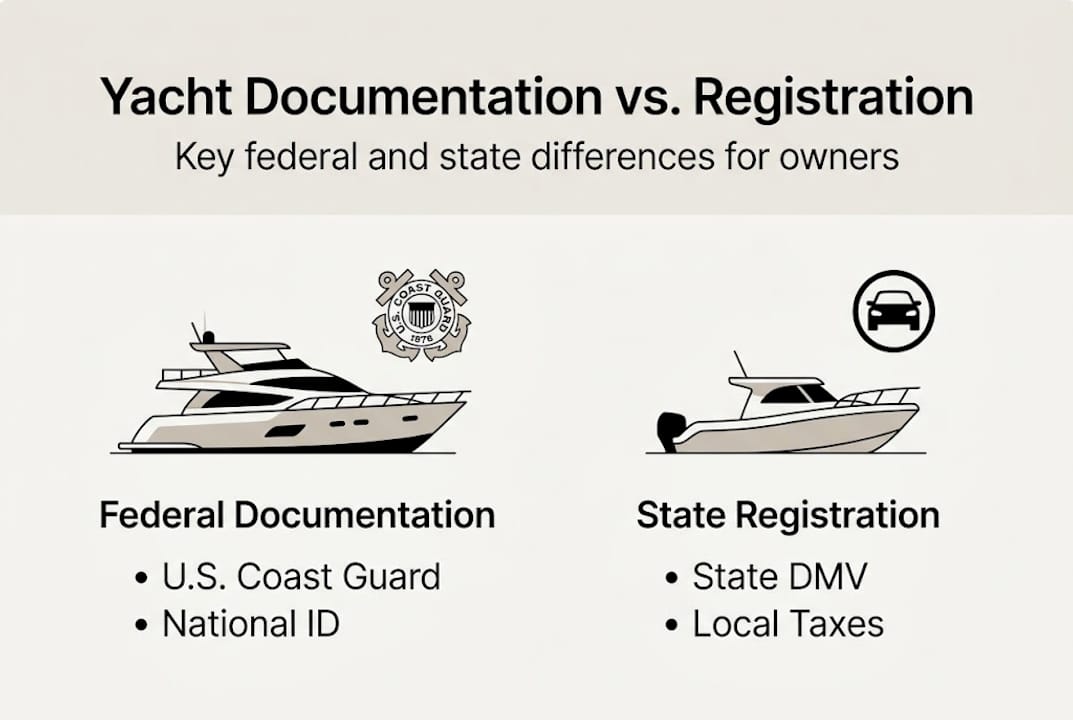
| Feature | Federal Documentation | State Registration |
|---|---|---|
| Issued by | U.S. Coast Guard (NVDC) | State DMV or equivalent |
| Proves | U.S. nationality and ownership | State-level vessel identity |
| Required for | Commercial trade, foreign waters | Local operation and taxes |
| Displays | Name and hailing port on stern | State registration numbers |
| Financing support | Strong | Limited |
Familiarity with sales terminology like “COD,” “Abstract of Title,” and “endorsement” will also help you communicate confidently with brokers and attorneys throughout this process.
One more thing worth noting: documentation is not automatic. You must actively apply, maintain, and renew it. Letting it lapse has real consequences, which we’ll cover shortly.
The step-by-step yacht documentation process
With a clear definition in place, it’s time to explore exactly how the documentation process works from start to finish.
Initial documentation requires Form CG-1258, proof of ownership (bill of sale or builder’s certificate), U.S. citizenship evidence, and tonnage measurement. Smaller vessels use a simplified tonnage formula. Everything is submitted through the NVDC eStorefront, and processing typically takes 4 to 8 weeks.
Here’s how the process unfolds step by step:
- Gather your documents. Collect Form CG-1258, a clean bill of sale or builder’s certificate, proof of U.S. citizenship for all owners, and tonnage measurement details.
- Verify your ownership chain. Every transfer of ownership must be documented. A gap in the chain can delay or derail your application.
- Submit via the NVDC eStorefront. The online portal accepts applications, fees, and supporting documents. Double-check every field before submitting.
- Await processing. Standard processing runs 4 to 8 weeks. Expedited options are available for an additional fee.
- Receive and review your COD. Once issued, confirm that all details (vessel name, hailing port, official number) are accurate before displaying.
Pro Tip: Before purchasing any yacht, request an Abstract of Title from the NVDC. This document reveals the full ownership history and any liens or encumbrances on the vessel. Skipping this step is one of the most expensive mistakes buyers make. Our ownership transfer guide goes deeper on why a clean title chain is non-negotiable.
| Common mistake | What goes wrong | How to avoid it |
|---|---|---|
| Incomplete ownership trail | Application rejected or delayed | Request full title history upfront |
| Incorrect tonnage measurement | Documentation denied | Use a certified measurer |
| Missing signatures | Submission returned | Review checklist before filing |
| Expired citizenship docs | Citizenship eligibility questioned | Use current, valid documents |
Before you finalize any purchase, a thorough boat inspection checklist combined with a clean Abstract of Title gives you the most complete picture of what you’re actually buying.
Documentation vs. registration: Key differences explained
Once you’ve started the federal process, it’s vital to understand how documentation interacts and sometimes overlaps with state requirements.
Federal documentation is your yacht’s national identity. State registration is its local identity. Both serve distinct purposes, and confusing them leads to compliance gaps that can surface at the worst possible moments, like during a sale or a port inspection.
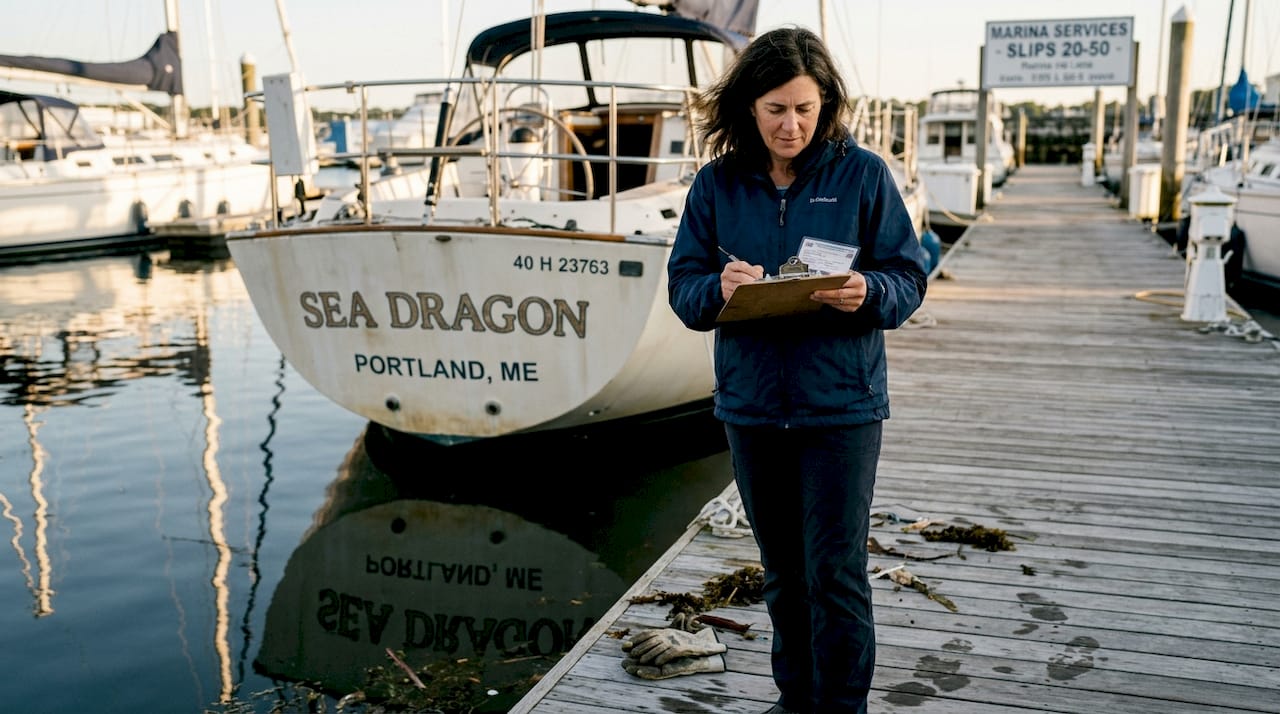
Documented yachts display the vessel name and hailing port on the stern, and the official number inside the hull. They are exempt from displaying state registration numbers. However, many states still require separate registration for tax purposes, even if the vessel is federally documented.
What this means practically for you:
- Your yacht may need both a COD and a state registration sticker
- State registration fees and taxes apply regardless of federal status
- Some states require annual renewals independent of NVDC timelines
- Failure to comply with state rules can result in fines even on a documented vessel
“Federal documentation and state registration are not interchangeable. They serve different legal purposes, and most yacht owners in the U.S. need both to stay fully compliant.”
This dual-compliance reality is exactly where working with an experienced yacht broker pays off. A knowledgeable broker understands the state registration rules in your specific state and can help you avoid gaps that trigger penalties or complicate your transaction. Understanding how yacht deals work in your state also helps you anticipate which compliance steps happen in which order.
Special cases and common pitfalls in yacht documentation
Even after securing your documentation, not every scenario is straightforward. Here’s what to watch for in complex cases.
Most documentation applications are routine. But a meaningful number of yacht owners run into edge cases that catch them completely off guard. Knowing these scenarios in advance puts you in a much stronger position.
Edge cases to know: Foreign-built yachts need a full chain of title going back to the original build. Coastwise trade vessels over 200 gross tons face additional ownership and citizenship verification requirements. Expired CODs require formal reinstatement, and non-U.S. citizens must either delete the documentation or transfer ownership to a qualifying U.S. citizen.
Watch out for these specific pitfalls:
- Foreign-built yachts: Every link in the ownership chain must be documented, including transfers that occurred in other countries
- Coastwise endorsements: These require proof that every past owner was a U.S. citizen, which can be difficult to reconstruct
- Expired documentation: Acting quickly on reinstatement is critical. Long lapses can result in permanent loss of eligibility
- Non-citizen ownership: If you are not a U.S. citizen, you cannot maintain USCG documentation. The vessel must be deleted from the registry or sold
- Lien surprises: Undisclosed liens can transfer with the vessel and become your legal problem after purchase
Pro Tip: Use the NVDC FAQ as your reference point before any high-value transaction. Our yacht tax guide also outlines how documentation status can affect your tax obligations in Florida. And if you’re exploring yacht financing options, lenders will scrutinize your documentation status closely before approving any loan.
Why proper yacht documentation can make or break your investment
Here’s a perspective we don’t hear discussed enough: documentation is not just a legal formality. It’s a financial strategy.
We’ve seen deals fall apart at the last minute because a seller couldn’t produce a clean chain of title. We’ve watched buyers inherit liens they didn’t know existed because they skipped the Abstract of Title. These aren’t rare edge cases. They happen regularly, and they are almost always avoidable.
Proper documentation dramatically simplifies resale, strengthens financing terms, and improves your insurability. Cutting corners, even small ones, invites costly surprises down the road. The ownership transfer insights we’ve gathered over years in this business point to one consistent truth: the owners who invest in getting documentation right from day one always come out ahead.
Professional consultation, whether with a broker or a maritime attorney, pays for itself many times over when navigating complex cases. And understanding the insurance challenges tied to documentation gaps reinforces why this process deserves your full attention. Peace of mind and market leverage are the real returns on doing this right.
Get expert help with your yacht documentation
Documentation doesn’t have to be stressful. With the right team behind you, it becomes one of the smoothest parts of your ownership journey.

At Yachting Experts, we hold your hand through every step of the process, from verifying your title chain to coordinating with the NVDC and ensuring full state compliance. Our yacht broker support team is ready to simplify even the most complex documentation scenarios. Whether you’re buying, selling, or just trying to get compliant, we make it seamless. Explore our full yacht sales process resources and connect with our team today. Your investment deserves nothing less than expert care.
Frequently asked questions
What vessels must be documented with the US Coast Guard?
Vessels over 5 net tons used in commercial trade, or those seeking federal protection in foreign waters, must be federally documented. Recreational vessels may document voluntarily for added legal and financial benefits.
Does federal documentation replace state registration?
No. Many states require separate registration for taxes even if your vessel is federally documented, so you’ll likely need to maintain both.
How long does the yacht documentation process take?
Standard processing runs 4 to 8 weeks from the date of a complete submission. Expedited processing is available for an additional fee through the NVDC.
What happens if my documentation expires?
You may face penalties, but reinstatement is possible if you act quickly. Extended lapses can result in loss of eligibility, so renewing on time is always the smarter move.
Recommended
Request A Call
Featured Listings

2027 Canados
100
Miami Florida

2015 Maiora
$3,750,000
90
Miami Florida

2027 Canados
57
Miami Florida

2019 Silent-Yachts Fair Dinkum
$1,599,000
55
Fort Lauderdale Florida

2026 Canados
49
Miami Florida

2026 Buddy Davis
47
Miami Florida

2020 Grady-White No Name
$610,000
45
Hallandale Beach Florida

2020 Viking Huckleberry
$1,495,000
44
Fort Lauderdale Florida

2027 Canados
43
Miami Florida

2021 Intrepid Dream Faster
$730,000
40
Coral Gables Florida

2016 Edgewater
$299,000
37
Miami, Florida

2022 Avid
$56,900
23
Stuart Florida
Get your yacht value Estimate
"*" indicates required fields