

Buying a yacht is one of the most exciting decisions you will ever make. It is also one of the most complex. Without a clear, structured workflow, even experienced buyers can overpay, overlook serious defects, or end up with a vessel that simply does not match their lifestyle. The stakes are high, and the margin for error is slim. This guide walks you through every critical step, from clarifying your objectives to closing the deal and planning for long-term value, so you can move forward with confidence and genuine excitement.
Table of Contents
- Understand your yacht buying objectives
- Prepare your finances and purchase criteria
- Build your expert team and shortlist contenders
- Conduct due diligence: inspections, documentation, and negotiation
- Finalize your purchase: closing, registration, and aftercare
- Get expert support for your yacht buying journey
- Frequently asked questions
Key Takeaways
| Point | Details |
|---|---|
| Define your needs | Clarifying how and where you’ll use your yacht shapes the entire buying workflow. |
| Budget for ongoing costs | Expect annual expenses to run about 10 percent of the yacht’s purchase price. |
| Rely on experts | A professional broker and surveyor can shield you from costly mistakes and legal issues. |
| Never skip due diligence | Surveys and legal checks are vital to protect your investment and ensure smooth ownership. |
| Plan for long-term value | Aftercare, chartering, and condition management help retain resale value in the luxury yacht market. |
Understand your yacht buying objectives
Start by clarifying what you need from your yacht before you even look at listings. This sounds simple, but it is where most buyers go wrong. Emotion takes over, and suddenly you are touring a 90-foot motor yacht when a 55-foot sailing catamaran would actually serve your life better.
The most important principle here is to match your yacht to real destinations and expected use, keeping the process structured rather than emotional. Ask yourself these questions first:
- Primary purpose: Will you use this yacht privately, charter it commercially, or both?
- Destinations: Are you cruising the Bahamas, the Mediterranean, or coastal Florida? Shallow draft matters in some areas.
- Crew requirements: Do you plan to captain it yourself, or will you need a professional crew?
- Must-have features: Think stabilizers, range, cabin layout, and entertainment systems.
- Nice-to-have features: Jet ski garage, beach club, custom interiors.
Investment value and lifestyle value are not always the same thing. Popular brands and sizes in the 60 to 80-foot range tend to hold value better at resale. Our luxury buyer’s guide breaks down which models deliver the strongest combination of both.
Pro Tip: Write your objectives down before speaking to any broker. A written list keeps you anchored when the excitement of a private viewing tempts you to stretch your criteria.
Prepare your finances and purchase criteria
Once you clarify your vision, it is critical to anchor it in financial reality and clear purchase criteria. The purchase price is just the beginning.
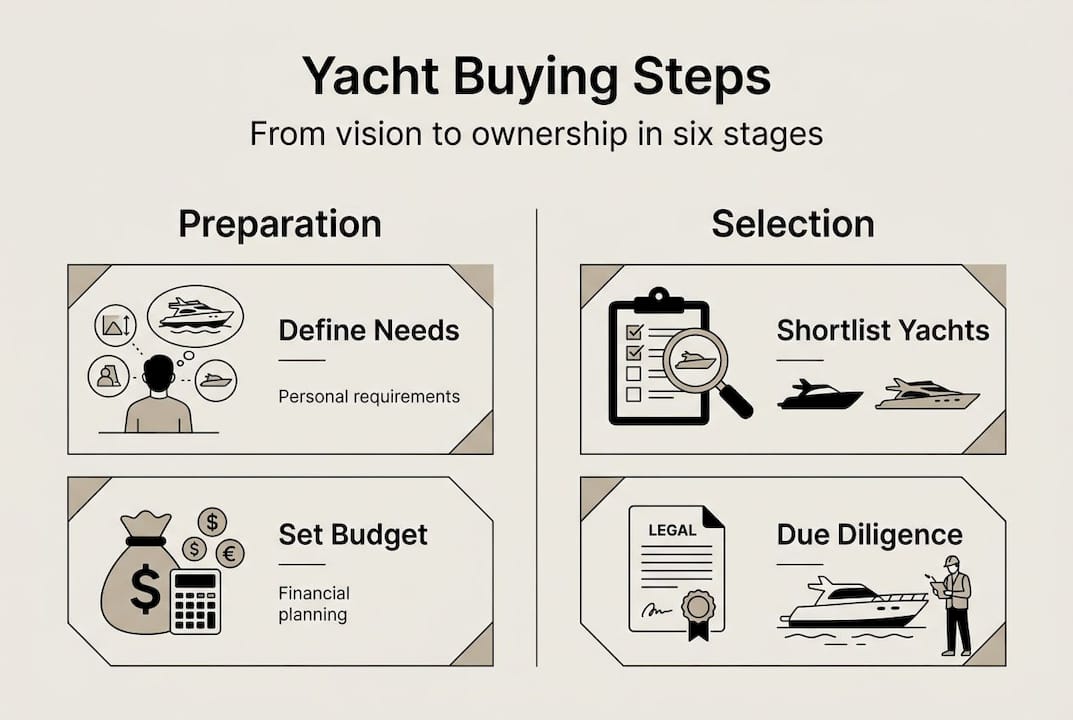
The industry standard benchmark is that annual operating costs run approximately 10% of the purchase price each year. On a $5 million yacht, that means budgeting $500,000 annually for crew, fuel, insurance, dockage, and maintenance. On a $12 million vessel, that figure climbs to $1.2 to $1.6 million per year.
| Cost category | Estimated annual range |
|---|---|
| Crew salaries | 30 to 40% of running costs |
| Fuel | 15 to 25% of running costs |
| Insurance | 1 to 1.5% of vessel value |
| Dockage and marina fees | 10 to 15% of running costs |
| Maintenance and refit | 15 to 20% of running costs |
Understanding yacht ownership costs in full before you commit is non-negotiable. VAT and tax implications vary significantly depending on where the yacht is flagged and where it operates. Financing options exist, but lenders will want full financial documentation upfront.
- Set a firm maximum purchase price and do not move it.
- Prepare bank statements, proof of funds, and tax returns in advance.
- Factor in a contingency reserve of at least 10% for unexpected repairs post-purchase.
The investment advantages of yacht ownership are real, but only when you enter the transaction with clear financial boundaries.
Pro Tip: Never stretch your budget to the absolute limit on the purchase price. The yacht that costs you $200,000 more than planned will cost you that same premium every single year in operating expenses.
Build your expert team and shortlist contenders
With your budget and goals set, it is time to gather trusted professionals and create your shortlist. This step separates buyers who get exceptional deals from those who pay too much and regret it.
A qualified yacht broker can save buyers significant money and help avoid costly mistakes. Your core team should include:
- Yacht broker: Your primary advisor for vessel sourcing, market insight, and negotiation.
- Marine surveyor: An independent inspector who assesses the vessel’s true condition.
- Maritime attorney: Essential for reviewing contracts, title, and registration structures.
Once your team is in place, build your shortlist. Compare new versus pre-owned yachts carefully.
| Factor | New yacht | Pre-owned yacht |
|---|---|---|
| Price | Higher upfront | Lower entry cost |
| Warranty | Full manufacturer warranty | Limited or none |
| Customization | Full options available | Fixed as-built |
| Depreciation | Steepest in first 3 years | Already absorbed |
| Availability | Lead times of 12 to 36 months | Immediate delivery |
Review maintenance logs, engine hours, and previous usage history for every pre-owned candidate. Dockage availability at your preferred marina should also be confirmed before you fall in love with a specific vessel. Understanding the full yacht sales process helps you move faster and smarter when the right boat appears.
Pro Tip: Ask your broker to show you why they are recommending each vessel on your shortlist. A great broker explains the reasoning, not just the listing.
Conduct due diligence: inspections, documentation, and negotiation
Now that your shortlist is set, ensure each candidate meets high standards through rigorous due diligence. This phase protects your investment and gives you negotiating power.
A professional survey and sea trial are fundamental. Never skip them, regardless of how new or well-presented a yacht appears. Here is what to verify:
- Hull and structural integrity: Osmosis, stress cracks, and delamination are expensive to fix.
- Engine hours and service records: Low engine hours are not always a positive sign. A yacht that has sat unused for years may have more problems than one that has been actively maintained.
- Title and liens: Confirm there are no outstanding debts secured against the vessel.
- VAT and tax status: Especially critical for yachts operating in European waters.
- KYC compliance: Know Your Customer checks are now standard in superyacht transactions.
“A survey is non-negotiable; check for title and lien issues, VAT status, sanctions, and clouded ownership before proceeding.”
Negotiate contingencies based on survey findings. If the survey reveals issues, you have three options: request repairs, negotiate a price reduction, or walk away. Buying a yacht through a company structure can complicate things further, as you may inherit the company’s liabilities. Understanding the full range of deal structures before you sign anything is essential. Also review insurance market trends early, as coverage terms can affect your closing timeline.
Finalize your purchase: closing, registration, and aftercare
Once due diligence clears and negotiation succeeds, proceed smoothly to finalizing ownership and optimizing long-term satisfaction. This phase moves quickly, so preparation matters.
Closing and transfer of ownership:
- Funds are placed into escrow by a neutral third party.
- All documentation is reviewed and signed by both parties.
- The vessel is formally delivered, and title transfers to you.
- Registration is completed under your chosen flag state.
Choosing your flag state is a strategic decision. Popular options include the Marshall Islands, Cayman Islands, and Malta, each offering different tax, liability, and operational advantages. Your maritime attorney will guide you to the right choice based on where you plan to cruise.
Post-purchase priorities:
- Crew onboarding and orientation to the vessel’s systems.
- Warranty registration and first scheduled service.
- Insurance policy activation and documentation aboard.
- Review of charter or management options if applicable.
After buying, consider ongoing management, resale factors, and charter strategies from day one. Proactive yacht management keeps your vessel in peak condition and maximizes its value when you are ready to trade up. Planning your exit strategy early is not pessimistic. It is smart ownership. Our guide on how to maximize yacht resale value gives you a clear roadmap for protecting your investment from the moment you take ownership.
Get expert support for your yacht buying journey
The yacht buying workflow is genuinely exciting, but it is also layered with complexity that can cost you dearly without the right guidance. Every step, from vessel sourcing to closing, benefits from personalized, expert support.

At Yachting Experts, we hold your hand through the entire process. Our team brings unrivaled market insight, a keen eye for detail, and a passion for matching buyers with the right vessel at the right price. Whether you are stepping aboard your first yacht or trading up to something exceptional, we are here to make it seamless. Explore our yacht purchase advisory services, learn about our yacht management support, and review our full investment guide to see exactly how we protect and grow your investment from day one.
Frequently asked questions
What are the hidden costs when buying a yacht?
Beyond the purchase price, expect annual running costs of roughly 10% of the vessel’s value, covering crew salaries, fuel, insurance, dockage, and maintenance. Unexpected repairs and refit costs can add significantly on top of that baseline.
Is buying a yacht a good investment?
Yachts are primarily lifestyle assets rather than financial instruments. Chartering can offset a meaningful portion of running costs, but resale value depends heavily on brand reputation, vessel condition, and size, so buying smart from the start is essential.
What are the biggest legal pitfalls in the yacht buying process?
The most serious risks include title and lien issues, unresolved VAT obligations, and purchasing the owning company rather than the vessel itself, which can transfer hidden liabilities directly to you.
Why is a survey non-negotiable?
A professional survey reveals hidden structural, mechanical, and compliance problems that are invisible during a casual viewing. It gives you documented evidence to negotiate repairs or a price reduction, and it protects your investment from day one.
Recommended
Request A Call
Featured Listings

2027 Canados
100
Miami Florida

2015 Maiora
$3,750,000
90
Miami Florida

2027 Canados
57
Miami Florida

2019 Silent-Yachts Fair Dinkum
$1,599,000
55
Fort Lauderdale Florida

2026 Canados
49
Miami Florida

2026 Buddy Davis
47
Miami Florida

2020 Grady-White No Name
$610,000
45
Hallandale Beach Florida

2020 Viking Huckleberry
$1,495,000
44
Fort Lauderdale Florida

2027 Canados
43
Miami Florida

2021 Intrepid Dream Faster
$730,000
40
Coral Gables Florida

2016 Edgewater
$299,000
37
Miami, Florida

2022 Avid
$56,900
23
Stuart Florida
Get your yacht value Estimate
"*" indicates required fields