

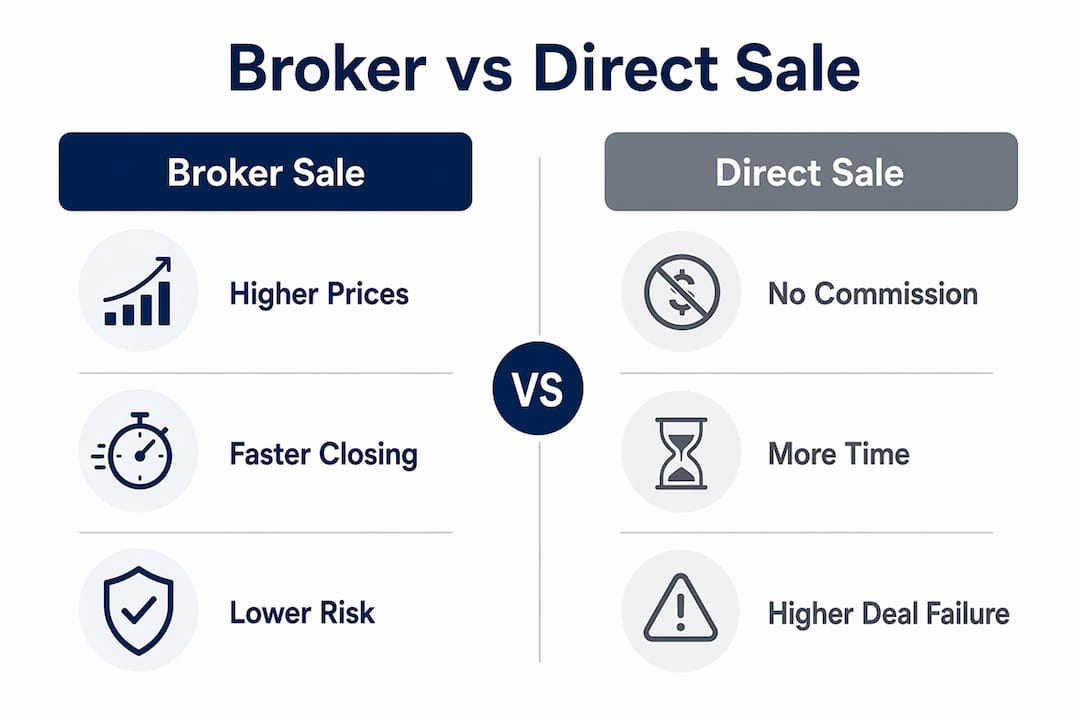
Selling through a broker is defined as engaging a licensed professional to manage your vessel’s valuation, marketing, buyer qualification, and closing on your behalf. For boat owners weighing their options, this decision carries real financial weight. Broker-assisted sales consistently deliver 10 to 20% higher sale prices compared to DIY transactions, and that premium more than covers the typical commission. Whether you own a 35-foot cruiser or a 70-foot sportfish, the advantages of selling through a broker are grounded in data, not just convenience.
Why sell through a broker: the core case for professional representation
The single most powerful thing a yacht broker does is create competition among buyers. Experienced brokers build competitive auction environments that push prices upward rather than accepting the first offer that lands on the dock. A private seller posting on Boat Trader or Craigslist reaches a fraction of the qualified buyers a broker can contact directly through a vetted database. That difference in reach translates directly into dollars.
Brokers also bring defensible valuations to the table. A well-supported asking price prevents two costly mistakes: overpricing, which stalls the listing for months, and underpricing, which leaves money on the table. When a broker presents comparable sales data from recent Florida transactions, buyers take the number seriously. When a private seller names a price, buyers immediately test it.
Here is what a professional broker brings to your sale that a DIY approach simply cannot replicate:
- Qualified buyer access. Brokers maintain large buyer databases with thousands of vetted prospects, creating the competitive tension that drives prices up.
- Market-calibrated pricing. Brokers use recent comparable sales to set a price that attracts serious buyers without leaving value behind.
- Professional presentation. High-quality photography, detailed specs, and targeted listings on platforms like YachtWorld reach buyers who are ready to act.
- Negotiation leverage. An unrepresented seller signals vulnerability to buyers, who then push harder for discounts and tougher terms. A broker signals that the seller has counsel and a process.
Pro Tip: Before signing with any broker, ask them to show you three to five recent comparable sales in your vessel category and explain exactly how many active buyers are in their database. A broker who cannot answer both questions confidently is not the right fit.
How much time does selling through a broker actually save?
Time is the hidden cost of a DIY boat sale, and most owners dramatically underestimate it. DIY sellers spend 20 to 30 hours per week on sale-related tasks. A broker reduces that commitment to roughly 5 to 10 hours per week for the seller. That is a meaningful difference if you are still working, managing other assets, or simply want to keep enjoying your boat while it is listed.

The timeline gap is even more striking. Broker-assisted sales close in 6 to 9 months on average, while DIY sales stretch to 12 to 18 months. A longer listing period is not just an inconvenience. It increases the risk of price reductions, buyer fatigue, and market shifts working against you.
Here is what a broker handles so you do not have to:
- Valuation and pricing strategy. Brokers analyze current market data and recent sales to set a price that attracts buyers quickly.
- Professional marketing. Listings on YachtWorld, Boat International, and targeted social channels reach buyers you would never find on your own.
- Buyer screening. Brokers qualify buyers for financial capability before you ever step aboard for a showing, saving you from tire-kickers.
- Sea trials and surveys. Coordinating marine surveys and sea trials is time-consuming. Brokers manage the logistics and attend on your behalf.
- Negotiation and paperwork. From the initial offer through closing documents, brokers handle the back-and-forth so you stay focused on the outcome, not the process.
Pro Tip: Honestly assess your weekly availability before deciding to sell independently. If you cannot commit 20 or more hours per week to marketing, communications, and showings, a broker is not a luxury. It is the practical choice.
Does a broker reduce the risk of your deal falling apart?
The answer is yes, and the data is stark. Direct negotiations collapse due to emotional factors in 28% of deals, while broker-mediated transactions see that failure rate drop to just 7%. For a transaction that may represent one of your largest financial assets, that gap matters enormously.
Boat sales are personal. You built memories on that vessel. A buyer who lowballs your asking price or criticizes the upholstery is not just making a business comment. Sellers who negotiate directly often react emotionally, and deals break down over issues that a professional intermediary would handle in a single phone call. Brokers act as emotional buffers, keeping both parties focused on the transaction rather than the tension.
Confidentiality is another layer of protection that private sellers rarely consider. When you list your boat publicly with your name attached, you expose yourself to unsolicited inquiries, competitors gathering market intelligence, and in some cases, personal security concerns. Brokers use blind listings and NDAs to protect your identity and interests throughout the process. Confidentiality management protects your standing and prevents premature disclosure that can complicate the sale.
“The most dangerous broker is the one who tells you what you want to hear about price in order to win the listing.” This warning from experienced Florida brokers applies directly to boat sellers. A broker who inflates your valuation to secure the listing will cost you months of wasted time when the market does not respond.
Common pitfalls DIY sellers face around privacy and risk include:
- Public exposure of personal details through direct listings, which can attract unqualified or opportunistic inquiries.
- Emotional negotiation breakdowns when buyers push back on price or condition, leading to deals collapsing unnecessarily.
- Inadequate due diligence management, leaving sellers exposed to post-sale disputes over undisclosed conditions.
Broker vs selling directly: when is it worth it?
The honest answer is that broker representation pays off in most boat sales, but not every single one. Broker commission fees range from 8 to 12%, typically on a sliding scale based on sale price. When you factor in the 10 to 20% price premium brokers consistently achieve, the math favors professional representation in the majority of cases.
| Scenario | Broker recommended? | Reason |
|---|---|---|
| First-time seller, no prior experience | Yes | Brokers prevent costly pricing and negotiation mistakes |
| Vessel valued under $1M | Yes | Brokers connect buyers using SBA financing and individual buyer pools |
| Limited time available for sale activities | Yes | Broker reduces weekly time commitment by 60 to 75% |
| Pre-identified buyer, simple transaction | Possibly not | If both parties agree on price and terms, direct sale may be faster |
| Very small vessel under $15,000 | Possibly not | Commission may exceed the value added on low-price transactions |
For Florida boat owners specifically, the advantages of yacht brokerage are amplified by the state’s active market and the concentration of qualified buyers in ports like Fort Lauderdale, Miami, and Palm Beach. A broker with strong Florida connections brings a ready pool of buyers that a private listing simply cannot access.
The broker vs selling directly question ultimately comes down to three factors: your available time, your experience with marine transactions, and the value of your vessel. For the vast majority of boat owners, professional representation is the clear choice.
Key takeaways
Selling through a broker delivers higher prices, shorter timelines, and significantly lower deal failure rates compared to selling independently.
| Point | Details |
|---|---|
| Price premium justifies commission | Brokers achieve 10 to 20% higher sale prices, more than covering the 8 to 12% commission fee. |
| Faster sale cycle | Broker-assisted sales close in 6 to 9 months versus 12 to 18 months for DIY sellers. |
| Lower deal collapse rate | Broker mediation reduces deal failure from 28% to 7% by removing emotional friction. |
| Confidentiality protection | Blind listings and NDAs protect seller identity and prevent premature disclosure. |
| Time savings are significant | Brokers reduce seller time commitment from 20 to 30 hours per week down to 5 to 10 hours. |
What I have learned from watching sellers go it alone
I have seen both sides of this equation play out more times than I can count. The sellers who come to us after a failed DIY attempt share a remarkably consistent story: they priced the boat based on emotion, spent months fielding unqualified inquiries, and eventually accepted a lower offer than they would have gotten through a broker in the first place. The time and stress cost was enormous, and the financial outcome was worse.
The piece of advice I give every seller before they decide is this: interview at least three brokers before you commit to anyone, including us. Ask each one for their honest assessment of your vessel’s market value, not the number that makes you feel good. Brokers who inflate valuations to win listings are the single biggest trap in this industry. A realistic price, marketed to the right buyers, will always outperform an inflated price that sits unsold for a year.
The other thing I want you to take away is that using a broker does not mean losing control. The best broker relationships are collaborative. You set the parameters, you approve the marketing, and you make the final call on every offer. A good broker gives you the information and leverage to make better decisions. That is the whole point. Approach your sale strategically, not out of urgency, and you will be in a far stronger position from day one.
— Jason
Ready to sell your boat the right way?
At Yachtingexperts, we handle every step of your vessel sale with the care and expertise your investment deserves. From professional valuation and targeted marketing to buyer qualification, negotiation, and closing, our team manages the entire process so you can focus on what comes next.

We work closely with Florida boat owners to maximize return on investment, connecting your vessel with qualified buyers through our established network. Whether you are selling a sportfish, a cruiser, or a sailing yacht, we bring the market knowledge and personal attention that makes the difference between a good sale and a great one. Explore our boat selling workflow to see exactly how we guide you from listing to closing, or visit our brokerage services page to get started today.
FAQ
What does a yacht broker typically charge in commission?
Yacht broker commissions typically range from 8 to 12%, often on a sliding scale based on the final sale price. This fee is generally offset by the 10 to 20% price premium brokers achieve compared to private sales.
How long does it take to sell a boat through a broker?
Broker-assisted boat sales close in an average of 6 to 9 months, compared to 12 to 18 months for sellers going it alone. The shorter timeline reflects a broker’s access to qualified buyers and their ability to manage the process efficiently.
Is it worth using a broker for a smaller boat?
For vessels under $15,000, the commission may not justify the cost depending on the transaction’s simplicity. For boats valued above that threshold, the benefits of using a broker, including buyer access, negotiation support, and time savings, almost always outweigh the fee.
Why do broker-mediated deals fail less often?
Brokers act as neutral intermediaries, removing the emotional friction that causes 28% of direct negotiations to collapse. With a broker managing communications, both buyer and seller stay focused on the transaction rather than personal reactions to offers and counteroffers.
Can I still control the sale if I use a broker?
Yes. A broker manages the process, but you approve pricing, marketing materials, and every offer. The broker’s role is to give you better information and stronger leverage so your decisions are grounded in market reality, not guesswork.
Recommended
Request A Call
Featured Listings

2027 Canados
100
Miami Florida

2015 Maiora
$3,750,000
90
Miami Florida

2027 Canados
57
Miami Florida

2019 Silent-Yachts Fair Dinkum
$1,599,000
55
Fort Lauderdale Florida

2026 Canados
49
Miami Florida

2026 Buddy Davis
47
Miami Florida

2020 Grady-White No Name
$610,000
45
Hallandale Beach Florida

2020 Viking Huckleberry
$1,495,000
44
Fort Lauderdale Florida

2027 Canados
43
Miami Florida

2021 Intrepid Dream Faster
$730,000
40
Coral Gables Florida

2016 Edgewater
$299,000
37
Miami, Florida

2022 Avid
$56,900
23
Stuart Florida
Get your yacht value Estimate
"*" indicates required fields