

Choosing a custom yacht means committing to a 24 to 48-month journey that transforms your vision into a floating masterpiece. While production yachts offer immediate gratification and standardized features, custom builds provide unlimited design freedom that reflects your exact lifestyle preferences. Many affluent buyers underestimate the complexity and timeline involved, assuming customization simply means selecting finishes from a catalog. The reality involves intricate engineering phases, substantial financial commitments, and strategic decisions that impact both your immediate enjoyment and long-term investment value. This guide clarifies the compelling reasons to choose custom, the construction realities you’ll face, and practical strategies to maximize your return while minimizing risks.
Table of Contents
- Key takeaways
- The unique benefits of custom yachts: personalization and exclusivity
- Understanding the custom yacht construction process and timelines
- Weighing the costs and risks of customization versus benefits
- Finding the right fit: semi-custom versus full custom yachts
- Explore custom and semi-custom yachts with expert guidance
- FAQ
Key Takeaways
| Point | Details |
|---|---|
| Unlimited design freedom | Custom yachts let owners tailor hulls, layouts, and technology to exact lifestyle needs, creating a floating extension of personal taste. |
| Long build timeline | The construction process spans typically 24 to 48 months with several engineering phases and critical decisions that shape cost and feasibility. |
| Higher cost with exclusivity | Customization significantly increases upfront spending but yields unique spaces and potential resale value tied to rarity and tailored performance. |
| Expert project management | Partnering with reputable builders and dedicated project managers reduces delays and quality risks while coordinating hundreds of craftsmen. |
| Semi custom alternative | Semi custom yachts offer personalized features with lower risk and shorter timelines for buyers seeking balance between personalization and practicality. |
The unique benefits of custom yachts: personalization and exclusivity
When you commission a custom yacht, you’re not purchasing a vessel but rather creating a floating extension of your lifestyle. Custom yachts offer unlimited design freedom that production models simply cannot match. You control every detail from hull geometry and propulsion systems to cabin layouts and entertainment spaces. This level of personalization allows you to optimize for your specific needs, whether that’s extended family cruising, corporate entertaining, or transoceanic exploration.
The ability to create a truly bespoke environment sets custom builds apart in the luxury market. Affluent families increasingly view their yachts as floating homes reflecting personal style, not just recreational assets. You can specify rare woods, commission original artwork, design custom furniture, and integrate cutting-edge technology that aligns with your preferences. This exclusivity carries significant social capital among high-net-worth circles where rarity and individuality signal status more effectively than brand recognition alone.
Market trends reveal growing demand from younger affluent buyers who prioritize experiences and personalization over traditional luxury markers. These buyers want yachts that accommodate their specific lifestyle patterns, from dedicated gym spaces and wellness centers to professional-grade galley equipment and flexible entertainment zones. The custom route allows you to future-proof your investment by building in adaptability that production models lack.
Pro Tip: Partner with reputable builders like Feadship, Moonen, or Benetti who have proven track records managing complex custom projects. Their experience helps balance your creative vision with engineering realities and construction feasibility.
Choosing the right builder becomes critical because expert builders manage construction risks while maintaining quality standards. The relationship between owner and builder shapes the entire experience. Top-tier yards assign dedicated project managers who translate your lifestyle requirements into technical specifications, coordinate hundreds of specialized craftspeople, and ensure your vision materializes without compromising safety or performance. For insights into the broader luxury yachting landscape in Florida, understanding regional expertise helps inform builder selection.
“A custom yacht represents the ultimate expression of personal taste and lifestyle priorities, but success depends entirely on selecting builders who combine artistic sensibility with engineering discipline.”
Key advantages of custom yacht ownership include:
- Complete control over spatial design and flow patterns that match how you actually use the vessel
- Ability to specify performance characteristics like range, speed, and fuel efficiency based on your cruising plans
- Integration of emerging technologies and sustainable systems from the design phase
- Creation of unique spaces that cannot be replicated, enhancing exclusivity and personal satisfaction
- Opportunity to work directly with naval architects and designers to solve specific functional challenges
Understanding the custom yacht construction process and timelines
Building a custom yacht involves navigating multiple distinct phases, each with its own timeline and complexity. The construction process spans 24 to 48 months from initial concept to sea trials and delivery. Understanding these phases helps you plan financially, manage expectations, and maintain realistic schedules throughout the journey.
The process begins with concept development where you work with designers to establish the yacht’s fundamental parameters. This phase typically requires three to six months and involves countless decisions about size, style, performance goals, and budget frameworks. Naval architects translate your lifestyle requirements into preliminary drawings and specifications that guide all subsequent work.
Following these stages ensures systematic progress:
- Technical design and engineering refine the concept into detailed construction plans, typically requiring six to nine months of intensive work
- Hull construction begins once engineering approves plans, taking six to 12 months depending on size and material choices
- Systems installation integrates mechanical, electrical, and plumbing infrastructure over four to eight months
- Interior outfitting brings your design vision to life through six to 10 months of detailed craftsmanship
- Testing and commissioning verify all systems function correctly before delivery, requiring two to four months of sea trials
| Phase | Duration | Key Activities |
|---|---|---|
| Concept Development | 3-6 months | Initial design, specifications, budget planning |
| Technical Design | 6-9 months | Engineering drawings, structural calculations, regulatory compliance |
| Hull Construction | 6-12 months | Fabrication, assembly, quality control |
| Systems Installation | 4-8 months | Mechanical, electrical, plumbing integration |
| Interior Outfitting | 6-10 months | Custom finishes, furniture, technology installation |
| Testing & Delivery | 2-4 months | Sea trials, system verification, owner training |
Delays and cost overruns represent common challenges without expert oversight. Material shortages, engineering changes, regulatory requirements, and coordination issues between multiple specialized contractors can extend timelines significantly. Each delay compounds costs through extended labor, storage fees, and financing charges. Professional yacht management services optimize build progress by maintaining schedule discipline and identifying potential problems before they cascade into major setbacks.
Pro Tip: Build contingency time and budget into your planning from day one. Experienced owners typically add 15 to 20% to both timeline and cost estimates to accommodate inevitable changes and discoveries during construction.
The complexity of coordinating hundreds of craftspeople, suppliers, and technical specialists requires sophisticated project management. Your builder should provide regular progress updates, transparent financial reporting, and proactive problem-solving when issues arise. This level of involvement ensures you remain informed and engaged throughout the multi-year journey without becoming overwhelmed by technical details.

Weighing the costs and risks of customization versus benefits
Customization significantly impacts both initial investment and ongoing ownership costs. Customization adds 10 to 30% to semi-custom yacht costs and over 50% to full custom builds due to bespoke engineering, materials, and testing requirements. These premiums reflect the reality that every custom element requires unique design work, specialized fabrication, and additional quality assurance compared to production components.
The financial equation extends beyond construction costs to include resale considerations. Production yachts have better resale value and liquidity due to brand recognition and standardization. Buyers in the pre-owned market often prefer established models with known performance characteristics and readily available parts. Highly personalized custom yachts appeal to narrower buyer pools, potentially requiring longer selling periods and accepting lower prices relative to initial investment.
| Cost Factor | Semi-Custom | Full Custom | Production |
|---|---|---|---|
| Base Price Premium | 10-30% above production | 50%+ above production | Baseline |
| Timeline | 18-30 months | 24-48 months | 12-18 months |
| Resale Value Retention | Moderate | Lower | Higher |
| Buyer Pool at Resale | Moderate | Narrow | Broad |
| Parts Availability | Good | Variable | Excellent |
Risk management becomes essential when pursuing custom builds. Custom builds carry higher risks including engineering challenges, delays, cost overruns, and contract traps like liability waivers that shift responsibility to owners. Without experienced project management, these risks can transform your dream yacht into a financial nightmare. Engineering miscalculations may not surface until construction is well underway, requiring expensive redesigns and timeline extensions.
Contract structures deserve careful scrutiny before committing to any custom build. Many builders include clauses that limit their liability for delays, cost increases, or performance shortfalls. You need legal counsel experienced in maritime contracts to negotiate terms that protect your interests while maintaining realistic expectations about the inherent uncertainties in custom construction. Understanding commission structures and negotiation strategies helps you evaluate all costs comprehensively.
Pro Tip: Insist on staged payment schedules tied to verified completion milestones rather than calendar dates. This approach protects your capital and incentivizes the builder to maintain progress.
Strategic risk mitigation approaches include:
- Selecting builders with strong financial stability and proven delivery records to reduce abandonment risk
- Engaging independent surveyors to verify construction quality at each phase before releasing payments
- Maintaining adequate contingency reserves to handle unexpected costs without project disruption
- Documenting all decisions and changes in writing to prevent disputes about specifications
- Building relationships with specialized marine attorneys who can intervene quickly if problems arise
“The difference between a successful custom build and a cautionary tale often comes down to contract quality and owner diligence during construction, not just the builder’s reputation.”
Balancing customization benefits against costs and risks requires honest assessment of your priorities. If exclusivity and perfect lifestyle alignment justify premium costs and extended timelines, full custom makes sense. If you value personalization but want to moderate risk and expense, semi-custom options deserve serious consideration.
Finding the right fit: semi-custom versus full custom yachts
Semi-custom yachts represent a pragmatic middle ground for buyers seeking personalization without full custom complexity. Semi-custom offers proven hulls with high personalization, shorter timelines, and better resale than full bespoke builds. These yachts start with tested hull designs and engineering platforms, then allow extensive customization of interiors, systems, and finishes within proven parameters.
The semi-custom approach reduces technical risk because the fundamental vessel architecture has demonstrated performance in real-world conditions. You avoid the uncertainty inherent in completely novel designs while still achieving substantial personalization. This proven foundation accelerates construction timelines and reduces engineering costs compared to full custom projects.
| Feature | Semi-Custom | Full Custom |
|---|---|---|
| Hull Design | Proven, tested platform | Completely bespoke |
| Interior Flexibility | High within structural limits | Unlimited |
| Construction Timeline | 18-30 months typical | 24-48 months typical |
| Engineering Risk | Lower | Higher |
| Cost Premium vs Production | 10-30% | 50%+ |
| Resale Market Appeal | Moderate to good | Variable, often narrow |
| Design Limitations | Some structural constraints | None |
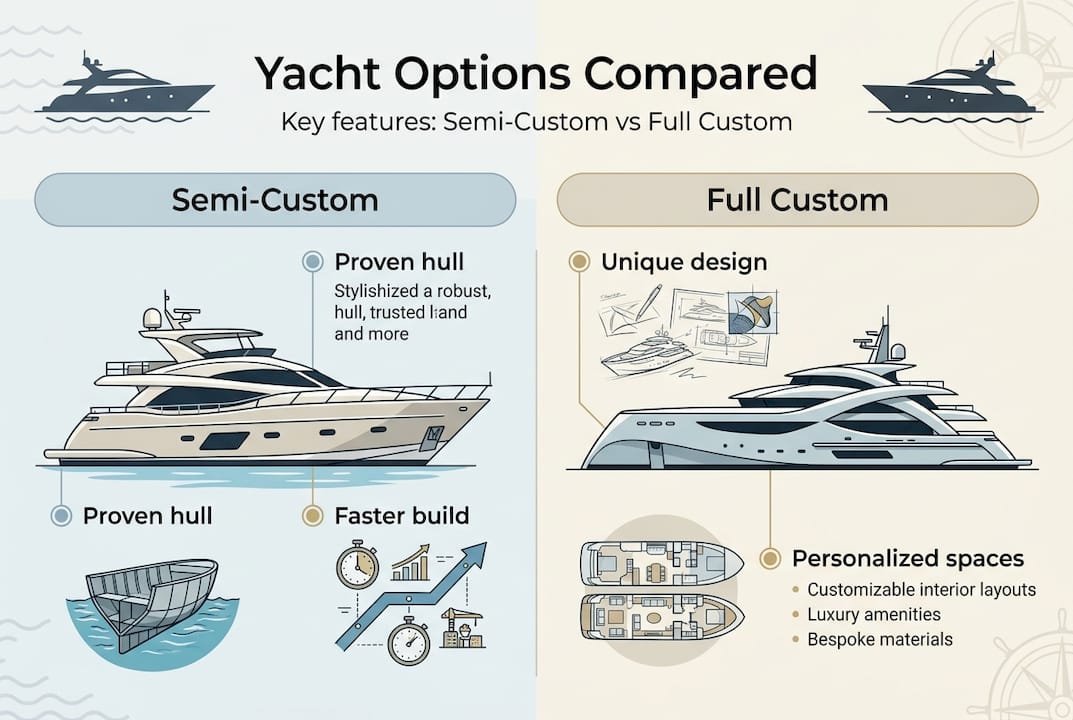
Resale considerations favor semi-custom yachts over highly personalized full custom builds. Buyers in the pre-owned market appreciate the combination of individuality and proven performance that semi-custom yachts offer. The vessels retain more value because they balance uniqueness with broader market appeal. Full custom yachts with extremely specific layouts or unusual design choices may struggle to find buyers willing to pay premium prices for someone else’s vision.
Your choice between semi-custom and full custom depends on several factors. If your lifestyle requirements align reasonably well with existing semi-custom platforms, the time and cost savings make this option attractive. If you have truly unique needs that cannot be accommodated within semi-custom constraints, or if creating a one-of-a-kind vessel is itself a primary goal, full custom justifies the additional investment.
Practical considerations for making this decision:
- Evaluate whether your must-have features can be incorporated into semi-custom platforms from respected builders
- Calculate the total cost difference including financing charges over extended construction periods
- Assess your timeline flexibility and whether you can wait an additional year or more for delivery
- Consider your likely ownership duration and whether resale value matters for your financial planning
- Examine comparable semi-custom models to determine if they meet 80% of your requirements
Safety considerations should influence your decision regardless of which path you choose. Avoid modifications that compromise structural integrity or system reliability. Working within semi-custom parameters or with experienced full custom builders ensures that personalization doesn’t sacrifice seaworthiness or regulatory compliance. For those exploring specific options, reviewing examples like the 75-foot semi-custom Bertram motor yacht illustrates how semi-custom platforms deliver substantial personalization.
The semi-custom route particularly appeals to buyers who value proven performance and want to minimize construction risk while still creating a yacht that reflects their style. You gain most of the personalization benefits with significantly reduced timeline and cost exposure compared to full custom builds.
Explore custom and semi-custom yachts with expert guidance
Navigating the custom yacht journey requires expertise that extends beyond construction into comprehensive ownership support. Whether you’re considering a full custom build or exploring semi-custom alternatives, professional guidance helps you make informed decisions that protect your investment and enhance your yachting experience.

Yachting Experts offers tailored MC setup services that streamline the administrative and operational aspects of yacht ownership. Our team handles the complexities of registration, compliance, and ongoing management so you can focus on enjoying your vessel. We understand that purchasing a custom yacht represents one of your most significant investments, and our personalized approach ensures every detail receives proper attention.
Professional yacht management services in Florida maximize your investment value through proactive maintenance, crew management, and operational optimization. Our comprehensive approach covers everything from routine servicing to major refit coordination. For those beginning their yacht ownership journey, our detailed guide to buying a yacht provides step-by-step insights into the acquisition process.
FAQ
How long does it typically take to build a full custom yacht?
Building a custom yacht requires 24 to 48 months from initial concept through final delivery. This timeline includes design development, engineering, construction, systems installation, interior finishing, and comprehensive testing. Larger yachts with complex systems or highly customized features often extend toward the upper end of this range. Understanding this multi-year commitment helps you plan financially and logistically for the extended period before taking delivery.
What are the main risks associated with custom yacht builds?
Main risks include engineering challenges, cost overruns, construction delays, and contractual pitfalls like liability waivers. Coordination among multiple specialized contractors creates opportunities for miscommunication and quality issues. Many builders include contract clauses that shift substantial risk to owners, making legal review essential before signing agreements. Professional project management and independent surveying help identify problems early and maintain construction quality. Learn more about protecting your interests through our Florida yacht commission guide.
Is a semi-custom yacht a good compromise for personalization and cost?
Yes, semi-custom yachts offer proven hulls with extensive personalization, shorter construction timelines, and superior resale value compared to full custom builds. You gain substantial design flexibility for interiors, systems, and finishes while benefiting from tested hull performance and reduced engineering risk. This approach typically costs 10 to 30% more than production yachts versus 50% or more for full custom. Semi-custom represents an ideal solution for buyers wanting exclusivity without maximum risk exposure. Explore options like the 75-foot semi-custom Bertram to see how this approach delivers personalization.
How does customization affect yacht resale value?
Highly personalized custom yachts typically experience lower resale values and longer selling periods due to narrow buyer appeal. Production and semi-custom yachts benefit from brand recognition, standardized features, and broader market interest. Buyers in the pre-owned market often prefer vessels with conventional layouts and proven designs rather than extremely specific customization. Strategic customization that enhances functionality without creating unusual configurations helps preserve resale value better than purely aesthetic personalization.
What should I look for when selecting a custom yacht builder?
Prioritize builders with strong financial stability, proven delivery records, and transparent communication practices. Review their portfolio of completed projects similar in size and complexity to your vision. Verify their relationships with key suppliers and subcontractors who will execute much of the actual work. Insist on detailed contracts with clear milestone definitions, payment schedules tied to verified progress, and reasonable liability provisions. Visit their facilities to assess organization, quality control processes, and project management capabilities before committing.
Recommended
Request A Call
Featured Listings

2027 Canados
100
Miami Florida

2015 Maiora
$3,750,000
90
Miami Florida

2027 Canados
57
Miami Florida

2019 Silent-Yachts Fair Dinkum
$1,599,000
55
Fort Lauderdale Florida

2026 Canados
49
Miami Florida

2026 Buddy Davis
47
Miami Florida

2020 Grady-White No Name
$610,000
45
Hallandale Beach Florida

2020 Viking Huckleberry
$1,495,000
44
Fort Lauderdale Florida

2027 Canados
43
Miami Florida

2021 Intrepid Dream Faster
$730,000
40
Coral Gables Florida

2016 Edgewater
$299,000
37
Miami, Florida

2022 Avid
$56,900
23
Stuart Florida
Get your yacht value Estimate
"*" indicates required fields