

Marine escrow is defined as a neutral third-party arrangement where funds and transaction documents are held in trust until all agreed conditions of a vessel sale are fully satisfied. It is the financial backbone of secure yacht transactions, protecting both buyer and seller from premature fund transfers, disputes, and insolvency risk. If you are stepping into a high-value boat purchase for the first time, understanding what is marine escrow is not optional. It is the single most important safeguard between you and a very expensive mistake.
What is marine escrow and how does it work in yacht sales?
Marine escrow works by placing a neutral escrow agent between the buyer and seller to manage funds and documents until every closing condition is met. The escrow process follows a clear sequence: both parties agree on terms, the buyer funds the escrow account, the seller deposits all required documentation, inspections are completed, and then funds and title are released simultaneously. No money moves until every condition checks out.

The step-by-step marine escrow process
Here is how a standard marine sale escrow unfolds from start to finish:
- Agreement on terms. Buyer and seller sign a purchase agreement that defines every release condition, including survey approval, title verification, and any outstanding liens.
- Buyer funds the escrow account. The deposit and any subsequent payments go directly to the escrow agent, not the seller. The seller never touches the money until closing.
- Seller deposits documentation. The seller submits the vessel title, registration documents, and any warranties or service records into escrow.
- Inspections and surveys. The buyer arranges a marine survey with a certified surveyor. The survey result is a defined release condition, so a failed survey can pause or cancel the transaction.
- Conditions verified. The escrow agent confirms every contractual condition is satisfied. This is not a judgment call. The agent follows the written instructions exactly.
- Simultaneous release. Funds go to the seller and title transfers to the buyer at the same moment. Boat escrow services coordinate this controlled disbursement to eliminate the risk of one party receiving their consideration before the other.
Pro Tip: Write every release condition in plain, objective language. Vague terms like “satisfactory condition” give the escrow agent nothing to work with and can stall your closing for weeks.
The escrow agent’s role is strictly administrative. Interpreting vague contract terms or mediating disputes falls outside their role entirely. That means the contract itself carries all the weight. Get it right before you fund the account.
What are the different types of marine escrow accounts?
Not all marine escrow arrangements are the same. The two primary types serve very different purposes, and knowing which one applies to your transaction protects you from using the wrong structure.
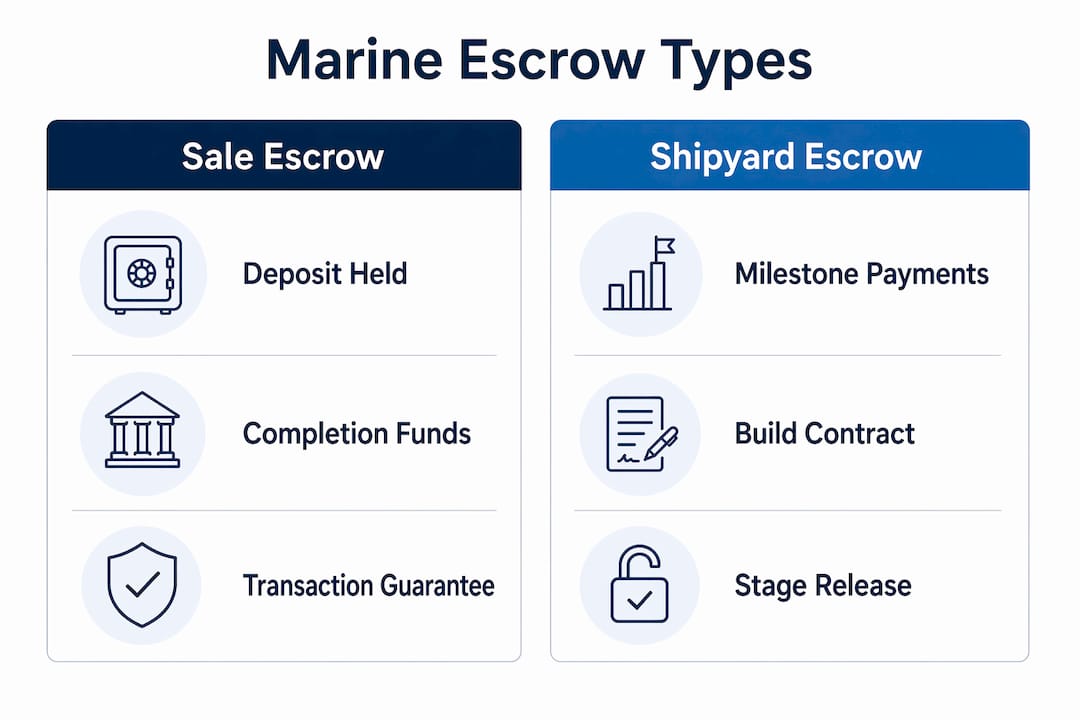
Sale escrow vs. shipyard escrow
| Feature | Marine sale escrow | Shipyard or build escrow |
|---|---|---|
| Primary use | Existing vessel purchase or sale | New build, refit, or major repair project |
| Payment structure | Deposit plus completion funds | Milestone-based stage payments |
| Release trigger | Survey approval, title transfer, closing conditions | Third-party certifications at each build milestone |
| Key safeguard | Funds held until all sale conditions are met | Payments tied to verified progress, not self-reported progress |
| Third-party verifier | Marine surveyor, title agent | Naval architect or classification society |
Marine sale escrow holds deposits and completion funds separately, releasing money only when all transaction conditions are satisfied. This protects against premature or insecure fund transfers in a standard vessel purchase.
Shipyard escrow is more complex. Shipyard escrow accounts hold milestone-based stage payments that are released only upon verified certification from independent third parties like naval architects or classification societies such as Lloyd’s Register or Bureau Veritas. This matters enormously because a shipyard cannot simply report that a milestone is complete. An independent expert must certify it.
Shipyard escrow agreements sit alongside the build contract and define exactly when and how funds may be released, linked to milestone completion and independent certifications. Think of it as a financial checkpoint system built directly into your build contract.
What are the key benefits and protections of marine escrow?
Marine escrow replaces blind trust with a neutral, contractual mechanism. That shift matters enormously when you are wiring six figures to a seller you may have met only once.
“Escrow provides buyers the confidence that six-figure sums won’t be lost prematurely, replacing blind trust with contractual guarantees essential in high-value yacht transactions.”
The core benefits break down clearly:
- Protection against premature payment. Your funds never reach the seller until every condition is verified. A failed survey or a title defect stops the release automatically.
- Seller insolvency protection. If the seller or shipyard becomes insolvent before closing, your money is not part of their estate. Escrow accounts held at regulated institutions keep buyer funds legally separate from the seller’s assets.
- Neutral fund management. The escrow agent has no financial interest in the outcome. That neutrality removes the pressure that can push buyers into releasing funds before they should.
- Contractual dispute prevention. Clear release conditions eliminate most disputes before they start. When both parties agree in writing on exactly what triggers a fund release, there is very little room for disagreement.
- Title and documentation security. The seller cannot walk away with your money while the title is still in their name. Both transfer simultaneously at closing.
Safeguarding client capital through accounts at highly regulated institutions is as critical as controlling fund releases. Choosing an escrow provider that holds funds at a central bank or regulated financial institution adds a second layer of protection that most buyers never think to ask about.
What practical pitfalls should buyers and sellers watch out for?
The most common escrow mistake is assuming the process runs itself after the deposit is made. Buyers often believe that once their funds are in escrow, the transaction is on autopilot. It is not.
Escrow agents follow written instructions. They do not fill gaps, make judgment calls, or push either party to act. Milestone definitions in shipyard escrow must be tied to objective, third-party certifications rather than self-reported progress. The same principle applies to sale escrow. Every condition must be defined with enough specificity that a third party can verify it without interpretation.
Here are the most important practical considerations:
- Define survey scope before funding. Specify which systems the marine surveyor must inspect and what pass or fail looks like in writing.
- Set hard deadlines for each condition. Open-ended timelines invite delays. Include specific dates for survey completion, title search, and documentation delivery.
- Verify the escrow institution. Confirm that funds are held at a regulated bank or financial institution, not in a broker’s operating account.
- Confirm the escrow agent’s marine experience. A general real estate escrow agent may not understand vessel title transfers, lien searches, or USCG documentation requirements.
- Read the release conditions aloud with your broker. If a condition sounds ambiguous when spoken, rewrite it before signing.
Pro Tip: Work with an escrow agent who has direct experience in marine transactions. A specialist understands USCG documentation, state title requirements, and the specific timing of vessel surveys in a way that a generalist simply does not.
Understanding how yacht closing works in your state adds another layer of clarity. Florida, for example, has specific requirements around sales tax, title transfer, and lien releases that must be reflected in your escrow release conditions.
Key Takeaways
Marine escrow is the most reliable protection available to buyers and sellers in high-value yacht transactions, replacing informal trust with verified, contractual fund control.
| Point | Details |
|---|---|
| Marine escrow definition | A neutral third party holds funds and documents until all sale conditions are verified and met. |
| Two main types | Sale escrow covers vessel transfers; shipyard escrow manages milestone payments in new builds or refits. |
| Escrow agent’s role | Agents follow written instructions only and cannot interpret vague terms or resolve disputes. |
| Institutional protection | Funds held at regulated banks remain protected even if the seller or shipyard becomes insolvent. |
| Precision is critical | Every release condition must be objective and specific so the agent can verify it without ambiguity. |
Why I think most buyers underestimate marine escrow
After years of working through yacht transactions, the pattern I see most often is this: buyers treat escrow as a formality rather than a tool. They sign the purchase agreement, wire the deposit, and assume the process is now protected. The escrow account is open, so everything is fine. That assumption is where deals go sideways.
The escrow account is only as strong as the contract behind it. I have seen transactions stall for weeks because a release condition said “vessel in good working order” with no definition of what that means. The surveyor found issues. The seller disagreed. The escrow agent could not move because the contract gave them nothing objective to act on. Both parties paid for extra legal time, and the deal nearly collapsed.
What actually works is treating the release conditions like a checklist that a stranger could verify without ever speaking to either party. Specific systems, specific standards, specific deadlines. When you build escrow that way, closings go smoothly and both sides feel protected. That is the version of marine escrow worth using.
For buyers new to the process, I always recommend reading through a yacht escrow buyer’s guide before signing anything. The more you understand the mechanics, the better your contract will be.
— Jason
How Yachtingexperts supports secure marine transactions
Yachtingexperts brings a hands-on, detail-oriented approach to every yacht sale and purchase, including the escrow process. Our team knows that a smooth closing depends on getting the financial and legal framework right from the start, not just finding the right vessel.

We walk you through every step, from structuring clear release conditions to coordinating with surveyors and title agents, so nothing falls through the cracks. Whether you are buying your first yacht or trading up to something bigger, our marine escrow services are built to protect your investment at every stage. ✅ Reach out to the Yachtingexperts team today and let us make your next transaction as secure as it is exciting.
FAQ
What is the marine escrow definition in simple terms?
Marine escrow is a financial arrangement where a neutral third party holds a buyer’s funds and a seller’s documents until every agreed condition of a vessel sale is satisfied. Funds and title transfer simultaneously at closing.
How does yacht escrow differ from a standard bank wire?
A bank wire sends funds directly to the seller with no conditions attached. Yacht escrow holds those funds at a neutral institution and releases them only when verified conditions, such as a passed survey or clear title, are confirmed.
Who acts as the escrow agent in a marine transaction?
The escrow agent is typically a regulated financial institution, a specialized marine escrow service, or a licensed title company with marine experience. They follow the written contract instructions and do not take sides in any dispute.
What happens if the survey fails during the escrow process?
If the survey reveals defects that meet the contract’s defined failure criteria, the escrow agent holds the funds until the parties renegotiate or the buyer formally cancels. The buyer’s deposit is returned according to the terms agreed at the start.
Is marine escrow required by law for yacht purchases?
Marine escrow is not universally required by law, but it is strongly recommended for any high-value vessel transaction. Many professional brokers and lenders require it as a standard condition of the sale to protect all parties involved.
Recommended
Request A Call
Featured Listings

2027 Canados
100
Miami Florida

2015 Maiora
$3,750,000
90
Miami Florida

2027 Canados
57
Miami Florida

2019 Silent-Yachts Fair Dinkum
$1,599,000
55
Fort Lauderdale Florida

2026 Canados
49
Miami Florida

2026 Buddy Davis
47
Miami Florida

2020 Grady-White No Name
$610,000
45
Hallandale Beach Florida

2020 Viking Huckleberry
$1,495,000
44
Fort Lauderdale Florida

2027 Canados
43
Miami Florida

2021 Intrepid Dream Faster
$730,000
40
Coral Gables Florida

2016 Edgewater
$299,000
37
Miami, Florida

2022 Avid
$56,900
23
Stuart Florida
Get your yacht value Estimate
"*" indicates required fields