

Fractional yacht ownership is defined as a legal co-ownership model where multiple individuals each purchase an equity share in a single luxury yacht, granting them scheduled usage rights, proportional cost sharing, and a saleable asset. Unlike chartering, where you pay for temporary access with no financial stake, fractional ownership means your name is on the title. Unlike a timeshare, your share holds real market value and can be sold. A standard 1/8 share typically delivers around 6 weeks of guaranteed yacht time per year, making it a serious yacht ownership option for those who want the experience without absorbing 100% of the cost.
What is fractional yacht ownership and how does it differ from chartering?
Fractional yacht ownership, also called yacht syndication or co-ownership, means you hold a legally recognized equity stake in a vessel alongside a small group of co-owners, typically between four and eight individuals. Each owner’s share is proportional to their investment, and that share can be sold, transferred, or included in an estate plan. This is the defining distinction between fractional ownership and every other access model on the market.

Chartering gives you a week aboard a yacht you will never own. Yacht clubs and timeshares operate on membership or access rights, not asset ownership. Fractional ownership sits in a different category entirely. You build equity, you share in any appreciation of the vessel’s value, and you exit by selling your stake rather than simply walking away.
The model draws a clear parallel to fractional real estate investing, where investors pool capital to own a high-value asset that would be prohibitive to purchase alone. The same logic applies here. A $2 million yacht becomes accessible at a $250,000 entry point for an eighth-share buyer, with running costs split proportionally among all owners.
How fractional yacht ownership works: structure, scheduling, and management
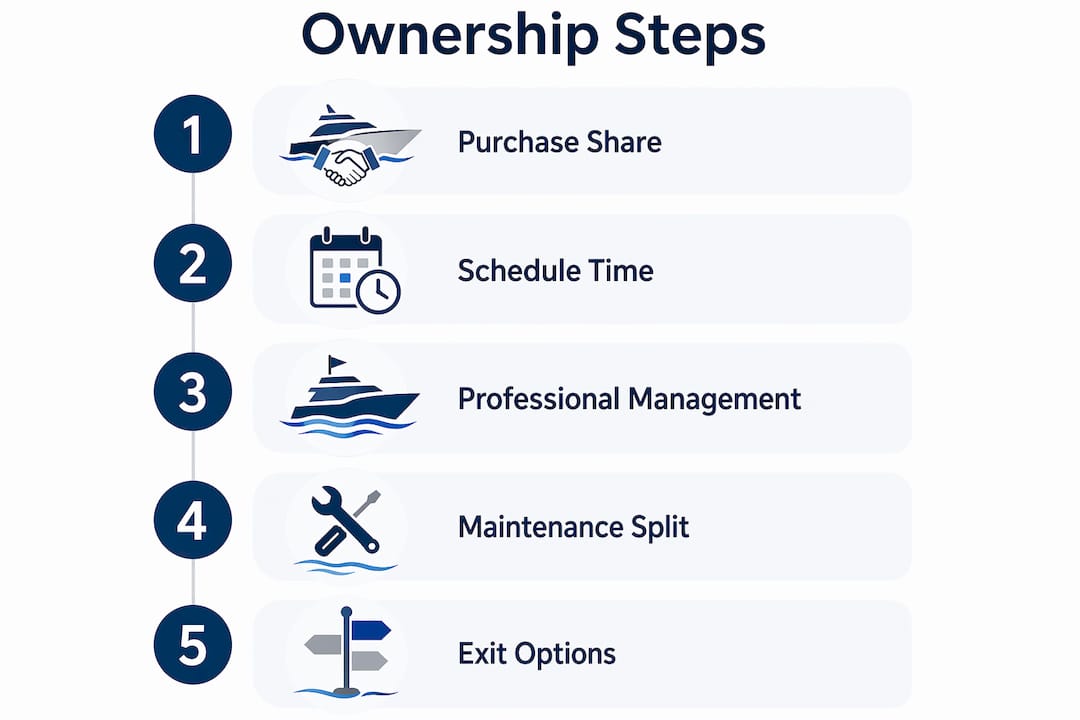
The operational structure of a fractional program is what separates a well-run syndicate from a frustrating shared-ownership nightmare. Here is how a properly structured program functions:
- Ownership entity: The yacht is typically held under a shared LLC, with each co-owner holding a membership interest proportional to their share. LLC ownership provides liability protection, simplifies title management, and allows ownership transfers without triggering unnecessary tax events.
- Usage scheduling: Time is allocated through a transparent rotating system. Each owner receives their designated weeks on a predictable calendar, often rotating priority annually so no single owner always gets peak season.
- Professional management: A management company coordinates all scheduling, maintenance, crew hiring, compliance, insurance, and provisioning. Owners show up and enjoy the boat. They do not manage contractors or chase paperwork.
- Maintenance and compliance: The management company handles everything from engine servicing to Coast Guard documentation, keeping the vessel in flag-state compliance year-round.
- Owner communication: Most programs use a shared portal or app where owners can view schedules, submit maintenance requests, and communicate with the management team.
Pro Tip: Before signing any syndicate agreement, ask specifically how the management company handles scheduling disputes and what the escalation process looks like. A well-run program has a written conflict resolution protocol, not just a handshake understanding.
The scheduling system assures guaranteed time windows but requires planning ahead. Spontaneous weekend getaways are not realistic in most fractional programs. If your lifestyle demands last-minute flexibility, that trade-off matters and you should weigh it honestly before committing.
Benefits and drawbacks of fractional ownership vs. full ownership and chartering
The financial case for fractional ownership is compelling, but it is not the right fit for every buyer. Here is an honest comparison across the three primary yacht access models.
| Factor | Fractional ownership | Full ownership | Chartering |
|---|---|---|---|
| Upfront cost | Fraction of vessel price | Full vessel price | Per-charter fee only |
| Equity building | Yes, saleable share | Yes, full asset | No |
| Scheduling flexibility | Assigned weeks, planned ahead | Complete freedom | Booking-dependent |
| Maintenance burden | Shared and managed | Full responsibility | None |
| Customization | Limited by shared use | Unlimited | None |
| Annual running costs | Proportional share | Full 10% rule applies | Included in charter rate |
The cost savings are the headline benefit. Annual running costs for a yacht approximate 10% of the vessel’s purchase price each year, covering crew, maintenance, insurance, docking, and fuel. On a $2 million yacht, that is $200,000 annually. An eighth-share owner pays roughly $25,000 per year in running costs, which is less than many people spend on a two-week charter vacation. You also explore yacht investment advantages that chartering simply cannot offer, including equity appreciation and a saleable asset.
The drawbacks are real and worth stating plainly. Fractional agreements often restrict owner control over décor, fixtures, and customization because the vessel must remain consistent for all co-owners. You will not be repainting the hull or installing a custom sound system. Group decision-making on major upgrades can also be slow, particularly if co-owners have differing priorities.
Pro Tip: If you are comparing fractional ownership to chartering purely on cost, factor in the equity component. A charter fee is a pure expense. A fractional share purchase is a capital allocation that may return value when you sell.
Financial and legal logistics: costs, agreements, and exit strategies
Understanding the financial and legal structure of fractional ownership is non-negotiable before you write a check. Here is what the numbers and documents actually look like.
Typical cost structure
- Initial share purchase: Entry prices vary widely by vessel size and program. A 1/8 share in a well-maintained 50-foot sailing yacht might start around $100,000 to $150,000. Motor yachts and superyachts command significantly higher entry points.
- Annual running costs: Budget approximately 10% of the full vessel value per year, divided by the number of shares. For a $1.2 million vessel with eight owners, each owner contributes roughly $15,000 annually.
- Management fees: Professional management companies typically charge a fee on top of operating costs, often ranging from 10% to 20% of the annual operating budget.
- Reserve fund contributions: Most syndicates require owners to contribute to a capital reserve fund for major repairs or eventual vessel replacement.
| Cost category | Typical annual amount (1/8 share, $1.2M vessel) |
|---|---|
| Operating costs (proportional) | ~$15,000 |
| Management fee | ~$2,000–$3,000 |
| Reserve fund contribution | ~$1,500–$2,500 |
| Total estimated annual cost | ~$18,500–$20,500 |
The syndicate agreement: your most important document
The syndicate agreement governs everything. This document defines usage rights, payment default procedures, sale and transfer conditions, scheduling rules, and what happens when co-owners disagree. Read it with a maritime attorney before signing. Pay particular attention to the default clause. In most well-structured programs, a defaulting owner’s share can be auctioned after a defined non-payment period, protecting the remaining co-owners from carrying an unresponsive partner’s costs.
Exiting your fractional position
Exit strategies typically involve selling or transferring your share, subject to the terms of the syndicate agreement. Some agreements give existing co-owners right of first refusal on any share sale. Others allow open-market sales with management company approval. The LLC structure makes transfers administratively clean. You transfer your membership interest rather than re-titling the vessel, which reduces legal friction and cost considerably. For a deeper look at Florida yacht ownership costs, including how fractional structures affect your annual budget, the numbers are worth reviewing before you commit.
Who should consider fractional ownership and how to get started
Fractional yacht ownership suits a specific type of buyer. You are a strong candidate if you match most of these criteria:
- You want genuine yacht ownership, not just access, and you value having equity in the asset
- You can plan your yacht time in advance and are comfortable with assigned scheduling windows
- You want to enjoy the yacht experience without managing crew, maintenance contractors, or compliance paperwork
- You are open to co-ownership yachts as a stepping stone toward eventual sole ownership
- You have the capital for a share purchase and the annual operating budget without stretching your finances
You are probably not a strong candidate if you demand spontaneous access, want to customize the vessel to your personal taste, or prefer making all decisions unilaterally. Full ownership is the right answer for those buyers, and the cost difference reflects that freedom.
Steps to get started
Getting into a fractional program the right way takes deliberate preparation. Work with a yacht broker who specializes in co-ownership arrangements. Review at least two or three syndicate agreements before settling on a program, because terms vary significantly between operators. Confirm that a professional management company is in place before you commit. Verify the vessel’s maintenance history, current condition, and insurance coverage independently. Ask how many owners are currently in the syndicate and whether any shares are available for resale versus new program entry. Understanding what yacht chartering looks like as an alternative will also sharpen your comparison before you decide.
Key takeaways
Fractional yacht ownership delivers real equity, professional management, and proportional cost sharing, making it the most financially structured path to yacht access short of full ownership.
| Point | Details |
|---|---|
| Legal equity, not just access | Fractional owners hold a saleable LLC membership interest, not a membership or rental right. |
| Usage averages 3 to 6 weeks | A standard 1/8 share delivers approximately 6 weeks of scheduled yacht time per year. |
| Annual costs are proportional | Budget roughly 10% of the full vessel value annually, divided by the number of shares. |
| The syndicate agreement controls everything | Read it with a maritime attorney before signing, focusing on default and exit clauses. |
| Professional management is non-negotiable | Managed programs reduce conflict and maximize owner enjoyment compared to peer-to-peer arrangements. |
Why fractional ownership deserves more serious attention than it gets
I have spent years watching buyers dismiss fractional ownership too quickly, usually because they conflate it with timeshares or assume it means compromising on quality. That assumption is wrong, and it costs people real money.
The buyers who thrive in fractional programs are not settling. They are making a deliberate financial decision. They recognize that a $250,000 share in a $2 million yacht, professionally managed and maintained, delivers a better experience per dollar than either a $2 million full purchase or a $30,000 annual charter habit. The math is not subtle.
What I tell every client who asks me about this model is to focus first on the management company, not the boat. The vessel is secondary. A poorly managed syndicate with a beautiful yacht is a miserable experience. A well-managed program with a solid but not spectacular vessel is genuinely enjoyable. Professional yacht management is what separates the two outcomes, and it is the variable most buyers underweight in their research.
The scheduling rigidity is real, and I will not minimize it. If you are the kind of person who decides on Friday afternoon that you want to be on the water by Saturday morning, fractional ownership will frustrate you. But for buyers who plan their leisure time in advance, that constraint is trivial compared to the financial and lifestyle benefits.
My honest recommendation: treat fractional ownership as a serious first chapter in your yachting life, not a consolation prize. Many of the sole owners I work with today started in a syndicate, learned the market, built relationships with management companies, and traded up with confidence. That path is smarter than jumping straight into full ownership without experience.
— Jason
Ready to explore fractional yacht ownership?
At Yachtingexperts, we work with buyers at every stage of the ownership journey, including those seriously evaluating fractional programs for the first time. Our team reviews syndicate agreements, vets management companies, and helps you understand exactly what you are buying before you commit. We have guided clients through co-ownership arrangements on vessels ranging from 40-foot sailing yachts to 80-foot motor yachts, and we know what separates a well-structured program from one that will cause headaches.

Whether you are ready to move forward or still comparing your options, our yacht ownership consulting services are designed to make the process clear, personalized, and worth your time. Reach out to our team today and tell us what your ideal ownership experience looks like. We will help you find the right structure to get there.
FAQ
What is fractional yacht ownership in simple terms?
Fractional yacht ownership means you purchase a legal equity share in a yacht, entitling you to scheduled usage time and proportional cost sharing. Your share is a real asset you can sell or transfer, unlike a charter or club membership.
How many weeks per year do fractional yacht owners get?
Most fractional programs offer approximately 6 weeks of usage per year for a standard 1/8 share, with scheduling allocated through a rotating system to give each owner equitable access.
Is fractional yacht ownership worth it financially?
Fractional ownership builds equity and splits running costs proportionally, making it far more cost-effective than sole ownership for buyers who use the yacht less than 8 to 10 weeks per year. The key question is whether scheduled access fits your lifestyle.
What happens if a co-owner stops paying their share?
Most syndicate agreements include a default clause that allows the defaulting owner’s share to be auctioned after a defined period, protecting the remaining co-owners from absorbing unpaid costs indefinitely.
How is fractional yacht ownership different from a timeshare?
Fractional ownership gives you real legal equity in the vessel through an LLC membership interest, which you can sell on the open market. A timeshare grants only usage rights with no saleable asset value, making the two models fundamentally different in financial terms.
Recommended
Request A Call
Featured Listings

2027 Canados
100
Miami Florida

2015 Maiora
$3,750,000
90
Miami Florida

2027 Canados
57
Miami Florida

2019 Silent-Yachts Fair Dinkum
$1,599,000
55
Fort Lauderdale Florida

2026 Canados
49
Miami Florida

2026 Buddy Davis
47
Miami Florida

2020 Grady-White No Name
$610,000
45
Hallandale Beach Florida

2020 Viking Huckleberry
$1,495,000
44
Fort Lauderdale Florida

2027 Canados
43
Miami Florida

2021 Intrepid Dream Faster
$730,000
40
Coral Gables Florida

2016 Edgewater
$299,000
37
Miami, Florida

2022 Avid
$56,900
23
Stuart Florida
Get your yacht value Estimate
"*" indicates required fields