

A marine warranty is defined as a mandatory, insurance-driven verification process in which an independent Marine Warranty Surveyor confirms that a specific marine operation meets strict safety and compliance standards. If you own a vessel and plan any complex operation, from heavy lifts to offshore transport, this process is not optional. It sits at the center of your insurance coverage, and skipping it can void your policy entirely. Understanding how marine warranties work is one of the most practical things you can do to protect your investment.
What is a marine warranty and why does it matter?
A Marine Warranty Survey (MWS) is a third-party verification required by insurers for high-risk marine operations. The surveyor confirms that the planned operation complies with industry best practices and the specific obligations written into your insurance policy. Without that confirmation, your insurer has grounds to deny any claim arising from the operation.

The marine warranty definition is often confused with the broader idea of a product warranty. These are entirely different things. A marine warranty is not a manufacturer’s guarantee on your engine or hull. It is an insurer’s requirement that an independent expert signs off on how a specific operation will be carried out.
Operations that typically require MWS approval include:
- Heavy lifts involving cranes or specialized equipment
- Vessel transport on semi-submersible or heavy-lift ships
- Offshore installation of structures or subsea equipment
- Towing operations for large or unusual cargo
- Salvage and wreck removal projects
Pro Tip: If your insurer’s policy contains the phrase “subject to MWS approval,” treat that as a hard requirement. Proceeding without it puts your entire coverage at risk.
The marine warranty importance goes beyond paperwork. MWS prevents costly failures by enforcing technical integrity and safe execution against your insurer’s risk threshold. That means fewer accidents, fewer claims, and a vessel that stays in the water where it belongs.
How does a marine warranty survey differ from other surveys?
This is where most boat owners get tripped up, and the confusion is understandable. There are three distinct concepts that share similar language: Marine Warranty Surveys, classification surveys, and legal insurance warranties. Each serves a completely different purpose.
| Type | Purpose | Who Requires It | What It Confirms |
|---|---|---|---|
| Marine Warranty Survey | Operational safety for a specific task | Insurer | Safe execution of a defined operation |
| Classification survey | Vessel structural and design fitness | Flag state / class society | Hull, machinery, and design compliance |
| Legal insurance warranty | Contractual obligation in the policy | Insurer (by law) | Seaworthiness, legality, or other stated conditions |
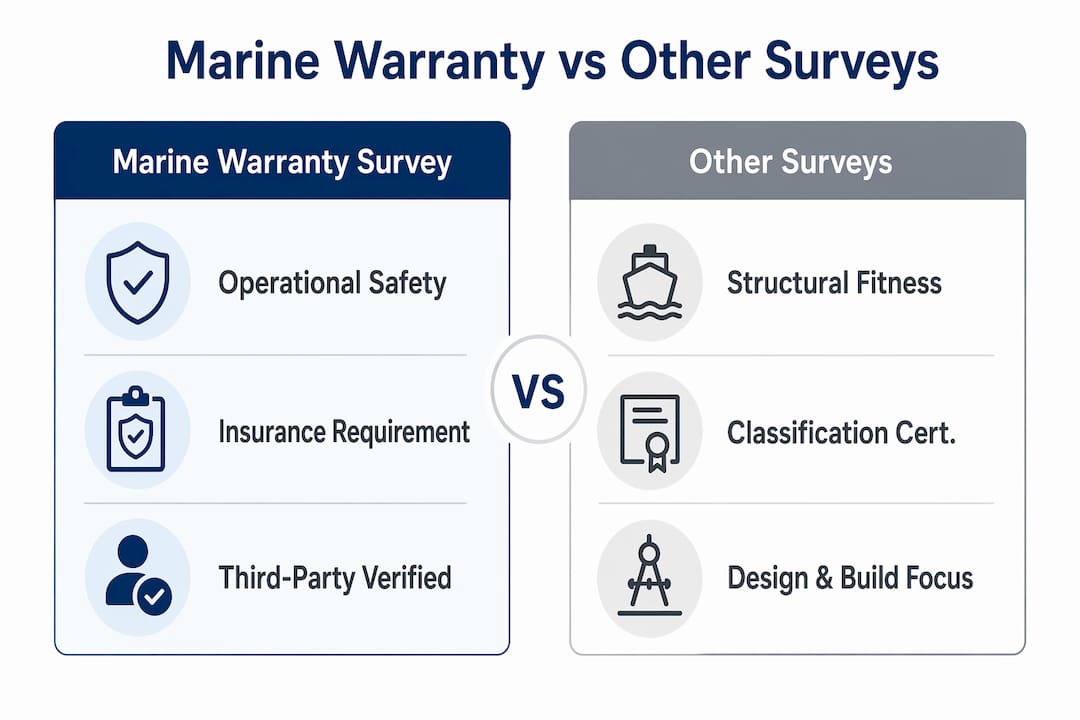
Classification surveys confirm vessel structural fitness. MWS confirms operation-specific safety and insurance compliance. Both are needed, but they require separate approval processes and serve entirely different functions.
Legal warranties in marine insurance are even more strict. Express and implied warranties in insurance policies require exact, literal compliance. Implied warranties, such as seaworthiness and legality, are mandated by law regardless of whether your policy spells them out. Breach of a promissory warranty voids insurer liability from the date of the breach, regardless of whether the breach caused the actual damage. That is a significant legal exposure most owners do not fully appreciate.
Pro Tip: Read your insurance policy carefully for the word “warranty.” Every instance is a strict contractual obligation. Missing one, even on a technicality, can leave you uninsured at the worst possible moment.
The practical implication is clear. Your class certificate does not satisfy your insurer’s MWS requirement. And your MWS approval does not replace your obligation to maintain seaworthiness under your policy. These are parallel tracks, not interchangeable ones.
What is the typical marine warranty process for vessel owners?
The marine warranty process follows a defined sequence. Knowing each phase helps you plan ahead and avoid the delays that catch so many owners off guard.
-
Early engagement. Contact a qualified Marine Warranty Surveyor during the planning phase, not after you have finalized your method statement. Late MWS involvement risks operation halts and high standby costs due to unmet insurance safety criteria.
-
Method statement review. The surveyor reviews your operational plan in detail. This includes equipment specifications, load calculations, weather criteria, and crew qualifications. Any gaps are identified here, before they become expensive problems on the water.
-
Approval and Certificate of Approval (CoA). Once the surveyor is satisfied, they issue a Certificate of Approval. Underwriters require this CoA to validate insurance coverage for complex marine projects. Without it, your coverage risks complete invalidation if an incident occurs.
-
Operational attendance. For many high-risk operations, the surveyor attends in person or remotely to confirm the work is carried out exactly as approved. Deviating from the approved method statement during execution can trigger the same consequences as having no approval at all.
-
Post-operation documentation. The surveyor provides a final report confirming compliance. This document supports your insurer’s records and protects you in the event of a future claim or dispute.
When you are buying or selling a vessel that has recently undergone a complex operation, ask for the CoA and the surveyor’s report. These documents tell you whether the work was done correctly and whether the insurance was valid at the time. Understanding the role of a surveyor in any transaction gives you a significant advantage as a buyer.
Common pitfalls boat owners make with marine warranties
The single biggest mistake is treating the MWS as a final checklist item. Treating MWS as a box-ticking exercise leads to operational failures. Successful operators involve the surveyor during engineering and planning to avoid costly redesigns and delays.
Other frequent mistakes include:
- Ignoring policy conditions. Owners assume their general marine insurance covers all operations. Many policies contain specific MWS requirements for defined activities. Missing these conditions means operating without valid coverage.
- Choosing an unqualified surveyor. Not every marine surveyor is qualified to act as an MWS. Your insurer may have a list of approved surveyors. Using someone outside that list can invalidate the approval.
- Poor communication between parties. The surveyor works independently for the insurer, not for you. MWS acts independently to focus on risk reduction and operational integrity. Treating the surveyor as an adversary rather than a technical partner creates friction and delays.
- Last-minute documentation. Submitting your method statement days before the operation leaves no time for revisions. Surveyors need adequate time to review complex plans properly.
Pro Tip: Build MWS engagement into your project timeline from day one. Treat the surveyor as a technical advisor, not an inspector. Owners who do this consistently report fewer surprises and smoother operations.
Best practice is to view the marine warranty process as a partnership. The surveyor’s job is to help you execute safely and keep your insurance intact. That alignment of interests is worth taking seriously.
How marine warranties protect your vessel investment
MWS enhances insurance underwriting by providing third-party technical assurance, reducing risk, and preventing loss. That benefit flows directly to you as the vessel owner in several concrete ways.
“MWS provides independent validation that a marine operation is well-engineered, facilitating insurance and stakeholder confidence.” — Global Maritime
First, a clean MWS record strengthens your position with lenders and buyers. When you go to sell or refinance, a documented history of compliant operations signals that the vessel has been managed responsibly. That matters when a buyer is deciding whether to trust your asking price. You can learn more about protecting that value through yacht warranty fundamentals specific to the Florida market.
Second, MWS approval reduces the risk of claim denial. Insurers look for any reason to limit liability after a major loss. A properly documented CoA removes one of the most common grounds for denial. That protection is worth far more than the cost of the survey itself.
Third, lenders financing large vessel purchases increasingly require evidence of MWS compliance for any financed operation. Skipping the process can trigger a loan covenant breach, not just an insurance problem. Understanding yacht investment protection from a financial perspective helps you see why this documentation matters beyond the operational moment.
Key Takeaways
A marine warranty is the insurer-required, surveyor-verified confirmation that a specific vessel operation meets safety and compliance standards. Without it, your insurance coverage is at serious risk.
| Point | Details |
|---|---|
| Marine warranty definition | An MWS is an insurer-required third-party verification of operational safety, not a product guarantee. |
| Distinct from class surveys | Classification surveys confirm vessel fitness; MWS confirms operation-specific safety and insurance compliance. |
| Legal warranties are strict | Breaching a promissory warranty in your policy voids insurer liability from the date of breach. |
| Early engagement is critical | Involving the surveyor during planning avoids costly delays, redesigns, and potential coverage gaps. |
| CoA protects your investment | A Certificate of Approval documents compliance and supports claims, resale value, and lender confidence. |
Why I tell every boat owner to stop fearing the MWS process
Most owners I speak with come to the marine warranty conversation with one of two reactions. Either they have never heard of it, or they have heard of it and assume it is a bureaucratic headache designed to slow them down. Both reactions lead to the same outcome: they engage too late, they feel blindsided by requirements, and they end up paying more than they needed to.
Here is what I have learned from working with owners across a wide range of vessel types and operations. The Marine Warranty Surveyor is not your adversary. The surveyor is the one person in the room whose job is to make sure your operation succeeds without destroying your insurance coverage. That is a person you want on your side early, not someone you call the week before you move a vessel.
The owners who get the most out of the MWS process are the ones who treat it as a planning tool. They share their method statements early. They ask questions. They let the surveyor flag problems while there is still time to fix them cheaply. The owners who resist the process until the last moment are the ones who end up with expensive standby costs or, worse, a denied claim after something goes wrong.
My honest advice: get comfortable with the process. Read your insurance policy. Know which operations trigger an MWS requirement. And when you are buying or selling a vessel, always ask for the CoA documentation on any recent complex operation. That single document tells you more about how a vessel has been managed than almost anything else.
— Jason
Protect your vessel with the right expert support
Navigating marine warranties, surveys, and insurance requirements is a lot to manage on your own, especially when you are also focused on getting the most from your vessel purchase or sale.

At Yachtingexperts, we work alongside boat owners at every stage of the process. Whether you need guidance on marine warranty consulting before a complex operation or want a trusted partner to help you buy or sell with full confidence, our team brings the expertise and personal attention your investment deserves. We hold your hand through the details so you can focus on the water. Reach out to Yachtingexperts today and let us help you protect what matters most.
FAQ
What is a marine warranty in simple terms?
A marine warranty is an insurer-required process where an independent Marine Warranty Surveyor confirms that a specific vessel operation is safe and compliant before it takes place.
Does every boat owner need a marine warranty survey?
Not for routine use, but any complex or high-risk operation covered by your insurance policy may require MWS approval. Check your policy for specific MWS conditions.
What happens if I skip the marine warranty process?
Without a valid Certificate of Approval, your insurer can deny any claim arising from the operation. Skipping MWS approval risks complete invalidation of your insurance coverage.
How is a marine warranty different from a classification survey?
A classification survey certifies your vessel’s structural and design fitness. A marine warranty survey confirms that a specific operation will be carried out safely. Both serve different purposes and neither replaces the other.
Can breaching a legal marine warranty void my insurance?
Yes. Breaching a promissory warranty discharges your insurer from liability from the date of the breach, even if the breach had no direct connection to the damage that occurred.
Recommended
Request A Call
Featured Listings

2027 Canados
100
Miami Florida

2015 Maiora
$3,750,000
90
Miami Florida

2027 Canados
57
Miami Florida

2019 Silent-Yachts Fair Dinkum
$1,599,000
55
Fort Lauderdale Florida

2026 Canados
49
Miami Florida

2026 Buddy Davis
47
Miami Florida

2020 Grady-White No Name
$610,000
45
Hallandale Beach Florida

2020 Viking Huckleberry
$1,495,000
44
Fort Lauderdale Florida

2027 Canados
43
Miami Florida

2021 Intrepid Dream Faster
$730,000
40
Coral Gables Florida

2016 Edgewater
$299,000
37
Miami, Florida

2022 Avid
$56,900
23
Stuart Florida
Get your yacht value Estimate
"*" indicates required fields