

Most boat buyers assume all boats lose value the same way. They don’t. What affects boat depreciation is a mix of factors most people never consider until they’re sitting across from a buyer offering far less than expected. Age matters, sure. But so does whether you rinsed saltwater off after every trip, where you stored the boat each winter, and whether you kept a maintenance log. Understanding these factors before you buy or sell puts real money back in your pocket.
Table of Contents
- Key takeaways
- What affects boat depreciation: new vs. used timing
- Key factors influencing boat depreciation rates
- What marine surveys reveal about hidden depreciation
- How to reduce boat depreciation through maintenance and storage
- How market dynamics shift resale value
- My take on what actually drives depreciation
- Let Yachtingexperts help you protect your investment
- FAQ
Key takeaways
| Point | Details |
|---|---|
| Year-one drop is steep | New boats lose 10–20% of their value in the first year, making slightly used boats a smarter buy. |
| Cosmetic condition drives value | Gel coat oxidation and hardware corrosion can reduce a boat’s resale value by 15–25%. |
| Surveys reveal negotiating power | A professional marine survey report helps buyers negotiate price reductions that far exceed the survey cost. |
| Storage slows value loss | Proper off-season storage prevents UV and moisture damage that directly accelerates depreciation. |
| Documentation adds dollars | A well-maintained service record and recent upgrades meaningfully increase a boat’s resale appeal. |
What affects boat depreciation: new vs. used timing
Buying a brand-new boat feels exciting. But the moment you leave the dealer’s dock, that boat begins losing value fast. New boats typically lose 10–20% of their value in the first year alone, with cumulative losses of 30–40% by year five.
Here is the good news for smart buyers. After that initial five-year period, depreciation slows considerably for well-maintained boats, settling around 3–6% annually. This is the depreciation curve working in your favor. When someone else absorbs that brutal year-one drop, you benefit.
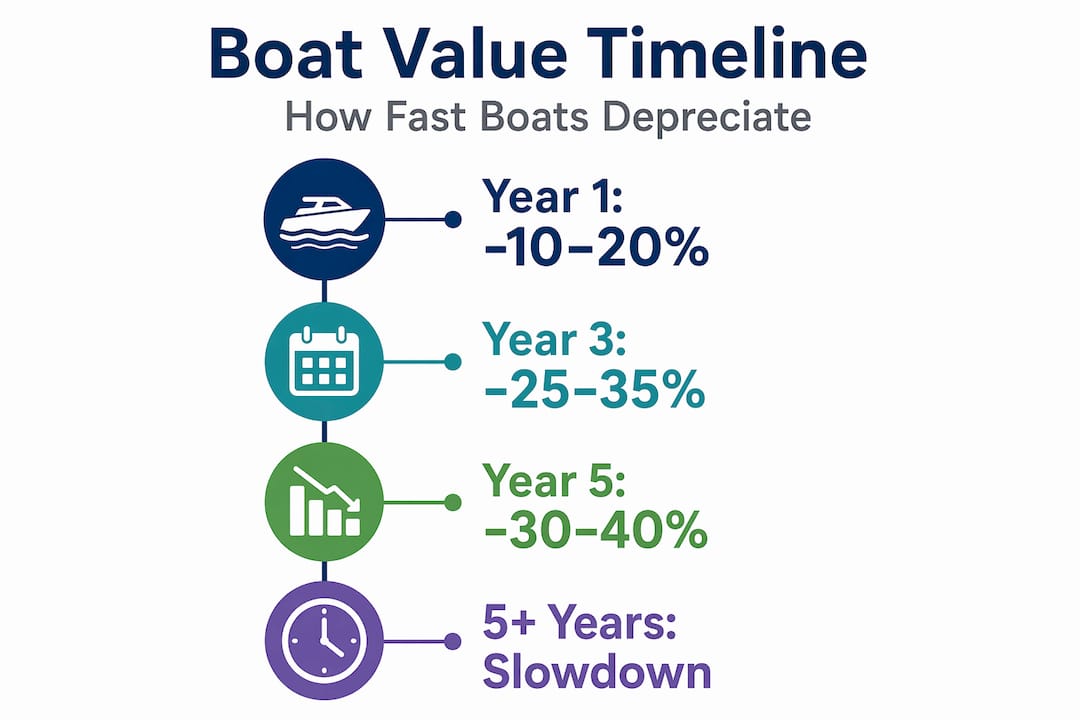
| Year | Approximate value retained (new boat) |
|---|---|
| Year 1 | 80–90% |
| Year 3 | 65–75% |
| Year 5 | 60–70% |
| Year 10 | 50–60% |
The financial difference is stark. In one cost comparison, a used boat’s five-year net cost came in around $89,520 versus approximately $134,800 for a comparable new boat. That gap is almost entirely driven by depreciation absorbed by the original owner.
Pro Tip: If you’re buying, target boats that are 2–3 years old and well-documented. You get near-new condition at a significantly lower acquisition cost, and the depreciation curve works entirely in your favor from that point forward.
Key factors influencing boat depreciation rates
Boat age and depreciation are connected, but age is only part of the picture. Several other factors influencing boat value can make two boats of the same year and model worth dramatically different amounts.
- Brand reputation and build quality. Manufacturers with strong reputations for durability, like Grady-White, Boston Whaler, or Viking, hold value better than budget alternatives. Buyers pay a premium knowing parts and support are available for decades.
- Engine hours and usage type. High engine hours signal wear, but context matters just as much. A boat with 400 hours of offshore saltwater use has endured far more stress than one with 400 hours on a freshwater lake. The effects of usage on boat value are very real. Saltwater use without regular maintenance accelerates corrosion throughout the drivetrain and hull fittings.
- Maintenance history and cosmetic condition. Oxidized gel coat and corroded hardware can reduce a boat’s value by 15–25%. That is thousands of dollars lost because of cosmetic neglect that could have been prevented with a $30 bottle of wax and a few hours of work each season.
- Environmental exposure. Salt is hygroscopic, meaning it pulls moisture from the air and keeps surfaces wet long after the boat is docked. Prolonged UV exposure without a quality cover or coating attacks gel coat at the molecular level. Both are major, often underestimated, depreciation accelerators.
- Regional market demand and seasonality. A center console sells fast in South Florida in January. The same boat sitting in Minnesota in November might take months to move. Timing and location shift perceived value in ways that feel almost arbitrary but are entirely predictable.
Market forces play a real role in why boats lose value faster at certain moments. Economic uncertainty and high financing costs create downward pressure on entry-level boat prices as buyers become more hesitant and selective.
What marine surveys reveal about hidden depreciation
This is where most buyers get burned. A boat can look flawless on the outside while hiding thousands of dollars in problems below the waterline, behind panels, or inside the bilge.
Professional marine surveys catch what the naked eye misses. Survey findings commonly include osmotic blistering in the hull, structural stringer rot from water intrusion, and electrical hazards from amateur wiring jobs. Any one of these can significantly reduce what a boat is actually worth versus what the seller is asking.
- Osmotic blistering forms when water passes through the gel coat into the fiberglass laminate over time. Repairs can run $3,000 to $15,000 depending on severity.
- Stringer rot compromises the structural integrity of the hull. It develops silently when water sits in the bilge for extended periods and is almost impossible to detect without a proper inspection.
- Electrical hazards from overloaded circuits, corroded terminals, or improper wiring are both a safety risk and a resale liability.
Experienced surveyors prioritize bilge cleanliness and non-skid condition over engine hours alone, because those details reveal how an owner actually treated the boat. A clean bilge and pristine non-skid tell a story of pride and care. A grimy bilge with cracked non-skid tells another.
Survey costs typically run $10–$40 per foot, which on a 35-foot boat puts you at $350 to $1,400. In exchange, you get a professional report you can use to renegotiate the purchase price. Skipping the survey hands all that negotiating power directly to the seller.
Pro Tip: Treat the survey report as a negotiating tool, not just a checklist. Every defect documented is a price reduction opportunity. Buyers who arrive with a professional marine survey report consistently negotiate better final prices.
How to reduce boat depreciation through maintenance and storage
You cannot stop depreciation. But you can absolutely slow it down. These are the strategies that consistently protect resale value of boats when it counts most.
- Wash and wax regularly. Gel coat is your boat’s first line of defense. A quality marine wax applied two to three times per season prevents oxidation and keeps the surface looking new. After each saltwater outing, rinse the hull, deck, and all hardware with fresh water. This one habit prevents more corrosion than almost anything else you can do.
- Invest in a ceramic coating. Applied by a professional detailer, marine ceramic coatings create a hydrophobic barrier that repels saltwater, UV rays, and organic staining for one to three years per application. The upfront cost pays off in better cosmetic condition at trade-in or sale time.
- Store smart in the off-season. Boats stored outdoors without cover degrade faster in gel coat and hardware condition, which directly accelerates depreciation. Indoor storage is ideal. A covered dry stack or a properly fitted shrink wrap are excellent alternatives when indoor options are unavailable.
- Upgrade strategically. Refreshed canvas, upholstery, and electronics add meaningful resale appeal. Canvas and upholstery replacements can run $3,500 to $13,000 or more, so when a boat shows up to market with recently done work, buyers notice and pay accordingly.
- Document everything. Keep a physical or digital folder with service receipts, upgrade invoices, and survey reports. A well-organized maintenance history signals to buyers that they are buying a cared-for vessel, not a liability. This documentation directly reduces the uncertainty buyers price into their offers.
How market dynamics shift resale value
Understanding boat market trends is just as important as understanding the boat itself. The same vessel can fetch very different prices depending on forces completely outside your control.
- Regional demand is powerful. Florida, the Gulf Coast, and the Pacific Northwest each have distinct buyer pools with different brand loyalties and preferred boat types. A walkaround center console is a commodity in South Florida but a specialty item in the Midwest.
- Seasonality affects your leverage. Sellers who list in late winter or early spring, just before boating season, attract motivated buyers who want to be on the water now. That urgency translates to better offers and faster sales.
- Economic conditions shift the buyer profile. When interest rates rise, monthly financing costs on a $150,000 boat become a real barrier. The result is downward pricing pressure on entry-level and mid-range boats as buyer pools shrink. Timing a sale ahead of rate increases protects your return.
- Professional presentation closes the gap. High-quality photos, a clean vessel, and a clear listing description with documented service history consistently attract more offers and reduce days on market. For boats listed through experienced brokers familiar with negotiating boat price in Florida, the final sale price often exceeds what private sellers achieve on their own.
My take on what actually drives depreciation
I’ve watched owners spend tens of thousands on engine upgrades while ignoring the oxidized gel coat that any buyer sees the moment they step aboard. That is a mistake I see repeatedly. Cosmetic condition shapes a buyer’s emotional response before they ever ask about engine hours. If the boat looks neglected, buyers assume everything is neglected. The price drops fast.

In my experience, the most underestimated factor in boat depreciation is documentation. Not the maintenance itself, but the proof of it. Two boats with identical upkeep can sell at a $5,000 spread simply because one owner kept receipts and the other didn’t. Buyers price uncertainty into their offers. Remove the uncertainty, and you remove the discount.
I also believe most buyers should lean into pre-purchase surveys far more aggressively than they do. A survey is not just a pass/fail inspection. It is an evidence-based negotiating tool that shifts the conversation from “what are you asking?” to “what does the data say this boat is worth?” That is a very different and much more profitable conversation to be in.
The owners who protect their investment best treat their boats like property, not toys. Regular care, smart storage, strategic upgrades, and detailed records turn a depreciating asset into one that holds its value remarkably well.
— Jason
Let Yachtingexperts help you protect your investment
When you’re ready to sell, preparation is everything. At Yachtingexperts, we’ve helped countless owners turn well-maintained vessels into top-dollar sales by knowing exactly what buyers are looking for and how to present it. Whether you’re buying your first boat or trading up to something bigger, we hold your hand through every step of the process.

Our team specializes in maximizing your return at every stage of ownership. From understanding where your boat sits on the depreciation curve to preparing it for a competitive listing, we bring the market knowledge and personalized attention your investment deserves. Explore our boat sale prep guide to see exactly how owners increase their final sale price, or check out our step-by-step selling workflow to understand what a profitable, low-stress sale actually looks like. Your boat is worth more than you think. Let’s make sure you get it.
FAQ
How much value does a new boat lose in the first year?
Most new boats lose 10–20% of their value in the first year, with cumulative depreciation reaching 30–40% by year five. After that, the rate slows significantly for well-maintained vessels.
Does saltwater use make a boat depreciate faster?
Yes. Saltwater use without consistent rinsing and protective coatings accelerates corrosion on hardware, fittings, and gel coat, which directly reduces resale value. Freshwater boats in comparable condition typically command higher prices.
Is a marine survey worth the cost before buying a used boat?
Absolutely. Survey costs range from $10–$40 per foot but routinely uncover defects worth thousands of dollars in repairs. The survey report also gives buyers leverage to negotiate a lower purchase price.
What maintenance habit has the biggest impact on resale value?
Regular washing, waxing, and fresh water rinsing after saltwater use consistently protect gel coat condition, which is one of the first things buyers evaluate. Combined with documented service records, this habit protects more value than almost any other single action.
When is the best time to sell a boat for maximum value?
Late winter through early spring is the strongest window in most markets, particularly in the Sun Belt. Buyers are motivated and willing to pay full price to be ready before boating season. Listing during peak demand with a clean, well-documented boat delivers the best returns.
Recommended
Request A Call
Featured Listings

2027 Canados
100
Miami Florida

2015 Maiora
$3,750,000
90
Miami Florida

2027 Canados
57
Miami Florida

2019 Silent-Yachts Fair Dinkum
$1,599,000
55
Fort Lauderdale Florida

2026 Canados
49
Miami Florida

2026 Buddy Davis
47
Miami Florida

2020 Grady-White No Name
$610,000
45
Hallandale Beach Florida

2020 Viking Huckleberry
$1,495,000
44
Fort Lauderdale Florida

2027 Canados
43
Miami Florida

2021 Intrepid Dream Faster
$730,000
40
Coral Gables Florida

2016 Edgewater
$299,000
37
Miami, Florida

2022 Avid
$56,900
23
Stuart Florida
Get your yacht value Estimate
"*" indicates required fields