

Most luxury yacht owners spend months selecting the right vessel and minutes thinking about what comes after the purchase. That’s where the trouble starts. Understanding yacht documentation is not a one-time checkbox exercise. It’s a living compliance system that determines your vessel’s legal nationality, your right to cruise internationally, your financing options, and whether a port inspector lets you leave or detains you. Get it right, and your yacht operates without friction anywhere in the world. Miss a renewal, ignore a status change, or misread a certificate, and the consequences are expensive. This guide gives you the full picture.
Table of Contents
- What yacht documentation really means for owners
- Understanding U.S. Coast Guard vessel documentation: Certificate of Documentation explained
- Verifying and maintaining your vessel’s documentation status
- Navigating international yacht documentation complexities
- Avoiding detention and costly delays through proactive documentation management
- Why yacht documentation is a living system, not just paperwork
- Simplify your yacht ownership with expert documentation and compliance support
- Frequently asked questions about yacht documentation
Key Takeaways
| Point | Details |
|---|---|
| Documentation is multidimensional | Yacht documentation includes ownership, flag registration, compliance, communication licenses, and insurance, essential for legal operation. |
| Verify status actively | Certificates can become invalid before records update; always confirm current COD status via official electronic databases. |
| Jurisdictional requirements evolve | International documentation obligations can change, as shown by Spain’s new charter affidavit system replacing licenses. |
| Prevent expensive detentions | Most vessel detentions result from documentation issues, which can be reduced by proactive management and digital compliance tools. |
| Treat documentation dynamically | View yacht documentation as a living compliance system requiring ongoing attention, electronic management, and integration with operational plans. |
What yacht documentation really means for owners
The phrase “yacht documentation” sounds simple. It isn’t. Yacht documentation for compliance and registration covers far more than a single ownership certificate. It includes legal ownership titles, flag state registration, safety and environmental compliance certificates, MMSI communication licenses, and insurance documentation. Every one of these serves a distinct legal and operational role.
Think of your documentation package the way we think of your yacht’s passport. Without it, or with any piece expired or incorrect, you cannot legally operate in most waters. Here’s what a complete documentation file typically includes:
- Certificate of Documentation (COD): Federal proof of ownership and nationality (U.S.-flagged vessels)
- Flag state registration: Establishes which country’s laws govern the vessel
- Safety Management Certificate (SMC): Required for commercially operated yachts under ISM Code
- MMSI license: Authorizes use of VHF Digital Selective Calling radio equipment
- Oil Pollution Certificate (MARPOL compliance): Required for vessels above certain tonnage
- Insurance documentation: Proof of P&I and hull coverage, required at most marinas and by charter operators
- Cruising permits: Required when entering foreign territorial waters for extended periods
We explore the complete breakdown of yacht documentation essentials in greater depth for owners who want a full inventory of what their file should contain.
Understanding U.S. Coast Guard vessel documentation: Certificate of Documentation explained
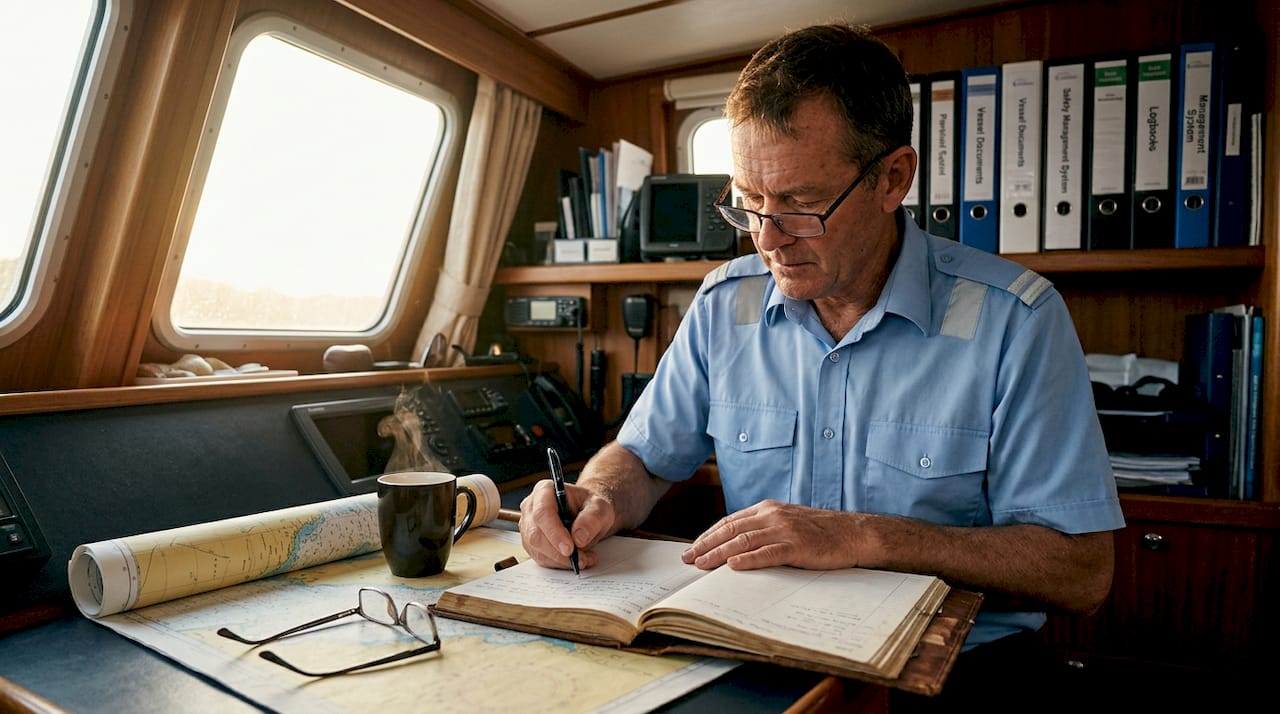
For U.S.-based luxury yacht owners, the Certificate of Documentation issued by the U.S. Coast Guard’s National Vessel Documentation Center (NVDC) is the cornerstone document. It is federal proof of vessel ownership and nationality, recognized internationally in a way that most state titles are not.
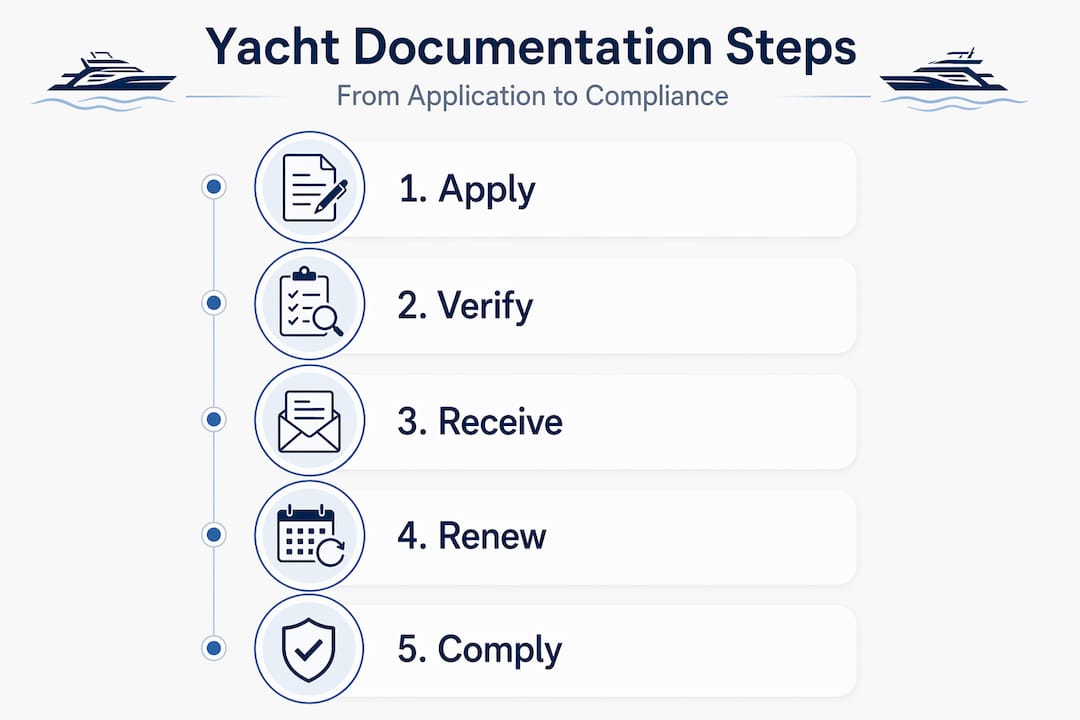
Here’s how to obtain and maintain yours:
- Verify eligibility: Your vessel must measure at least 5 net tons and be wholly owned by a U.S. citizen or a qualifying U.S. entity.
- Choose a vessel name and hailing port: Names must be unique among documented vessels. Your hailing port doesn’t have to be your home marina.
- Gather ownership proof: Bill of sale, builder’s certificate, or other chain-of-title documents tracing back to original manufacture.
- Submit application electronically: Since October 2025, all filings go through the NVDC eStorefront. Paper applications are no longer accepted.
- Receive and verify your COD: Once issued, confirm the document’s issuance date, expiration, and vessel data match your records exactly.
One of the biggest practical benefits of USCG documentation that owners overlook is preferred ship mortgage eligibility. If you finance your yacht, lenders almost universally require USCG documentation because it allows them to record a preferred ship mortgage with federal standing, giving the lender stronger legal protection than a state title would provide.
| Documentation type | Fee | Validity |
|---|---|---|
| Initial documentation | $26 | 1 year |
| Annual renewal | $26 | 1 year |
| 2-year renewal (recreational) | $52 | 2 years |
| 3-year renewal (recreational) | $78 | 3 years |
| 5-year renewal (recreational) | $130 | 5 years |
Per the USCG documentation guide, documentation also verifies ownership and nationality while enabling benefits like preferred ship mortgages, making it far more valuable than its modest fee suggests.
Pro Tip: Multi-year renewals reduce the risk of a lapse caused by a forgotten renewal date. For owners with active travel schedules, a five-year renewal is worth every cent of the $130 fee.
The importance of understanding yacht documentation basics before you finance, charter, or travel internationally cannot be overstated. It affects nearly every major ownership decision.
Verifying and maintaining your vessel’s documentation status
Owning a valid-looking Certificate of Documentation is not the same as having a currently valid one. This distinction catches owners off guard, especially during yacht purchases and charter transactions.
Certificates can become invalid due to legal events such as ownership transfers, liens, or operational changes that occur before the NVDC updates its records. The physical certificate on board may look fine. The official record may tell a different story. Always verify COD status verification through the NVDC eStorefront or the PSIX database before completing any transaction.
Key practices every owner should build into their annual routine:
- Check issuance and expiration dates electronically, not just on the paper certificate
- Verify endorsements: Confirm whether your COD is endorsed for coastwise trade, fisheries, or recreation, since using a vessel outside its endorsement is a compliance violation
- Monitor for involuntary liens or abstract of title changes, which can affect COD validity without your knowledge
- Renew before the 30-day grace window closes: Lapsing beyond 30 days can trigger a deletion from documented status, requiring reinstatement through a more involved process
- After any ownership event (sale, estate transfer, corporate restructuring), verify that NVDC records have been updated before the vessel moves
Pro Tip: Set a calendar reminder 90 days before your COD expires. This gives you time to resolve any issues, including ownership record discrepancies, without rushing into the 30-day window where options narrow quickly.
Due diligence for yacht transactions should always include a live status check, not just a review of documents the seller hands you. We’ve seen transactions stall because a seemingly clean COD had a recorded lien the buyer didn’t discover until closing.
Navigating international yacht documentation complexities
U.S. documentation handles your home waters well. The moment you cross into foreign jurisdiction, the requirements multiply. Every country you visit can and often does apply its own documentation rules on top of your flag state requirements.
Spain offers one of the most instructive recent examples of how fast these rules can shift. Spain replaced its charter licence with a self-declaration system, requiring an affidavit completed by the captain rather than a formal government-issued licence. The change simplified the process on paper but created a compliance gap for owners who didn’t update their procedures promptly.
Here’s how the old and new Spanish charter documentation processes compare:
| Aspect | Old system (charter licence) | New system (captain’s affidavit) |
|---|---|---|
| Authorization type | Government-issued licence | Self-declaration by captain |
| Processing time | Weeks to months | Immediate upon declaration |
| Renewal process | Formal application | Updated declaration when details change |
| Documentation burden | High, formal bureaucratic | Lower, but owner-responsibility shifts higher |
| Risk of non-compliance | Bureaucratic delay | Captain liability increases |
The practical steps for keeping international documentation current:
- Before each international voyage, research the specific entry and chartering documentation requirements for each destination country.
- Assign a flag state agent or local compliance contact in your key cruising regions. They track regulatory changes you may not hear about.
- Update your cruising permit and charter declarations promptly when captain, ownership, or operational details change.
- Keep digital copies of all documents accessible on board and at your home office.
- Consult your yacht charter documentation obligations specifically if you plan to charter your vessel in foreign waters, since charter compliance often involves additional layers.
The Spain example is instructive because it shows that simplification does not mean less vigilance. When the compliance burden shifts to the owner or captain, the margin for error actually increases.
Avoiding detention and costly delays through proactive documentation management
Here’s a number worth sitting with: 82% of vessel detentions relate to documentation deficiencies rather than equipment failures. That means the overwhelming majority of port state detentions are preventable through organized, current paperwork.
A single detention can cost $150,000 or more when you factor in port fees, crew costs, passenger compensation, legal fees, and the operational losses from a yacht sitting idle. For a vessel on an active charter program, the reputational and financial damage compounds quickly.
Documentation deficiencies are not a sign of a poorly maintained yacht. They are a sign of a poorly managed compliance system. Port state control officers look at your paperwork first, and they look hard.
The most effective approach we’ve seen among high-performing owners:
- Maintain a master documentation log with every document, its issue date, expiration date, and the responsible party for renewal
- Conduct a pre-inspection audit at least twice per year, independent of any scheduled port call
- Use digital compliance management tools to track certificate expiry dates and auto-flag renewals 60 to 90 days in advance
- Verify crew certification documents alongside vessel documents, since crew deficiencies account for a significant share of detentions
- Keep physical and digital copies organized and immediately accessible to the captain and the owner’s representative
Managing yacht compliance at this level doesn’t require a large team. It requires a clear system and the discipline to follow it.
Why yacht documentation is a living system, not just paperwork
Here’s what most marine documentation guides won’t tell you: the biggest threat to your documentation compliance isn’t ignorance of the rules. It’s the false confidence that comes from having done it right once.
We call this status drift. Your COD looks valid. The expiration date is months away. But somewhere between your last renewal and today, a corporate restructuring, a change in registered agent, or an unrecorded lien quietly changed your official status. Certificates appear valid while official records differ, which is why verifying current issuance, expiration, and status indicators through live electronic sources isn’t optional. It’s the only reliable method.
The shift to the USCG eStorefront is a perfect example of how quickly legacy workflows become compliance risks. Owners who relied on paper filings or PDF submissions for years suddenly faced an entirely new process. Those who adapted quickly maintained clean records. Those who held on to old habits experienced lapses and delays that cost far more than the minor inconvenience of learning a new system.
In our experience working with owners across the full spectrum of luxury yachts, the ones who treat documentation as a dynamic compliance system rather than a file folder they open once a year operate with dramatically more freedom. They cruise where they want, when they want, without scrambling to fix paperwork before a scheduled departure. They manage their charters confidently because their compliance records are current. And when it’s time to sell, their ongoing yacht documentation management history becomes a genuine selling asset.
Documentation is not the glamorous side of yacht ownership. But it is one of the highest-leverage areas you can invest attention in.
Simplify your yacht ownership with expert documentation and compliance support
Understanding the full scope of yacht documentation is one thing. Staying on top of it across renewals, international jurisdictions, ownership changes, and evolving digital filing requirements is another thing entirely. That’s where having the right team beside you makes all the difference.

At Yachting Experts, we hold your hand through every stage of yacht ownership, including the parts that don’t happen on the water. From professional documentation setup at the time of purchase to full yacht compliance management that keeps your vessel inspection-ready year-round, our team brings the same attention to detail to your paperwork that you bring to your time on the water. If you’re planning to charter your vessel internationally, our yacht chartering guidance ensures your documentation meets every jurisdiction’s requirements before you arrive. Your investment deserves that level of care.
Frequently asked questions about yacht documentation
What is the difference between yacht documentation and state registration?
Yacht documentation is a federal record of ownership and nationality under the U.S. Coast Guard, while state registration covers state legal requirements and tax compliance. Documentation establishes federal ownership and nationality while state registration serves state legal and tax purposes, and some vessels are required to maintain both.
How often must I renew my USCG Certificate of Documentation?
Standard renewal is annual at $26 per year, but recreational vessel owners can choose multi-year options. USCG multi-year renewals range from $52 for two years up to $130 for five years, making longer terms a practical choice for reducing lapse risk.
Can documentation requirements change when chartering in different countries?
Yes, and they can change faster than most owners expect. Spain’s documentation system shifted from a formal charter licence to a captain’s affidavit process, illustrating how quickly compliance obligations can change in a single jurisdiction.
Why is electronic submission important for vessel documentation renewal?
The USCG transitioned to an all-electronic filing system via the NVDC eStorefront, and paper renewals are no longer accepted as of late 2025. Submitting electronically ensures timely processing and eliminates the risk of postal delays causing an unintentional lapse.
What risks do yacht owners face if documentation lapses?
Lapsed documentation removes your vessel’s legal nationality status under the U.S. flag, which can result in denied port entry, insurance coverage gaps, and detention. Expired documentation also eliminates your ability to engage in coastwise trade or maintain a preferred ship mortgage, creating serious financial and operational consequences.
Recommended
Request A Call
Featured Listings

2027 Canados
100
Miami Florida

2015 Maiora
$3,750,000
90
Miami Florida

2027 Canados
57
Miami Florida

2019 Silent-Yachts Fair Dinkum
$1,599,000
55
Fort Lauderdale Florida

2026 Canados
49
Miami Florida

2026 Buddy Davis
47
Miami Florida

2020 Grady-White No Name
$610,000
45
Hallandale Beach Florida

2020 Viking Huckleberry
$1,495,000
44
Fort Lauderdale Florida

2027 Canados
43
Miami Florida

2021 Intrepid Dream Faster
$730,000
40
Coral Gables Florida

2016 Edgewater
$299,000
37
Miami, Florida

2022 Avid
$56,900
23
Stuart Florida
Get your yacht value Estimate
"*" indicates required fields