

Yacht depreciation isn’t a simple straight-line loss you can predict from a chart. Most buyers and owners treat it as one concept when it’s actually two very different things working at the same time: market depreciation that affects your resale price, and tax depreciation that affects what you owe the IRS. Confusing the two, or ignoring either one, can cost you tens of thousands of dollars across the life of your ownership. This guide breaks both down clearly so you can make smarter decisions whether you’re buying your first yacht, managing one you already own, or preparing to sell.
Table of Contents
- What is yacht depreciation?
- How yacht market depreciation really works
- Yacht depreciation and U.S. tax rules: What every owner must know
- Common mistakes and smart strategies to minimize yacht depreciation
- The truth most yacht owners miss about depreciation
- Ready to take control of your yacht investment?
- Frequently asked questions
Key Takeaways
| Point | Details |
|---|---|
| Market vs. tax depreciation | Yacht depreciation means both loss of market value and potential tax deductions for eligible owners. |
| IRS rules matter | Only business or income-producing yachts qualify for depreciation deductions under strict IRS guidelines. |
| Recapture risk | Accelerated tax depreciation can trigger surprise taxes if you sell quickly, so plan accordingly. |
| Protect your value | Proper maintenance, smart timing, and feature choices can help minimize loss and maximize your yacht’s worth. |
What is yacht depreciation?
Before we look at strategies for managing depreciation, it’s crucial to define exactly what “depreciation” means in the yachting world. The word gets used loosely, and that looseness causes real financial pain.
There are two completely separate concepts hiding under the same word:
- Market depreciation is the decline in your yacht’s resale value over time due to age, wear, competition from newer models, and shifting buyer preferences.
- Tax or accounting depreciation is a deduction the IRS allows business owners to claim each year to reflect the “used-up” value of a business asset, calculated using specific IRS methods.
These two move independently. Your yacht could be holding its market value beautifully while your accountant is writing off thousands in tax depreciation. Or the opposite: your yacht loses significant resale value while you get zero tax benefit because it’s used purely for personal enjoyment.
Important: IRS depreciation rules treat depreciation as an accounting and tax deduction concept that is entirely distinct from resale value decline. If your yacht is used in a trade or business, deductions are computed using MACRS (Modified Accelerated Cost Recovery System) and potentially Section 179 or bonus depreciation, if eligible.
Understanding this split is the foundation for everything else. If you’re planning Florida yacht tax strategies or evaluating the full cost of ownership, you need both definitions firmly in place before you make any move.
How yacht market depreciation really works
Now that you understand the dual meanings of depreciation, let’s focus first on how market value actually drops after purchase.
New yachts take the biggest hit early. Most owners are surprised to learn that the first two to three years of ownership can account for the sharpest value loss, often in the range of 10 to 20 percent in year one alone, then tapering as the yacht ages. This front-loaded pattern is very similar to what happens with luxury automobiles, but the dollar amounts are far more significant given the asset size.
Here’s a general picture of how market depreciation tends to unfold for a well-maintained production yacht:
| Year of ownership | Approximate annual value loss |
|---|---|
| Year 1 | 10–20% |
| Year 2–3 | 7–12% |
| Year 4–6 | 5–8% |
| Year 7–10 | 3–6% |
| Year 10+ | 2–4% (stabilizes) |
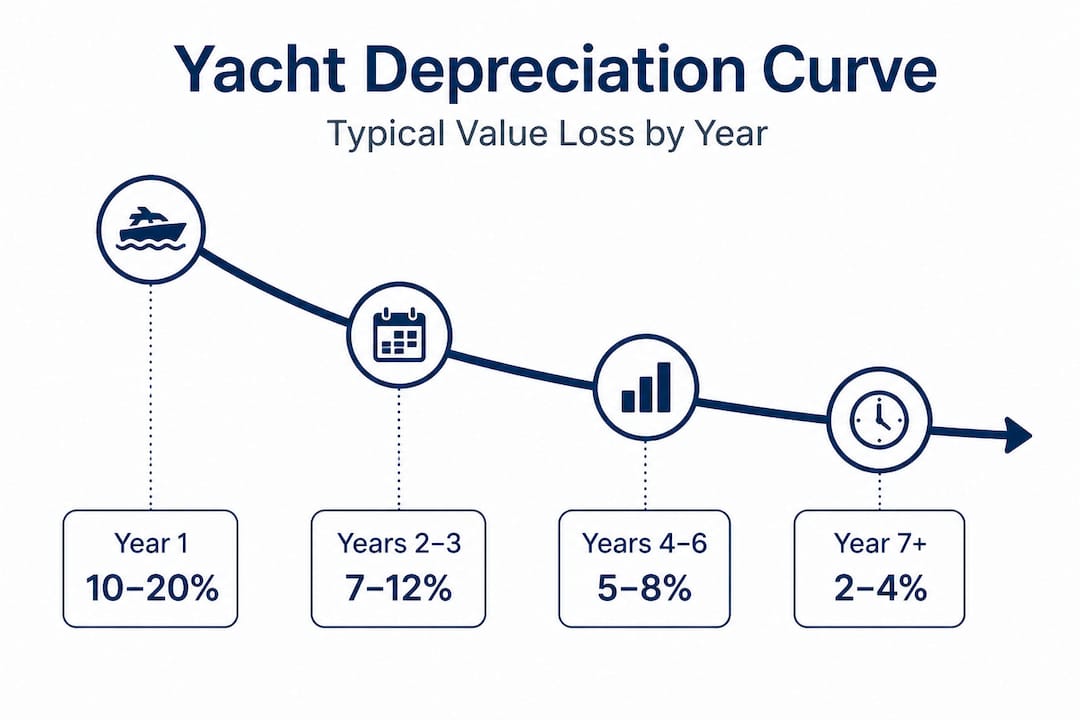
These are estimates. Actual figures depend on brand reputation, model demand, build quality, and market conditions at the time of sale. Premium European builders and certain American brands with strong reputations tend to hold value better than entry-level production yachts.
Several forces drive how fast or slow your yacht loses market value:
- Brand and build quality: Top-tier builders like Feadship, Lürssen, and Hatteras tend to retain value better because their build standards are recognized globally.
- Maintenance record: A documented, thorough service history is worth real money to buyers. Gaps in maintenance records signal risk and pull offers down.
- Popular onboard features: Modern electronics, updated engines, and desirable amenities like watermakers and stabilizers help attract buyers and justify stronger asking prices.
- Market timing: Economic downturns and major global events can cause sudden softening of resale prices across the yacht market, regardless of the individual vessel’s condition.
Understanding yacht investment returns means knowing that depreciation isn’t a fixed number you plug into a spreadsheet. It’s a moving target influenced by factors you can partially control.
Pro Tip: One of the most effective ways to slow market depreciation is to keep a detailed maintenance log from day one. Buyers pay a premium for confidence, and nothing builds confidence like a clean, organized service history that shows every engine service, hull inspection, and systems upgrade.
Strong pro yacht management practices, including regular surveys and proactive upkeep, can meaningfully reduce the speed at which your yacht loses market appeal. Think of it as protecting the asset, not just enjoying it.

Yacht depreciation and U.S. tax rules: What every owner must know
Beyond market value, depreciation unlocks important tax deductions. Let’s break down how this works and the risks to watch out for.
If your yacht is used in a legitimate trade or business, or as an income-producing asset such as a charter vessel, the IRS allows you to depreciate it. This means you can deduct a portion of the yacht’s cost from your taxable income each year. For a high-value asset, those annual deductions can be substantial.
Here’s how the process typically works:
- Establish qualified business use. The yacht must be used in a trade or business, not personal enjoyment. Charter income, marine research, or legitimate hospitality business use can qualify. Personal vacations do not.
- Calculate the depreciable basis. This is generally the purchase price plus any capitalized improvements, minus any prior deductions already claimed.
- Choose a depreciation method. Most business yachts fall under MACRS, which the IRS assigns to specific asset classes with defined recovery periods, typically 5 to 7 years depending on use classification.
- Apply Section 179 or bonus depreciation if eligible. These accelerated options let you front-load your deductions, writing off a large portion of the yacht’s cost in the first year rather than spreading it across several years.
- Track everything meticulously. Business use logs, charter contracts, and maintenance records all support your deduction claims if the IRS ever questions them.
Critical tax note: IRS Publication 946 confirms that yacht depreciation deductions for business use are computed using MACRS, and sometimes Section 179 or bonus depreciation where eligible. These are powerful tools, but they come with responsibility.
The biggest trap here is depreciation recapture. If you claim accelerated deductions through bonus depreciation or Section 179 and then sell the yacht, the IRS may treat the gain on sale as ordinary income rather than capital gains, up to the amount you previously deducted. According to tax guidance on boat depreciation, accelerated write-offs can create recapture on sale, a nuance that changes the economics even when market depreciation looks favorable.
This matters enormously for your exit strategy. If you plan to sell within five years, aggressive early deductions could create a tax bill that offsets the benefit you captured upfront. Work with a marine tax specialist before making this call, and make sure you’re also thinking about how to maximize Florida yacht ROI across the full ownership timeline.
The path to smart tax depreciation isn’t just about claiming deductions. It’s about building a yacht investment strategy that accounts for what happens when you eventually sell.
Common mistakes and smart strategies to minimize yacht depreciation
The process gets tricky. Let’s look at common pitfalls and ways you can confidently protect your investment.
Here’s a straightforward comparison of the mistakes we see most often versus the smarter approach:
| Common mistake | Smart strategy |
|---|---|
| Claiming tax depreciation without proper business use documentation | Keep detailed logs: dates, business purpose, miles/hours traveled |
| Taking maximum Section 179 deductions without planning for sale | Model the recapture tax before committing to accelerated deductions |
| Skipping routine maintenance to save money | Consistent upkeep protects market value and prevents costly breakdowns |
| Over-upgrading with personal preference items | Focus upgrades on features buyers actually want: electronics, stabilizers, engines |
| Selling at the worst point in the market cycle | Time your sale strategically based on demand, seasonality, and condition |
| Ignoring depreciation in the purchase price negotiation | Use depreciation curves to negotiate confidently on older or poorly maintained yachts |
Let’s dig a little deeper into a few of these:
- Documentation is everything. The IRS does not take your word for business use. Charter agreements, logbooks with business purpose noted, and invoices for business-related expenses all build the paper trail that supports your deductions. Without them, you’re exposed.
- Over-upgrading is a real risk. Installing custom features that reflect your personal taste rarely translates into added resale value. A professional-grade dive setup might matter to you but not to 90% of buyers. Focus your upgrade budget on items with broad market appeal.
- Timing your sale matters more than most owners realize. Seasonality affects yacht sales significantly in markets like Florida and the Northeast. Listing at peak demand periods and presenting the vessel in top condition gives you the best chance of achieving a strong price.
According to recapture guidance for boat owners, the economic picture can shift dramatically once recapture tax is factored in, so plan your deduction strategy alongside your exit timeline from the beginning.
Pro Tip: Before you list your yacht for sale, have it professionally surveyed and address any items a buyer’s surveyor would flag. Proactive condition disclosure and a clean survey report dramatically reduce buyer negotiation leverage and protect your asking price.
If you’re thinking about your next move, resources on how to minimize yacht investment risk and selling for best return give you the framework to act decisively rather than reactively.
The truth most yacht owners miss about depreciation
With all this in mind, here’s an experienced perspective on depreciation that challenges industry assumptions.
Most people in the market treat depreciation as the enemy. They see it as the inevitable cost of ownership, something to grimace at and accept. We see it differently, and the owners who build real value from their yachts see it differently too.
Depreciation is a planning tool. When you understand the depreciation curve deeply, you can use it to your advantage in at least three concrete ways.
First, you can time your purchase to let someone else absorb the steepest early losses. Buying a yacht that is three to five years old often means you’re acquiring a well-maintained asset at a significantly reduced price, while the prior owner absorbed the year-one and year-two losses. You step into a more favorable position on the curve immediately.
Second, if your yacht qualifies for business use, front-loading tax depreciation through bonus depreciation can generate real, immediate cash flow benefits from reduced tax liability. The key is pairing that strategy with a clear picture of when you plan to sell and what the recapture impact will be at that point. This is not a set-it-and-forget-it decision.
Third, and most underappreciated: understanding buyer psychology around depreciation helps you sell smarter. Buyers expect a deal on older yachts because they assume significant wear and value loss. A yacht that defies those expectations, with excellent documentation, fresh systems, and a strong survey result, commands a premium because it surprises buyers in the best possible way. You are essentially decoupling your yacht from the depreciation narrative in buyers’ minds.
We’ve seen this dynamic play out consistently across markets, including unique yacht investment opportunities in different regions of the country. Owners who approach their yacht strategically, not just emotionally, consistently outperform those who treat it purely as a lifestyle expense.
Depreciation is not something that happens to you. It’s something you can shape with the right knowledge and the right team in your corner.
Ready to take control of your yacht investment?
Knowing the facts lets you act. Here’s how you can move forward confidently.
We work with yacht owners and buyers every day who want more than just a transaction. They want a partner who understands the full financial picture of yacht ownership, from purchase price negotiation to depreciation planning to selling strategy. That’s exactly what our team delivers.

Whether you’re ready to evaluate your yacht’s ROI potential before buying, or you’re thinking about when and how to sell for maximum return, we’re here with personalized guidance tailored to your specific situation. Our profitable yacht selling process is designed to protect your investment at every step, from valuation through closing. Reach out to our team today and let’s map out a strategy that puts you in the strongest position possible.
Frequently asked questions
Can I depreciate my yacht for tax purposes if I use it personally?
You cannot depreciate a yacht used strictly for personal enjoyment. According to IRS depreciation rules, only business or income-producing use qualifies for annual depreciation deductions.
What is MACRS and how does it apply to yacht ownership?
MACRS (Modified Accelerated Cost Recovery System) is the primary IRS method for calculating annual depreciation on business assets, including yachts. The IRS confirms MACRS applies when a yacht is used in a qualifying trade or business.
How does tax recapture impact yacht owners?
When you claim accelerated deductions and later sell, the IRS may require you to pay back a portion of those deductions as ordinary income. Per boat depreciation guidance, this recapture tax can significantly change the net economics of your sale.
Can upgrades or refits reduce yacht depreciation?
Only upgrades that genuinely boost broad buyer appeal, such as upgraded electronics, new engines, or in-demand safety features, can meaningfully offset market depreciation. Personal taste upgrades rarely add equivalent resale value.
What’s the typical annual depreciation rate on a new yacht?
Most new yachts lose 10 to 20 percent of their market value in the first year, then approximately 5 to 10 percent annually in subsequent years as the rate gradually slows with age and stabilization of the asset.
Recommended
Request A Call
Featured Listings

2027 Canados
100
Miami Florida

2015 Maiora
$3,750,000
90
Miami Florida

2027 Canados
57
Miami Florida

2019 Silent-Yachts Fair Dinkum
$1,599,000
55
Fort Lauderdale Florida

2026 Canados
49
Miami Florida

2026 Buddy Davis
47
Miami Florida
2020 Grady-White No Name
$610,000
45
Hallandale Beach Florida
2020 Viking Huckleberry
$1,495,000
44
Fort Lauderdale Florida

2027 Canados
43
Miami Florida

2021 Intrepid Dream Faster
$730,000
40
Coral Gables Florida

2016 Edgewater
$299,000
37
Miami, Florida

2022 Avid
$56,900
23
Stuart Florida
Get your yacht value Estimate
"*" indicates required fields