

Marine financing is a secured lending process where the vessel itself serves as collateral, allowing buyers to purchase a boat through structured loans backed by instruments like a preferred ship mortgage or a standard installment boat loan. Think of it as a home mortgage, but for the water. The loan amount, term, and interest rate all hinge on the vessel’s appraised value, your credit profile, and the lender’s specific marine risk criteria. Understanding marine financing before you shop puts you in control of one of the most exciting purchases you will ever make.
What are the common types of marine financing options?
Marine finance options fall into four main categories, and choosing the right one depends on the vessel type, your ownership goals, and how long you plan to hold the asset.
Preferred ship mortgage is the most formal structure. Filed with the U.S. Coast Guard, it creates a federally recognized lien on documented vessels and gives lenders strong priority over most competing claims. This structure suits larger yachts and commercial vessels where the stakes are high and documentation matters.
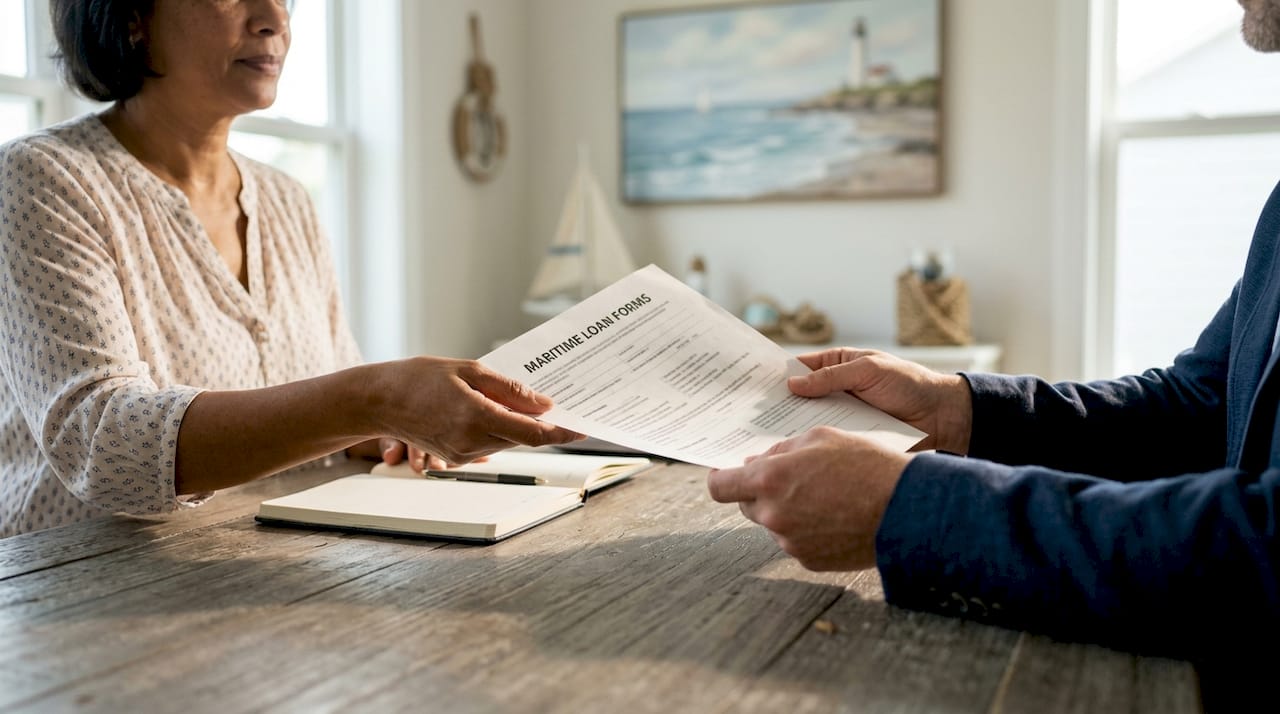
Consumer boat loans work like auto loans. The lender holds a lien on the vessel, you make fixed monthly installments, and the loan-to-value can reach up to 90% for well-qualified borrowers. These are the most common structure for recreational buyers purchasing vessels under $500,000.
Leasing and sale-leaseback arrangements offer an alternative for buyers who want lower monthly obligations or prefer not to carry the vessel on their balance sheet. Ownership implications differ significantly here. You do not hold title during the lease period, which affects how you insure, register, and eventually sell the boat.
Draw-based newbuild financing mirrors real estate construction lending. Staged construction draws are verified by marine surveyors at milestones including steel cutting, hull completion, sea trials, and delivery. The loan converts to term debt upon delivery.
| Loan type | Best for | Typical LTV | Key feature |
|---|---|---|---|
| Preferred ship mortgage | Documented vessels, large yachts | 60%–80% | Federal lien priority via U.S. Coast Guard |
| Consumer boat loan | Recreational buyers | Up to 90% | Fixed monthly payments, lender lien |
| Leasing / sale-leaseback | Cash-flow-focused buyers | Up to 90% | No ownership during lease term |
| Newbuild draw financing | Custom builds | 60%–80% | Milestone-based draws, survey-verified |
Pro Tip: If you are buying a yacht over 26 feet and plan to document it federally, ask your lender specifically about preferred ship mortgage structures. The lien priority protection is worth the extra paperwork.
What lender requirements and approval processes should buyers expect?
Lenders evaluate marine loan applications using criteria similar to auto lending, but with vessel-specific layers that can catch first-time buyers off guard. Here is what you need to prepare.
-
Credit and income review. Credit score, income, and debt-to-income ratios are the primary approval filters. A hard credit pull happens at application, so avoid opening new credit lines in the 90 days before you apply.
-
Down payment. Down payments typically range from 10% to 30% of the purchase price. A larger down payment lowers your loan-to-value ratio and directly improves your rate and terms. For luxury yacht purchases, Yachtingexperts has a detailed down payment strategy guide that walks through the 30% to 50% range for high-value vessels.
-
Marine survey. Lenders depend heavily on marine surveys to assess pre-owned vessel condition and establish loan value. A survey that reveals deferred maintenance can reduce the appraised value and shrink your approved loan amount. Commission your survey early.
-
Insurance requirements. Hull and Protection & Indemnity (P&I) insurance must name the lender as loss payee. A lapse in coverage constitutes a loan default. Hull insurance covers physical damage; P&I covers liability. Both are non-negotiable.
-
Vessel documentation. U.S. Coast Guard federal vessel documentation is required for preferred ship mortgages and affects how the lender perfects its lien. State title registration applies to smaller, undocumented vessels.
Pro Tip: Get your marine survey and insurance binder in hand before submitting your loan application. Lenders who see complete documentation at submission move significantly faster to approval.
How do marine loan terms and rates compare to other financing?
Marine loan terms occupy a middle ground between auto loans and home mortgages, and understanding where they sit helps you plan your monthly budget accurately.
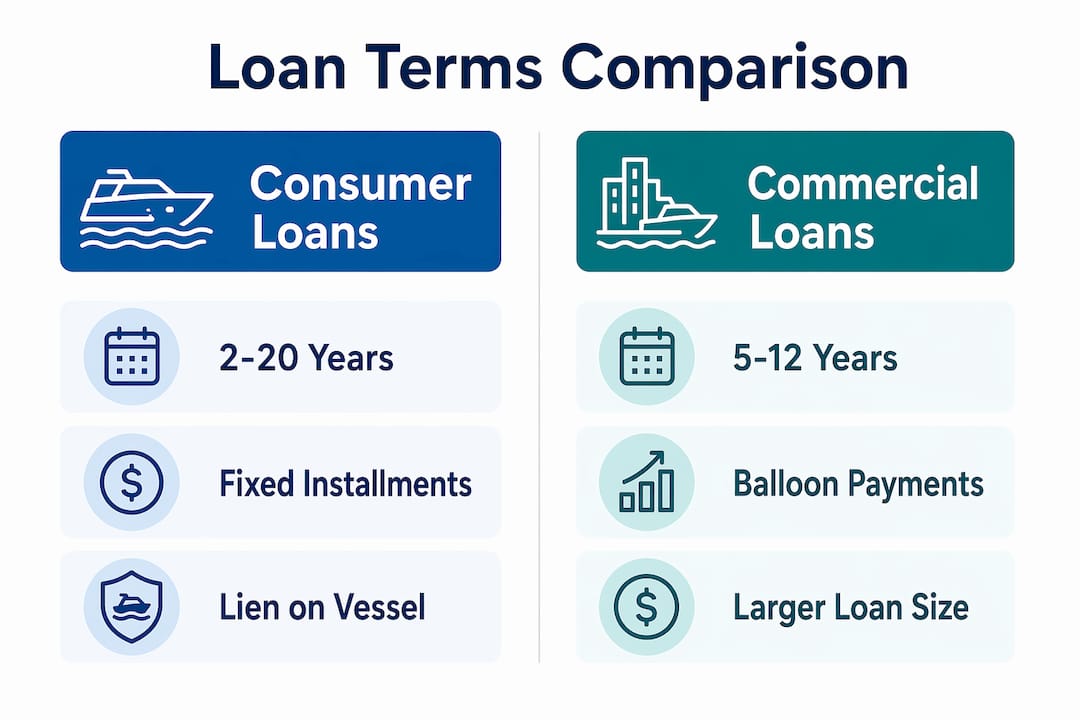
Consumer boat loan terms run from 2 to 20 years. Shorter terms mean higher monthly payments but less total interest paid over the life of the loan. Longer terms reduce monthly obligations but extend your exposure to rate risk and depreciation. Most recreational buyers land in the 10 to 15 year range for mid-size vessels.
Commercial and shipping loans follow a different pattern. Typical shipping loans last 5 to 12 years and often include balloon payments at maturity, meaning you pay a lump sum at the end rather than fully amortizing the loan. For buyers of larger yachts or commercial vessels, this structure requires careful cash-flow planning.
Interest rates on marine loans are generally higher than home mortgage rates but lower than unsecured personal loans. The spread reflects the collateral’s mobility risk. A boat can leave a jurisdiction; a house cannot. Your credit score, loan-to-value ratio, vessel age, and lender type all influence your final rate.
| Loan type | Typical term | LTV range | Rate benchmark |
|---|---|---|---|
| Consumer boat loan | 2–20 years | Up to 90% | Higher than mortgage, lower than personal loan |
| Preferred ship mortgage | 5–15 years | 60%–80% | Competitive, tied to SOFR or prime |
| Export credit / government-backed | Up to 15 years | 60%–80% | Below-market, restricted eligibility |
| Newbuild draw loan | Construction + term | 60%–80% | Variable during draw, fixed at delivery |
Down payment size is the single most controllable variable in your rate negotiation. Buyers who bring 20% or more to the table consistently receive better pricing than those at the 10% minimum.
What legal and maritime lien priorities affect marine financing?
This is where marine financing diverges most sharply from auto or real estate lending, and it is the section most buyers skip. Do not skip it.
Preferred ship mortgages filed with the U.S. Coast Guard create a lien that outranks nearly all other claims. The key word is “nearly.” Certain statutory maritime liens sit above even a perfected preferred mortgage. These include:
- Crew wages and repatriation costs
- Salvage claims
- Stevedore wages and port charges
This hierarchy matters because a lender financing your yacht could theoretically find its security interest subordinated to a crew wage claim if the vessel has unpaid crew. For buyers purchasing a used vessel with any commercial history, a lien search is not optional.
Filing and documentation perfection are critical. The timing of filing determines priority against competing claims. A mortgage filed one day after a competing lien loses priority. Lenders know this. You should too.
Default consequences under federal admiralty law are swift. A lender can seek vessel arrest and judicial sale through federal court. The vessel is physically seized and auctioned, often at a significant discount to market value.
Critical: A vessel with an uncleared mortgage cannot be transferred or re-documented until the discharge is recorded with the U.S. Coast Guard. Failure to clear a mortgage can result in fines reaching $10,000. Always confirm mortgage discharge before completing any vessel purchase.
How can you practically navigate the marine financing process?
The difference between a smooth closing and a stressful one almost always comes down to preparation. Here is the sequence that works.
-
Set your budget and get pre-approved. Know your debt-to-income ratio before you fall in love with a specific vessel. Pre-approval gives you a real number to shop with and signals to sellers that you are a serious buyer.
-
Gather documentation early. Collect your vessel’s USCG documentation or state title, existing insurance certificates, and any prior survey reports. Updated documents submitted late in the process can trigger repricing or delays at closing.
-
Commission your marine survey. Schedule this before you finalize your offer. Survey findings can shift the purchase price negotiation in your favor and prevent surprises that derail financing.
-
Compare marine-specific lenders. Nonbank direct lenders have grown significantly in marine financing, offering faster approvals and more flexible structures than traditional banks. Credit unions with marine lending programs are also worth comparing. For Florida-based buyers, Yachtingexperts covers yacht financing strategies specific to the state’s market.
-
Lock your rate and close cleanly. Once approved, avoid any financial changes. New credit inquiries, large purchases, or employment changes between approval and closing can void your commitment letter.
Pro Tip: Marine lenders move faster when your file is complete on day one. Think of your loan application like a vessel inspection: every missing document is a deficiency that slows the process.
Key takeaways
Marine financing works best when buyers treat it as a structured process, not an afterthought, combining credit preparation, early documentation, and lender comparison to secure the best terms available.
| Point | Details |
|---|---|
| Vessel as collateral | Marine loans are secured by the boat itself, with lien priority determined by filing type and timing. |
| Down payment range | Expect 10%–30% down; larger down payments directly improve your rate and loan-to-value terms. |
| Survey is non-negotiable | Marine surveys determine loan value for both new builds and pre-owned vessels; commission one early. |
| Lien hierarchy matters | Crew wages and salvage claims outrank preferred ship mortgages; always conduct a lien search on used vessels. |
| Preparation speeds closing | Complete documentation at application submission reduces delays and prevents costly repricing. |
What I have learned after years in the yacht market
I have watched buyers lose their dream vessel because they waited until the purchase agreement was signed to start their financing conversation. By then, the survey revealed issues, the lender needed more documentation, and the seller moved on. Marine financing rewards preparation the same way a well-maintained vessel rewards its owner.
The rise of nonbank lenders has genuinely changed the game for buyers. Institutions that specialize in marine lending understand vessel depreciation curves, seasonal market fluctuations, and the nuances of USCG documentation in ways that a general bank branch simply does not. If your local bank quotes you a rate, get a second quote from a marine-specific lender before you accept.
One thing I tell every buyer: choose your loan term with your exit strategy in mind. A 20-year term on a vessel you plan to sell in five years means you will be paying mostly interest when you sell, and your payoff balance may exceed the vessel’s market value. Run the amortization numbers for your realistic ownership horizon, not the maximum term the lender offers.
The lien priority rules are the part of marine financing that surprises people most. I have seen transactions stall because a prior owner’s mortgage was never discharged from the USCG documentation. That is a fixable problem, but it costs time and money. A title search and lien clearance check should be standard practice on every pre-owned vessel purchase, full stop.
— Jason
Ready to finance your next yacht with expert guidance?
Stepping aboard your first yacht or trading up to something extraordinary is a milestone worth doing right. At Yachtingexperts, we hold your hand through every step of the financing process, from pre-approval strategy to closing day, so you can focus on the excitement of ownership rather than the paperwork.

Whether you are exploring marine financing options for the first time or looking to optimize the terms on a luxury yacht purchase, our team brings the market insight and lender relationships to get you the best possible outcome. We work with buyers across Florida and beyond, and our personalized approach means your financing plan fits your specific vessel, budget, and timeline. Connect with us today and let’s get your financing in order.
FAQ
What is marine financing?
Marine financing is a secured loan where the vessel serves as collateral, structured similarly to a home mortgage but governed by maritime-specific rules including preferred ship mortgages filed with the U.S. Coast Guard.
How much down payment do you need to finance a boat?
Down payments typically range from 10% to 30% of the purchase price, with well-qualified borrowers accessing loan-to-value ratios up to 90% depending on the lender and vessel type.
What credit score do you need for a boat loan?
Lenders evaluate credit score, income, and debt-to-income ratio as primary approval factors. While minimum thresholds vary by lender, stronger credit profiles consistently receive better rates and terms.
Why do marine loans require a survey?
Marine surveys establish the vessel’s condition and market value, which directly determines the loan amount a lender will approve. For newbuild vessels, surveyors also verify construction milestones before each draw is released.
What happens if you default on a marine loan?
Under federal admiralty law, a lender can seek vessel arrest and judicial sale through federal court. The vessel is physically seized and sold, often below market value, to recover the outstanding loan balance.
Recommended
Request A Call
Featured Listings

2027 Canados
100
Miami Florida

2015 Maiora
$3,750,000
90
Miami Florida

2027 Canados
57
Miami Florida

2019 Silent-Yachts Fair Dinkum
$1,599,000
55
Fort Lauderdale Florida

2026 Canados
49
Miami Florida

2026 Buddy Davis
47
Miami Florida

2020 Grady-White No Name
$610,000
45
Hallandale Beach Florida

2020 Viking Huckleberry
$1,495,000
44
Fort Lauderdale Florida

2027 Canados
43
Miami Florida

2021 Intrepid Dream Faster
$730,000
40
Coral Gables Florida

2016 Edgewater
$299,000
37
Miami, Florida

2022 Avid
$56,900
23
Stuart Florida
Get your yacht value Estimate
"*" indicates required fields