

Not every large, beautiful yacht is ready to cross the Atlantic. That surprises a lot of buyers who come to us with serious ocean-crossing ambitions but have been shown vessels built for coastal cruising dressed up in bluewater marketing language. The term “bluewater yacht” gets used loosely in listings, at boat shows, and in sales conversations, and that creates real risk for buyers making significant investments. The concept is primarily mission-based, centered on ocean passage-making and extended time offshore, not simply a yacht’s length or price tag. This guide gives you the clarity to shop smarter.
Table of Contents
- Defining a bluewater yacht: Mission and misconceptions
- Core design features that set a bluewater yacht apart
- Monohulls vs. catamarans: Bluewater capability by hull type
- Evaluating true bluewater readiness: Beyond marketing labels
- The uncomfortable truth most buyers miss about bluewater yachts
- Navigate your bluewater journey with expert guidance
- Frequently asked questions
Key Takeaways
| Point | Details |
|---|---|
| Mission-driven definition | A bluewater yacht is defined by its offshore capability, not its size or label. |
| Key design features | Critical aspects include hull strength, stability, redundancy, and serious passage-making support. |
| Hull-type differences matter | Monohulls and catamarans meet bluewater standards differently—buyers must know what to look for in each. |
| Marketing vs. reality | Rely on in-depth evaluation and history, not just claims, to confirm bluewater readiness. |
| Expert guidance pays off | Professional support helps avoid critical mistakes when investing in a bluewater yacht. |
Defining a bluewater yacht: Mission and misconceptions
The word “bluewater” sounds straightforward, but it carries far more nuance than most buyers expect. When you understand the real definition, your entire approach to evaluating yachts changes.
A bluewater yacht is specifically designed and equipped to make extended ocean passages, often weeks at a time, far from marinas, repair facilities, and outside assistance. That mission shapes every design decision, from hull geometry and ballast ratio to the redundancy built into onboard systems. A yacht that looks stunning in a marina brochure may not have the structural weight, tankage, or storm-handling capability to be genuinely safe 600 miles offshore in 30-knot winds.
Here is where the misconceptions stack up. Size alone does not equal offshore readiness. Many beautiful 70-foot motor yachts are built for Mediterranean coastal runs or Caribbean day charters, with glamorous interiors but lightweight hulls and minimal fuel range. Similarly, a sleek, modern racing-influenced sailboat may deliver thrilling performance but lack the deep keel stability and conservative sail plan a true bluewater passage requires. As you work through our yacht buyer’s guide, you will see that mission alignment is the first filter we apply.
There is no universally agreed-upon size cutoff for what makes a bluewater yacht; the designation is earned through capability, not category. Common misconceptions worth addressing directly:
- “Any yacht over 50 feet is bluewater-ready.” False. Size matters far less than design intent and build standard.
- “Luxury finishes signal offshore quality.” False. Interior quality and offshore structural integrity are separate engineering decisions.
- “A yacht certified for offshore racing is automatically bluewater-capable.” Partially true, but racing designs prioritize speed in ways that can compromise long-term comfort and durability on extended passages.
- “New always means better for offshore.” Not necessarily. Older, heavier displacement designs built to traditional bluewater standards often outperform newer, lighter yachts in sustained heavy weather.
“Bluewater is not a trophy designation. It is a functional description of whether a vessel can safely sustain human life far from help for extended periods.”
Our buying workflow integrates this mission-based thinking from the very first conversation we have with you. Before we discuss luxury yacht amenities or brand preferences, we want to understand exactly where you plan to sail and for how long. That conversation changes everything.
Core design features that set a bluewater yacht apart
With mission and misconceptions covered, let’s examine what makes a yacht structurally and functionally bluewater-capable. The differences show up in specific, measurable design choices.
Bluewater design guidance consistently emphasizes stability, load-carrying capacity, and hull, keel, and rudder geometry, and modern performance-focused designs often introduce real tradeoffs in offshore durability. Here is what to look for:
- Displacement-to-length ratio (D/L). Heavier displacement hulls absorb wave energy more predictably. A D/L ratio above 200 generally signals a yacht built for seakeeping rather than speed. Lighter, modern designs with ratios below 150 can be fast but may slam harder and fatigue crew in sustained rough conditions.
- Ballast ratio. A higher ballast-to-displacement ratio (typically 35% to 45% for bluewater monohulls) provides the righting moment to recover from severe knockdowns. This is life-safety engineering, not a preference.
- Keel type and attachment. Full-keel and fin-keel designs behave very differently offshore. Full-keel boats track steadily and are more forgiving in a following sea. Fin keels deliver better pointing performance but require more active steering. The attachment structure matters enormously: keel bolt failures at sea are catastrophic.
- Rudder protection. A skeg-hung rudder is physically protected from debris strikes. Spade rudders, while common on performance boats, are vulnerable in ocean conditions where flotsam, fishing lines, and kelp become genuine hazards.
- Tankage capacity. True bluewater passages require serious fuel and water reserves. We look for water tankage supporting at least 20 to 30 days of onboard use plus watermaker backup, and fuel capacity sufficient for motoring in calms without reaching critical reserves.
| Feature | Bluewater-focused design | Performance/coastal design |
|---|---|---|
| Hull weight | Heavy displacement | Light to ultralight |
| Keel type | Full or protected fin | Spade or racing fin |
| Rudder design | Skeg-hung or full | Spade rudder |
| Tankage | High capacity, redundant | Moderate, optimized for range |
| Sail plan | Conservative, balanced | Aggressive, high-aspect |
| Build standard | Heavy layup, reinforced | Thin laminate, weight-saving |
Pro Tip: Do not equate sleek, modern styling with offshore readiness. Some of the most capable bluewater yachts look almost plain compared to performance designs, because their engineering priorities are different. When you are evaluating a yacht for performance vs. safety features, ask specifically which tradeoffs the designer made and why.
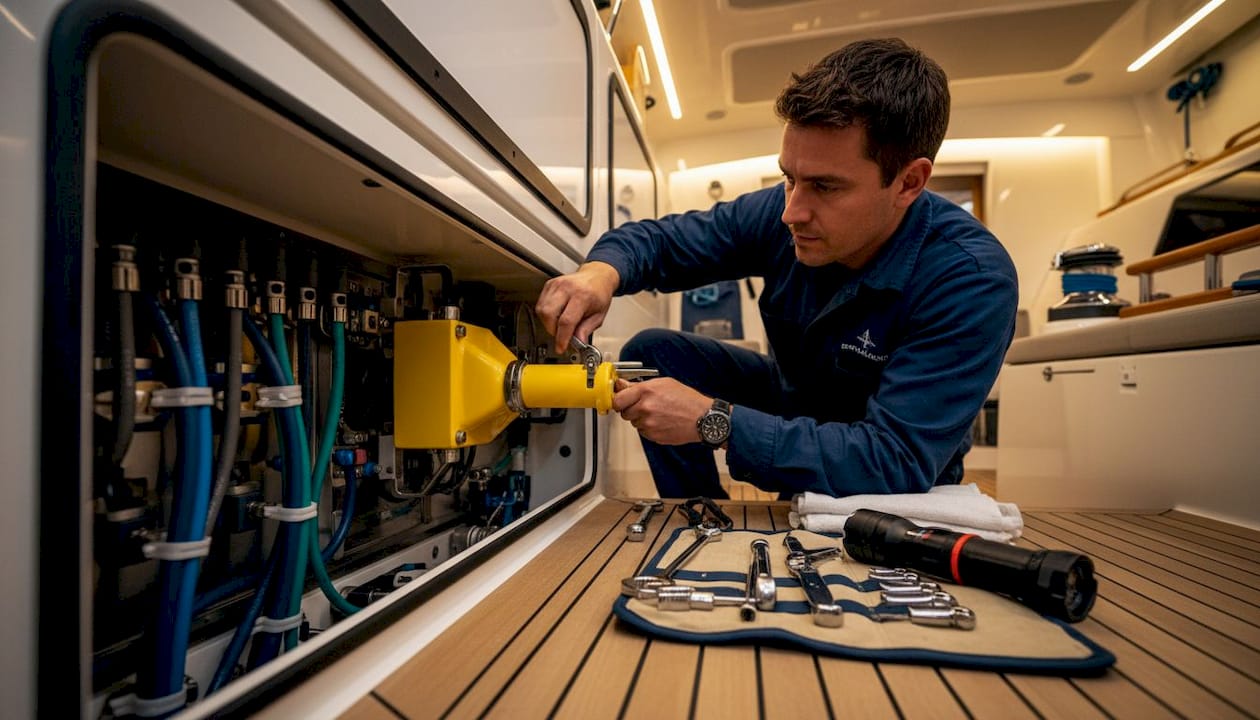
System redundancy is another non-negotiable. A bluewater yacht should have backup steering capability, at minimum a second anchor windlass circuit, redundant bilge pumps, an independent autopilot power source, and ideally a watermaker. These are not luxury upgrades. They are the systems that keep you safe when the primary system fails three days from land.
Monohulls vs. catamarans: Bluewater capability by hull type
Having explored general design elements, let’s compare how different hull types meet bluewater demands, especially monohulls versus catamarans. This is one of the most common questions we field from serious buyers.
Both hull types can be genuinely bluewater-capable, but their stability characteristics, motion, and system arrangements differ significantly, and what “bluewater capable” looks like in practice is different for each. The key is whether the vessel remains predictable and supportable under real offshore conditions and loads.
Monohulls have a self-righting advantage. When a monohull is knocked down, ballast and hull shape work together to bring it back. They also tend to have a more comfortable motion in a beam sea for many experienced sailors, and their single-hull structure simplifies haulout, inspection, and bottom work globally. Their disadvantage is that they heel significantly under sail, which affects comfort and crew fatigue on long passages.
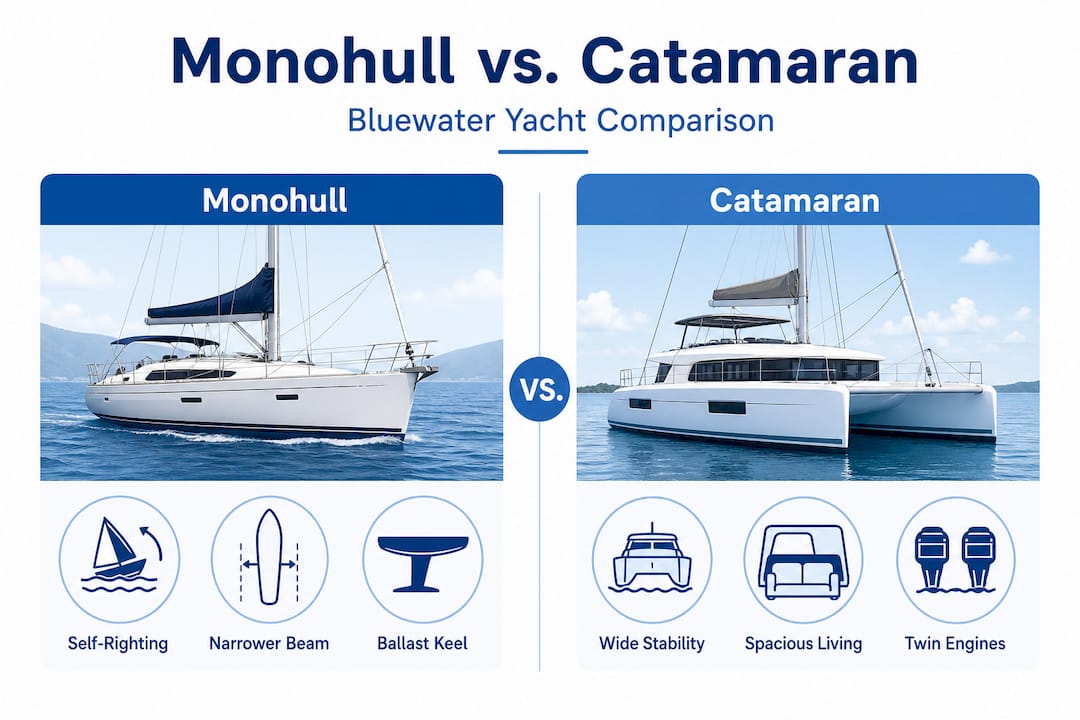
Catamarans offer exceptional initial stability and far more living space for the same waterline length. Their motion in light to moderate conditions is often gentler. However, they do not self-right if inverted. They require wider berths and have deeper draft considerations in some configurations. Their dual-engine redundancy is a genuine offshore advantage, but both systems need to meet bluewater maintenance standards individually.
| Criteria | Monohull | Catamaran |
|---|---|---|
| Self-righting | Yes | No |
| Heel underway | Significant | Minimal |
| Living space | Moderate | Very generous |
| Shallow water access | Limited (deep keel) | Better |
| Engine redundancy | Single engine typical | Dual engine standard |
| Marina availability | Universal | Limited in some regions |
| Passage-making motion | Comfortable in following seas | Excellent in moderate conditions |
When evaluating either type at a yacht show, the questions you ask matter enormously. Our yacht show buying insights outline exactly how to direct conversations with brokers to surface real offshore capability data rather than glossy talking points.
- For monohulls: Ask for the D/L ratio, ballast ratio, keel bolt inspection records, and storm trysail specifications.
- For catamarans: Ask for beam-to-length ratio, bridge deck clearance height (critical in ocean swells), and individual engine hour records.
- For both: Request documentation on offshore passages the specific vessel has completed.
Evaluating true bluewater readiness: Beyond marketing labels
Seeing how different hulls approach the bluewater challenge, the next step is learning how to cut through marketing to confirm true offshore readiness. This is where your investment protection lives.
The practical approach is to evaluate whether construction, seakeeping, tankage, and system redundancies actually support your planned offshore scenarios, rather than relying on marketing labels or category designations alone. A yacht listed as “bluewater ready” by a broker is not automatically so.
Here is a structured approach we use with clients:
- Define your actual route scenarios first. Are you crossing oceans or making long coastal passages? A Pacific circuit has different demands than a Caribbean circuit. Knowing your real mission lets you set objective standards.
- Commission an offshore-specific survey. A standard pre-purchase survey checks condition. An offshore survey evaluates bluewater suitability. These are different, and you want both. The surveyor should physically inspect keel attachment, through-hull fittings, standing rigging, and structural reinforcements at high-stress points.
- Verify tankage against your route. Calculate actual fuel and water consumption at passage speeds over your longest planned leg, then verify the tanks support that leg with a 20% safety buffer.
- Ask for passage-making history. Any genuinely bluewater-proven yacht has a logbook or documented history. Passages completed, conditions encountered, and systems performance under real ocean conditions tell you far more than a spec sheet.
- Test systems under load. Run the watermaker, autopilot, windlass, and generator during sea trials, not at anchor. Know what fails and what doesn’t before you buy.
“Marketing tells you what a yacht was designed for. Real evidence tells you what it has actually survived.”
Pro Tip: Demand a full account of offshore passage history from the seller or broker. If the yacht has never left coastal waters despite being marketed as bluewater-capable, that is material information for your purchase decision. Understanding the investment advantages of bluewater-capable vessels also matters here; proven offshore track records hold value when you eventually sell. Our ROI guide for yacht buyers breaks down exactly how offshore capability affects resale prices.
The uncomfortable truth most buyers miss about bluewater yachts
Here is something we tell clients that most articles skip over: checklists and specifications are starting points, not destinations. We have seen buyers arrive with exhaustive feature lists, tick every box on paper, and still end up with the wrong yacht for their actual plans.
The real test of a bluewater yacht is not whether it passes a survey in a marina. It is whether you can maintain it, repair it offshore, and manage it in conditions that nobody plans for. A technically bluewater-capable yacht with complex systems that require a factory technician to service is a liability, not an asset, once you are three days from a major port.
We consistently see buyers underestimate one specific factor: use-case alignment. A retired couple planning to spend six months a year island-hopping across the Pacific has fundamentally different needs than a family planning annual Atlantic circuits. Both might select an identical yacht on paper. But the right vessel for one is potentially wrong for the other once maintenance frequency, crew capacity, and passage duration are factored in.
The types of yacht ownership models you explore also shape this conversation. Whether you’re buying outright, considering fractional ownership, or planning charter use alongside personal passages, the demands on the vessel change. A charter-capable bluewater yacht needs even higher redundancy standards because guests are not trained offshore sailors.
True bluewater capability is proven in isolation and adversity, not demonstrated at a boat show. We push our clients to be honest about their actual offshore experience and ambitions, because that honesty is what separates a great long-term investment from a beautiful but mismatched vessel. Serious due diligence early saves you real risk and genuine regret later.
Navigate your bluewater journey with expert guidance
Applying everything in this guide takes experience, market knowledge, and the right questions asked at exactly the right moments. We are genuinely thrilled to be the team that walks alongside you through this process.

At Yachting Experts, our personalized vessel sourcing process puts your actual cruising ambitions at the center of every search. We provide private viewings, independent offshore surveys, and real market insight that protects your investment from day one. Whether you are ready to explore yacht investment advantages or want a step-by-step framework through our yacht investment guide, our team is ready to deliver the seamless, expert-guided experience your investment deserves. Reach out today and tell us where you want to sail. We will help you find the yacht that is genuinely ready to take you there.
Frequently asked questions
Does a bluewater yacht have to be a certain size?
No strict size requirement exists for a bluewater yacht; the designation is earned through ocean-crossing capability and mission-appropriate design, not simply by overall length.
Can modern, lightweight yachts still be bluewater-capable?
Some modern designs can qualify, but stability and load-carrying tradeoffs in performance-focused construction mean buyers must verify offshore safety standards independently rather than assuming capability from the build year.
What should buyers prioritize when choosing a bluewater yacht?
Prioritize verified construction quality, seakeeping data, tankage capacity, and documented offshore history above all else, because marketing labels alone do not confirm that a vessel can support weeks-long passages far from assistance.
Are catamarans or monohulls more bluewater-capable?
Both types can perform well offshore when properly built and equipped, but stability and system arrangements differ meaningfully between hull types, so the right choice depends on your route, experience, and crew.
Recommended
Request A Call
Featured Listings

2027 Canados
100
Miami Florida

2015 Maiora
$3,750,000
90
Miami Florida

2027 Canados
57
Miami Florida

2019 Silent-Yachts Fair Dinkum
$1,599,000
55
Fort Lauderdale Florida

2026 Canados
49
Miami Florida

2026 Buddy Davis
47
Miami Florida

2020 Grady-White No Name
$610,000
45
Hallandale Beach Florida

2020 Viking Huckleberry
$1,495,000
44
Fort Lauderdale Florida

2027 Canados
43
Miami Florida

2021 Intrepid Dream Faster
$730,000
40
Coral Gables Florida

2016 Edgewater
$299,000
37
Miami, Florida

2022 Avid
$56,900
23
Stuart Florida
Get your yacht value Estimate
"*" indicates required fields