

Transferring boat ownership is the formal legal act of changing a vessel’s title from the seller to the buyer, protecting both parties and confirming compliance with state and federal regulations. This process, formally called a vessel title transfer, covers everything from signing the title and bill of sale to paying applicable taxes and submitting paperwork to your state’s DMV or Department of Natural Resources. Proper ownership transfer legally protects the buyer with clear title and frees the seller from future liability. Whether you’re selling a center console in Florida or buying a sailboat in the Pacific Northwest, getting this right the first time saves you from costly legal headaches down the road.
What documents are required to transfer ownership of a boat
The boat ownership transfer process lives and dies by paperwork. Missing even one document can stall your transfer for weeks or trigger a rejection from your state agency. Here is exactly what you need to gather before you sit down at the DMV or DNR.
- Certificate of title: This is the primary legal document proving ownership. Most states require a title for motorized vessels above a certain length, typically 14 feet or longer. The seller must sign the back of the title in the presence of a notary in many states.
- Bill of sale: A properly written bill of sale must include the vessel’s make, model, year, Hull Identification Number (HIN), purchase price, date of sale, and the full legal names of both buyer and seller. Keep the original bill of sale long-term as your ultimate proof of purchase and ownership chain.
- Lien release: If the seller financed the boat, a written lien release from the lender must accompany the transfer application. All liens must be cleared with a written release before transfer. Sellers frequently underestimate how long payoff processing takes, so request the lien release from the lender at least two weeks before closing.
- Hull Identification Number verification: The HIN is a 12-character code stamped on the starboard stern of the vessel. Confirm the HIN on the physical boat matches the HIN on the title and bill of sale before signing anything.
- State registration vs. federal documentation: State registration is a permit to operate on state waters, while federal USCG documentation is a national title for vessels of 5 net tons or larger. Knowing which applies to your vessel determines where you submit your transfer paperwork.
Notarization requirements vary by state. Florida, Texas, and California each have different rules, so check your specific state’s DMV or DNR website before your appointment.
Pro Tip: Make three copies of every document before submitting anything. Keep one set at home, one in the boat’s onboard file, and submit the originals. You will thank yourself the first time a state agency loses a form.
How to complete the boat title transfer process step by step
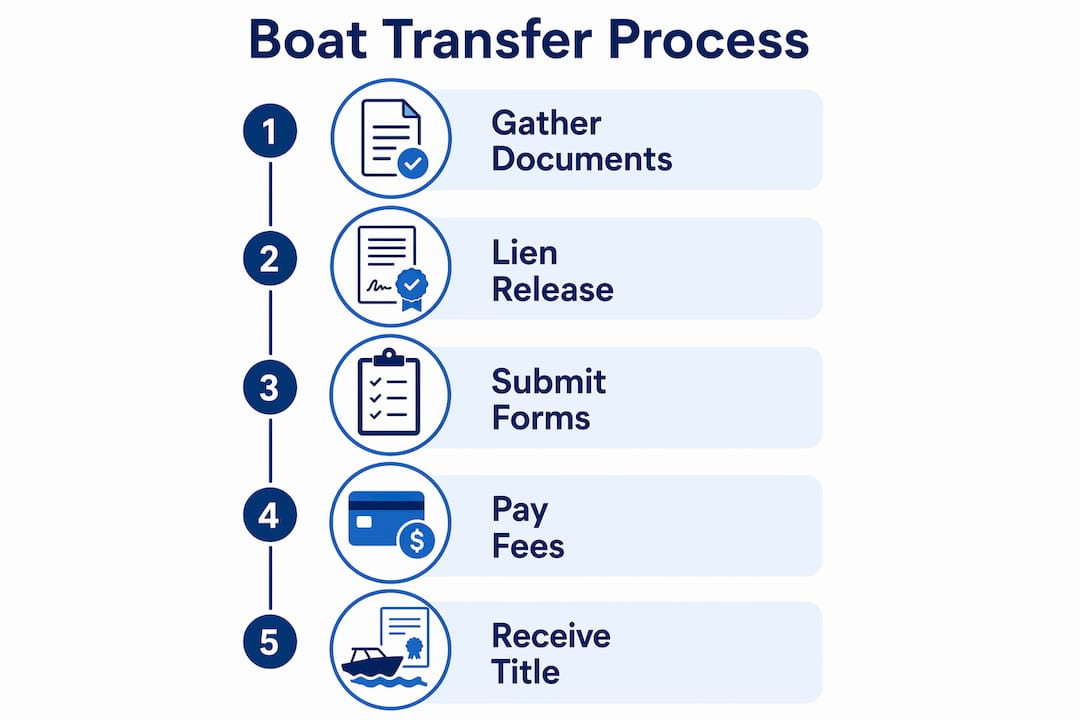
The steps for transferring boat ownership follow a logical sequence, and skipping any one of them creates problems for both parties. Here is the full procedural roadmap for 2026.
- Seller signs the title. The seller signs and dates the back of the certificate of title, transferring ownership to the buyer. Some states require this to happen in front of a notary public.
- Seller provides lien release. If any loan is attached to the vessel, the seller delivers a written lien release from the financing institution. A verbal release or a delayed payoff can cause registration rejection at the state office.
- Seller delivers the bill of sale. The completed bill of sale is handed to the buyer at closing. This document is the buyer’s primary proof of purchase until the new title arrives.
- Buyer verifies all paperwork. Before handing over any money, the buyer confirms the HIN matches, the title is clean, and the lien release is in hand.
- Buyer pays applicable fees and taxes. Title transfer fees range from $5 to $55 depending on the state, plus registration fees and applicable sales tax. Budget accordingly, because some states charge sales tax based on the full purchase price.
- Buyer submits the transfer application. The completed title transfer application, signed title, bill of sale, lien release, and payment go to the state DMV, DNR, or equivalent agency. Many states now offer online submission, though in-person processing is faster and more secure.
- New title and registration are issued. The state processes the transfer and mails the new title to the buyer, typically within two to four weeks.
The timing window matters. Most states require buyers to transfer title within 30 to 90 days after the sale, with late fees applied for delays. That deadline starts the day the bill of sale is signed, not the day you get around to visiting the DMV.
| Step | Typical Timeline | Estimated Cost |
|---|---|---|
| Gather documents | 1 to 14 days | $0 |
| Lien release from lender | 5 to 14 days | Varies by lender |
| Submit transfer application | Same day | $5 to $55 base fee plus taxes |
| Receive new title | 2 to 4 weeks | Included in filing fee |
Pro Tip: Meeting at the DMV or DNR to complete the title transfer in person is the gold standard for security. It confirms identity, verifies title authenticity, and prevents a dishonest seller from completing multiple sales of the same vessel.
Common pitfalls when transferring a boat title
Even experienced boat owners run into problems during the transfer process. These are the most frequent mistakes and how to avoid them.
- Incomplete or missing title: Some sellers have lost their title or never received one. A missing title does not kill the deal, but it does require the seller to apply for a duplicate title before the sale can close. This adds days or weeks to the process.
- Unresolved liens: A lien that was paid off but never formally released in writing will block your transfer. Always request a lien search through your state’s DMV or a third-party title search service before purchasing.
- State-by-state variation: Transfer requirements in Florida differ significantly from those in Michigan or Washington. What counts as a valid bill of sale in one state may be rejected in another. Always confirm your specific state’s requirements before preparing documents.
- Confusing registration with title: Confusing state registration with federal USCG documentation leads to common errors. Registration proves you have permission to operate on state waters. Title proves you own the vessel. They are not interchangeable.
- Seller identity and ownership verification: Confirm the seller’s name on the title matches their government-issued ID. If the title lists a deceased owner or a business entity, additional legal steps are required before transfer.
- Errors on submitted forms: A single transposed digit in the HIN or a misspelled name triggers a rejection. Review every form twice before submitting.
A critical safety step: Verify the HIN on the vessel matches the paperwork before purchase to avoid buying a stolen or financially encumbered boat. Run the HIN through the National Insurance Crime Bureau (NICB) database and request a title history report for complete peace of mind.
Pro Tip: Always perform a lien check and HIN verification before signing anything. A title search typically costs $20 to $50 and can save you from inheriting someone else’s debt or a vessel with a clouded ownership history.
Special cases: gifting, inheritance, and boats without titles
Not every boat transfer follows the standard sale model. These situations require extra steps and, in some cases, legal counsel.
Gifting a boat follows a similar paperwork process to a standard sale, but the bill of sale lists the purchase price as $0 or “gift.” Many states offer a sales tax exemption for gifts between immediate family members, but you must declare the gift status explicitly on the transfer application. Failing to do so can result in the state calculating sales tax on the vessel’s fair market value.
Inheriting a vessel requires probate documentation in most states. If the deceased owner had a will, the executor can transfer the title using the probate court order and a copy of the death certificate. If no will exists, the process moves through intestate succession laws, which vary by state. Either way, the new owner must still complete a standard title transfer application once the legal authority to transfer is established.
Buying a boat without a title is the most complicated scenario. Here is how the three main options break down:
- Duplicate title: If the original title exists in state records, the seller applies for a duplicate before the sale closes.
- Bonded title: When no title record exists, a bonded title process provides a legal pathway to clear ownership. This requires a surety bond typically 1.5 times the boat’s value, which protects against future ownership claims.
- State exemptions: Some states do not require titles for older vessels or boats below a certain length. In these cases, a notarized bill of sale and registration transfer serve as the ownership record.
| Scenario | Key Document Needed | Sales Tax Applies? |
|---|---|---|
| Standard sale | Signed title plus bill of sale | Yes |
| Gift to family member | Bill of sale showing $0 or “gift” | Often exempt |
| Inheritance | Probate order plus death certificate | Varies by state |
| No title available | Bonded title or duplicate title | Yes |
For complex ownership structures involving marina slips or waterfront properties, consulting a maritime attorney before closing is money well spent.
Key takeaways
A successful boat ownership transfer requires clean title documentation, a verified HIN, a written lien release, and submission to the correct state or federal agency within the required deadline.
| Point | Details |
|---|---|
| Title transfer is legally required | Formal transfer protects both buyer and seller and prevents future liability disputes. |
| Lien release must be in writing | A verbal payoff confirmation will not satisfy state agencies; get the written release before closing. |
| Deadlines are real | Most states require transfer within 30 to 90 days of sale, with late fees for delays. |
| HIN verification prevents fraud | Always match the physical HIN on the vessel to the title and bill of sale before purchase. |
| Special cases need extra steps | Gifts, inheritances, and no-title purchases each require additional documentation beyond a standard sale. |
What I’ve learned from watching transfers go sideways
I have seen more boat deals fall apart in the final paperwork stage than at any other point in the transaction. The vessel is perfect, the price is agreed upon, and then someone discovers a lien that was never released, or the title has a name that does not match the seller’s ID. These are not rare edge cases. They happen constantly, and they are almost always preventable.
The single most underrated step in the entire process is the pre-purchase lien search. Buyers skip it because it feels like an extra expense on top of a big purchase. But inheriting a $15,000 outstanding loan on a boat you thought you owned free and clear is a far worse outcome. Run the search. Every time.
I also want to push back on the idea that online transfer submissions are always the smart move. Yes, they are convenient. But for any transaction above $20,000, completing the transfer in person at the state office gives you immediate confirmation, a receipt, and a human being to call if something goes wrong. The Florida yacht registration process is a good example of where in-person processing consistently outperforms mail or online options in terms of turnaround time and error resolution.
Finally, keep your original bill of sale forever. Not in a drawer you forget about. In a fireproof document safe or a scanned digital archive. Ownership disputes can surface years after a transaction, and that document is your definitive proof. I have seen clients wish they had it and clients who were very glad they did. Be the second kind.
— Jason
Ready to make your next boat transfer effortless?
At Yachtingexperts, we hold your hand through every step of the ownership transfer process, from pre-purchase lien checks to final title submission. Our team knows the paperwork, the deadlines, and the state-specific requirements that trip up even experienced buyers and sellers.

Whether you are buying your first vessel or trading up to something spectacular, our boat selling workflow gives you a clear, step-by-step path from handshake to clean title. We also offer personalized guidance through our ownership transfer service for clients who want expert eyes on every document before anything is signed. This is your moment. Let us make it a great one.
FAQ
What is the boat ownership transfer process?
The boat ownership transfer process is the legal procedure of changing a vessel’s title from the seller to the buyer by completing a signed title, bill of sale, and lien release, then submitting them to the appropriate state or federal agency. Most states require this to be completed within 30 to 90 days of the sale date.
Do I need a title to transfer boat ownership?
Most states require a certificate of title for motorized vessels above a minimum length, typically 14 feet. If no title exists, buyers can pursue a duplicate title through the state or a bonded title process, which requires a surety bond of approximately 1.5 times the vessel’s appraised value.
What is the difference between boat registration and a boat title?
A boat title proves legal ownership of the vessel, while registration is a state-issued permit to operate on state waters. Federal USCG documentation serves as a national title for vessels of 5 net tons or larger and is separate from both state title and registration.
How much does a boat title transfer cost?
Title transfer fees range from $5 to $55 depending on the state, plus applicable registration fees and sales tax. The total out-of-pocket cost varies significantly based on the vessel’s purchase price and your state’s tax rate.
How do I avoid buying a boat with a lien on it?
Request a title history report and run the HIN through the National Insurance Crime Bureau database before purchase. Confirm that any outstanding loan has a written lien release from the lender, since a verbal payoff confirmation will not satisfy state transfer requirements.
Recommended
Request A Call
Featured Listings

2027 Canados
100
Miami Florida

2015 Maiora
$3,750,000
90
Miami Florida

2027 Canados
57
Miami Florida

2019 Silent-Yachts Fair Dinkum
$1,599,000
55
Fort Lauderdale Florida

2026 Canados
49
Miami Florida

2026 Buddy Davis
47
Miami Florida

2020 Grady-White No Name
$610,000
45
Hallandale Beach Florida

2020 Viking Huckleberry
$1,495,000
44
Fort Lauderdale Florida

2027 Canados
43
Miami Florida

2021 Intrepid Dream Faster
$730,000
40
Coral Gables Florida

2016 Edgewater
$299,000
37
Miami, Florida

2022 Avid
$56,900
23
Stuart Florida
Get your yacht value Estimate
"*" indicates required fields