

Documentation in boat sales is the legal foundation that proves ownership, establishes vessel condition, and protects both buyer and seller from post-sale disputes. Without the right paperwork, even the most beautiful vessel can sit unsold for weeks while lawyers, lenders, and state agencies sort out the mess. The role of documentation in boat sales goes far beyond a simple receipt. It determines how fast a deal closes, how much negotiating power you hold, and whether the buyer walks away confident or cautious. Get this right, and you set yourself up for a clean, profitable transaction.
What are the essential documents required for selling a boat?
The paperwork side of a boat sale follows a clear hierarchy, and knowing what belongs at the top saves you from scrambling at the closing table. Thorough paperwork directly links to smoother negotiations and faster sales, according to Boat Trader research. That connection is not accidental. Buyers who receive a complete document package feel protected. Buyers who have to chase down records start questioning everything else about the deal.
Here is what every seller should have ready before listing:
- Title or Certificate of Documentation (USCG): This is your proof of ownership. For vessels 26 feet and over used in commerce or traveling internationally, federal documentation through the U.S. Coast Guard National Vessel Documentation Center (NVDC) is standard. For smaller recreational boats, a state-issued title serves the same purpose.
- Bill of Sale: The primary legal transfer document recognized at both state and federal levels. It must include the hull identification number (HIN), purchase price, vessel description, buyer and seller names, and the date of transfer. In private sales, an as-is bill of sale also documents the buyer’s acceptance of the vessel’s condition, which limits post-sale liability for the seller.
- Maintenance and service records: A complete log of engine hours, oil changes, haul-outs, and repairs tells the buyer the vessel has been cared for. Gaps in this record raise red flags faster than almost anything else.
- Lien release or payoff letter: If you financed the boat, the lender holds an interest in the title. A lien release confirms the loan is satisfied and the title is clear. Without it, the sale cannot legally transfer clean ownership.
- Survey report: Pre-sale surveys from a certified marine surveyor, such as those accredited by the Society of Accredited Marine Surveyors (SAMS) or the National Association of Marine Surveyors (NAMS), give buyers an independent condition assessment. Sellers who provide a recent survey signal confidence and transparency.
- Insurance documents and warranty records: These confirm the vessel has been insured and, where applicable, that manufacturer warranties remain transferable.
Pro Tip: Assemble all documents into a single digital folder before you list the boat. Buyers who receive a complete package within 24 hours of asking are far more likely to move forward without hesitation.
Missing or incorrect documents can stall a closing for weeks. A single unsigned bill of sale or an expired lien release can freeze the entire transaction while both parties wait on third parties to respond.

How does federal vessel documentation differ from state titling?
This is one of the most misunderstood areas in boat sales and legal documents, and the confusion costs sellers real time and money. Federal documentation and state titling are not interchangeable. They serve overlapping but distinct legal purposes.
| Feature | Federal Documentation (USCG/NVDC) | State Title and Registration |
|---|---|---|
| Issued by | U.S. Coast Guard National Vessel Documentation Center | State DMV or Fish and Wildlife agency |
| Replaces state title? | Yes, for eligible vessels | N/A |
| Replaces state registration? | No | Yes |
| Required vessel size | Typically 5 net tons or more | Varies by state |
| Transfer instrument | Form CG-1340 (Abstract of Title) | State-specific bill of sale or title transfer form |
| Best for | Commercial use, international travel, financing | Smaller recreational vessels |
| Renewal process | Annual renewal through NVDC | Varies, typically biennial |
Federal documentation replaces the state title but does not replace state registration. That distinction matters enormously. A federally documented vessel still needs to display a valid state registration decal in most states, even though it carries a USCG Certificate of Documentation instead of a state title. Sellers who assume federal documentation covers everything often discover at closing that the buyer’s home state requires additional paperwork.
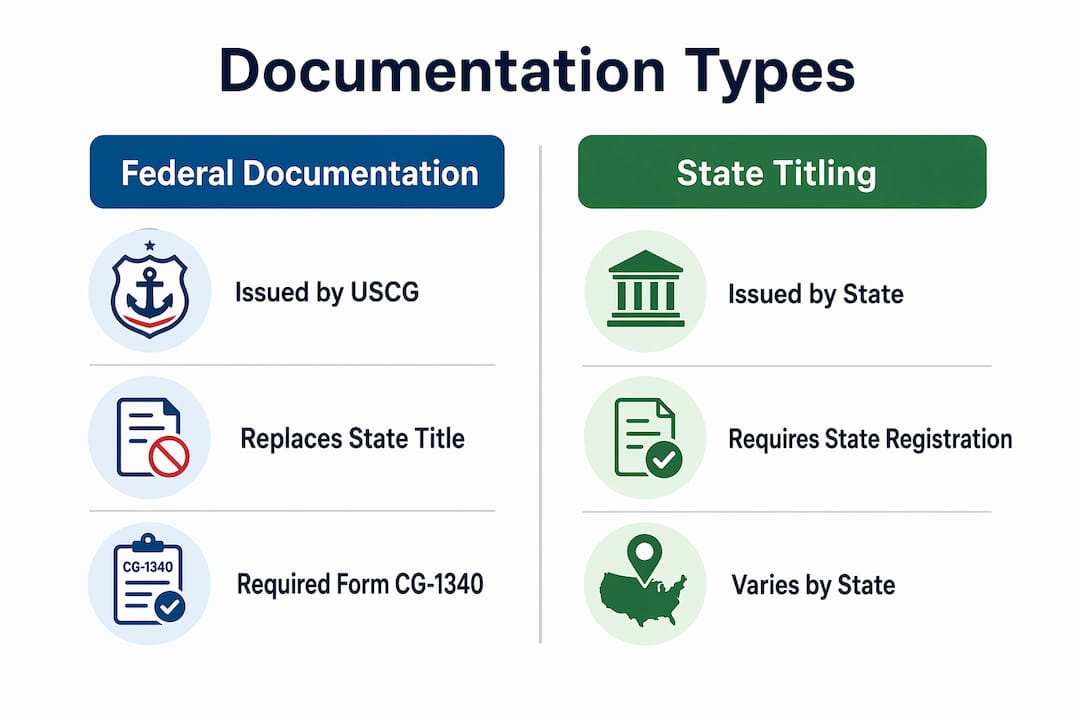
For ownership transfers on federally documented vessels, Form CG-1340 must be completed with exact precision. Every data field, including ownership percentages and the HIN, must match the existing certificate. Errors cause outright rejection by the NVDC and delay reissuance of the certificate, sometimes by weeks. Informal sale agreements, a handshake or a simple receipt, are insufficient for federal transfers and will not be accepted.
For international sales or vessels that cross state lines regularly, experienced owners must manage both federal documentation updates and applicable state registration rules simultaneously to stay legally compliant.
What documentation errors most commonly delay or derail boat sales?
Most boat sale delays trace back to a small number of recurring paperwork mistakes. Knowing them in advance is the difference between a clean 30-day close and a two-month ordeal.
- Incorrect hull identification number (HIN). The HIN is the vessel’s fingerprint. An error of even one digit on the bill of sale or transfer form causes the state or NVDC to reject the filing. Errors in HIN or ownership percentages on federal transfer documents result in rejection and delay reissuance of certificates.
- Unsigned or improperly notarized bills of sale. For federally documented vessels, the bill of sale must be notarized. A missing notary stamp or a signature in the wrong field invalidates the document entirely.
- Missing lien releases. Sellers who paid off a loan years ago sometimes cannot locate the lien release. Tracking down a lender that has since merged or closed takes time the buyer is not willing to wait.
- No supporting paperwork for claimed upgrades. A seller who says “we just replaced the engines” but cannot produce invoices loses negotiating leverage immediately. Buyers discount unverified claims.
- Relying on informal agreements for documented vessels. A handwritten note or email does not satisfy federal transfer requirements. The NVDC requires a properly executed bill of sale as the primary instrument.
Pro Tip: Cross-check the HIN on the physical vessel against every document in your package before listing. Discrepancies between the transom plate, the title, and the bill of sale are the single most common cause of registration delays.
Documentation gaps do not just slow things down. They shift negotiating power to the buyer. A seller who cannot produce records quickly signals disorganization, and buyers use that to justify lower offers or walk away entirely.
How does complete documentation influence negotiation and closing?
Thorough preparation of boat documentation significantly improves negotiation leverage and buyer confidence, enabling faster and cleaner sales. This is not a soft benefit. It is a measurable transactional advantage.
Documentation works as the transaction’s chain-of-title proof, linking your current ownership to a recognized legal record. When that chain is unbroken and clearly presented, buyers have no grounds to question legitimacy. When it has gaps, every missing piece becomes a negotiating chip against you.
Here is how organized paperwork directly affects the closing process:
- Speeds up registration and tax reporting. Buyers who receive a clean title or USCG certificate, a properly executed bill of sale, and a lien release can register the vessel in their name within days. Delays in registration mean delays in the buyer’s ability to legally operate the boat, which creates friction and resentment.
- Builds trust through maintenance transparency. A complete service log from a reputable yard, such as MarineMax or a certified Yamaha or Mercury dealer, tells the buyer exactly what they are getting. That transparency reduces the buyer’s perceived risk and supports your asking price.
- Supports a pre-agreed survey outcome. When your maintenance records align with the marine surveyor’s findings, the buyer has no ammunition to demand a price reduction based on condition. Mismatches between your claims and the survey report are where deals fall apart.
- Reduces time between offer and close. Missing documentation can stall or jeopardize closing entirely. Sellers who hand over a complete package at the time of offer acceptance remove the most common source of closing delays.
You can explore how documentation ties into the broader yacht escrow process to understand how funds and paperwork move together in a protected transaction.
What special considerations apply to cross-border vessel sales?
Selling a documented vessel across state lines or internationally adds another layer of documentation requirements that many sellers underestimate. Cross-border boat sales require comprehensive documentation, including registration proof, insurance verification, customs forms, and trailer documentation to satisfy temporary admission laws.
| Document | Purpose | Required For |
|---|---|---|
| USCG Certificate of Documentation | Proves federal registration and nationality | International travel and financing |
| Temporary Admission (TA) permit | Allows foreign-flagged vessel in domestic waters | Vessels entering the U.S. temporarily |
| Customs declaration form | Declares vessel for import/export | All international transfers |
| Trailer registration and title | Proves legal ownership of transport equipment | Road transport across state or national borders |
| Insurance certificate | Confirms active coverage for the vessel | Most border crossings and marina requirements |
For vessels traveling internationally, the USCG Certificate of Documentation serves as the vessel’s nationality certificate, the equivalent of a passport. Without it, foreign port authorities may detain the vessel or require a bond. Sellers transferring ownership to a foreign buyer must also confirm whether the buyer’s flag state requires re-documentation under their own registry.
State-to-state sales within the U.S. require the buyer to re-register the vessel in their home state within a set window, typically 30 to 90 days depending on the state. Sellers should confirm the buyer understands this obligation at closing to avoid disputes over registration lapses.
Key takeaways
Complete, accurate documentation is the single most powerful tool a boat seller controls, directly determining how fast a deal closes and at what price.
| Point | Details |
|---|---|
| Documentation drives trust | Buyers who receive a complete package move faster and negotiate less aggressively. |
| Federal and state paperwork differ | USCG documentation replaces state title but not registration; both are required for full compliance. |
| Errors cause real delays | Incorrect HINs, missing notarization, or absent lien releases can stall closing by weeks. |
| Cross-border sales need extra prep | International and interstate transfers require customs forms, trailer titles, and insurance certificates. |
| Maintenance records support price | Service logs from certified dealers validate your asking price and neutralize survey-based price cuts. |
Why documentation is the deal, not just the paperwork
I have sat across the table from buyers who were ready to sign, and watched the energy drain out of the room the moment a seller said, “I think I have that somewhere.” That pause costs money. I have seen deals fall apart over a missing lien release that the seller swore was “taken care of years ago.” And I have watched sellers with pristine document packages close at or above asking price because the buyer felt zero anxiety about what they were buying.
Here is what most sellers miss: documentation is not administrative housekeeping. It is your sales pitch in legal form. A well-organized binder with the USCG certificate, a clean bill of sale, service records from a recognized yard, and a recent SAMS-accredited survey tells the buyer a story about how you cared for this vessel. That story is worth real dollars.
My honest advice is to build your document package before you set your asking price. Go through the selling your boat checklist and treat every missing document as a negotiating liability you are handing to the buyer for free. Fix it before they find it.
— Jason
Ready to sell with confidence? Yachtingexperts has you covered
At Yachtingexperts, we know that getting your documentation right is what separates a smooth, profitable sale from a stressful one. Our team guides sellers through every step of the paperwork process, from verifying your USCG certificate and lien status to organizing maintenance records that support your asking price.

We offer a personalized, high-touch experience that takes the guesswork out of one of your biggest financial transactions. Whether you need help with MC Setup or want a clear, step-by-step path to closing, we are here for you. Explore our boat selling workflow to see exactly how we help sellers like you get maximum return with minimum stress. This is your moment to sell smart.
FAQ
What documents do I need to sell a boat?
The core documents are the title or USCG Certificate of Documentation, a notarized bill of sale, lien release, maintenance records, and a marine survey report. Missing any of these can delay registration and close.
Is a bill of sale enough to transfer a federally documented vessel?
A bill of sale is required but must be properly notarized and completed with exact details, including the correct HIN and ownership percentages. Informal agreements are not accepted by the NVDC for federal transfers.
Does Coast Guard documentation replace my state registration?
No. Federal documentation replaces the state title but not state registration. Vessel owners must satisfy both federal and state requirements to remain legally compliant.
How does documentation affect my negotiating position as a seller?
Sellers with complete, organized paperwork close faster and face fewer price reduction demands. Sellers unable to provide documents quickly risk losing buyer trust and negotiation leverage.
What extra paperwork is needed for international boat sales?
International sales require the USCG Certificate of Documentation, customs declaration forms, a Temporary Admission permit if applicable, trailer registration, and proof of insurance. Each document satisfies a specific legal requirement at the border or foreign port.
Recommended
Request A Call
Featured Listings

2027 Canados
100
Miami Florida

2015 Maiora
$3,750,000
90
Miami Florida

2027 Canados
57
Miami Florida

2019 Silent-Yachts Fair Dinkum
$1,599,000
55
Fort Lauderdale Florida

2026 Canados
49
Miami Florida

2026 Buddy Davis
47
Miami Florida

2020 Grady-White No Name
$610,000
45
Hallandale Beach Florida

2020 Viking Huckleberry
$1,495,000
44
Fort Lauderdale Florida

2027 Canados
43
Miami Florida

2021 Intrepid Dream Faster
$730,000
40
Coral Gables Florida

2016 Edgewater
$299,000
37
Miami, Florida

2022 Avid
$56,900
23
Stuart Florida
Get your yacht value Estimate
"*" indicates required fields