

Most buyers approach a yacht listing the same way they scroll through real estate photos — drawn in by the glamour and quick to move on. But the role of detail in yacht listings goes far beyond aesthetics. A gleaming deck shot tells you nothing about engine hours, refit history, or whether the watermaker was serviced last season. The difference between a confident purchase and a costly mistake almost always lives in those specifics. This guide breaks down exactly what detailed listings look like, why they matter, and how to use them to your advantage before you ever step aboard.
Table of Contents
- Key takeaways
- The role of detail in yacht listings that actually matter
- How detail reveals hidden value and reduces buyer risk
- Best practices for sellers and brokers creating listings
- A buyer’s checklist for evaluating listing detail
- My honest take on listing transparency
- How Yachtingexperts helps you get it right
- FAQ
Key takeaways
| Point | Details |
|---|---|
| Photos only show so much | Build year, refit year, and engine hours reveal far more about true vessel condition than any image. |
| Maintenance records are non-negotiable | Documented service history directly impacts appraisal value and gives buyers real negotiating power. |
| Crew and amenities belong in listings | Specialist crew qualifications and onboard features like wellness facilities create measurable market differentiation. |
| Vague listings hide problems | Missing specs and generic descriptions are red flags, not neutral omissions. |
| Detailed listings protect both sides | Transparency reduces post-purchase surprises for buyers and speeds up the sales process for sellers. |
The role of detail in yacht listings that actually matter
Walk into any yacht brokerage and you will hear the same pitch: great photos, strong price, motivated seller. What you hear less often is a conversation about hull soundness assessments, documented oil change intervals, or whether the generator was rebuilt or simply serviced. That gap is where buyers get burned.
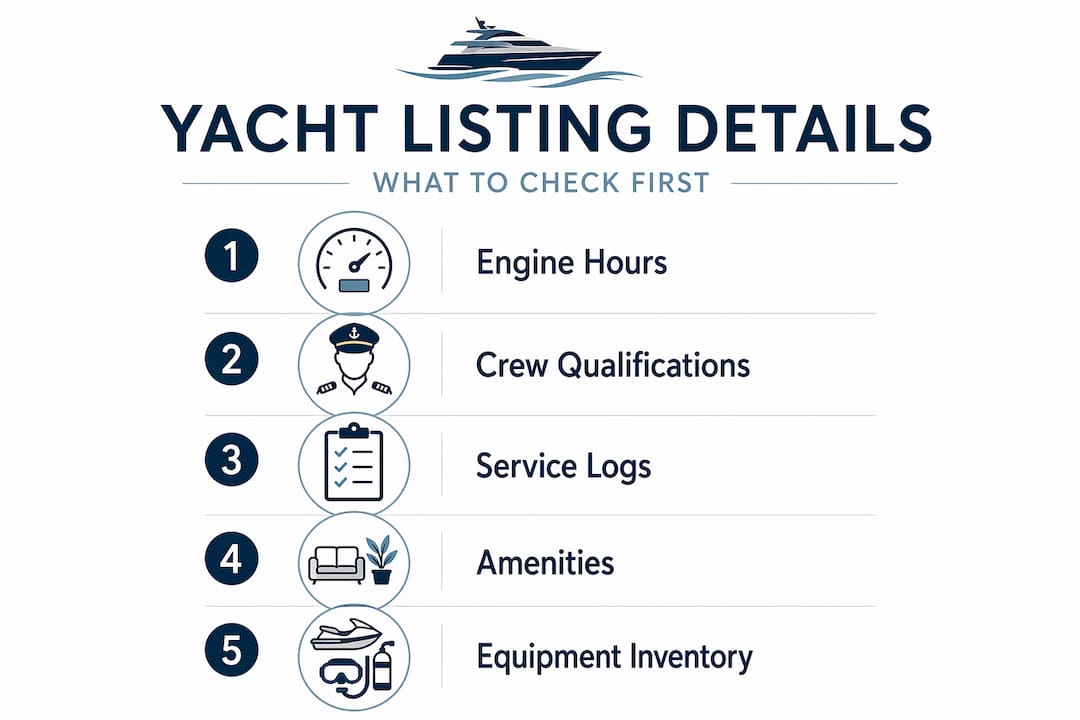
A truly detailed yacht listing covers several distinct categories, and each one earns its place:
- Hull year vs. refit year. These are not the same number, and confusing them is one of the most common errors buyers make. Listings frequently omit this clarification, leaving buyers with a wildly inaccurate picture of actual vessel age and condition.
- Engine hours and service logs. An engine with 800 hours and documented annual servicing is a completely different purchase from one with 800 hours and a blank paper trail.
- Technical specifications. Fuel capacity, watermaker output, generator size, electrical system specs. These tell you whether the yacht actually fits how you plan to use it.
- Inventory lists. Every tender, toy, safety item, and piece of navigation equipment should be accounted for. Surprises at sea are expensive.
- Maintenance and survey documentation. A yacht’s appraisal value depends more on condition and maintenance records than on age or size alone.
On the media side, professional listing photos typically include not just wide interior and exterior shots, but targeted detail shots of the engine room, helm station, mechanical spaces, and aerial drone images. These images support the written specs rather than replace them.
For luxury listings, crew qualifications and onboard amenities deserve their own section. Listing details that outline crew qualifications and onboard features create genuine consumer confidence and market differentiation. A yacht crewed by a certified dive master and a trained chef is a different product from one that mentions “professional crew” with no further context.
Pro Tip: When reading any listing, cover the photos and ask yourself whether the written content alone gives you enough to make an informed decision. If the answer is no, the listing is incomplete.
How detail reveals hidden value and reduces buyer risk
Here is a scenario worth considering. Two yachts, same builder, same year, same length. One lists for $200,000 more than the other. On paper, they look nearly identical. In reality, listings with documented maintenance history and professional crew oversight consistently outperform those that rely solely on good photos. The price difference is not arbitrary. It reflects real, documentable condition.
This is where the importance of detail in yacht sales becomes concrete rather than theoretical.
“Experienced destination yacht charter specialists emphasize the value of unseen details such as maintenance standards and crew personality over mere listing photos.” — Upscale Living Magazine
Transparent mechanical records shift the buyer’s position entirely. Instead of scheduling a survey to discover what the seller should have disclosed, you walk in knowing the timeline of every major service. That changes your negotiation posture and your risk profile at the same time.
Onboard features also carry more weight than buyers typically expect. Wellness facilities and modern toy inventories are now non-negotiable in detailed listings for superyachts over 100 meters to remain competitive. Ice baths, inflatable slides, paddleboards, and dive equipment are not just lifestyle perks. They are value drivers that affect pricing power and resale appeal, and they belong in the listing.

The downstream impact of this transparency is significant. Up to 70 percent of a luxury yacht’s charter bookings can come from repeat clients when listings emphasize service and crew quality. Whether you are buying for personal use or as an investment, that kind of loyalty data belongs in your due diligence.
For more on how professional crew documentation enhances a yacht’s perceived and actual value, the yacht crew management guide at Yachtingexperts is worth reading before you evaluate any listing seriously.
Best practices for sellers and brokers creating listings
Sellers and brokers who take listing detail seriously sell faster and at better prices. Strong presentation improves both listing performance and negotiation outcomes. This is not a soft benefit. It translates directly to dollar figures and time on market.
Here is how to approach it correctly:
- Gather all documentation before you list. Engine logs, service records, survey reports, equipment manuals, warranty documents. If you cannot produce a paper trail for a major system, that gap will show up in the survey and cost you in negotiations.
- Distinguish between original build specs and refit improvements. List both clearly. A 2010 hull with a comprehensive 2022 refit is a genuinely different product from a 2010 hull with original systems. Buyers need that context.
- Use professional photography strategically. Photos should support the specs, not substitute for them. Hire a marine photographer who understands lighting in tight mechanical spaces, not just exterior glamour shots.
- Write amenity descriptions with specificity. “Fully equipped galley” is useless. “Four-burner induction cooktop, dual undercounter refrigeration, Nespresso, and full entertaining service for 12” gives buyers a real picture.
- Include crew qualifications in luxury listings. Adding specialist crew like trainers or dive masters is a subtle but important listing advantage that many sellers overlook entirely.
- Price transparently. Break out mandatory fees, extras, and what is included. Hidden costs discovered late in due diligence erode trust fast.
The most common pitfall we see is sellers treating the listing as a marketing brochure rather than a disclosure document. Both functions matter. The marketing gets buyers to the table; the detail keeps them there.
Pro Tip: Review your listing from the perspective of a skeptical buyer who has been burned before. If any section reads as vague or evasive, rewrite it with specifics before publishing.
For a detailed walkthrough on preparing your yacht for sale with the right documentation, Yachtingexperts has a practical guide that covers exactly this process.
A buyer’s checklist for evaluating listing detail
When you are evaluating listings, bring structure to the process. The impact of detail on yacht sales is real, but you have to know what to look for. Use this framework:
- ✅ Does the listing specify both build year and most recent refit year?
- ✅ Are engine hours documented, and is a service log available upon request?
- ✅ Is there a full equipment and inventory list, or just a vague reference to “extras included”?
- ✅ Are crew qualifications listed with specificity, including certifications?
- ✅ Does the pricing section break out what is and is not included?
- ✅ Are mechanical spaces shown in the photo set, or only the salon and deck?
- ✅ Is there reference to recent survey reports or available survey documentation?
Beyond the checklist, learn to read between the lines. Phrases like “well maintained” with no supporting documentation, or “priced to sell quickly” with no price breakdown, are common deflections. Authentic listings use specifics because the seller has nothing to hide.
Always complement your listing review with an independent marine survey. No matter how detailed a listing appears, a professional surveyor will catch what words and photos cannot reveal. Think of the listing as your first filter and the survey as your final confirmation.
| Listing detail | What it signals |
|---|---|
| Documented engine hours with logs | Seller is transparent; maintenance culture is strong |
| “Well maintained” with no records | Potential gap in service history; ask for documentation |
| Full inventory list with photos | Seller is organized and confident in what they are offering |
| Amenities listed without specs | Buyer should verify every item before closing |
| Refit year clearly stated | Accurate representation of vessel’s actual working age |
For a breakdown of what to verify throughout the full purchase process, the Florida yacht sales guide from Yachtingexperts maps out each step clearly.
My honest take on listing transparency
I have watched too many buyers close on yachts that looked spectacular in photos and turned out to be expensive disappointments. The pattern is almost always the same. The listing was light on specifics, the buyer was dazzled by the imagery, and nobody asked the hard questions early enough.
In my experience, the sellers who resist providing detailed documentation are not doing so out of laziness. They often know the records are not strong. That is the signal. When a broker hesitates to share engine logs or a refit history, that hesitation is data.
What excites me about where the market is heading is that buyer expectations are rising. Sophisticated buyers now request detailed specs and documentation as a baseline, not a special request. That shift is forcing better listing standards across the board. It is the kind of accountability that actually improves the market for everyone.
My recommendation: if a listing does not include documented maintenance history, transparent pricing, and specific crew or amenity information for a luxury vessel, treat those omissions as a negotiating point at minimum and a red flag at maximum. You deserve the full picture before committing to one of the most significant purchases of your life.
— Jason
How Yachtingexperts helps you get it right

At Yachtingexperts, we believe every buyer and seller deserves complete clarity throughout the process. Our team brings the same attention to listing detail that we expect from the market, whether we are helping you evaluate a listing or prepare your own vessel for sale.
We work with clients to ensure every listing we touch includes full documentation, accurate specs, professional media, and transparent pricing. No guesswork. No vague descriptions. If you are preparing to sell, our boat selling workflow guide walks you through exactly how to structure your listing for maximum buyer confidence and the best possible return. If you are buying, we help you read between the lines and ask the right questions. Connect with our team at Yachtingexperts today for a personalized strategy session that puts you in control of your next move.
FAQ
What does a detailed yacht listing include?
A detailed yacht listing includes build year, refit year, engine hours, service logs, full equipment inventory, crew qualifications, transparent pricing, and professional photos covering mechanical spaces. Listings that omit any of these elements give buyers an incomplete picture of vessel value.
Why do maintenance records matter so much in yacht listings?
A yacht’s appraisal value depends more on condition and maintenance records than on age or size alone. Documented service history gives buyers accurate insight into vessel health and strengthens their negotiating position before a survey.
How can I tell if a yacht listing is hiding something?
Watch for vague phrases like “well maintained” without supporting documentation, missing engine hours, or pricing sections that reference extras without specifics. These patterns often signal gaps the seller would prefer not to highlight.
Do crew qualifications really affect a listing’s value?
Yes. Listing details that outline crew qualifications and onboard features create genuine consumer confidence and market differentiation, particularly for luxury and superyacht listings where service quality is a primary purchase driver.
Should I always get an independent survey even with a detailed listing?
Absolutely. A detailed listing is your first filter and a sign of seller transparency, but an independent marine survey is non-negotiable before closing. It verifies what the listing states and uncovers what no document can fully capture.
Recommended
Request A Call
Featured Listings

2027 Canados
100
Miami Florida

2015 Maiora
$3,750,000
90
Miami Florida

2027 Canados
57
Miami Florida

2019 Silent-Yachts Fair Dinkum
$1,599,000
55
Fort Lauderdale Florida

2026 Canados
49
Miami Florida

2026 Buddy Davis
47
Miami Florida

2020 Grady-White No Name
$610,000
45
Hallandale Beach Florida

2020 Viking Huckleberry
$1,495,000
44
Fort Lauderdale Florida

2027 Canados
43
Miami Florida

2021 Intrepid Dream Faster
$730,000
40
Coral Gables Florida

2016 Edgewater
$299,000
37
Miami, Florida

2022 Avid
$56,900
23
Stuart Florida
Get your yacht value Estimate
"*" indicates required fields