

Most first-time boat buyers treat a marine survey as a formality. Something the bank wants. A box to check before the wire clears. That assumption costs people real money. The role of surveyor in boat buying goes far deeper than a quick walk-through and a signature. A qualified marine surveyor is your independent expert on deck, evaluating the vessel’s structure, systems, and safety before you commit to one of the largest purchases of your life. This article covers what surveyors actually do, how the inspection process works, what the report means for you, and how to get the most out of the whole experience.
Table of Contents
- Key takeaways
- The role of surveyor in boat buying starts with credentials
- What the boat inspection process actually looks like
- Understanding your marine survey report
- Benefits of hiring a surveyor and pitfalls to avoid
- How to prepare for survey day and work well with your surveyor
- My honest take on surveys after years in this business
- Let Yachtingexperts connect you with the right marine surveyor
- FAQ
Key takeaways
| Point | Details |
|---|---|
| Surveyors require real credentials | Look for SAMS or NAMS accreditation plus a minimum of 5 years of professional experience. |
| Surveys are not pass/fail tests | Reports classify findings by urgency to inform your decisions, not to approve or reject a vessel. |
| The report is your property | You decide whether and how to share findings with sellers, insurers, or lenders. |
| Hiring a surveyor protects your wallet | Surveyors uncover hidden structural, mechanical, and safety risks before they become your problem. |
| Preparation improves inspection quality | Clearing access points and communicating concerns upfront directly affects what a surveyor can find. |
The role of surveyor in boat buying starts with credentials
Not everyone who calls themselves a marine surveyor has earned the title. The most trusted professionals in this field hold accreditation from recognized bodies like the Society of Accredited Marine Surveyors (SAMS) or the National Association of Marine Surveyors (NAMS). Both organizations require at least 5 years of professional experience and passing rigorous standards before granting membership.
Beyond accreditation, look for surveyors who hold American Boat and Yacht Council (ABYC) certifications. ABYC standards are the industry benchmark for electrical systems, fuel systems, and structural safety. A surveyor fluent in those standards evaluates your vessel against objective criteria, not just personal opinion.
There is also a meaningful difference between a generalist and a specialist. A generalist handles most production sailboats and powerboats with confidence. But if you are purchasing a high-performance racer, a commercial vessel, or a superyacht, you want someone whose career has been spent in that specific category. Asking a surveyor directly what type of boats make up the majority of their work is a completely reasonable question, and a good surveyor will welcome it.
One credential worth asking about specifically: Errors and Omissions (E&O) insurance. E&O insurance protects you if a surveyor misses something significant during the evaluation. Not every surveyor carries it. Those who do have made a professional commitment to accountability that should matter to you.
Pro Tip: Ask potential surveyors for a sample report before hiring them. A well-organized, detailed sample tells you immediately whether their documentation standards match what you need for insurance, financing, and negotiation.
What the boat inspection process actually looks like
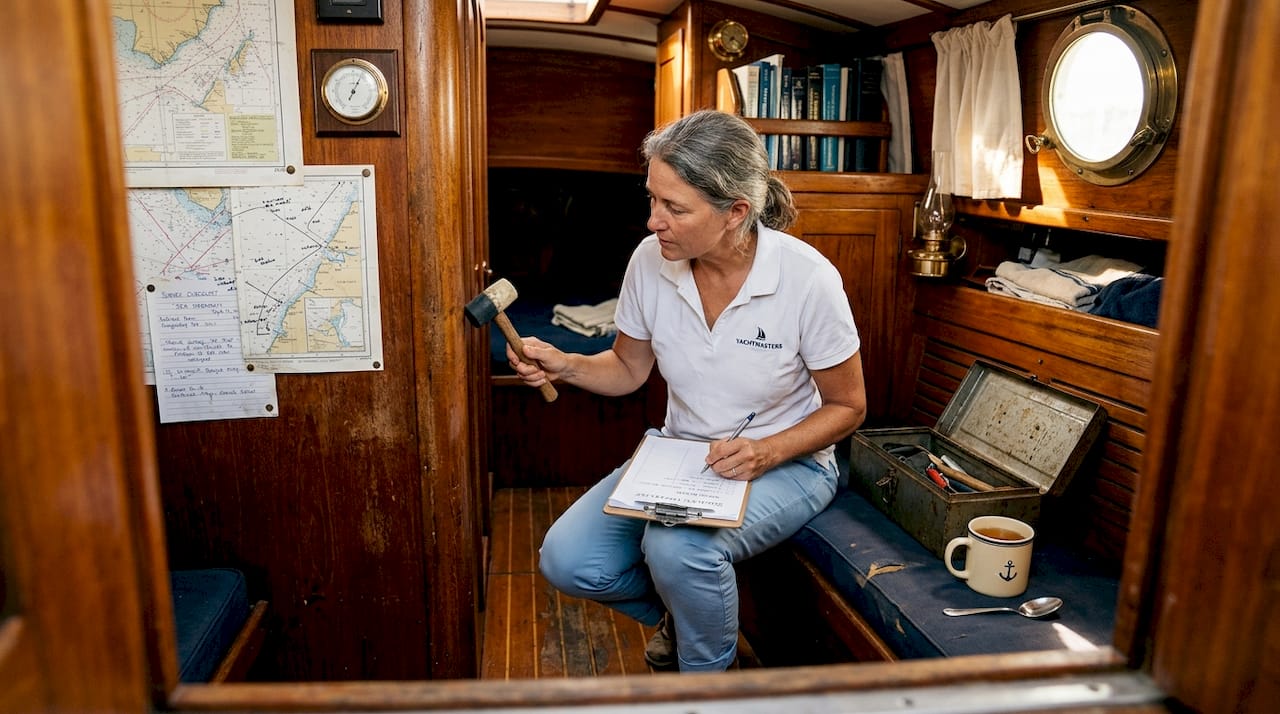
A thorough pre-purchase boat inspection typically unfolds in two distinct phases: an out-of-water inspection and an in-water inspection. Both matter, and skipping either one weakens the findings significantly.
Here is what you can expect from a full survey:
- Haulout and out-of-water inspection. The boat is pulled from the water so the surveyor can examine the hull exterior, through-hull fittings, keel attachment, rudder, propeller, and any underwater gear. This phase often reveals osmotic blistering, delamination, or structural damage that is invisible from the dock.
- In-water systems check. Once the boat is back in the water or while still at the slip, the surveyor evaluates all onboard systems under normal operating conditions. This includes electrical systems, plumbing, fuel systems, bilge pumps, and navigation electronics.
- Engine and mechanical review. Most surveyors perform a visual and operational check of the engine, but for comprehensive coverage, specialist surveyors or subcontractors with dedicated mechanical expertise are often called in for engine inspections or mast evaluations.
- Safety gear and compliance. The surveyor checks fire extinguishers, flares, life rings, ventilation, and other safety gear against ABYC standards and US Coast Guard regulations to determine compliance and flag gaps.
- Sea trial. Many surveys include a sea trial to observe how the vessel actually performs under load. Vibrations, steering behavior, instrument accuracy, and engine performance under power all become visible during this phase.
Surveys generally take four to eight hours depending on the vessel’s size and complexity. Surveyors inspect accessible areas only. They do not disassemble systems or remove cabinetry, which means buyer preparation directly affects what gets evaluated.
Pro Tip: Be present for the survey if at all possible. Watching the surveyor work in real time gives you context that the written report alone cannot provide. You will understand the findings more clearly and ask better questions on the spot.
Understanding your marine survey report
When the report arrives, usually within a few days of the inspection, many buyers read it as a verdict. It is not. A marine survey is expert opinion and documentation, not a judgment call on whether you should buy the boat.
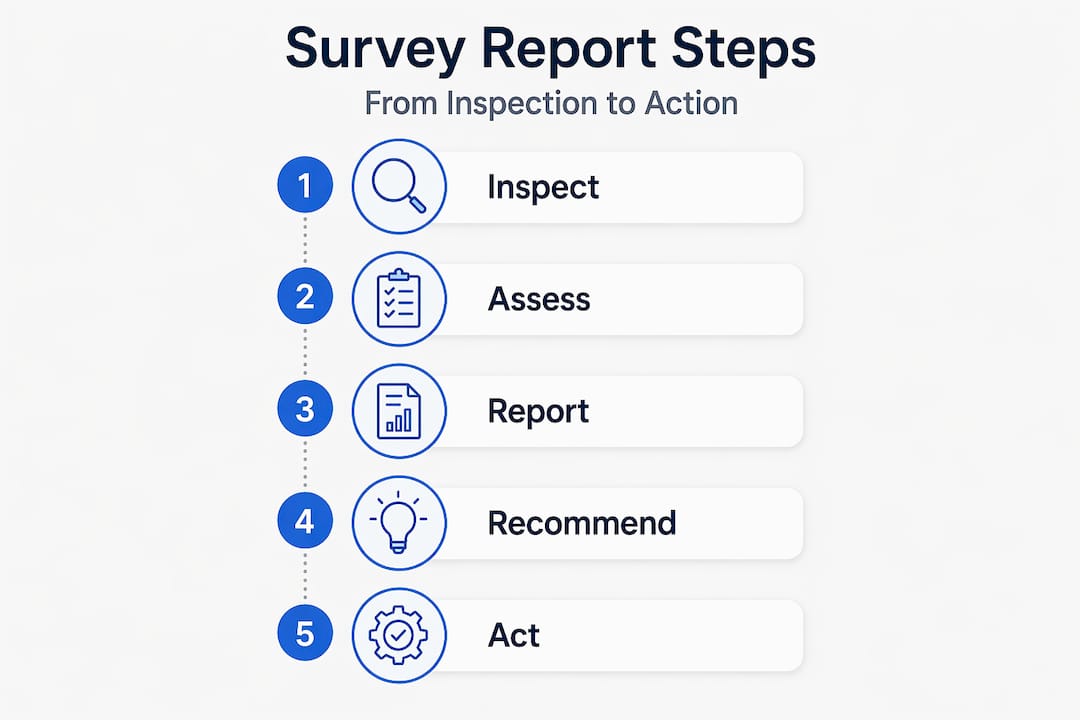
Survey findings are organized into three levels of urgency:
| Finding category | What it means | Typical buyer action |
|---|---|---|
| Immediate safety concern | Active hazard requiring repair before use | Negotiate repair or price reduction; may affect insurance |
| Near-term repair needed | Issue that will require attention soon | Factor into purchase price or post-sale budget |
| Recommended maintenance | Standard wear items or upgrades | Plan for routine ownership costs |
The report also includes a market valuation, which tells you what the vessel is worth in current condition relative to comparable boats. That number becomes leverage in negotiations, backing your position with an independent professional’s assessment rather than a gut feeling.
Survey reports become key documents during insurance underwriting and financing due diligence because they provide objective condition assessments. Most insurers require surveys on vessels older than 10 years, and lenders frequently want them as part of their approval process. Check out the Florida buyer’s survey guide for a closer look at how this plays out in one of the most active boat markets in the country.
One thing to keep in mind: the report is your property. Sharing it with the seller is voluntary. Sometimes sharing it benefits you, specifically when you want to explain why you are requesting a price reduction or asking the seller to address specific repairs before closing.
Benefits of hiring a surveyor and pitfalls to avoid
The benefits of hiring a surveyor reach well beyond peace of mind. Here is what a qualified professional genuinely delivers:
- Protection from hidden damage. A boat survey is the last chance buyers have to identify costly defects before finalizing a purchase. Surveyors look past fresh paint and clean upholstery to find structural failures, water intrusion, and compromised safety systems.
- Negotiation power. An independent market valuation and a classified list of repair needs give you concrete grounds to negotiate a lower price or request seller repairs.
- Insurance eligibility. Insurance companies frequently require pre-purchase surveys to assess risk before coverage approval, particularly on older vessels. Walking into that conversation with a clean, current survey from an accredited professional puts you in the best position.
- Long-term ownership clarity. Surveyors function as a crucial education source about a vessel’s condition. The findings you receive today will guide maintenance priorities for years.
There are also common mistakes that can quietly undermine all of that value. Waiving the survey entirely to speed up the deal is the most expensive shortcut in boat buying. Hiring a friend of the broker rather than an independent professional introduces a conflict of interest that may not be obvious until you are staring at a repair bill six months later. And pushing your surveyor to exaggerate problems can jeopardize insurance coverage for the boat, making it harder and more expensive to insure.
Pro Tip: When possible, source your surveyor independently of the selling broker. A professional with no existing relationship to the listing has every reason to give you an unfiltered assessment.
How to prepare for survey day and work well with your surveyor
Getting the most from the boat inspection process starts before the surveyor arrives. A few focused steps make a real difference.
- Clear the vessel for access. Remove gear from lockers, bilges, and storage spaces so the surveyor can physically reach what needs to be examined. Full access equals a more thorough evaluation.
- Communicate your concerns upfront. If you noticed something odd during your viewing, tell the surveyor before they start. A specific concern gets direct attention rather than being missed in the flow of a full survey.
- Have the boat systems ready to run. All electronics, engines, and onboard systems should be in operable condition and ready to demonstrate. A system that cannot be tested gets documented as untested, which creates uncertainty in the report.
- Understand what the survey cannot cover. A surveyor’s evaluation is a snapshot in time. A system functioning on survey day can still fail a week later. The survey reduces uncertainty; it cannot eliminate it.
- Use the report to plan your next move. Whether you negotiate, walk away, or buy at asking price, the report gives you the information to make that call with confidence. Review the yacht inspection checklist to understand how findings map to real ownership decisions.
My honest take on surveys after years in this business
I have watched buyers treat the survey as an obstacle and buyers treat it as the most valuable tool in the whole purchase process. The second group makes better decisions every time.
The pass/fail mindset is the single biggest misconception I see. When buyers approach a survey looking for a thumbs up or thumbs down, they miss the actual value. No boat over ten years old comes through a survey without findings. The useful question is not “did it pass?” It is “do these findings change how much I want to pay, or how much confidence I have in this vessel?”
The independence of the surveyor matters just as much as their technical skill. I have personally seen situations where a surveyor with long-standing ties to a local broker network produced reports that underplayed significant problems. It is not always intentional, but surveyor independence matters greatly, and bringing in someone from outside the immediate transaction circle is worth the extra effort.
The other thing I would tell any buyer: keep that report. Read it again six months into ownership. The findings that seemed minor at purchase often become the maintenance items that define your first season on the water. A good survey report is a living document, not a one-time transaction.
— Jason
Let Yachtingexperts connect you with the right marine surveyor

At Yachtingexperts, we know that finding a trusted, accredited marine surveyor is one of the most consequential steps in your boat purchase. Our team has built relationships with certified professionals who bring real independence and technical depth to every inspection. We make it simple to book a pre-purchase inspection and connect with surveyors who specialize in the exact type of vessel you are considering. From buyer guides and market valuations to personalized support throughout your search, we are here to make sure every decision you make is grounded in expert insight. Your investment deserves that level of care, and we are excited to deliver it.
FAQ
What does a marine surveyor do when buying a boat?
A marine surveyor inspects the hull, systems, safety equipment, and mechanical components of a vessel, then provides a written report classifying findings by urgency and including a market valuation. Their role is to give buyers an independent, expert assessment of the vessel’s condition before purchase.
Is a boat survey required to get insurance?
Most insurers require surveys on boats older than 10 years before approving coverage. Even when not required, a current survey from an accredited surveyor often results in better coverage terms.
Who pays for a boat survey, the buyer or the seller?
The buyer typically pays for the pre-purchase survey since the report belongs to them and serves their due diligence. Survey costs vary by vessel size but generally range from a few hundred to several thousand dollars.
Can a boat fail a marine survey?
No. Marine surveys do not produce a pass or fail result. They provide a transparent condition assessment organized by finding severity, giving buyers the information they need to negotiate, plan, or walk away.
How long does a boat survey take?
Most surveys on mid-size vessels take between four and eight hours, depending on complexity. Larger yachts or vessels requiring specialist subcontractors for engine or rigging evaluations may take longer or require a follow-up visit.
Recommended
Request A Call
Featured Listings

2027 Canados
100
Miami Florida

2015 Maiora
$3,750,000
90
Miami Florida

2027 Canados
57
Miami Florida

2019 Silent-Yachts Fair Dinkum
$1,599,000
55
Fort Lauderdale Florida

2026 Canados
49
Miami Florida

2026 Buddy Davis
47
Miami Florida

2020 Grady-White No Name
$610,000
45
Hallandale Beach Florida

2020 Viking Huckleberry
$1,495,000
44
Fort Lauderdale Florida

2027 Canados
43
Miami Florida

2021 Intrepid Dream Faster
$730,000
40
Coral Gables Florida

2016 Edgewater
$299,000
37
Miami, Florida

2022 Avid
$56,900
23
Stuart Florida
Get your yacht value Estimate
"*" indicates required fields