

A boat buying checklist is the single most effective tool for protecting yourself from costly surprises during one of the largest purchases you will ever make. Buying a boat without one is like signing a contract without reading it. The industry term for the formal version of this process is a pre-purchase inspection, and it covers everything from hull integrity and engine health to legal title verification and insurance survey requirements. Whether you are shopping for a center console, a cruiser, or a sailing yacht, the same core categories apply. This guide gives you the exact framework we use at Yachtingexperts to help buyers walk away confident, not regretful.
1. Your boat buying checklist starts with the hull and deck
The hull and deck are the boat’s foundation, and visual hull examination is the first category any serious pre-purchase inspection covers. Damage here is expensive to repair and easy to miss if you do not know what to look for.
Below the waterline, focus on these areas:
- Blisters and osmosis: Small bubbles in the gelcoat indicate water intrusion into the laminate. Widespread osmosis can cost tens of thousands of dollars to remediate.
- Stress cracks: Spiderweb cracking around hardware or structural joints signals flexing or impact damage, not just cosmetic wear.
- Thru-hull fittings and seacocks: Every fitting below the waterline must be bronze or Marelon, not plastic. Operate each seacock to confirm it moves freely and does not leak.
- Keel, rudder, and propeller: Look for cracks at the keel joint, play in the rudder bearings, and dings or bends in the propeller blades. A bent prop causes vibration that damages the shaft and transmission over time.
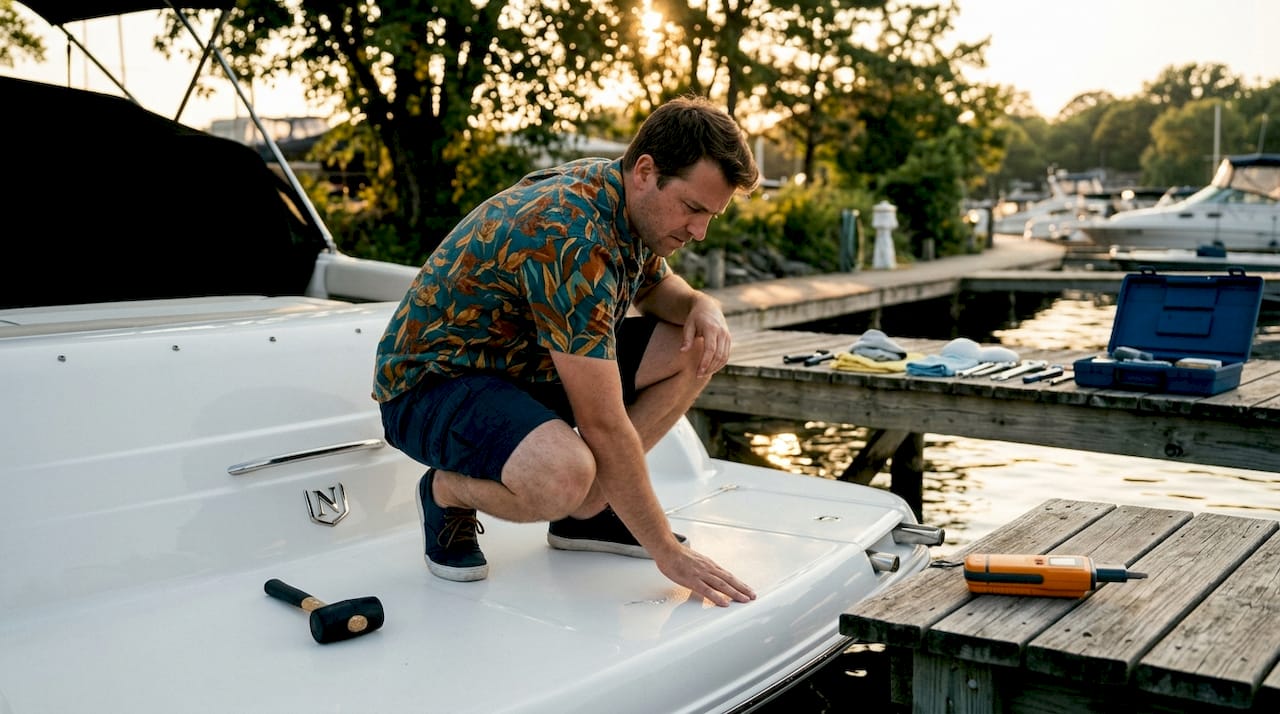
On deck, walk every inch and press down firmly with your foot. Soft spots indicate delamination between the deck skin and core material, which is a structural failure, not a cosmetic one. Check that all deck hardware is bedded properly and shows no signs of weeping rust stains around fasteners.
Pro Tip: Bring a moisture meter and a small rubber mallet. Tap the hull and deck systematically. A dull thud instead of a sharp ring indicates delamination or water intrusion in the core. This technique takes five minutes and can save you from a six-figure repair bill.
2. Engine, mechanical systems, and electrical inspection
The engine room tells the real story of how a boat was maintained. Electrical system issues including poor wiring and unsecured batteries are among the leading causes of boat fires, which makes this section non-negotiable on any used boat inspection checklist.
Work through this list methodically:
- Engine appearance: Look for oil leaks, corrosion on the block, and evidence of overheating such as white mineral deposits around the heat exchanger.
- Fluid levels and condition: Check engine oil, transmission fluid, and coolant. Dark, milky oil signals water intrusion. Low coolant with no explanation is a red flag.
- Heat exchanger zincs: Missing or fully depleted zincs mean the owner neglected corrosion protection. Replace them annually; their condition reveals maintenance habits instantly.
- Hoses and belts: Squeeze every hose. Cracked, soft, or brittle hoses are a failure waiting to happen. Check belt tension and look for fraying.
- Exhaust system: Inspect the wet exhaust hose for burns, cracks, or water staining. A failed exhaust hose can sink a boat at the dock.
- Steering system: Turn the wheel lock to lock. It should move smoothly with no binding or excessive play. Hydraulic steering should show no fluid leaks at the helm or cylinder.
- Bilge pump and bilge condition: A clean, dry bilge is a good sign. Oily water, rust staining, or a pump that runs constantly indicates chronic water intrusion.
- Fuel tanks: Inspect for corrosion, especially on aluminum tanks in saltwater environments. Smell for fuel odors, which can indicate a cracked tank or loose fitting.
- Battery security and electrical panel: Batteries must be secured in rated boxes. The breaker panel should be labeled, organized, and free of corrosion or melted wiring.
- Navigation lights and electronics: Test every circuit. Non-functional nav lights are a Coast Guard violation and a safety hazard.
For outboard engines specifically, a compression tester is a higher-signal check than any visual inspection. Compression testing reveals cylinder health issues that look perfectly fine from the outside.
Pro Tip: Pack a compression tester, a spark plug socket, a multimeter, and a flashlight before every inspection. These four tools will tell you more about a boat’s true condition in 30 minutes than a seller’s service records will in an hour.
3. Conducting a sea trial and system performance testing
Dock appearance alone is not a reliable indicator of a boat’s condition. A sea trial is where hidden failures reveal themselves, and skipping it is one of the most common and expensive mistakes first-time buyers make.
Here is what to evaluate during the trial:
- Cold start behavior: The engine should start without excessive cranking, smoke, or rough idling. Blue smoke means burning oil. White smoke at startup can be normal condensation, but persistent white smoke indicates a head gasket issue.
- Acceleration and wide-open throttle RPM: Sea trial testing should push the engine from idle through wide-open throttle to verify cooling and fuel systems under load. Compare the achieved RPM against the manufacturer’s specified range.
- Steering response under load: At speed, the helm should feel direct and predictable. Vagueness or pulling to one side indicates a steering or trim problem.
- Vibration analysis: Sea trials uncover issues like bent shafts and fuel system problems that are invisible at the dock. Any vibration at a specific RPM range points to a shaft, prop, or strut issue.
- Electronics and navigation instruments underway: Test the chartplotter, VHF radio, depth sounder, and autopilot while moving. Some electronics only malfunction under vibration or load.
- Unusual noises: Knocking, grinding, or squealing under load are disqualifying sounds unless the seller can provide a documented repair history explaining them.
Give the boat at least 30 minutes underway at varied speeds. A 10-minute putter around the marina tells you almost nothing.
4. Financial, legal, and insurance considerations
Physical condition is only half the picture. These due diligence steps protect your ownership rights and your wallet long after the survey is complete.
- Verify the Hull Identification Number (HIN). The HIN is a 12-character code on the transom. HIN verification against the title and registration is non-negotiable legal due diligence. Altering or removing a HIN is a federal crime, and any discrepancy between the HIN and the title is a serious red flag.
- Check for liens and mortgages. A boat can be sold with an outstanding loan attached to it. Run a UCC lien search through your state’s Secretary of State database before signing anything.
- Understand insurance survey requirements. Insurance often requires a professional Condition & Value (C&V) survey for underwriting and coverage approval. A C&V report includes detailed condition assessment, market value documentation, and photo evidence accepted by insurers. Planning the survey early reduces friction when securing both insurance and financing.
- Get financing pre-approval first. Pre-approval improves your negotiating position and clarifies your real budget before you fall in love with a boat that is out of range. Lenders evaluate credit score, income, debt-to-income ratio, and the vessel’s age and condition before approving a marine loan.
- Budget for true ownership costs. The purchase price is the beginning, not the total cost. Factor in annual storage (wet slip or dry storage), haul-out and bottom paint, insurance premiums, registration fees, and routine maintenance. For most boats, annual ownership costs run 10 to 15 percent of the vessel’s value.
- Confirm required safety equipment. The U.S. Coast Guard mandates specific safety gear based on vessel length and type, including life jackets, fire extinguishers, flares, and a sound-producing device. Verify the boat carries compliant, in-date equipment before closing.
Key takeaways
A thorough boat buying checklist covers hull integrity, mechanical systems, sea trial performance, and legal due diligence in that order, and skipping any category creates financial exposure that no price negotiation can fully offset.
| Point | Details |
|---|---|
| Hull and deck first | Tap for soft spots and use a moisture meter before evaluating any other system. |
| Compression testing matters | For outboard engines, a compression tester reveals cylinder health that visual checks miss entirely. |
| Sea trial is non-negotiable | Bent shafts, fuel system failures, and steering issues only appear under real operating conditions. |
| HIN verification protects ownership | Any mismatch between the HIN, title, and registration is a federal-level red flag. |
| Plan the C&V survey early | Scheduling a Condition & Value survey before closing aligns your insurance and financing timelines. |
What I have learned from watching buyers skip the checklist
I have watched buyers walk away from boats they loved because a proper inspection revealed a $40,000 osmosis repair hiding under a fresh coat of bottom paint. I have also watched buyers close on boats with undisclosed engine problems because they trusted a seller’s verbal assurances over a compression test. The checklist is not pessimism. It is the professional standard.
The single biggest mistake I see is treating the inspection as a formality rather than as evidence collection. Inspection workflows are treated by insurers and lenders as documentation for underwriting. That means your photos, your notes, and your surveyor’s report are not just personal records. They are the paper trail that determines your coverage terms and your loan rate.
My honest advice: bring your own tools, take your own photos, and hire a certified marine surveyor who has no relationship with the seller or the broker. The surveyor’s job is to find problems. A good one will find things you missed, and that report becomes your negotiating leverage. I have seen buyers use survey findings to negotiate $15,000 off the asking price on a boat the seller swore was “turn-key ready.”
One more thing. Do not schedule your survey before you have financing pre-approval in hand. If the lender later requires a different survey format or additional documentation, you will pay for a second survey. Align your timeline so the C&V report satisfies both your insurer and your lender in a single appointment. Our team at Yachtingexperts walks buyers through this sequencing every time, because getting the order right saves both money and weeks of delay.
— Jason
Let Yachtingexperts guide your purchase from inspection to closing
Buying a boat is exciting, and it should feel that way from the first viewing to the moment you take the helm. At Yachtingexperts, we offer a high-touch, personalized experience that covers every step of your boat purchase journey, from evaluating listings and arranging private viewings to coordinating Condition & Value surveys accepted by major insurers.

Our team brings the market insight and inspection expertise to protect your investment and give you confidence at the negotiating table. Whether you are buying your first vessel or trading up to something exceptional, we make the process clear, organized, and genuinely enjoyable. Visit our marine survey and consulting services page to see exactly how we can support your purchase from day one.
FAQ
What is a boat buying checklist?
A boat buying checklist is a structured pre-purchase inspection framework covering hull condition, mechanical systems, electrical components, sea trial performance, and legal due diligence. It protects buyers from hidden defects and costly post-purchase repairs.
Do I need a professional marine survey to buy a used boat?
Most insurers require a Condition & Value (C&V) survey for coverage approval, and lenders often require one for marine financing. Scheduling the survey early aligns your insurance and loan timelines in a single step.
What should I bring to a boat inspection?
Bring a moisture meter, rubber mallet, compression tester, spark plug socket, multimeter, and flashlight. These tools reveal hull delamination, cylinder health, and electrical issues that a visual walkthrough will miss.
How long should a sea trial last?
A sea trial should last at least 30 minutes at varied speeds, including a wide-open throttle run. Shorter trials do not generate enough operating time to surface fuel system problems, vibration issues, or electronics failures.
How do I check for liens on a boat?
Run a UCC lien search through your state’s Secretary of State database using the seller’s name and the vessel’s HIN. Any outstanding lien transfers with the title unless formally discharged before closing.
Recommended
Request A Call
Featured Listings

2027 Canados
100
Miami Florida

2015 Maiora
$3,750,000
90
Miami Florida

2027 Canados
57
Miami Florida

2019 Silent-Yachts Fair Dinkum
$1,599,000
55
Fort Lauderdale Florida

2026 Canados
49
Miami Florida

2026 Buddy Davis
47
Miami Florida

2020 Grady-White No Name
$610,000
45
Hallandale Beach Florida

2020 Viking Huckleberry
$1,495,000
44
Fort Lauderdale Florida

2027 Canados
43
Miami Florida

2021 Intrepid Dream Faster
$730,000
40
Coral Gables Florida

2016 Edgewater
$299,000
37
Miami, Florida

2022 Avid
$56,900
23
Stuart Florida
Get your yacht value Estimate
"*" indicates required fields