

TL;DR:
- Most superyachts are owned through corporate, family, or individual structures influencing taxes and privacy.
- Offshore registration, particularly in Cayman Islands, offers privacy, tax benefits, and operational flexibility.
- Fractional ownership models reduce costs and provide access to larger vessels with professional management.
Most people picture a single ultra-wealthy individual as the sole owner of a superyacht. The reality is far more structured, strategic, and frankly more interesting. Superyacht ownership statistics show that 37% of superyachts are held by companies, 35% by individuals, and 28% by families, meaning the majority of these vessels sit inside legal entities rather than personal names. That split is not accidental. Ownership structure shapes your tax exposure, privacy, liability, and even how much you enjoy the vessel day to day. This guide breaks down every major model, from offshore corporations to fractional syndicates, so you can make the most informed decision possible.
Table of Contents
- Superyacht ownership models: Corporate, individual, and family structures
- Jurisdictions and registration: Where and why owners flag their yachts
- Offshore, onshore, and hybrid structures: LLCs, trusts, and special vehicles explained
- Shared and fractional ownership: Syndicates, cost sharing, and new investment trends
- Operating costs, chartering offsets, and real investment outcomes
- A smarter approach to superyacht ownership: What most buyers overlook
- Elevate your yachting journey with expert-led solutions
- Frequently asked questions
Key Takeaways
| Point | Details |
|---|---|
| Corporate structures prevail | Most superyachts are owned through company setups for privacy and cost benefits. |
| Jurisdiction impacts taxes | Where you register your yacht affects costs, compliance, and privacy levels. |
| Shared ownership rising | Fractional and syndicate models offer lower entry costs and professional management. |
| Charter rarely breaks even | Chartering covers much but not all running expenses; strategic ownership is essential. |
| Expert guidance pays off | Choosing the right structure with expert help maximizes enjoyment and investment returns. |
Superyacht ownership models: Corporate, individual, and family structures
Having set the stage for why structures matter, let’s break down the primary ownership models you can use. Each comes with a distinct risk profile, set of benefits, and ideal use case.
Corporate ownership is the most popular choice for a reason. Holding your yacht inside an LLC or offshore company creates a legal wall between your personal assets and any liability the vessel generates. It also opens the door to meaningful tax planning and keeps your name off public registries. For owners who charter their vessel or operate across multiple jurisdictions, corporate ownership is almost always the starting point.
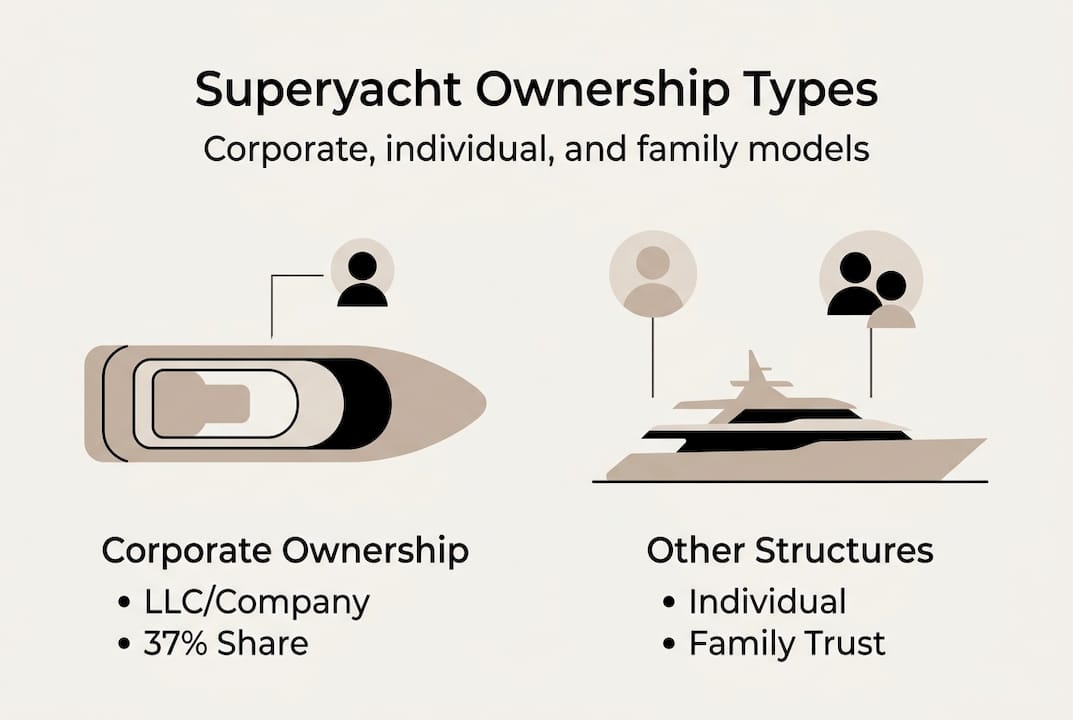
Individual ownership is the simplest path. You buy the yacht, your name is on the documentation, and you have direct control over every decision. The trade-off is exposure. Without a corporate layer, your personal assets are at risk if a crew member is injured or a charter guest files a claim. Privacy is also limited, since individual ownership is easier to trace through public records.
Family ownership structures are designed for multi-generational use and succession planning. These arrangements often involve a family trust or holding company that distributes usage rights among family members. The challenge is governance. Without clear agreements on scheduling, maintenance responsibilities, and exit strategies, family ownership can become contentious.
Here is a quick comparison of the three models:
| Structure | Privacy | Tax benefits | Liability protection | Complexity |
|---|---|---|---|---|
| Corporate (LLC/offshore) | High | High | Strong | Moderate to high |
| Individual | Low | Limited | Minimal | Low |
| Family trust/holding | Moderate | Moderate | Strong | High |
One statistic that puts this all in perspective: UHNWIs (ultra-high-net-worth individuals with $50M or more in assets) control 92% of superyachts over 50 meters. At that level, the question is never whether to use a structure. It is which structure. Understanding yacht management value becomes critical once you commit to a model, because management costs and efficiencies vary significantly by structure.
“The ownership model you choose on day one will follow your vessel for its entire life. Getting it right from the start is not optional, it is essential.”
Jurisdictions and registration: Where and why owners flag their yachts
Once you know your structure, choosing where to register your yacht shapes everything from costs to privacy. The flag state you choose determines which country’s maritime law governs your vessel, which inspection regime applies, and what your crew certification requirements look like.

The numbers tell a clear story. Cayman Islands registration dominates at 54% of superyacht registrations, followed by Malta at 9% and the Marshall Islands at 8%. These jurisdictions have built reputations for efficient administration, strong privacy protections, and favorable tax treatment.
Here is how the top jurisdictions compare:
| Jurisdiction | Market share | Privacy level | VAT/tax exposure | Compliance burden |
|---|---|---|---|---|
| Cayman Islands | 54% | Very high | Minimal | Moderate |
| Malta | 9% | Moderate | EU VAT applies | Moderate |
| Marshall Islands | 8% | High | Minimal | Low |
| US (domestic) | Varies | Low | State taxes apply | High |
Key reasons owners choose offshore registration include:
- Privacy: Offshore registries do not publicly link vessel names to individual owners
- Tax efficiency: Many offshore jurisdictions impose no VAT or income tax on charter income
- Flexibility: Easier crew certification from a wider international pool
- Resale appeal: Cayman-flagged vessels are widely recognized and trusted by buyers globally
American owners face a specific consideration. Registering domestically under the US flag triggers Coast Guard documentation requirements and exposes the vessel to state sales and use taxes. Offshore registration, paired with smart yacht tax strategies, can dramatically reduce that exposure for owners who spend significant time in international waters.
The flag state decision also affects day-to-day operations. A Cayman-registered vessel operating in European waters still needs to comply with local port state control inspections. Choosing a reputable flag with strong international standing reduces the friction of those encounters considerably.
Offshore, onshore, and hybrid structures: LLCs, trusts, and special vehicles explained
With registration explained, it is time to understand the underlying legal vehicles that shape your ownership experience. The structure you use is not just a formality. It determines how income is taxed, how liability flows, and how your estate plan treats the asset.
Common ownership structures include US LLCs, offshore companies, trusts and foundations, and special-purpose vehicles (SPVs). Each serves a different strategic purpose.
US LLCs are a strong choice for owners who primarily use their yacht in American waters or plan to charter domestically. The LLC offers pass-through taxation, meaning income and deductions flow to your personal return without corporate-level tax. Liability protection is solid. The downside is that the US tax system follows you globally, so charter income earned abroad is still reportable.
Offshore companies registered in the Cayman Islands or Malta are the preferred vehicle for international owners. They offer maximum privacy, minimal tax exposure on charter income, and flexibility in crew arrangements. The trade-off is compliance. Offshore structures face increasing scrutiny under substance test requirements, meaning the company must demonstrate genuine economic activity in its jurisdiction.
Trusts and foundations (popular in Jersey and Liechtenstein) are ideal for succession planning. They separate legal ownership from beneficial enjoyment, allowing family members to use the vessel without triggering estate tax events.
SPVs are used for complex syndicate arrangements or when multiple investors co-own a single vessel. Each investor holds a share of the SPV rather than the vessel itself, simplifying transfer of ownership interests.
Pro Tip: Combining a US LLC with an offshore holding company creates a layered structure that captures domestic tax deductions while shielding international charter income. This hybrid approach is increasingly popular among American UHNWIs. Review the latest LLC tax laws before finalizing your setup, as 2025 changes affect charter deduction eligibility.
The biggest pitfall to avoid is the IRS hobby loss rule. If your yacht generates losses year after year without a credible profit motive, the IRS can disallow those deductions entirely.
Shared and fractional ownership: Syndicates, cost sharing, and new investment trends
While traditional structures dominate, new shared models are rapidly changing the game for savvy buyers. Fractional and syndicate ownership has moved from niche experiment to mainstream strategy, and the growth numbers are striking.
Syndicate ownership grew 45% in 2025, with typical entry points ranging from $500,000 to $3 million for a 1/8 to 1/12 share of a superyacht. That is a fraction of the $10 to $30 million you might spend on outright ownership of a comparable vessel.
Here is how a typical syndicate works:
- Formation: A professional management company or broker assembles 8 to 12 investors
- Ownership vehicle: Each investor holds a share in an SPV that owns the vessel
- Usage allocation: Weeks are divided among owners, often through a booking platform or rotation system
- Costs: Operating expenses are split proportionally, reducing each owner’s annual burden by up to 90%
- Charter income: When no owner is using the vessel, it enters a managed charter program
- Exit: Shares can be sold independently, providing liquidity that outright ownership rarely offers
Who benefits most from this model? Owners who want 4 to 8 weeks of superyacht access per year, not 20. Buyers who want exposure to a larger, more impressive vessel than they could justify owning outright. Investors who want the asset to generate income between personal use periods.
Pro Tip: Fractional ownership transforms a superyacht from a pure cost center into a semi-yielding asset. Pair it with a strong co-ownership model and professional charter management, and you can realistically offset 70 to 90% of your annual costs. For a deeper look at return expectations, explore yacht investment returns before committing.
“The smartest buyers in 2026 are not asking ‘can I afford to own this yacht?’ They are asking ‘what structure makes this yacht work hardest for me?’”
Operating costs, chartering offsets, and real investment outcomes
To complete the ownership picture, let’s address the costs, revenue streams, and investment logic underpinning each structure. Understanding the numbers before you buy is what separates a rewarding ownership experience from a frustrating one.
Annual operating costs run between 10% and 20% of the vessel’s value every year. On a $20 million yacht, that is $2 to $4 million annually before you set foot on board. Chartering can offset 50% to 80% of those costs, but it rarely covers them entirely.
Here is where those costs go:
- Crew: The single largest expense, often 30 to 40% of total operating costs
- Insurance: Typically 1 to 1.5% of vessel value annually
- Berthing and marina fees: Vary dramatically by location, from $50,000 to over $500,000 per year
- Maintenance and refit: Older vessels or those in heavy charter use require more frequent and expensive work
- Legal and compliance: Structure maintenance, flag state fees, and tax filings add up quickly
The ownership structure directly influences how much of this you can offset. A US LLC with a documented charter program allows you to deduct operating losses against other income, subject to passive activity rules. An offshore company can shield charter income from US taxation if structured correctly. Fractional ownership slashes the absolute dollar amount of each cost category.
The honest truth is that very few superyacht owners turn a genuine profit. But disciplined owners who choose the right structure, commit to a managed charter program, and work with experienced advisors can realistically recover 60 to 80% of their annual costs. That changes the math considerably. For a full breakdown of what returns look like in practice, our maximizing yacht ROI guide walks through real scenarios.
A smarter approach to superyacht ownership: What most buyers overlook
After exploring conventional and innovative structures, here is an honest perspective based on real-world client outcomes. Most buyers we work with arrive focused on the vessel itself: the brand, the length, the interior design. That excitement is completely understandable. But the owners who get the most from their investment are the ones who treat the structure as seriously as the yacht.
We have seen clients purchase exceptional vessels and then struggle for years because the ownership entity was set up hastily, the flag state was chosen for the wrong reasons, or the charter program was an afterthought. Conversely, clients who invest time in the ownership workflow before signing anything tend to enjoy their yachts more, spend less on surprises, and exit at better values.
The contrarian insight is this: a well-designed ownership structure often matters more than the vessel itself. A $15 million yacht inside a smart, flexible structure will outperform a $25 million yacht held carelessly. Structure is leverage. Use it intentionally.
Elevate your yachting journey with expert-led solutions
If you are ready to move from understanding to action, we are here to make that transition seamless. At Yachting Experts, we specialize in helping high net worth buyers build ownership structures that protect assets, maximize enjoyment, and position every vessel for the strongest possible return.

Our team provides personalized guidance on custom structure setup, whether you are exploring LLCs, offshore entities, or fractional syndicate entry. We also connect clients with proven yacht management experts who keep operating costs in check and charter programs performing. Before you commit, review our investment return guide to set realistic expectations and identify the structure that fits your goals. This is your moment to own smarter.
Frequently asked questions
What is the most common superyacht ownership structure?
The most common structure is a corporate entity, such as an LLC or offshore company, used by 37% of owners for asset protection and tax benefits.
Does a superyacht owner need to register offshore?
Offshore registration is not required, but 54% choose Cayman Islands registration for privacy and tax advantages. Domestic and hybrid setups are viable depending on your goals.
Can chartering a superyacht cover all ownership costs?
Chartering typically offsets 50 to 80% of annual costs but rarely covers everything. A disciplined structure with professional charter management maximizes the offset.
What are the risks of improper ownership structure?
Poor structures can trigger IRS hobby loss disallowances, fail substance tests, and expose owners to penalties in their chosen jurisdiction. Expert setup from the start prevents costly corrections later.
How does fractional superyacht ownership work?
Fractional ownership lets you purchase a 1/8 to 1/12 share of a vessel, dramatically lowering entry costs while providing professional management and access to charter income between personal use periods.
Recommended
Request A Call
Featured Listings

2027 Canados
100
Miami Florida

2015 Maiora
$3,750,000
90
Miami Florida

2027 Canados
57
Miami Florida

2019 Silent-Yachts Fair Dinkum
$1,599,000
55
Fort Lauderdale Florida

2026 Canados
49
Miami Florida

2026 Buddy Davis
47
Miami Florida

2020 Grady-White No Name
$610,000
45
Hallandale Beach Florida

2020 Viking Huckleberry
$1,495,000
44
Fort Lauderdale Florida

2027 Canados
43
Miami Florida

2021 Intrepid Dream Faster
$730,000
40
Coral Gables Florida

2016 Edgewater
$299,000
37
Miami, Florida

2022 Avid
$56,900
23
Stuart Florida
Get your yacht value Estimate
"*" indicates required fields