

A sea trial is the on-water performance and safety evaluation that every yacht buyer must complete before signing a purchase agreement. The role of sea trials in buying is to give you direct, real-world evidence of how a vessel performs under load, how its systems behave, and whether any mechanical issues are hiding beneath a polished exterior. Think of it as the equivalent of a test drive, except the stakes are considerably higher and the price tag has more zeros. Skipping this step is one of the most expensive mistakes a first-time buyer can make.
What does the role of sea trials in buying actually cover?
A sea trial is not a casual cruise around the marina. It is a structured, systematic evaluation of every major system and performance characteristic on the vessel. Key systems tested include the engine, handling, safety features, navigation systems, bilge pumps, and lights. Each of those systems tells you something different about the vessel’s condition and reliability.
Here is what a thorough sea trial evaluation covers:
- Engine and propulsion: Acceleration, throttle response, and behavior at full load. Listen for unusual sounds and watch for smoke or vibration.
- Handling and maneuverability: How the yacht responds at low speed, in tight turns, and during docking. Poor handling can signal steering system wear.
- Electrical systems: Navigation lights, VHF radio, chartplotter, and bilge pumps. A failed bilge pump is not a minor inconvenience. It is a safety risk.
- Safety equipment: Life raft releases, fire suppression systems, and emergency signaling devices. These must function without hesitation.
- Comfort and seaworthiness: Comfort and seaworthiness go beyond raw engine performance. How does the hull handle chop? Does the ride feel stable at cruising speed?
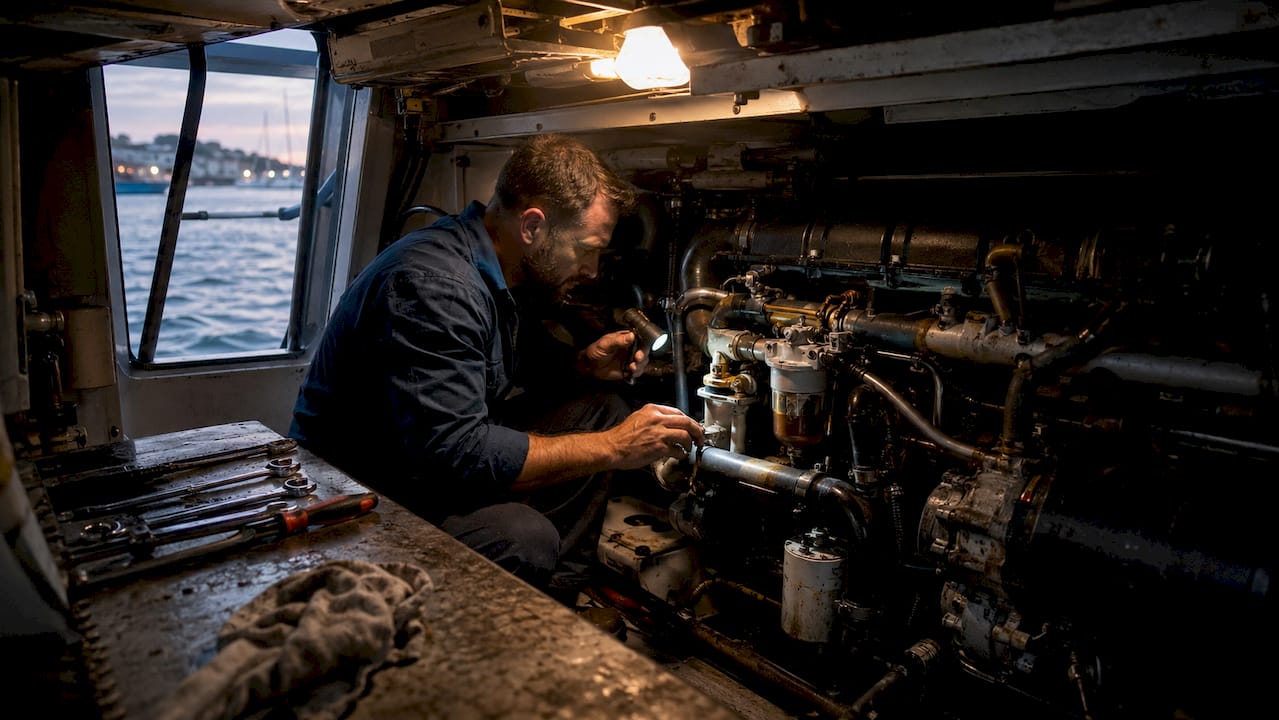
Pro Tip: Start in the engine bay before the engine even turns over. Look for oil leaks, fuel odors, and corrosion. Problems found dockside are far easier to document and negotiate than issues discovered mid-water.
For vessels over 30 feet, industry guidance recommends a trial duration of 2–3 hours. That window gives you enough time to test systems under sustained load, not just during a brief warm-up. A 20-minute spin around the harbor tells you almost nothing useful.
How do sea trials differ from marine surveys?
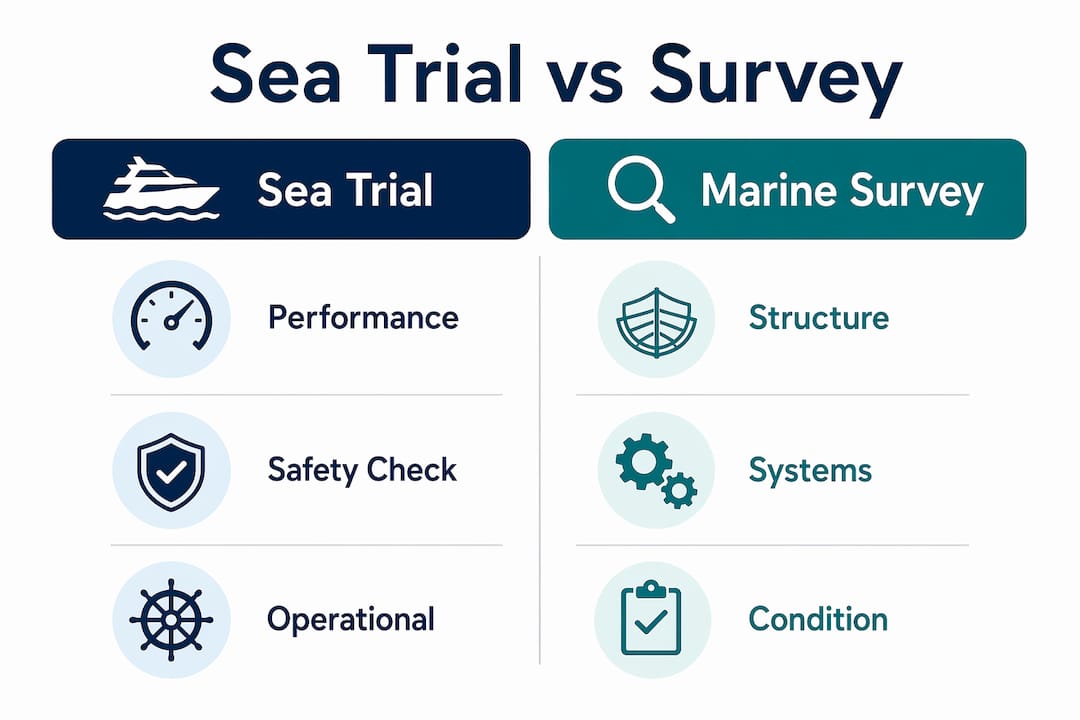
Buyers often confuse sea trials with marine surveys, and that confusion can leave serious gaps in their due diligence. Sea trials and marine surveys are distinct processes with different purposes, and you need both.
| Factor | Sea Trial | Marine Survey |
|---|---|---|
| Focus | Operational performance on water | Structural integrity and systems inspection |
| Location | Conducted underway | Conducted at dock or on the hard |
| What it finds | Engine faults, handling issues, electrical failures | Hull damage, osmotic blisters, hidden corrosion |
| Who leads it | Buyer, broker, or captain | Certified marine surveyor |
| When it happens | After initial inspection, before purchase | Typically concurrent or just before closing |
A marine survey examines the hull below the waterline, the structural components, and the condition of fixed systems. A sea trial proves whether those systems actually work when the vessel is moving. Neither process replaces the other. A yacht can pass a survey with flying colors and still reveal a misfiring engine or a sluggish autopilot the moment you leave the dock.
Marine surveyors add significant value when they attend the sea trial alongside you. They can identify subtle system faults that an untrained eye will miss entirely. Their presence transforms the trial from a general impression into a documented diagnostic report. That report becomes your negotiating tool.
The cost of the sea trial itself is typically the buyer’s responsibility, covering fuel and any captain or crew fees. The survey cost is also the buyer’s expense. Budget for both without hesitation. These are not optional line items on a six or seven-figure purchase.
Why is skipping a sea trial a costly mistake?
Mechanical failure causes 26% of boating accidents. That single statistic reframes the entire conversation. A sea trial is not just a performance check. It is a safety verification that protects you, your crew, and your passengers before you ever leave the dock as the new owner.
“Skipping a sea trial can lead to unforeseen mechanical or operational issues with no recourse for the buyer.” — BoatTEST
The financial implications are just as serious. Buyers who skip sea trials regularly discover engine problems, failing transmissions, or malfunctioning navigation systems after the sale closes. At that point, the seller has no legal obligation to cover repairs. You own the problem entirely.
Sea trials also give you direct leverage in price negotiations. When a trial reveals that the raw water pump needs replacement or that the autopilot is unreliable, you have documented evidence to request a price reduction or require the seller to complete repairs before closing. Without that evidence, you are negotiating blind. With it, you are negotiating from a position of knowledge.
The yacht inspection process works best when the sea trial findings feed directly into your final offer. A vessel that performs flawlessly commands its asking price. One that reveals issues during the trial gives you room to negotiate or walk away entirely. Both outcomes protect your investment.
Insurance implications are worth noting as well. Some marine insurers require documented sea trial results before issuing a policy on a pre-owned vessel. Arriving at closing without that documentation can delay coverage or affect your premium.
How should you prepare for a productive sea trial?
Preparation determines whether your sea trial produces useful information or just a pleasant afternoon on the water. Follow these steps to get the most from the experience.
-
Schedule in suitable conditions. Appropriate weather is not about comfort. It is about realistic testing. Calm, flat water hides handling problems that moderate chop would reveal immediately. Aim for conditions that reflect how you actually plan to use the vessel.
-
Bring a marine surveyor or experienced broker. This is not the time to rely solely on your own impressions. A professional eye catches what enthusiasm misses. Yachtingexperts recommends having your yacht broker present to coordinate the process and document findings in real time.
-
Use a structured checklist. The yacht inspection checklist approach removes the risk of forgetting a system in the excitement of the moment. Work through every item methodically, from engine bay to navigation station.
-
Take detailed notes and photographs. Detailed notes and checklists are the foundation of informed post-trial decisions and effective negotiation. Photograph every system you test, every reading you observe, and every anomaly you notice.
-
Test at multiple speeds. Run the vessel at idle, cruising speed, and full throttle. Each speed range reveals different information about engine health, hull behavior, and system stability.
-
Do not rush the dockside inspection. The dockside systems check before departure is the most critical safety step in the entire trial. Confirm that all safety equipment is present, accessible, and functional before you leave the slip.
Pro Tip: After the trial, give yourself 24 hours before making any decisions. Review your notes, consult your surveyor, and compare findings against the asking price. Emotional decisions made immediately after a beautiful day on the water rarely serve your financial interests.
Common mistakes buyers make include testing only at calm-water speeds, skipping minor systems like the horn or anchor windlass, and failing to run the air conditioning or generator under load. Minor systems matter. A failed windlass on a 50-foot cruiser is a $3,000 repair you did not budget for.
Key takeaways
A sea trial is the single most important on-water step in the yacht buying process, protecting both your safety and your financial investment.
| Point | Details |
|---|---|
| Sea trials verify real performance | Test engines, handling, and all onboard systems under actual operating conditions. |
| Mechanical failure is a real risk | Mechanical failure causes 26% of boating accidents, making trials a safety necessity. |
| Trials differ from surveys | Surveys assess structure; sea trials confirm operational performance. Use both. |
| Preparation drives results | Bring a surveyor, use a checklist, and schedule in realistic weather conditions. |
| Findings support negotiation | Documented issues from the trial give buyers leverage to adjust price or require repairs. |
What i’ve learned after watching buyers skip this step
I have seen buyers fall in love with a yacht at the dock and convince themselves the sea trial is a formality. It never is. One client I worked with nearly purchased a 52-foot motor yacht that looked immaculate in photos and at the slip. During the trial, the port engine overheated within 40 minutes. The seller had no idea, or so he said. That discovery saved my client roughly $28,000 in repair costs and gave him the option to renegotiate or walk away with his deposit.
The emotional confidence a clean sea trial provides is just as real as the financial protection. When a vessel performs exactly as advertised, you board it as the new owner with genuine peace of mind. That feeling is worth every hour of preparation.
First-time buyers often ask me whether they really need both a survey and a sea trial. My answer is always yes, without hesitation. The surveyor’s role in boat buying is to assess what you cannot see. The sea trial is to confirm what you can. Together, they give you a complete picture. Separately, each one leaves a blind spot large enough to cost you real money.
— Jason
Let Yachtingexperts guide you through every step
Buying a yacht is one of the most significant investments you will make, and the sea trial is where that investment is either protected or put at risk. At Yachtingexperts, we walk alongside you through every stage of the buying process, from vessel sourcing and private viewings to coordinating your sea trial and survey with trusted professionals.

Our team brings the market insight and hands-on experience to help you evaluate every finding from your trial and negotiate from a position of strength. Whether you are purchasing your first vessel or trading up to something exceptional, we make the process straightforward and rewarding. Connect with our team through our buyer consultation page and let us help you find a yacht that performs as beautifully on the water as it looks at the dock.
FAQ
What is a sea trial in yacht buying?
A sea trial is an on-water test conducted before purchase to evaluate a yacht’s engine performance, handling, safety systems, and overall operational condition. It is a required step in responsible yacht buying.
How long should a sea trial last?
For vessels over 30 feet, industry guidance recommends a duration of 2–3 hours to fully evaluate systems under sustained load. Shorter trials do not provide enough data to make a confident purchase decision.
Do i need both a sea trial and a marine survey?
Yes. A marine survey inspects structural integrity and fixed systems, while a sea trial confirms operational performance on the water. Both processes address different risks and complement each other in the buying process.
Who pays for the sea trial?
The buyer typically covers the cost of the sea trial, including fuel and any captain or crew fees. This is a standard expectation in the yacht buying process and a worthwhile expense relative to the purchase price.
Can sea trial findings affect the purchase price?
Documented issues discovered during a sea trial give buyers direct leverage to negotiate a lower price or require the seller to complete repairs before closing. Detailed notes and surveyor reports are the tools that make that negotiation effective.
Recommended
Request A Call
Featured Listings

2027 Canados
100
Miami Florida

2015 Maiora
$3,750,000
90
Miami Florida

2027 Canados
57
Miami Florida

2019 Silent-Yachts Fair Dinkum
$1,599,000
55
Fort Lauderdale Florida

2026 Canados
49
Miami Florida

2026 Buddy Davis
47
Miami Florida

2020 Grady-White No Name
$610,000
45
Hallandale Beach Florida

2020 Viking Huckleberry
$1,495,000
44
Fort Lauderdale Florida

2027 Canados
43
Miami Florida

2021 Intrepid Dream Faster
$730,000
40
Coral Gables Florida

2016 Edgewater
$299,000
37
Miami, Florida

2022 Avid
$56,900
23
Stuart Florida
Get your yacht value Estimate
"*" indicates required fields