

Buying or selling a yacht in Florida should feel exciting, not confusing. Yet many yacht owners find themselves lost in a sea of unfamiliar terms like closing costs, broker commissions, and contingencies. Understanding yacht sales terminology transforms complex transactions into confident decisions. This guide breaks down essential terms used in Florida’s yacht market, helping you navigate contracts, negotiations, and documentation with clarity. Whether you’re preparing to sell your current vessel or searching for your next yacht, mastering this language empowers you to maximize value and avoid costly mistakes.
Table of Contents
- Common Yacht Sales Terms Every Florida Owner Should Know
- Navigating Contracts, Commissions, And Negotiation Phrases In Florida Yacht Sales
- Comparing Yacht Sales Structures And Documentation In Florida: A Quick Guide
- Applying Yacht Sales Terminology: Practical Tips For Buying And Selling In Florida
- Explore Expert Yacht Sales Support With Yachting Experts Florida
- Frequently Asked Questions About Yacht Sales Terminology In Florida
Key takeaways
| Point | Details |
|---|---|
| Terminology impacts outcomes | Understanding yacht sales terms directly affects negotiations, contracts, and final transaction results. |
| Florida has unique market terms | Florida’s yacht market includes specific terminology related to commissions, registration, and coastal regulations. |
| Knowledge builds confidence | Clear understanding of sales language speeds up processes and helps you make informed decisions. |
| Expert guidance simplifies jargon | Working with experienced brokers translates complex terminology into actionable steps for your transaction. |
| Documentation requires precision | Proper use of terms ensures legal compliance and prevents delays during closing. |
Common yacht sales terms every Florida owner should know
Every yacht transaction starts with foundational terminology that shapes how deals unfold. Yacht sales involve specialized terms distinct to Florida’s market, and understanding these basics prevents surprises during negotiations. A listing agreement establishes the formal relationship between you and your broker, outlining responsibilities, duration, and commission structure. The asking price represents your initial valuation, though market conditions and survey results often influence the final sale price.
Closing costs encompass all expenses required to finalize the transaction. These typically include title transfer fees, documentation stamps, and survey costs. In Florida, closing costs can range from 2% to 5% of the purchase price depending on the yacht’s value and complexity. Broker commission refers to the fee paid to the yacht broker for facilitating the sale, usually split between the listing broker and buyer’s broker. Understanding commission structures helps you budget accurately and negotiate effectively.
A sea trial allows potential buyers to test the yacht’s performance under real conditions. This critical step reveals mechanical issues, handling characteristics, and overall vessel condition that static inspections might miss. Most Florida yacht sales include a sea trial clause in the purchase agreement, giving buyers the right to evaluate the yacht before finalizing the deal. Sellers should prepare their yacht thoroughly for this evaluation, as performance issues discovered during sea trials often lead to price renegotiations.
Key terms to remember:
- Listing agreement: Contract between seller and broker defining terms of representation
- Asking price: Initial price set by seller based on market analysis and yacht condition
- Closing costs: All fees required to complete the transaction legally
- Broker commission: Percentage of sale price paid to brokers for their services
- Sea trial: On-water test of yacht performance before purchase commitment
- Survey: Professional inspection assessing yacht condition and value
- Title: Legal document proving ownership of the vessel
Familiarizing yourself with these terms creates a solid foundation for understanding the Florida yacht sales process. When you speak the same language as your broker and potential buyers or sellers, communication becomes clearer and transactions progress more smoothly. This knowledge also helps you identify when using a yacht broker adds value to your specific situation.
Navigating contracts, commissions, and negotiation phrases in Florida yacht sales
Contracts form the legal backbone of every yacht transaction, and understanding their terminology protects your interests. An exclusive brokerage agreement grants one broker the sole right to represent your yacht for a specified period. This arrangement often motivates brokers to invest more resources in marketing your vessel, though it limits your ability to work with multiple brokers simultaneously. Dual agency occurs when one broker represents both buyer and seller, a situation requiring careful disclosure and consent from both parties.

Understanding yacht commission terms is crucial to maximize seller’s returns in Florida’s competitive market. Commission split describes how the total broker fee divides between the listing broker and buyer’s broker, typically ranging from 8% to 10% of the sale price. The closing date specifies when ownership officially transfers and payment completes, usually occurring after all contingencies are satisfied and documentation is finalized.
Negotiation phrases carry specific meanings that affect deal structure. A firm offer indicates the buyer will not negotiate further on price, though other terms may remain flexible. Contingencies are conditions that must be met before the sale finalizes, such as satisfactory survey results or successful sea trials. A counteroffer represents the seller’s response to an initial offer, proposing different terms or price. Understanding these phrases helps you respond appropriately during negotiations and avoid misunderstandings that could derail transactions.
Contracts regulate obligations and protect both parties throughout the transaction. The purchase agreement outlines all terms including price, deposit amount, contingencies, and closing timeline. Deposit clauses specify how much money the buyer must place in escrow to demonstrate serious intent, typically 10% of the purchase price. Default provisions explain consequences if either party fails to fulfill their contractual obligations.
Pro Tip: Negotiate broker commissions before signing a listing agreement. Many brokers will adjust their rates for high-value yachts or motivated sellers, potentially saving you thousands of dollars. Research typical commission rates in Florida’s yacht market and use this knowledge to secure competitive terms.
Common negotiation terms:
- Exclusive brokerage: Single broker representation for specified period
- Dual agency: One broker representing both buyer and seller
- Commission split: Division of total broker fee between listing and buyer’s brokers
- Firm offer: Non-negotiable price proposal from buyer
- Contingencies: Conditions that must be satisfied before sale completion
- Counteroffer: Seller’s response proposing different terms
- Deposit: Earnest money held in escrow demonstrating buyer commitment
The Florida yacht commission guide provides detailed strategies for negotiating favorable terms. Working with an experienced professional who understands the yacht broker role in Florida ensures contracts protect your interests while facilitating smooth transactions.
Comparing yacht sales structures and documentation in Florida: A quick guide
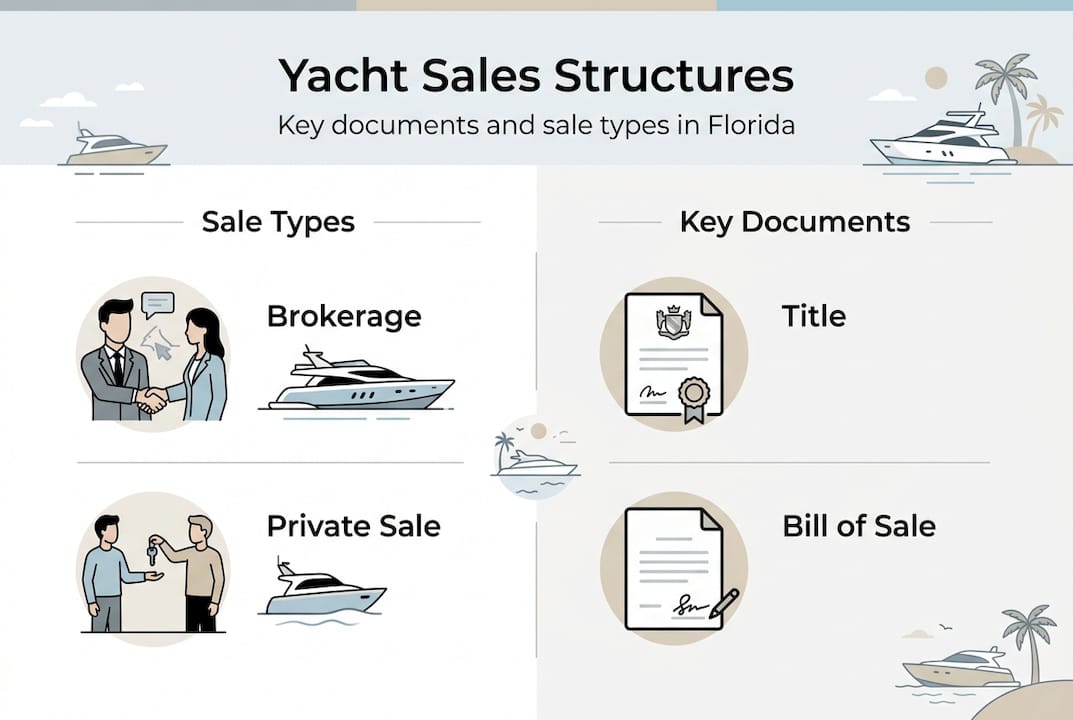
Different sales structures offer distinct advantages depending on your timeline, vessel value, and market conditions. Proper documentation streamlines yacht sales and prevents legal complications in Florida’s regulated maritime environment. A private sale occurs when you sell directly to a buyer without broker representation, offering maximum control but requiring you to handle all marketing, negotiations, and paperwork. Brokered sales involve professional representation that manages the entire process, from listing to closing, in exchange for commission fees. Auction sales create competitive bidding environments that can accelerate transactions, though final prices may vary significantly from asking prices.
| Sale Structure | Typical Timeline | Seller Responsibilities | Documentation Requirements | Best For |
|---|---|---|---|---|
| Private Sale | 6-12 months | Marketing, showings, negotiations, paperwork | Title certificate, bill of sale, registration, survey | Experienced sellers with time and market knowledge |
| Brokered Sale | 3-9 months | Yacht preparation, broker cooperation | Listing agreement, title, survey, maintenance records | Most sellers seeking professional guidance |
| Auction Sale | 1-3 months | Pre-auction preparation, reserve price setting | Title certificate, condition report, registration | Motivated sellers needing quick transactions |
Required documentation varies by sale structure but certain documents remain essential across all transactions. The title certificate proves legal ownership and must be clear of liens or encumbrances. Survey reports provide professional assessments of yacht condition, systems, and value, typically required by buyers and their lenders. Registration proof demonstrates compliance with Florida and federal maritime regulations. Maintenance records document service history and help buyers understand how well the yacht has been cared for over time.
Bill of sale transfers ownership legally from seller to buyer, including detailed yacht description and purchase price. Insurance certificates may be required during the transaction to protect all parties’ interests. Lien releases confirm that any outstanding loans or claims against the yacht have been satisfied. Tax documentation proves payment of applicable sales taxes and supports legal ownership transfer.
Pro Tip: Organize all documentation in a digital folder before listing your yacht. This preparation prevents delays when buyers request information and demonstrates professionalism that can justify higher asking prices. Include high-resolution photos, recent survey reports, and complete maintenance logs.
The yacht brokerage overview explains how professional brokers manage documentation complexities. Whether you choose a private sale or work with professionals, understanding documentation requirements prevents costly delays. The comprehensive how to sell a yacht guide walks through each paperwork requirement in detail, ensuring you’re prepared for every stage of the transaction.
Applying yacht sales terminology: practical tips for buying and selling in Florida
Knowledge becomes valuable only when applied to real transactions. Using correct terminology confidently can accelerate yacht sales and maximize value in Florida’s competitive market. Follow these steps to leverage your understanding of yacht sales language effectively.
-
Prepare your vocabulary before initial conversations. Review key terms related to your specific transaction type, whether buying or selling. This preparation helps you ask informed questions and understand broker recommendations without confusion.
-
Communicate clearly with all parties using precise terminology. When discussing offers, use terms like counteroffer and contingencies accurately to avoid misunderstandings. Precise language reduces back and forth negotiations and speeds up decision making.
-
Read contracts thoroughly, identifying each term and its implications. Don’t sign documents containing unfamiliar phrases. Ask your broker or attorney to explain any terminology you don’t fully understand before committing.
-
Document all communications using correct terminology. Written records using precise language protect you if disputes arise later. Email summaries after phone conversations, confirming what was discussed using proper yacht sales terms.
-
Negotiate confidently by referencing specific contract clauses and market terms. When you understand commission structures, closing costs, and contingency timelines, you can propose reasonable modifications that benefit your position.
-
Verify that all parties interpret terms identically. Regional variations in yacht sales language can cause confusion. Confirm that your understanding of terms like closing costs or sea trial matches what your broker and counterparty mean.
Common mistakes to avoid:
- Assuming you understand terms without verification
- Signing contracts containing unfamiliar language
- Mixing up similar terms like asking price and fair market value
- Failing to clarify who pays specific closing costs
- Overlooking contingency deadlines in purchase agreements
- Confusing exclusive listings with open listings
Pro Tip: Create a personal glossary of terms specific to your transaction. As you encounter new phrases during your yacht sale or purchase, add them to your list with definitions. This reference tool helps you stay organized and confident throughout the process.
The benefits of a yacht broker include translating complex terminology into actionable advice. Brokers serve as interpreters between technical maritime language and practical decision making. When you understand the basics yourself, you can have more productive conversations with your broker and make faster, more confident decisions. The detailed selling a yacht guide provides additional context for applying terminology throughout the sales process.
Your yacht ownership guide extends beyond initial purchase or sale. Understanding terminology helps you maintain value throughout ownership, from insurance discussions to maintenance planning. This knowledge compounds over time, making each subsequent transaction smoother and more profitable.
Explore expert yacht sales support with Yachting Experts Florida
Mastering yacht sales terminology represents an important first step, but applying this knowledge effectively requires experience and market insight. Yachting Experts simplifies complex yacht sales language for Florida owners through personalized guidance tailored to your specific situation. Our team translates technical jargon into clear action steps, ensuring you understand every aspect of your transaction without feeling overwhelmed.

We provide hands-on support throughout the entire sales and purchase process, from initial valuation to final closing. Our expertise in Florida’s unique yacht market means we understand regional terminology variations and regulatory requirements that affect your transaction. Whether you’re selling your current yacht to upgrade or purchasing your first vessel, our brokers maximize transaction value while protecting your interests. Understanding the role of a yacht broker helps you appreciate how professional guidance transforms complex processes into smooth experiences. Explore our comprehensive Florida yacht sales process guide or visit our yacht selling services page to discover how we can help you achieve your yachting dreams with confidence.
Frequently asked questions about yacht sales terminology in Florida
What does closing costs typically include in Florida yacht sales?
Closing costs in Florida yacht sales include title transfer fees, documentation stamps, survey expenses, and registration costs. Depending on the transaction, you may also pay for lien searches, insurance prorations, and escrow services. These costs typically range from 2% to 5% of the purchase price, with buyers and sellers negotiating who pays specific fees.
Why is understanding broker commission important for sellers?
Understanding broker commission helps sellers budget accurately and negotiate favorable terms before signing listing agreements. Commission rates typically range from 8% to 10% of the sale price, directly impacting your net proceeds. Knowing how commissions split between brokers allows you to evaluate whether dual agency or separate representation better serves your interests.
How can I verify all required documents before closing?
Work with your broker or maritime attorney to create a closing checklist specific to your transaction. Essential documents include clear title certificate, recent survey report, bill of sale, registration proof, and lien releases. Request copies of all documents at least one week before closing to review thoroughly and address any discrepancies.
What are contingencies in yacht sale contracts?
Contingencies are conditions that must be satisfied before the sale finalizes, protecting buyers from unforeseen issues. Common contingencies include satisfactory survey results, successful sea trials, financing approval, and clear title verification. If contingencies aren’t met within specified timeframes, buyers can typically withdraw from the contract and recover their deposit.
When should I consider hiring a yacht broker?
Consider using a yacht broker when you lack time to manage the sales process yourself, need access to qualified buyers, or want expert negotiation support. Brokers prove especially valuable for complex transactions involving high-value yachts, multiple contingencies, or international buyers. Their market knowledge and professional networks often result in faster sales at higher prices, offsetting commission costs.
Recommended
Request A Call
Featured Listings

2027 Canados
100
Miami Florida

2015 Maiora
$3,750,000
90
Miami Florida

2027 Canados
57
Miami Florida

2019 Silent-Yachts Fair Dinkum
$1,599,000
55
Fort Lauderdale Florida

2026 Canados
49
Miami Florida

2026 Buddy Davis
47
Miami Florida

2020 Grady-White No Name
$610,000
45
Hallandale Beach Florida

2020 Viking Huckleberry
$1,495,000
44
Fort Lauderdale Florida

2027 Canados
43
Miami Florida

2021 Intrepid Dream Faster
$730,000
40
Coral Gables Florida

2016 Edgewater
$299,000
37
Miami, Florida

2022 Avid
$56,900
23
Stuart Florida
Get your yacht value Estimate
"*" indicates required fields