

Many buyers assume luxury yacht financing mirrors standard auto or home loans. That assumption is wrong. Yacht loans require higher down payments of 30-50%, rigorous vessel inspections, and careful evaluation of Florida-specific costs like hurricane preparedness and saltwater maintenance. This guide clarifies financing options, lender criteria, and total ownership costs, ensuring you make informed decisions with personalized support from latest yacht financing news and Florida yacht insurance trends.
Table of Contents
- Introduction To Luxury Yacht Financing
- Types Of Luxury Yacht Financing And Loan Terms
- Borrower Qualifications And Underwriting Criteria
- Yacht Survey And Collateral Evaluation
- Loan Terms And Interest Rates In 2026
- Total Cost Considerations Beyond Loan Payments
- Leasing Vs Traditional Yacht Loans: Pros And Cons
- Common Misconceptions About Yacht Financing
- Personalized Financing And Support Services
- Explore Expert Luxury Yacht Financing Solutions
- Frequently Asked Questions About Luxury Yacht Financing
Key Takeaways
| Point | Details |
|---|---|
| Down Payment Expectations | Luxury yacht loans typically require 30-50% down, significantly higher than standard consumer loans. |
| Annual Ownership Costs | Florida’s environment drives operating costs to 14-25% of purchase price yearly, impacting affordability. |
| Lender Requirements | Approval depends on detailed surveys, strong credit, liquidity, and comprehensive vessel documentation. |
| Leasing Trade-offs | Lower upfront capital but higher total costs and limited customization compared to traditional loans. |
| Expert Support Value | Personalized financing guidance and tailored structures improve purchase confidence and long-term outcomes. |
Introduction to Luxury Yacht Financing
Florida dominates the luxury yacht market in 2026, serving as a premier hub for high-value purchases and specialized financing. Buyers face unique challenges here: saltwater exposure accelerates maintenance needs, hurricane seasons demand robust insurance, and local regulations shape ownership costs. Unlike standard loans, yacht financing evaluates both borrower financials and vessel condition rigorously.
Understanding these market dynamics helps you align financing with your profile. Florida yacht operating costs often range between 14-25% annually, a figure that must be integrated into your financing plan from day one. Ignoring these realities risks budget overruns and ownership stress.
Key considerations for Florida yacht buyers include:
- Environmental factors like saltwater corrosion and year-round usage intensity
- Regulatory compliance costs for docking permits and environmental regulations
- Insurance premiums elevated by hurricane risk and high vessel values
- Maintenance schedules driven by continuous use and harsh marine conditions
- Lender scrutiny of vessel surveys and borrower liquidity thresholds
Recognizing how Florida’s conditions affect loan terms positions you to negotiate better. Lenders price risk based on local factors, so buyers who demonstrate awareness and preparation secure favorable terms. Explore luxury yacht financing insights and Florida yacht investment tips to deepen your understanding of this specialized market.
Types of Luxury Yacht Financing and Loan Terms
Yacht financing structures vary widely, each with distinct advantages and limitations. Your choice depends on ownership goals, cash flow preferences, and customization needs.
Traditional yacht loans remain the most common route. You build equity over time, enjoy full customization freedom, and eventually own the vessel outright. However, typical down payments range from 30-50% depending on loan type and your financial profile. Loan terms normally span 5 to 20 years, with fixed or variable interest rates.
Leasing offers an alternative with lower upfront capital requirements. You pay monthly fees without the large down payment, and some lease structures provide tax benefits for business use. The trade-off is clear: you never own the yacht, customization is restricted, and total costs often exceed traditional loans over the lease period.
Owner financing introduces flexibility for buyers with unique situations. Sellers act as lenders, negotiating terms directly with you. This route works when traditional lenders decline or when you want faster closing timelines. Expect higher interest rates and less standardization compared to institutional loans.
Main financing options include:
- Traditional Loans: Build equity, full ownership, higher down payments, 5-20 year terms
- Leasing: Lower upfront costs, no ownership, restricted customization, higher long-term expense
- Owner Financing: Flexible terms, faster closing, higher rates, less standardization
When evaluating options, follow this decision framework:
- Assess your liquidity and down payment capacity realistically
- Define ownership goals: long-term equity or short-term flexibility
- Calculate total cost of ownership including operating expenses
- Compare interest rates and payment structures across lenders
- Evaluate customization needs and usage patterns
Explore yacht financing options in Florida to see how these structures apply to your situation.
Borrower Qualifications and Underwriting Criteria
Securing yacht financing demands more than good credit. Lenders evaluate your entire financial profile, vessel condition, and Florida-specific risk factors before approval.

Lenders require thorough creditworthiness evaluation, proof of income/assets, down payment capability, and detailed boat surveys prior to loan approval. Your credit score matters, but liquidity thresholds and asset disclosure requirements exceed standard consumer loans significantly. Expect to provide comprehensive documentation including tax returns, bank statements, investment portfolios, and debt-to-income calculations.
Vessel-specific criteria carry equal weight. Lenders demand detailed surveys covering structural integrity, mechanical systems, maintenance history, and safety compliance. A yacht with deferred maintenance or structural issues may be rejected outright or require substantial down payment increases to offset risk.
Essential qualification components:
- Credit Profile: Minimum scores vary by lender but typically exceed 680 for favorable terms
- Liquidity: Demonstrated cash reserves beyond down payment and closing costs
- Income Verification: Multiple years of tax returns and stable income documentation
- Asset Disclosure: Complete picture of investment accounts, real estate, and other holdings
- Vessel Documentation: Survey reports, maintenance logs, registration, and insurance history
Pro Tip: Start gathering financial documents and scheduling vessel surveys at least 90 days before you plan to purchase. Early preparation identifies gaps in qualification criteria and gives you time to address issues before formal underwriting begins.
Preparing documentation early streamlines approval and demonstrates financial sophistication to lenders. Buyers who arrive with organized records and clear understanding of criteria negotiate better terms and close faster. Review yacht financing loan application steps for detailed guidance on meeting lender requirements.
Yacht Survey and Collateral Evaluation
Yacht surveys function as the linchpin of financing approval. Lenders won’t commit capital without independent verification of vessel condition and value.
Surveys assess age, structural integrity, mechanical systems, electronics, and maintenance history. Surveyors grade condition across multiple categories, and those grades directly influence loan value and terms. A yacht with excellent condition grades secures higher loan-to-value ratios and lower interest rates. Conversely, vessels with deferred maintenance or structural concerns face loan reductions or outright rejection.
Well-maintained yachts demonstrate lower risk to lenders. Regular service records, documented repairs, and proactive upgrades signal responsible ownership. These factors translate to better collateral value and more favorable financing terms.
Key survey evaluation areas:
- Hull and Structural Integrity: Corrosion, blistering, stress cracks, and impact damage
- Mechanical Systems: Engine performance, transmission condition, fuel systems, cooling systems
- Electrical and Electronics: Wiring safety, navigation equipment, communication systems
- Safety Equipment: Life rafts, fire suppression, emergency beacons, and compliance gear
- Maintenance Documentation: Service records, repair history, upgrade receipts
| Survey Grade | Loan Impact | Typical LTV Ratio |
|---|---|---|
| Excellent | Best terms, lowest rates | 60-70% |
| Good | Standard terms | 50-60% |
| Fair | Higher rates, lower LTV | 40-50% |
| Poor | Likely rejection or major repairs required | 30% or denied |
Pro Tip: Schedule your pre-purchase survey with a marine surveyor accredited by the Society of Accredited Marine Surveyors (SAMS) or National Association of Marine Surveyors (NAMS). Lenders trust reports from accredited professionals and may reject surveys from unrecognized sources.
Advanced valuation methods provide transparency. Comparative market analysis, replacement cost calculations, and depreciation models help both you and lenders understand true vessel worth. This transparency predicts loan risk accurately and protects all parties from overvaluation. Check yacht survey and inspection checklist for comprehensive evaluation guidance.
Loan Terms and Interest Rates in 2026
Interest rates and loan terms shape your monthly payment and total financing cost. Understanding current market conditions helps you negotiate effectively.
Average interest rates for yacht loans range between 6% and 8% in 2026, influenced by Federal Reserve policy, borrower creditworthiness, and vessel characteristics. Fixed-rate loans provide payment predictability but typically carry slightly higher initial rates. Variable-rate loans start lower but expose you to rate increases over time.
Loan terms commonly span 5 to 20 years based on your preference and lender policies. Shorter terms mean higher monthly payments but lower total interest expense. Longer terms reduce monthly burden but increase cumulative interest significantly.
Market-driven risk assessment models impact pricing. Lenders analyze your debt-to-income ratio, liquidity reserves, vessel age, and Florida-specific factors like hurricane exposure. Buyers who present lower risk profiles secure better rates and terms.
Rate and term considerations:
- Fixed Rates: Payment stability, slightly higher initial cost, protection from market volatility
- Variable Rates: Lower starting rates, exposure to increases, potential long-term cost variability
- Short Terms (5-10 years): Higher payments, lower total interest, faster equity building
- Long Terms (15-20 years): Lower payments, higher total interest, extended debt obligation
| Loan Amount | Term | Rate Type | Monthly Payment | Total Interest |
|---|---|---|---|---|
| $500,000 | 10 years | Fixed 7% | $5,805 | $196,600 |
| $500,000 | 15 years | Fixed 7% | $4,494 | $308,920 |
| $500,000 | 20 years | Fixed 7% | $3,876 | $430,240 |
Understanding these terms helps you negotiate better loan agreements. Run multiple scenarios comparing different rate types and term lengths before committing. Stay informed with latest yacht loan rate updates to time your purchase strategically.
Total Cost Considerations Beyond Loan Payments
Monthly loan payments represent only part of yacht ownership expense. Florida’s environment and regulations drive ongoing costs that dramatically impact affordability.
Annual operating costs commonly range from 14-25% of purchase price due to Florida’s saltwater environment and year-round usage patterns. These expenses include insurance premiums elevated by hurricane risk, docking fees at premium marinas, regular maintenance driven by corrosion and wear, and hurricane preparedness measures like haul-out and storage.
Ignoring these costs risks financing beyond your sustainable budget. Buyers who focus solely on loan payments without accounting for operating expenses face ownership stress and potential forced sales at unfavorable prices.
Major ongoing expense categories:
- Insurance: 2-3% of vessel value annually, higher for hurricane-prone Florida locations
- Docking and Storage: $30-$150 per foot annually depending on marina location and amenities
- Maintenance and Repairs: 10-15% of purchase price yearly for saltwater vessels
- Fuel and Operating Supplies: Variable based on usage but substantial for active owners
- Hurricane Preparation: Haul-out, storage, and damage mitigation costs during storm season
Total cost considerations influence both down payment size and loan term decisions. A larger down payment reduces monthly debt service, leaving more cash flow for operating expenses. Shorter loan terms build equity faster but require higher payments that may squeeze operating budgets.
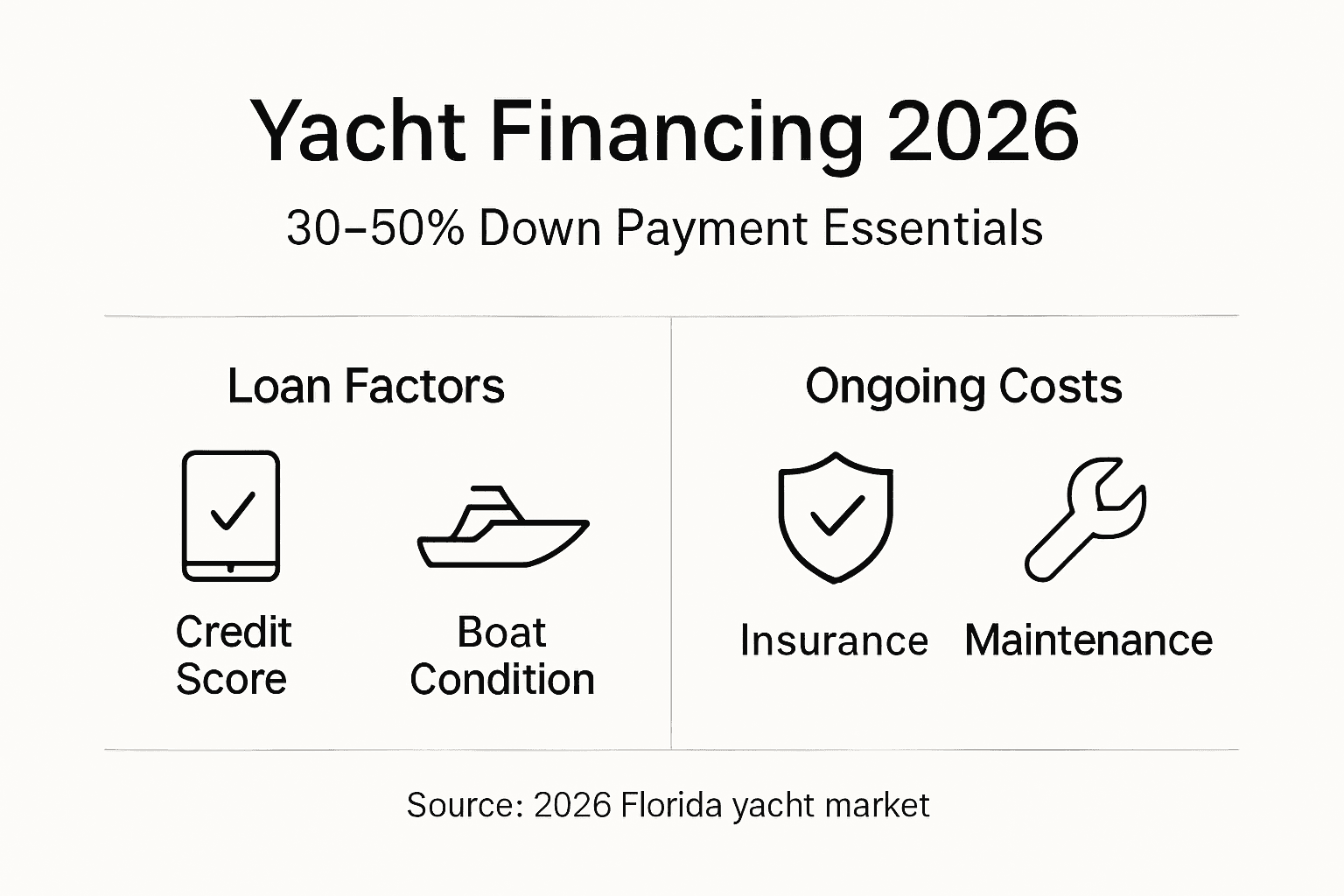
Budgeting with these costs ensures sustainable yacht ownership. Calculate your total annual expense including loan payments, insurance, docking, maintenance, and reserves for unexpected repairs. Compare this figure against your comfortable spending threshold before committing to purchase. Review insurance and cost trends for detailed Florida-specific expense analysis.
Leasing vs Traditional Yacht Loans: Pros and Cons
Choosing between leasing and traditional loans requires careful analysis of your financial goals, usage patterns, and customization preferences.
Traditional loans build equity with each payment. You own the vessel outright after the term ends, enjoy complete customization freedom, and benefit from potential appreciation. However, these loans require higher credit scores, larger down payments, and full responsibility for all maintenance and depreciation risk.
Leasing reduces upfront costs but results in higher total expenses and less customization compared to loans. Monthly payments are lower, tax benefits may apply for business use, and you avoid depreciation risk. The trade-off is clear: you never own the yacht, customization is restricted to preserve residual value, and cumulative costs typically exceed traditional loan expenses.
Owner financing serves buyers with unique needs but usually comes at higher costs and complexity. Sellers set terms directly, offering flexibility when traditional lenders decline. Interest rates exceed market rates, documentation standards vary, and legal complexity increases without institutional oversight.
| Financing Type | Upfront Cost | Ownership | Customization | Total Cost | Best For |
|---|---|---|---|---|---|
| Traditional Loan | 30-50% down | Full | Unlimited | Moderate | Long-term owners |
| Leasing | Low | None | Limited | Higher | Short-term users |
| Owner Financing | Variable | Full | Unlimited | Highest | Non-traditional buyers |
Cost analysis and flexibility considerations guide optimal choice:
- Long-term Ownership: Traditional loans deliver better value despite higher upfront costs
- Short-term Usage: Leasing works when you plan 3-5 years of use without ownership commitment
- Heavy Customization: Traditional loans provide unlimited modification freedom
- Business Use: Leasing may offer tax advantages depending on your structure
- Credit Challenges: Owner financing provides alternatives when institutional loans aren’t available
Pro Tip: Run a 10-year total cost comparison across all three financing types before deciding. Include down payment, monthly payments, operating expenses, tax implications, and residual value. The structure with the lowest total cost aligned to your usage goals wins.
Knowing pros and cons helps you align financing with lifestyle and investment goals. Explore leasing versus financing options for personalized guidance on choosing the right structure.
Common Misconceptions About Yacht Financing
Misunderstandings about yacht financing lead buyers to unrealistic expectations and poor decisions. Let’s clear up the most prevalent myths.
Yacht financing requires higher down payments and stricter vessel assessment than home or auto loans. Many buyers assume 10-20% down payments apply to yachts like they do for cars or houses. Wrong. Luxury yacht loans typically require 30-50% down because vessels depreciate faster and carry higher risk than real estate.
The 10% annual maintenance cost rule is another dangerous myth. Florida’s saltwater environment, year-round usage, and hurricane preparedness drive actual costs to 14-25% of purchase price annually. Budgeting at 10% leaves you dramatically underfunded and financially stressed.
Leasing isn’t always cheaper despite lower monthly payments. Over time, cumulative lease payments plus restricted customization and lack of equity often make leasing more expensive than traditional loans. The apparent savings upfront vanishes when you calculate total cost over 10 years.
Creditworthiness alone doesn’t guarantee approval. Lenders weigh vessel condition equally with borrower financials. A buyer with perfect credit can be rejected if the target yacht has deferred maintenance or structural issues. Vessel quality matters as much as your balance sheet.
Key misconceptions to avoid:
- Myth: Yacht loans require 10-20% down like auto loans
- Reality: 30-50% down payments are standard for luxury yachts
- Myth: Annual maintenance costs 10% of purchase price
- Reality: Florida yachts incur 14-25% annually due to environment
- Myth: Leasing is always cheaper than buying
- Reality: Leasing costs more long-term and limits ownership control
- Myth: Good credit guarantees loan approval
- Reality: Vessel condition and surveys are equally critical
Understanding that yacht financing differs fundamentally from standard consumer loans prevents costly mistakes and sets realistic expectations from the start.
Understanding myths improves preparedness and realistic expectations. Buyers who recognize these realities arrive at financing conversations better informed and negotiate from positions of strength.
Personalized Financing and Support Services
Navigating luxury yacht financing complexity demands expert guidance and tailored solutions. Specialized advisors and brokers make the difference between confusion and confidence.
Customized loan and lease structures accommodate ultra-high-net-worth buyer needs. Generic financing products rarely fit luxury yacht purchases optimally. Advisors craft structures matching your liquidity profile, tax situation, ownership timeline, and usage patterns.
Financial advisors and specialized brokers facilitate optimal lender matching and negotiation. They understand which lenders offer best terms for specific vessel types, borrower profiles, and Florida locations. This expertise saves you time and money by connecting you with the right lenders immediately.
Ongoing support extends beyond closing. Experts help with complex paperwork, approval processes, and even resale planning when you decide to upgrade. This continuity ensures smooth ownership transitions and maximizes return on investment.
Key personalized services:
- Custom Loan Structuring: Terms and conditions tailored to your financial profile and goals
- Lender Matching: Connections to specialized marine lenders offering competitive terms
- Documentation Assistance: Guidance through complex financial and vessel paperwork
- Negotiation Support: Expert representation securing favorable rates and conditions
- Resale Planning: Strategic advice maximizing value when upgrading vessels
Pro Tip: Partner with advisors who specialize exclusively in luxury yacht financing rather than generalists. Marine finance specialists understand vessel-specific risks, lender policies, and Florida market nuances that general financial advisors miss.
Personalized services reduce confusion and improve purchase confidence. Buyers working with dedicated experts report higher satisfaction, better loan terms, and smoother ownership experiences. Partnering with professionals ensures smooth financing and ownership transition. Learn more about personalized yacht financing services designed for your unique needs.
Explore Expert Luxury Yacht Financing Solutions
You now understand yacht financing realities: higher down payments, rigorous surveys, Florida-specific costs, and complex lender criteria. Knowledge alone isn’t enough. You need expert partners who translate this understanding into personalized solutions.

Yachting Experts offers custom yacht financing plans crafted for Florida’s luxury market. Our advisors hold your hand through every step, from initial lender matching to final closing and beyond. We leverage deep relationships with marine lenders to secure terms that generic brokers can’t access. Browse luxury yachts matched to your budget and financing capacity, then use our comprehensive yacht inspection guides to ensure you’re investing wisely. Start optimizing your yacht purchase today with guidance that transforms complexity into confidence.
Frequently Asked Questions About Luxury Yacht Financing
What credit score do I need to finance a luxury yacht in Florida?
Most lenders require minimum credit scores of 680 for yacht financing, with scores above 720 securing the best terms. However, credit is only one factor; lenders also evaluate liquidity, debt-to-income ratios, and vessel condition when making approval decisions.
How long does yacht financing approval typically take?
Approval timelines range from 30 to 60 days depending on documentation completeness and survey scheduling. Buyers who prepare financial records and vessel surveys in advance accelerate the process significantly, sometimes closing in as little as 21 days.
Can I finance a used yacht or only new vessels?
You can finance both new and used yachts, though age restrictions apply. Most lenders finance vessels up to 20-25 years old, with newer yachts qualifying for better terms and higher loan-to-value ratios based on condition and maintenance history.
Are there tax benefits to yacht financing in Florida?
Florida offers no state income tax, so direct deductions are limited. However, if you use your yacht for business purposes or charter it commercially, you may deduct loan interest, depreciation, and operating expenses on federal returns under specific IRS guidelines.
What happens if I default on a yacht loan?
Default triggers repossession procedures where the lender seizes the vessel to recover outstanding debt. You remain liable for any deficiency if sale proceeds don’t cover the loan balance, and default severely damages your credit score, affecting future financing options.
Should I get pre-approved before shopping for a yacht?
Yes, pre-approval clarifies your budget, strengthens negotiating position, and accelerates closing once you find the right vessel. Sellers take pre-approved buyers more seriously, and you avoid wasting time on yachts outside your financing capacity.
Recommended
Request A Call
Featured Listings

2027 Canados
100
Miami Florida

2015 Maiora
$3,750,000
90
Miami Florida

2027 Canados
57
Miami Florida

2019 Silent-Yachts Fair Dinkum
$1,599,000
55
Fort Lauderdale Florida

2026 Canados
49
Miami Florida

2026 Buddy Davis
47
Miami Florida

2020 Grady-White No Name
$610,000
45
Hallandale Beach Florida

2020 Viking Huckleberry
$1,495,000
44
Fort Lauderdale Florida

2027 Canados
43
Miami Florida

2021 Intrepid Dream Faster
$730,000
40
Coral Gables Florida

2016 Edgewater
$299,000
37
Miami, Florida

2022 Avid
$56,900
23
Stuart Florida
Get your yacht value Estimate
"*" indicates required fields