

Yacht deals in Florida often appear shrouded in mystery, with many buyers assuming complex negotiations, hidden costs, and disappointing investment returns are inevitable. The reality is far more straightforward when you understand the mechanics. This guide breaks down the yacht purchase process step by step, explains how broker commissions actually work, reveals true ownership costs in Florida, and sets realistic expectations for charter income and investment returns. Whether you’re eyeing your first yacht or upgrading to a larger vessel, knowing these fundamentals helps you navigate Florida’s vibrant yacht market with confidence and avoid costly mistakes.
Table of Contents
- Key takeaways
- The yacht purchase process explained
- Understanding yacht broker commissions and their role
- Annual costs and investment returns on Florida yachts
- Florida-specific factors influencing yacht deals
- Explore personalized yacht brokerage services in Florida
- Frequently asked questions
Key Takeaways
| Point | Details |
|---|---|
| Eight step process | Florida yacht buying follows an eight step sequence from defining your needs to post purchase management. |
| Early broker engagement | Hiring a professional yacht broker early provides access to public listings and exclusive off market opportunities. |
| Survey contingency leverage | A qualified marine surveyor inspects the hull and systems and the findings can be used to request repairs or price reductions. |
| Financing and closing steps | Secure financing with lenders experienced in yacht transactions and complete title transfer, insurance, and Florida registration within 30 days. |
| Broker commissions structure | The standard commission is five to ten percent of the final sale price, paid by the seller and split evenly between the listing and buyer brokers. |
The yacht purchase process explained
Navigating a yacht purchase in Florida follows a predictable sequence once you understand the framework. The eight-step buying process begins with defining your specific needs and culminates in post-purchase management. Each phase serves a distinct purpose in protecting your investment and ensuring you get the right vessel.
Start by clarifying your intended use, preferred size range, budget ceiling, and must-have features. This foundation prevents wasted time viewing unsuitable yachts and helps your broker identify ideal matches quickly. Engaging a professional yacht broker early gives you access to both public listings and exclusive off-market opportunities that never reach general databases.
The viewing and sea trial phase lets you assess each yacht’s condition firsthand. Pay attention to engine performance, hull integrity, systems functionality, and overall maintenance quality. Once you’ve identified your target yacht, submit a written offer specifying price, contingencies, and proposed closing timeline. Expect counteroffers and be prepared to negotiate based on survey findings.
The survey and sea trial contingency protects you from hidden defects. A qualified marine surveyor inspects the hull, mechanical systems, electrical components, and safety equipment, producing a detailed condition report. Use any identified issues as leverage to request repairs, price reductions, or credits at closing. This negotiation phase often saves buyers tens of thousands of dollars.
Secure financing if needed, working with lenders experienced in yacht transactions who understand vessel valuations and maritime lending requirements. Coordinate with your broker and attorney to complete all purchase documentation, title transfer paperwork, and insurance certificates. Florida law requires you to register your yacht within 30 days of purchase to avoid penalties.
Post-purchase management includes arranging slip rental or mooring, scheduling regular maintenance, securing comprehensive insurance, and potentially hiring crew for larger vessels. Many buyers underestimate these ongoing responsibilities and costs.
Pro Tip: Request maintenance logs and service records during the viewing phase. Yachts with documented regular maintenance typically require fewer immediate repairs and provide better long-term value than vessels with gaps in their service history.
The Florida yacht sales process varies slightly based on yacht size, age, and whether you’re buying domestically or importing, but these core steps remain consistent across most transactions.
Understanding yacht broker commissions and their role
Broker compensation in yacht transactions operates differently than many buyers expect. The standard commission structure ranges from 5-10% of the final sale price, with the seller bearing this cost rather than the buyer. This arrangement means you gain professional representation and expertise without direct payment, though the commission is factored into the listing price.
Commission splits typically divide evenly between the listing broker representing the seller and the buyer’s broker representing you. A 10% total commission on a yacht sale would allocate 5% to each broker’s firm. However, these splits are negotiable, particularly on higher-value yachts where even a smaller percentage represents substantial compensation.
The value brokers provide extends far beyond simple transaction facilitation. Experienced yacht brokers maintain extensive networks giving them early access to listings before they reach public markets. They understand current market values, helping you avoid overpaying while identifying genuinely good deals. Their expertise in contract negotiation, survey coordination, and closing logistics prevents common pitfalls that cost uninformed buyers significantly.
Brokers also serve as buffers during emotionally charged negotiations. When survey results reveal unexpected issues, your broker advocates for appropriate repairs or price adjustments without the personal tension of direct seller confrontation. They coordinate between surveyors, insurance companies, lenders, and attorneys, managing timeline pressures and documentation requirements that overwhelm many first-time buyers.
The paperwork complexity in yacht transactions justifies professional guidance alone. Purchase agreements, sea trial waivers, survey contingencies, financing documents, insurance certificates, and registration forms all require precise completion. Errors or omissions can delay closings, void protections, or create legal complications.
- Access to exclusive off-market listings unavailable through public channels
- Market expertise preventing overpayment and identifying value opportunities
- Negotiation skills that secure better terms and survey-based price reductions
- Transaction management coordinating all parties and documentation
- Problem-solving when complications arise during surveys or financing
Pro Tip: Interview multiple brokers before committing to representation. Ask about their recent Florida sales, specialization in your target yacht size and type, and how they communicate throughout the buying process. The right broker match significantly impacts your purchase experience and outcome.
Understanding the broker’s role helps you leverage their expertise effectively while maintaining realistic expectations about what they can deliver within market constraints.
Annual costs and investment returns on Florida yachts
Ownership expenses extend far beyond the purchase price, with annual costs averaging 10-15% of your yacht’s value. A yacht valued at two million dollars typically incurs between two hundred thousand and three hundred thousand dollars yearly in operating expenses. Understanding this cost structure prevents budget shock and helps you plan realistically.
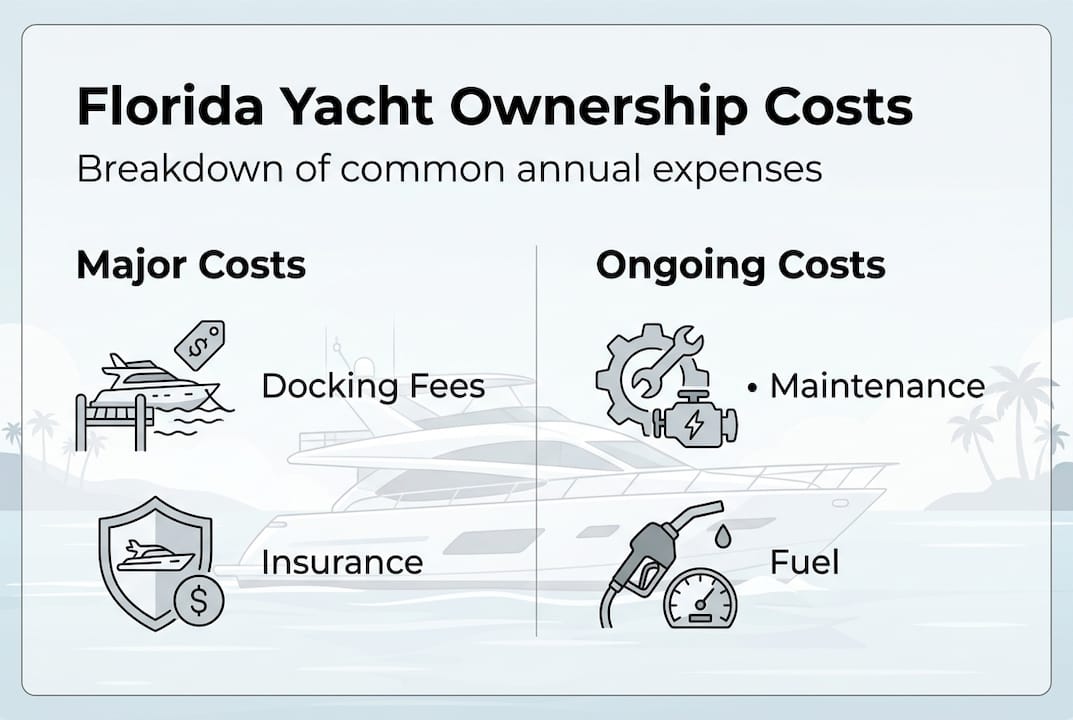
Docking fees represent one of the largest ongoing expenses in Florida. Marina rates vary dramatically by location, with costs ranging from $18 to $50 per foot monthly. A 70-foot yacht in a premium Fort Lauderdale marina might cost forty-two thousand dollars annually just for the slip, while the same vessel in a less prestigious location might run fifteen thousand dollars yearly.
| Cost category | Annual expense range | Notes |
|---|---|---|
| Docking/mooring | $15,000 to $42,000 | Based on 70-foot yacht at $18 to $50 per foot monthly |
| Maintenance and repairs | $30,000 to $80,000 | Includes hull work, engine service, systems upkeep |
| Insurance | $20,000 to $60,000 | Varies by yacht value, age, and coverage limits |
| Crew salaries | $50,000 to $150,000+ | For yachts requiring professional crew |
| Fuel and operations | $20,000 to $100,000+ | Depends heavily on usage patterns |
Maintenance demands constant attention and budget allocation. Regular engine servicing, hull cleaning and painting, electronics updates, safety equipment replacement, and systems repairs accumulate quickly. Deferred maintenance compounds problems, turning minor issues into major expenses while diminishing resale value.
Insurance premiums reflect yacht value, age, intended use area, and your experience level. Newer yachts with experienced owners operating in protected waters receive better rates than older vessels with novice operators venturing into challenging conditions. Comprehensive coverage protecting against storm damage, mechanical breakdown, and liability is essential but expensive.
Many buyers explore charter income to offset ownership costs. Charter revenue generates 5-10% gross of yacht value annually, but net returns disappoint after accounting for management fees and accelerated maintenance from charter use. A two million dollar yacht might gross one hundred fifty thousand dollars in charter revenue, but twenty to thirty percent management fees plus increased maintenance typically leave owners netting only fifty to eighty thousand dollars.
Realistic expectations matter here. Charter income offsets 50-80% of costs in successful programs, rarely covering full ownership expenses. Fractional ownership arrangements improve economics by spreading costs across multiple owners while maintaining access to luxury yachting experiences. These programs work well for buyers prioritizing financial efficiency over exclusive ownership.
- Fuel costs vary dramatically based on cruising speed and distance covered
- Crew expenses include salaries, benefits, training, and living accommodations
- Technology upgrades for navigation and entertainment systems require periodic investment
- Storm preparation and hurricane protection add seasonal costs in Florida
- Depreciation averages 5-10% annually on most production yachts
The true cost of yacht ownership in Florida extends beyond simple calculations, requiring careful budgeting and realistic revenue expectations to avoid financial strain.
Florida-specific factors influencing yacht deals
Florida’s yacht market operates under unique conditions that smart buyers leverage for advantage. The state’s three primary hubs in Fort Lauderdale, Miami, and Palm Beach concentrate the nation’s largest yacht inventory, creating competitive pricing and extensive selection. This density means you can view multiple comparable yachts in a single day, accelerating your search and improving negotiating position.
Tax considerations significantly impact purchase costs for Florida buyers. The state offers sales tax exemptions for buyers who file a non-Florida affidavit and remove the yacht from state waters within a specified timeframe. This exemption can save tens of thousands of dollars on larger purchases, though it requires careful documentation and compliance with departure requirements.
Registration requirements in Florida mandate completion within 30 days of purchase. Missing this deadline triggers penalties and complicates insurance coverage. The registration process involves submitting proof of ownership, completing application forms, paying applicable fees, and obtaining proper hull identification documentation. Your broker typically coordinates these requirements, but ultimate responsibility rests with you as the buyer.
Timing your purchase strategically yields substantial savings. The Florida yacht market experiences seasonal fluctuations, with late summer purchases saving up to 30% compared to peak winter season pricing. Sellers facing hurricane season storage costs and declining showing traffic become more negotiable from August through October. Patient buyers willing to purchase during this window consistently secure better deals.
- Fort Lauderdale offers the highest concentration of yacht brokerages and service providers
- Miami attracts international buyers creating diverse inventory and competitive pricing
- Palm Beach caters to ultra-luxury segment with premium yachts and exclusive services
- Hurricane season timing affects both pricing leverage and insurance considerations
- Exclusive broker listings provide access to off-market yachts avoiding public exposure
| Purchase timing | Market conditions | Potential savings |
|---|---|---|
| Winter peak season | High demand, limited inventory, strong seller position | Minimal discounts |
| Spring shoulder | Moderate activity, balanced negotiating power | 10-15% below peak |
| Late summer lull | Low traffic, motivated sellers, hurricane concerns | 20-30% below peak |
| Fall transition | Increasing activity, improving conditions | 15-20% below peak |
Broker relationships unlock additional advantages in Florida’s competitive market. Established brokers maintain connections providing early notification of new listings, off-market opportunities, and distressed sales requiring quick decisions. These exclusive opportunities often represent the best values, never reaching public databases where competition drives prices higher.
Understanding Florida’s commission structure and market dynamics helps you time purchases strategically and negotiate effectively, maximizing value while minimizing unnecessary costs.
Explore personalized yacht brokerage services in Florida
Navigating yacht purchases successfully requires expertise that only comes from years of market experience and transaction management. Professional yacht brokerage services streamline every phase of your purchase, from initial search through final registration, while providing access to exclusive listings and insider market knowledge that independent buyers never see.

The right brokerage partnership transforms a potentially overwhelming process into an exciting journey toward yacht ownership. Expert brokers understand Florida’s unique market conditions, seasonal timing advantages, and negotiation strategies that consistently save buyers significant money. Their networks extend across marinas, service providers, and fellow brokers, creating opportunities and solving problems before they become obstacles. When you’re ready to sell or upgrade, professional yacht management services maximize your return on investment through strategic marketing, proper maintenance documentation, and skilled negotiation. Comprehensive buyer guidance helps you avoid the costly mistakes that plague uninformed purchasers, protecting your investment from day one.
Frequently asked questions
What are the typical steps in a Florida yacht purchase?
The Florida yacht buying process involves eight key phases: defining your needs and budget, engaging a qualified broker, searching and viewing yachts, making an offer, conducting surveys and sea trials, negotiating based on findings, arranging financing and documentation, and completing closing with registration within 30 days. Each step includes specific tasks and deadlines that protect your interests and ensure legal compliance.
How do yacht broker commissions work in Florida?
Broker commissions typically range from 5% to 10% of the sale price, paid entirely by the seller rather than the buyer. The commission splits evenly between the listing broker and buyer’s broker in most transactions, though this division is negotiable. You receive professional representation and expertise without direct payment, as the commission is built into the listing price.
Can charter income cover yacht ownership costs?
Charter programs generate gross revenue of 5% to 10% of yacht value annually, but net income after management fees and maintenance typically covers only 50% to 80% of total ownership costs. Full cost coverage is rare in traditional ownership structures. Fractional ownership arrangements improve the financial equation by spreading expenses across multiple owners while maintaining access to the yacht.
What Florida-specific rules affect yacht buyers?
Florida offers sales tax exemptions for buyers who file non-Florida affidavits and remove their yachts from state waters within required timeframes. Registration must be completed within 30 days of purchase to avoid penalties and maintain insurance coverage. Strategic timing of purchases during late summer can yield savings up to 30% compared to peak winter season pricing when demand peaks and inventory tightens.
Recommended
Request A Call
Featured Listings

2027 Canados
100
Miami Florida

2015 Maiora
$3,750,000
90
Miami Florida

2027 Canados
57
Miami Florida

2019 Silent-Yachts Fair Dinkum
$1,599,000
55
Fort Lauderdale Florida

2026 Canados
49
Miami Florida

2026 Buddy Davis
47
Miami Florida

2020 Grady-White No Name
$610,000
45
Hallandale Beach Florida

2020 Viking Huckleberry
$1,495,000
44
Fort Lauderdale Florida

2027 Canados
43
Miami Florida

2021 Intrepid Dream Faster
$730,000
40
Coral Gables Florida

2016 Edgewater
$299,000
37
Miami, Florida

2022 Avid
$56,900
23
Stuart Florida
Get your yacht value Estimate
"*" indicates required fields