

Yacht closings in Florida are not as straightforward as signing paperwork and shaking hands. The process involves maritime law, federal documentation, lien searches, escrow management, and a cast of specialized professionals, all moving at once. Skip a single step and you could inherit unpaid debts on the vessel or face weeks of delays from U.S. Coast Guard backlogs. Whether you are buying your first yacht or selling to trade up, understanding every stage of the closing process protects your investment and keeps the experience exciting rather than stressful. This guide walks you through everything you need to know.
Table of Contents
- Understanding the yacht closing process in Florida
- Step-by-step walkthrough: From offer to final transfer
- Common pitfalls and edge cases every buyer and seller should know
- Strategies to ensure a smooth yacht closing
- Our perspective: What most yacht buyers and sellers get wrong
- Expert help for every stage of your yacht closing
- Frequently asked questions
Key Takeaways
| Point | Details |
|---|---|
| Yacht closings are complex | Buyers and sellers must handle documentation, liens, and legal checks unique to marine sales. |
| Lien searches are critical | Unpaid maritime liens can haunt new owners and often require up to two weeks to clear. |
| Edge cases matter | Superyachts, offshore deals, and LLC/trust ownership need special steps and extra time. |
| Expert help saves time and money | Brokers and documentation agents prevent costly mistakes and delays at closing. |
Understanding the yacht closing process in Florida
In a yacht transaction, “closing” refers to the moment when ownership officially transfers from seller to buyer, all funds are distributed, and the vessel is legally documented under the new owner’s name. It sounds simple. In practice, it is anything but.
Unlike a home purchase, yacht closings operate under both state and federal maritime law. That means you are not just dealing with a county clerk. You may be coordinating with the U.S. Coast Guard (USCG), a documentation agent, a marine lender, a title company, and an escrow officer, all at the same time. Each party has a specific role and a specific deadline.
Here is a snapshot of who is typically involved:
- Buyer and seller: The two principals who negotiate terms and sign the final bill of sale
- Yacht broker: Manages the transaction, coordinates parties, and protects your interests throughout
- Marine lender: Provides financing and requires verified title and lien clearance before funding
- Documentation agent: Files USCG paperwork and ensures federal vessel documentation is in order
- Escrow officer: Holds funds in a neutral account until all conditions are satisfied
- Surveyor and sea trial captain: Assess the vessel’s condition during the conditional period
A standard Florida yacht closing timeline runs anywhere from one to four weeks for well-documented vessels. For larger or more complex transactions, market time for superyachts runs 12 to 16 months, and lien or affidavit delays combined with USCG backlogs can significantly slow closings even after a deal is struck.
One of the biggest differences from real estate is how maritime liens work. A lien on a house is visible in county records. A lien on a vessel can be hidden, international, or tied to unpaid fuel, crew wages, or repair bills. Missing it at closing means the buyer inherits the debt. That is why the Florida yacht sales process demands thorough due diligence at every stage.
Pro Tip: Always confirm early whether the vessel carries USCG documentation or state registration. These two systems have different lien search requirements, and confusing them is one of the most common and costly mistakes we see.
For a deeper look at what paperwork is required before and during closing, reviewing yacht documentation requirements will give you a strong foundation.
Step-by-step walkthrough: From offer to final transfer
With a clear understanding of who is involved and the stakes, let’s walk through each concrete step of a typical yacht closing.
-
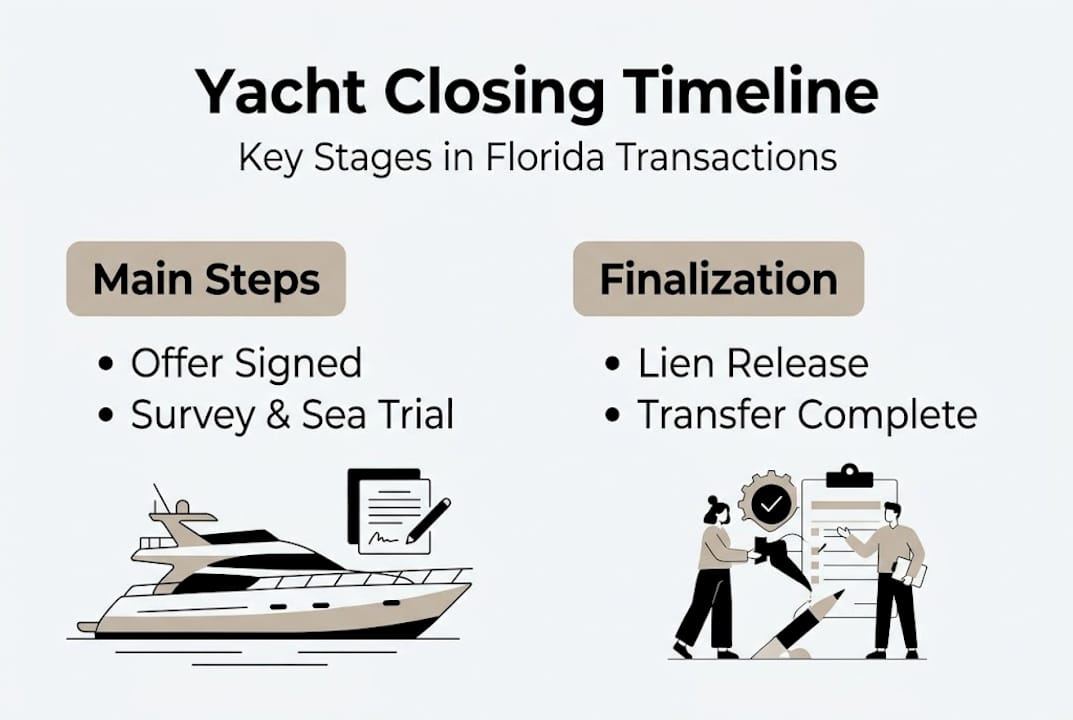
Initial offer and negotiation. The buyer submits a written offer, typically through a broker. Price, deposit amount, inspection period, and delivery terms are all negotiated at this stage. A signed purchase agreement locks in those terms.
-
Escrow deposit. The buyer places a deposit, usually 10% of the purchase price, into an escrow account. This shows good faith and protects both parties if the deal falls through for reasons outside the contract terms.
-
Conditional period: survey and sea trial. A certified marine surveyor inspects the vessel stem to stern. A sea trial confirms the yacht performs as represented. Insurance checks also happen here. This phase typically lasts three to seven days.
-
Lien search and title verification. This is where most delays happen. Lien searches can take 48 hours to two weeks, and delays by USCG documentation often extend closings further. Any outstanding maritime claims must be resolved before transfer.
-
Final paperwork review. Bill of sale, tax affidavits, seller’s affidavit of title, and any lien releases are prepared and reviewed. Every signature and notarization must be in order.
-
Funds transfer and vessel delivery. The marine lender or buyer wires funds to escrow. Once confirmed, the escrow officer distributes proceeds and releases the vessel. Keys, manuals, and documentation are handed over.
-
Post-closing registration. The documentation agent submits the new ownership paperwork to the USCG or state, depending on the vessel’s registration type. This finalizes the transfer.
Unique cases add layers. Superyachts often close more than three nautical miles offshore to satisfy tax and international law requirements. And here is a detail many buyers miss: if the yacht comes with a dinghy that has its own hull identification number, that tender may need its own title transfer. Your yacht broker’s role in Florida includes catching exactly these kinds of overlooked details.
Pro Tip: Never release escrow funds until you have confirmed that ALL lien releases are in hand and the documentation agent has everything needed to file. One missing signature can freeze the process for days. Review essential boat paperwork to know exactly what should be in your closing package.
Common pitfalls and edge cases every buyer and seller should know
Following the standard closing steps is essential, but missing the less obvious details can cause costly mistakes. Let’s identify them.
Maritime liens not cleared at closing can carry over to new owners, and unique documentation is needed for LLCs and trusts. This is one of the most financially dangerous surprises in any yacht transaction.
Important: A maritime lien is not like a standard loan. It attaches to the vessel itself, not the owner. That means even if the seller pays off their mortgage, unpaid crew wages, fuel bills, or repair invoices can still follow the boat to its new owner.
Here are the most commonly missed steps we see at closing:
- Failing to order a maritime lien search early enough to resolve issues before transfer
- Skipping the seller’s affidavit of title, which confirms no undisclosed encumbrances
- Not accounting for state sales tax obligations and related affidavits
- Overlooking dinghy or tender titles when the yacht comes with tenders
- Assuming LLC or trust ownership is simple, it actually requires additional documentation
| Scenario | Standard process | Edge case considerations |
|---|---|---|
| Single owner, documented vessel | Lien search, USCG filing, bill of sale | Straightforward if no liens found |
| LLC or trust ownership | Same steps plus entity authorization docs | Requires operating agreement review and authorized signers |
| Superyacht sale | Standard steps | Offshore closing, international registry, possible flag state changes |
| Vessel with unpaid liens | Lien search flags issues | Must resolve all liens before funds release |
| State-registered boat | State title transfer | Different lien search method than USCG-documented vessels |
For buyers considering complex ownership structures, exploring superyacht ownership strategies is a smart move before you get to the closing table. The structure you choose can affect taxes, liability, and how smoothly the closing proceeds.
Strategies to ensure a smooth yacht closing
Knowing the risks is key. Next, here is how to actively avoid them and close with confidence.
The single most effective thing you can do is start early. Order your lien search the moment a purchase agreement is signed. Do not wait until the conditional period is over. Those two weeks of overlap can be the difference between closing on time and losing your financing window.
Here is a practical closing prep checklist:
- Order lien search immediately after signing the purchase agreement
- Confirm documentation type early: USCG documented or state registered
- Engage a documentation agent as soon as the survey is ordered
- Request all affidavits from the seller upfront, not at closing day
- Verify insurance coverage is active before the sea trial
- Confirm tax affidavit requirements with your broker or closing agent
- Coordinate wire transfer timing with your lender and escrow officer
Non-compliance with key affidavits can result in back taxes and delayed transfers. That is not a risk worth taking on a six or seven figure transaction.
| Closing stage | Standard timeline | Edge case timeline |
|---|---|---|
| Offer to signed contract | 1 to 3 days | 1 to 7 days |
| Survey and sea trial | 3 to 7 days | 7 to 14 days |
| Lien search completion | 2 to 5 days | 7 to 14 days |
| USCG documentation filing | 3 to 7 days | 2 to 6 weeks |
| Full closing completion | 1 to 4 weeks | 4 to 12 weeks |
Pro Tip: For offshore closings on superyachts, confirm that your documentation agent has experience with international registries. The paperwork is different, and mistakes here can delay flag state transfers by months.
If you are on the selling side, following boat selling best practices in Florida before you even list the vessel will save you significant time at closing. Having your documentation clean and your lien history clear is a major selling point. You can also learn more about your options when you sell your yacht through our team.
Our perspective: What most yacht buyers and sellers get wrong
Having seen the proven strategies, consider this hands-on perspective shaped by years of yacht closings.
The most common mistake we see is buyers treating a yacht closing like a real estate deal. They expect a title company to handle everything and assume the process is the same. It is not. Maritime law operates in its own world, and the consequences of shortcuts are far more expensive.
We have watched buyers lose deposits because they did not complete surveys in time. We have seen sellers face unexpected tax bills because an affidavit was signed incorrectly. And we have seen deals fall apart entirely because a lien was discovered on closing day.
Thoroughness is not just good practice here. It is how you protect a six or seven figure investment. The brokers and documentation experts who earn their keep are the ones who anticipate problems before they happen, not react to them after. Leaning on brokerage advantages in 2026 means you have someone in your corner who has already seen every curveball this process can throw.
Do not shortcut this process. The detail work is where the real value is protected.
Expert help for every stage of your yacht closing
If your goal is to maximize your investment and avoid hidden risks, here is how expert help can make the difference.
Yacht closings in Florida reward preparation and punish shortcuts. From lien searches to USCG filings to offshore transfers, there are too many moving parts to navigate alone, especially when the stakes are this high.

At Yachting Experts, we hold your hand through every stage of the closing process with a personalized, high-touch approach that keeps your deal on track and your investment protected. Whether you are buying your first yacht or selling to trade up, our team brings the market insight and documentation expertise you need. Explore our expert yacht closing services, discover how to maximize value with our increasing boat sale value guide, or learn exactly how yacht brokers help make complex transactions seamless.
Frequently asked questions
What documents are required to close a yacht sale in Florida?
You need the bill of sale, USCG documentation or state registration, lien releases, and tax affidavits to close a yacht sale in Florida. Non-compliance with affidavits leads to back taxes, making lien release and documentation essential to finalize the deal.
How long does it take to close on a yacht in Florida?
Most yacht closings take one to four weeks, but USCG backlogs can delay closings by two or more weeks, especially when there are liens, complex ownership structures, or documentation issues.
What is a maritime lien, and why does it matter?
A maritime lien is a legal claim against the vessel itself for unpaid debts, and maritime liens survive sales if not cleared before transfer, meaning new owners can inherit the financial obligation.
Why do some superyacht deals close offshore?
Superyacht closings often take place more than three nautical miles offshore, and offshore closing for superyachts happens due to state tax avoidance and international legal requirements tied to the vessel’s registry.
How can I avoid delays and extra costs during yacht closing?
Start lien and document checks immediately after signing the purchase agreement, work with experienced brokers, and confirm all affidavits are complete before transfer. Early searches and compliance consistently prevent back taxes and costly closing delays.
Recommended
Request A Call
Featured Listings

2027 Canados
100
Miami Florida

2015 Maiora
$3,750,000
90
Miami Florida

2027 Canados
57
Miami Florida

2019 Silent-Yachts Fair Dinkum
$1,599,000
55
Fort Lauderdale Florida

2026 Canados
49
Miami Florida

2026 Buddy Davis
47
Miami Florida

2020 Grady-White No Name
$610,000
45
Hallandale Beach Florida

2020 Viking Huckleberry
$1,495,000
44
Fort Lauderdale Florida

2027 Canados
43
Miami Florida

2021 Intrepid Dream Faster
$730,000
40
Coral Gables Florida

2016 Edgewater
$299,000
37
Miami, Florida

2022 Avid
$56,900
23
Stuart Florida
Get your yacht value Estimate
"*" indicates required fields