

TL;DR:
- Florida’s yacht sales tax is capped at 18,000 dollars, offering significant savings on luxury yachts.
- Federal tax deductions are available if yachts are used for business more than 50% of the time.
- Strategic planning and documentation are essential to maximize tax benefits and ensure compliance.
Owning a luxury yacht in Florida feels like the ultimate reward, but the tax picture is more layered than most owners expect. Many high-net-worth buyers focus on the purchase price and overlook a web of state and federal obligations that can quietly erode returns. A single misstep, like bringing an out-of-state vessel into Florida waters too soon, can trigger a five-figure tax bill with no warning. This guide cuts through the complexity, covering everything from Florida’s capped sales tax to federal business deductions, so you can protect your investment, plan confidently, and get maximum value from every dollar spent on your yacht.
Table of Contents
- Understanding Florida yacht tax basics
- Federal deductions: Turning your yacht into a business asset
- Sales, use, and repair taxes: Real Florida scenarios
- Optimizing your yacht’s tax position: Compliance and planning strategies
- Why careful planning is the true investment (most owners miss this)
- Unlock expert support for stress-free yacht ownership
- Frequently asked questions
Key Takeaways
| Point | Details |
|---|---|
| Florida tax traps | Bringing a yacht into Florida within 6 months can trigger a 6% use tax unless you follow specific strategies. |
| Business use deductions | Yachts used for business may qualify for federal deductions, but strict IRS proof is required. |
| Sales and repair tax caps | Florida caps sales tax at $18,000 and repairs at $60,000 per event, often saving owners large sums. |
| Plan with experts | Working with a maritime CPA and yacht broker can maximize benefits and provide audit protection. |
Understanding Florida yacht tax basics
With the stakes established, let’s start with the basics every Florida yacht owner must know before purchase or transfer.
Florida’s tax structure for yachts is genuinely favorable compared to most states, but only if you understand the rules. The state charges a 6% sales tax on vessel purchases, capped at $18,000 per transaction. That cap is a significant advantage. In states without a cap, a $1 million yacht purchase can trigger $60,000 or more in sales tax alone.
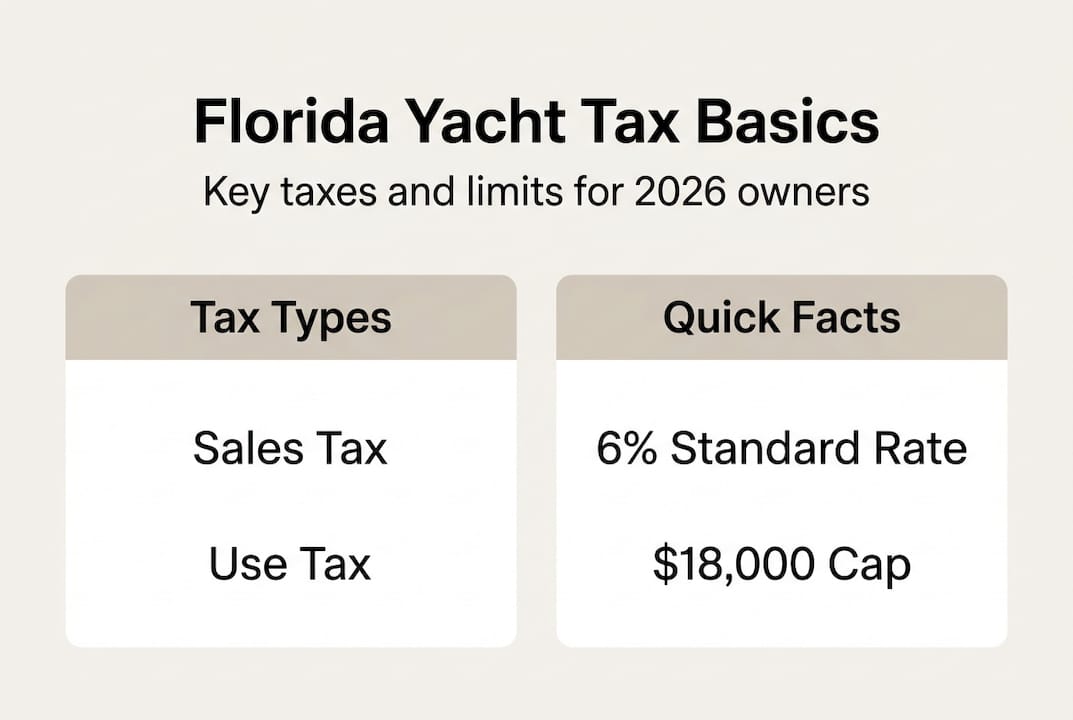
Here’s a quick breakdown of the core taxes you’ll encounter:
| Tax type | Rate | Cap/Limit |
|---|---|---|
| Florida sales tax | 6% | $18,000 per vessel |
| Florida use tax | 6% (minus credit) | Varies by prior tax paid |
| Repair event tax | 6% | $60,000 per event |
| State income tax | 0% | No state income tax |
The use tax is where many owners get caught off guard. Florida use tax applies to out-of-state yacht purchases brought into Florida within 6 months of purchase. If you buy a vessel in South Carolina to avoid Florida sales tax, then cruise it to Miami four months later, you owe use tax on the full purchase price, minus any tax already paid to the other state. This is not a loophole. The Florida Department of Revenue actively tracks vessel movements.
Repairs are also taxable, but the state caps liability at $60,000 per repair event. Splitting large maintenance projects into separate events can legally reduce your tax exposure. Timing and documentation matter enormously here.
Key misconceptions that cost Florida yacht owners thousands:
- Registering out of state does not exempt you from Florida use tax if the vessel spends significant time in Florida waters.
- Delivery location matters. Florida residents owe tax on delivery in state regardless of later registration.
- No state income tax means federal deductions work in your full favor, since there’s no state-level offset eating into your savings.
Pro Tip: Before you finalize any purchase, consult our Florida yachting guide to map out where and when you’ll take delivery. That single decision can save you tens of thousands.
Federal deductions: Turning your yacht into a business asset
After understanding Florida’s taxes, let’s explore how federal law can work to your advantage if you structure ownership wisely.
The federal tax code rewards yacht owners who use their vessel for legitimate business purposes. The threshold is clear: if your yacht is used for business more than 50% of the time, you unlock a powerful set of deductions that can dramatically reduce your overall tax burden.
Here’s what becomes available when you cross that 50% business use threshold:
- Section 179 expensing allows you to deduct the full purchase price (up to approximately $1.2 to $2.5 million) in the year of purchase rather than depreciating it over time.
- Bonus depreciation lets you write off a large percentage upfront. In 2026, that rate is 20%, down from 40% in 2025. There is ongoing legislative discussion about restoring it to 100%, but that remains unconfirmed.
- Operating expenses including fuel, crew salaries, maintenance, and docking fees are deductible on a prorated basis tied to your business use percentage.
A direct comparison helps clarify the stakes:
| Scenario | Tax benefit | Risk level |
|---|---|---|
| Personal use only | Minimal (mortgage interest only) | Low |
| Mixed use, documented | Prorated deductions | Medium |
| Primary business use (>50%) | Section 179, bonus depreciation, operating costs | Higher (IRS scrutiny) |
“Federal deductions are available if your yacht exceeds 50% business use, including bonus depreciation phasing out at 40% in 2025 and 20% in 2026, Section 179 up to approximately $1.2 to $2.5 million, and prorated operating expenses.”
The IRS pays close attention to yacht deductions. Auditors look for detailed logs showing client names, business purposes, and dates for every trip claimed as business use. Vague records are a red flag. Popular qualifying strategies include placing the vessel in a charter program, hosting documented client entertainment trips, and registering under a business entity.
Understanding how to maximize tax deductions as a self-employed owner or business operator can open additional avenues that many yacht owners never explore. Pairing these strategies with a clear understanding of Florida yacht investment returns gives you a complete financial picture before you ever sign a purchase agreement.
Sales, use, and repair taxes: Real Florida scenarios
To see the real impact on your finances, let’s break down what these taxes look like with concrete examples.
Numbers tell the story better than any general rule. Consider a $1 million yacht purchased in Miami-Dade County. Thanks to Florida’s cap, your total sales tax is approximately $18,000, compared to $60,000 or more in an uncapped state. That $42,000 difference is real money, and it’s one of the reasons Florida is a top destination for luxury vessel purchases.

Now consider a scenario where the same owner buys that yacht in Georgia to try to avoid Florida taxes, then brings it into Florida waters five months later. Use tax kicks in at 6% on the full $1 million, minus any Georgia tax paid. If Georgia charged 4%, Florida collects the remaining 2%, which is $20,000. Not catastrophic, but entirely avoidable with proper planning.
Repair tax scenarios are equally instructive:
| Repair scenario | Taxable amount | Tax owed (6%) |
|---|---|---|
| Single $200,000 refit | Capped at $60,000 | $3,600 |
| Two separate $100,000 events | $60,000 each, capped | $3,600 per event |
| Three $40,000 events | $40,000 each, no cap hit | $2,400 per event |
Splitting a large refit into separate, documented repair events can legally reduce your tax exposure. Each event has its own $60,000 cap, and repairs are taxed but capped at that limit per occurrence.
Three common mistakes Florida yacht owners make, and how to avoid them:
- Assuming registration location determines tax liability. It does not. Florida looks at where the vessel is used and delivered.
- Delaying use tax payment. Penalties and interest accrue quickly. Proactive disclosure is almost always cheaper than getting caught.
- Ignoring repair event timing. Bundling all maintenance into one invoice can eliminate the per-event cap benefit.
Working with specialists who understand yacht management strategies helps you avoid these pitfalls before they become expensive problems.
Optimizing your yacht’s tax position: Compliance and planning strategies
By seeing your tax scenarios in action, you’re ready to structure your ownership for compliance, peace of mind, and better financial outcomes.
The best tax outcomes don’t happen by accident. They result from deliberate planning before purchase, not after. Here’s a practical checklist to guide your approach:
- Choose the right ownership structure. An LLC or corporation can provide liability protection and make business use documentation cleaner and more defensible.
- Decide on US flagging early. US-flagged vessels are eligible for depreciation deductions that foreign-flagged boats are not. This matters significantly if you plan to place the yacht in a charter program for business use proof.
- Plan your delivery location and timing. Coordinate with your broker to ensure delivery happens in a way that minimizes sales and use tax exposure.
- Engage a Florida maritime CPA before closing. Pre-purchase tax planning is far cheaper than post-purchase corrections.
- Maintain a detailed trip log from day one. Record every trip with date, passengers, purpose, and distance. This is your primary defense in an IRS audit.
- Review your tax position annually. Bonus depreciation rates are changing, and legislative updates in 2026 could affect your strategy.
Pro Tip: Think about your exit strategy from the moment you buy. A well-documented, tax-optimized yacht is easier to sell at a premium. Our yacht broker expertise and understanding of yacht insurance trends mean we can help you plan from purchase through sale with your total return in mind.
The role of a knowledgeable broker goes beyond finding the right vessel. An experienced professional helps you structure the transaction, connect with the right CPA, and set up documentation systems that protect you for years.
Why careful planning is the true investment (most owners miss this)
With concrete steps in hand, it’s worth pausing to consider what most owners and sometimes their advisors still get wrong.
Here’s the uncomfortable truth we’ve seen play out repeatedly: financial power does not insulate you from tax mistakes. We’ve worked with exceptionally successful people who moved quickly on a purchase, skipped the pre-closing tax review, and ended up paying far more than necessary. Not because they lacked resources, but because they treated tax planning as an afterthought.
The real competitive advantage in luxury yacht ownership is not finding a loophole. It’s building a documentation and compliance system so thorough that an audit becomes a non-event. That means trip logs, business purpose records, charter agreements, and annual CPA reviews working together as a unified strategy.
We believe the owners who get the most from their yachts are the ones who treat the vessel as a managed asset from day one. Tax efficiency, expert guidance, and a clear exit strategy aren’t luxuries. They’re the foundation of smart ownership. The headline tax rate matters far less than how well you’ve structured everything around it.
Unlock expert support for stress-free yacht ownership
For those ready to elevate their yacht investment management, partnering with true specialists makes all the difference.
At Yachting Experts, we bring a personalized, hands-on approach to every aspect of Florida yacht ownership, from initial purchase planning through seamless resale. We help you navigate ownership setup, structure your vessel for maximum deductions, and connect you with trusted maritime CPAs who understand Florida’s unique tax environment.

When it’s time to sell, our team ensures you get the best price and maximum return on your investment. Whether you’re buying your first yacht or trading up to something exceptional, we’re here to make the process straightforward and rewarding. ✅ Ready to take the next step? Explore our Florida yacht sale process and let’s build your ideal ownership strategy together.
Frequently asked questions
What triggers the Florida yacht use tax?
If you bring a yacht purchased out of state into Florida within 6 months, the 6% use tax applies, minus any credit for tax already paid in the other state.
Can I deduct my yacht as a business expense?
Yes, if your yacht qualifies as primarily business use at more than 50%, you may access Section 179 expensing and bonus depreciation, though strict documentation and IRS scrutiny apply.
Is there a sales tax cap in Florida for yachts?
Yes, Florida caps yacht sales tax at $18,000 per vessel, making it one of the most favorable states for large luxury boat purchases.
How are yacht repairs taxed in Florida?
Yacht repairs are taxable in Florida, but each separate repair event is capped at $60,000, which creates a real opportunity to reduce liability through strategic scheduling.
Why involve a maritime CPA or yacht broker?
Expert CPAs and brokers help you structure purchases for compliance, maximize deductions, and avoid the audit pitfalls that catch underprepared owners off guard.
Recommended
Request A Call
Featured Listings

2027 Canados
100
Miami Florida

2015 Maiora
$3,750,000
90
Miami Florida

2027 Canados
57
Miami Florida

2019 Silent-Yachts Fair Dinkum
$1,599,000
55
Fort Lauderdale Florida

2026 Canados
49
Miami Florida

2026 Buddy Davis
47
Miami Florida

2020 Grady-White No Name
$610,000
45
Hallandale Beach Florida

2020 Viking Huckleberry
$1,495,000
44
Fort Lauderdale Florida

2027 Canados
43
Miami Florida

2021 Intrepid Dream Faster
$730,000
40
Coral Gables Florida

2016 Edgewater
$299,000
37
Miami, Florida

2022 Avid
$56,900
23
Stuart Florida
Get your yacht value Estimate
"*" indicates required fields