

Florida yacht port fees are calculated per foot of slip length and typically range from $15 to $50 per foot per month, depending on location and amenities. That means a 40-foot yacht can cost anywhere from $600 to $2,000 monthly just for dockage, before utilities, security, or seasonal surcharges enter the picture. South Florida marinas in Miami, Fort Lauderdale, and Palm Beach sit at the top of that range, driven by limited waterfront space and intense international demand. Understanding the full fee structure before you sign a lease agreement protects your budget and your investment.
What determines Florida yacht port fees?
The per-foot pricing model is the foundation of every marina lease in Florida. Marinas charge based on slip length, not vessel length. That distinction matters more than most boat owners realize.
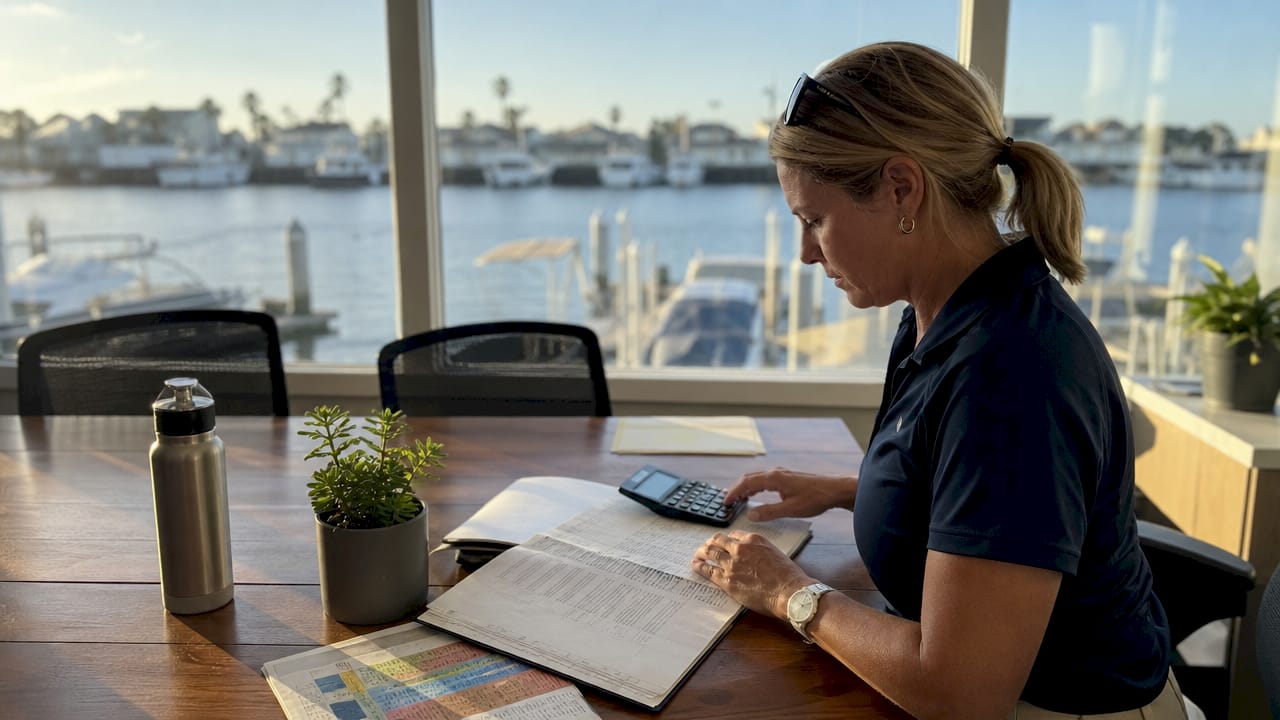
A 37-foot yacht requiring a 45-foot slip pays for 45 feet, not 37. That gap adds up fast, especially at premium South Florida rates. Wide-beam vessels like catamarans face an even steeper calculation: many marinas bill by slip area (length multiplied by width) rather than length alone, which can substantially increase monthly costs.
Regional pricing creates a wide spread across the state:
- South Florida (Miami, Fort Lauderdale, Palm Beach): $20 to $50 per foot per month, driven by high demand and an international client base
- Gulf Coast (Naples, Marco Island, Sarasota): Generally $15 to $35 per foot per month, with lower seasonal pressure than the Atlantic side
- Inland and rural marinas: Often $10 to $20 per foot per month, though amenities and services are limited
Duration of stay shapes your rate significantly. Transient dockage (nightly or weekly) costs far more per day than a monthly or annual lease. Annual contracts lock in a fixed rate and protect you from seasonal spikes. Month-to-month agreements leave you exposed to market fluctuations, particularly during peak winter months.
Additional charges stack on top of the base slip fee:
- Shore power: Metered electricity billed by kilowatt-hour or flat daily rate
- Water: Often metered separately, especially at full-service marinas
- Sewage pump-outs: Required by Florida law and charged per service
- Security fees: Common at gated or staffed facilities
- Liveaboard surcharges: Typically 10–20% above standard dockage
- Waitlist deposits: Often non-refundable at high-demand marinas
Pro Tip: Always ask for a full fee schedule in writing before signing. The base slip rate is rarely the number that matters most.
How do transient and long-term docking fees compare?
Transient dockage is the most expensive way to dock in Florida on a per-day basis. Daily transient rates run $2.50 to $8.00 per foot per day, with utility surcharges adding $10 to $30 per day depending on power draw. A 50-foot yacht staying transient for a week in Fort Lauderdale can easily spend $1,400 or more, before fuel and pump-outs.
Monthly leases bring that daily cost down considerably. At $25 per foot per month, a 50-foot yacht pays $1,250 monthly. That same yacht at $5.00 per foot per day transient pays $7,500 for 30 days. The math is not subtle.
| Stay type | Typical rate | 50-foot yacht monthly cost |
|---|---|---|
| Transient (daily) | $2.50–$8.00/ft/day | $3,750–$12,000 |
| Monthly lease | $15–$50/ft/month | $750–$2,500 |
| Annual contract | Often 10–15% below monthly | $675–$2,125 |
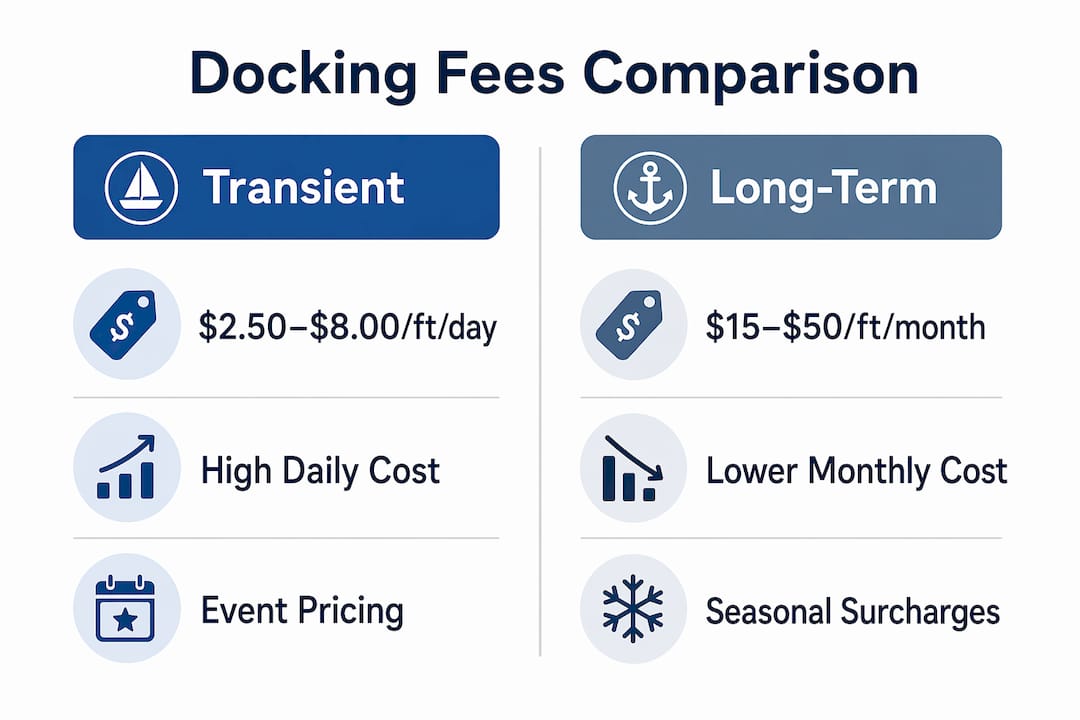
Seasonal surcharges of 20–40% apply at premium South Florida marinas during peak winter months, when snowbird demand floods the market. A marina charging $30 per foot in september may charge $40 per foot in january. Annual contracts sidestep this entirely by locking in a pre-negotiated rate year-round.
Key West presents a special case. Transient daily rates in Key West reach $5.00 to $8.00 per foot during major events, often with minimum stay requirements attached. Planning around those event windows saves real money.
Pro Tip: If you plan to stay at a marina for more than three weeks, a monthly lease almost always beats transient pricing. Run the numbers before you commit to a “short” stay that stretches.
What additional fees and hidden costs should Florida yacht owners expect?
The base slip fee is the headline number, but the full cost of yacht mooring in Florida includes a longer list of line items. Boat owners who budget only for dockage routinely underestimate their monthly marina bill by 20–40%.
Here are the most common additional charges to plan for:
- Background check fees: Marinas charge approximately $85 per applicant for background screening, and this fee is typically non-refundable regardless of outcome
- Liveaboard surcharges: Living aboard your vessel adds 10–20% to your base dockage rate at most Florida marinas, reflecting higher utility consumption and wear on facilities
- Shore power metering: High-amperage connections (50-amp or 100-amp service) carry higher daily or monthly charges; some marinas charge a flat rate while others meter actual consumption
- Sewage pump-out fees: Florida’s clean water regulations require regular pump-outs, and marinas charge per service or include a limited number in the monthly fee
- Hurricane preparation fees: Some marinas charge for additional line handling, haul-out coordination, or storm prep labor during named storm events
- Insurance requirements: Marinas require proof of insurance with hurricane provisions before issuing a lease, and gaps in coverage can void your slip agreement
- Waitlist deposits: Popular marinas in Fort Lauderdale and Miami maintain waitlists, and deposits to hold your place are often non-refundable
Understanding Florida yacht ownership costs in full, including these auxiliary marina charges, is the only way to build a budget that holds up in practice.
How can yacht owners negotiate and manage port fees effectively?
Published marina rates are sticker prices. Savvy boat owners treat them as a starting point, not a final number. Negotiation is common and expected, particularly for longer commitments or multiple vessel arrangements.
Here is a practical approach to reducing your docking costs:
-
Commit to an annual contract. Annual leases give the marina predictable revenue. In exchange, most marinas offer a discount of 10–15% below the equivalent monthly rate. That discount compounds significantly over 12 months on a large vessel.
-
Audit your slip size billing. Confirm exactly which slip length you are being charged for. If the marina assigned you a 50-foot slip but a 45-foot slip would accommodate your vessel safely, request the smaller slip and the lower rate.
-
Ask about concession agreements. Marinas sometimes waive fees for services like pump-outs, electricity, or parking in exchange for a higher base commitment. These concessions rarely appear in the standard rate sheet.
-
Use negotiating strategies from your purchase experience. The same leverage principles apply: competing offers, timing, and a willingness to walk away all shift the conversation in your favor.
-
Evaluate location trade-offs honestly. A marina 15 minutes farther from your home port may charge $10 per foot less per month. On a 60-foot yacht, that is $600 per month, or $7,200 per year. Factor in travel time and fuel, but do not dismiss the savings automatically.
-
Consider total cost, not just slip fees. Choosing a lower-cost marina without onsite maintenance can increase overall expenses through travel and repair logistics. A marina with a full-service yard may cost more per foot but save money when maintenance needs arise.
Boat registration and compliance costs also factor into the total picture. Understanding yacht registration cost factors alongside your dockage expenses gives you a clearer view of total annual ownership costs.
Key Takeaways
Florida yacht port fees vary widely by location, slip size, and lease duration, and the base slip rate rarely reflects the true monthly cost of docking.
| Point | Details |
|---|---|
| Per-foot billing by slip size | Marinas charge for the slip length, not your vessel length, so a 37-foot yacht in a 45-foot slip pays for 45 feet. |
| South Florida commands premium rates | Miami, Fort Lauderdale, and Palm Beach charge $20–$50 per foot per month due to high demand and limited waterfront space. |
| Transient rates cost significantly more | Daily transient fees of $2.50–$8.00 per foot far exceed the monthly-equivalent rate, making long-term leases the smarter financial choice. |
| Hidden fees add 20–40% to base costs | Background checks, liveaboard surcharges, utility metering, and hurricane prep fees routinely inflate the total monthly marina bill. |
| Annual contracts protect against seasonal spikes | Locking in an annual rate avoids the 20–40% seasonal surcharges that South Florida marinas apply during peak winter months. |
What I’ve learned about Florida marina fees that most owners find out too late
After years of working with Florida yacht owners at Yachtingexperts, I keep seeing the same pattern. Boat owners research the slip rate, sign the lease, and then spend the first three months surprised by the actual bill. The base rate is almost never the number that matters.
The most underestimated cost I see consistently is the slip size gap. A 42-foot yacht going into a 50-foot slip pays for eight extra feet every single month. At $30 per foot, that is $240 per month, or $2,880 per year, for space the vessel does not use. That money disappears silently unless you ask the right questions upfront.
The other misconception I hear often is that South Florida’s premium rates are non-negotiable. They are not. I have seen owners secure meaningful discounts simply by committing to 18 months instead of 12, or by bundling two vessels at the same facility. Marinas want reliable, long-term tenants. That gives you more leverage than most people realize.
My honest advice: treat your marina selection with the same rigor you applied to buying the vessel. Visit in person, request the full fee schedule, and compare at least three options before signing anything. The right marina at the right price makes ownership genuinely enjoyable. The wrong one turns every monthly statement into a frustration.
— Jason
How Yachtingexperts helps Florida yacht owners take control of their costs
Dockage costs are one piece of a larger ownership picture, and getting that picture right from the start makes a real difference to your bottom line.

At Yachtingexperts, we work directly with Florida boat owners to evaluate marina options, review lease terms, and identify where fees can be reduced or renegotiated. Our team brings hands-on market knowledge of South Florida, the Gulf Coast, and everything in between. Whether you are docking a 40-foot cruiser or a 100-foot motor yacht, we help you make informed decisions at every step. Our yacht management services are built for owners who want expert guidance without the guesswork that comes with navigating marina contracts alone. Reach out to our team and let us put that expertise to work for you. ✅
FAQ
What are typical Florida yacht slip costs per month?
Monthly dockage in Florida runs $15 to $50 per foot depending on location, with South Florida marinas at the top of that range. A 40-foot yacht typically pays $600 to $2,000 per month.
How much do transient docking fees cost in Florida?
Transient daily rates run $2.50 to $8.00 per foot per day, with utility surcharges of $10 to $30 per day on top. Key West event periods push rates to the upper end of that range with minimum stay requirements.
What hidden fees should I expect at a Florida marina?
Background check fees around $85, liveaboard surcharges of 10–20%, metered shore power, sewage pump-out charges, and non-refundable waitlist deposits are all common. Budget an additional 20–40% above the base slip rate to cover these costs.
Do Florida marinas charge more in winter?
Yes. South Florida marinas apply seasonal surcharges of 20–40% during peak winter months due to snowbird demand. Annual contracts lock in a fixed rate and eliminate exposure to those spikes.
Can I negotiate my marina slip rate in Florida?
Negotiation is standard practice, particularly for annual commitments or multi-vessel arrangements. Owners who commit to longer terms or bundle services regularly secure discounts and concessions that do not appear in the published rate sheet.
Recommended
Request A Call
Featured Listings

2027 Canados
100
Miami Florida

2015 Maiora
$3,750,000
90
Miami Florida

2027 Canados
57
Miami Florida

2019 Silent-Yachts Fair Dinkum
$1,599,000
55
Fort Lauderdale Florida

2026 Canados
49
Miami Florida

2026 Buddy Davis
47
Miami Florida

2020 Grady-White No Name
$610,000
45
Hallandale Beach Florida

2020 Viking Huckleberry
$1,495,000
44
Fort Lauderdale Florida

2027 Canados
43
Miami Florida

2021 Intrepid Dream Faster
$730,000
40
Coral Gables Florida

2016 Edgewater
$299,000
37
Miami, Florida

2022 Avid
$56,900
23
Stuart Florida
Get your yacht value Estimate
"*" indicates required fields