

Florida’s yacht market is doing something that surprises most people watching national headlines. While boat sales declined significantly across the US in 2025, premium yachts in Florida showed remarkable resilience, holding their value and moving through inventory at a pace that defied broader economic pressure. If you own a yacht, are thinking about buying one, or considering selling, what’s happening right now in this market matters more than you might realize. This guide breaks down exactly what the trends mean for you and how to use them to your advantage.
Table of Contents
- Understanding market trends in the Florida yacht industry
- Economic headwinds: Rates, inflation, and fuel costs
- Buyer and seller strategies in a shifting market
- Spotlight: Resilient segments and Florida opportunities
- Why market trend guidance is your true competitive edge
- Ready to navigate Florida’s yacht market with confidence?
- Frequently asked questions
Key Takeaways
| Point | Details |
|---|---|
| Market trends matter | Understanding shifts in interest rates, inventory, and demand can help Florida yacht owners buy or sell at the right moment. |
| Luxury market resilience | High-end yachts in Florida remain in demand despite national slowdowns, fueled by affluent and international buyers. |
| Strategic timing pays off | Both buyers and sellers benefit by acting on early signs and professional insights to secure deals and maximize value. |
| Florida-specific factors | Unique local trends—like seasonal events and insurance costs—offer real advantages to informed buyers and sellers. |
Understanding market trends in the Florida yacht industry
Before we talk numbers and strategy, let’s get clear on what “market trends” actually means in the yachting world. A market trend is a sustained pattern in buying, selling, pricing, or inventory that reflects broader forces at work. For yacht owners and buyers, trends signal when to act, when to wait, and where the best opportunities live.
Florida’s yacht market is not a mirror image of the national picture. It has its own engine. International buyers, a massive year-round boating season, and a steady wave of high-net-worth residents relocating from high-tax states all drive demand in ways that other markets simply cannot replicate. Florida leads all US states in boat sales, contributing $6.1 billion to the economy in 2024 and supporting a significant portion of the state’s GDP.
Key forces shaping Florida’s yacht market right now:
- Economic migration: Tens of thousands of affluent residents relocated to Florida in recent years, bringing significant purchasing power with them
- International demand: Buyers from Latin America, Europe, and Canada actively shop Miami and Fort Lauderdale for premium vessels
- Event-driven commerce: The Fort Lauderdale International Boat Show and Miami Yacht Show generate billions in sales activity annually
- Tourism and charter demand: Florida’s charter market fuels both ownership interest and resale demand for well-maintained vessels
- Tax advantages: Florida’s favorable tax structure compared to states like New York and California makes it a smart place to register a vessel
Understanding a yacht broker’s impact on your transaction starts with understanding these forces. A skilled broker tracks all of them simultaneously, so you don’t have to.
Here’s a quick comparison of how Florida stacks up against the national market:
| Market indicator | National trend (2025) | Florida trend (2025) |
|---|---|---|
| Overall boat sales | Down significantly | Flat to slightly positive |
| Premium yacht segment | Down 2.6% | Resilient, steady demand |
| International buyer activity | Minimal | High, especially Miami/Ft. Lauderdale |
| Inventory levels | Rising | Moderately elevated |
| Average days on market | Increasing | Longer but manageable |
This table tells a clear story. Florida is not immune to national pressures, but it is far better insulated than most markets. If you’re making decisions based on national news alone, you’re likely misreading your local opportunity.
Economic headwinds: Rates, inflation, and fuel costs
Let’s talk about the forces working against the market right now, because ignoring them would be a disservice to you. Rising rates, inflation, and fuel costs have significantly slowed boat sales nationwide and influenced how buyers approach financing and ownership costs.
Interest rates are the most visible pressure point. In 2022, financing a yacht at 4.5% was attractive for many buyers. By 2025, that rate climbed to roughly 7.8%, which adds thousands of dollars annually to the cost of carrying a loan on a $500,000 vessel. That kind of shift does not just affect monthly payments. It changes the psychology of the buyer, extending research timelines and making negotiation more aggressive. Meanwhile, new powerboat retail units dropped more than 10.2% year over year in early 2025, a far steeper decline than the premium yacht segment experienced.
“When financing becomes more expensive, buyers shift their attention toward pre-owned vessels, shorter loan terms, and fuel-efficient models that reduce total cost of ownership over time.”
Here’s a data snapshot of how economic conditions are affecting different buyer categories:
| Buyer profile | Rate sensitivity | Impact on behavior |
|---|---|---|
| Mass-market boat buyer | Very high | Delaying purchases, opting for used |
| Mid-range yacht buyer | Moderate | More negotiation, longer timelines |
| Premium/luxury yacht buyer | Low | Largely proceeding, cash-heavy |
| International buyer | Variable | Benefiting from exchange rates |
For you as a Florida yacht owner or buyer, this creates two distinct realities. If you’re shopping for a vessel under $300,000, you’re competing in a segment where financing costs are genuinely changing what people can afford. If you’re in the premium market above $1 million, the buyer pool is less rate-sensitive, and transactions are moving more on emotional and lifestyle fit than on loan rates.
What this means practically:
- Pre-owned yachts in great condition are seeing increased demand as buyers avoid premium pricing on new models
- Sellers of older or poorly maintained vessels face longer listing periods and more buyer pushback on price
- Fuel-efficient and hybrid options are drawing more interest as operational costs become a decision factor
- Understanding your full ownership cost breakdown before buying is now more critical than ever
- Insurance trends in Florida are also adding to operational costs and deserve careful attention before committing to a vessel
Pro Tip: If you’re financing a yacht purchase in today’s rate environment, consider asking your broker about lender relationships that specialize in marine financing. Dedicated marine lenders often offer better structures than traditional banks, including longer amortization periods that can meaningfully reduce your monthly exposure.
Buyer and seller strategies in a shifting market
Now that you understand the economic backdrop, let’s get specific about what winning looks like for both sides of the transaction. The market has shifted, and the strategies that worked in 2021 and 2022 when inventory was tight and buyers competed aggressively need to be updated.
Buyers today are more research-intensive and more aggressive on price negotiation, while sellers are experiencing longer listing periods and need to price competitively from day one to attract serious offers. That’s the new normal.
For buyers, here’s a practical approach:
- Get pre-qualified early. With financing costs elevated, knowing your exact budget ceiling before touring vessels saves time and prevents you from falling in love with a yacht outside your range.
- Focus on late-model, well-documented vessels. Survey results matter more now. A yacht with complete maintenance records and a clean survey commands trust and a faster close.
- Use elevated inventory to your advantage. More listings mean more leverage. Don’t rush. Compare similar vessels and let data inform your offer.
- Factor in all operational costs. Fuel, insurance market trends, dockage, and maintenance should all be calculated before you sign anything.
- Engage a broker who knows the local market. National platforms give you listings; a Florida-based expert gives you context, access, and negotiating leverage.
For sellers, the winning formula looks different:
- Price it right from the start. Overpricing in a market with rising inventory leads to price reductions that signal weakness to buyers. A well-priced listing generates momentum quickly.
- Invest in presentation. Professional photos, a clean and detailed vessel, and organized documentation are not optional. They are your first impression.
- Gather your records. Maintenance logs, survey history, and recent upgrades all justify your asking price and reduce buyer hesitation.
- Experts recommend selling late-model yachts with modern or eco-friendly features early and obtaining insurance quotes early to streamline the buyer’s experience.
- Work with a broker who has an active buyer network. Exposure to qualified, motivated buyers matters far more than just getting listed.
Pro Tip: If you’re a seller, consider having a pre-listing survey completed before you go to market. It removes surprises during the buyer’s due diligence phase and shows that you stand behind your vessel. That kind of transparency builds buyer confidence and often results in cleaner, faster transactions.
Spotlight: Resilient segments and Florida opportunities
Even in a market facing headwinds, certain segments are thriving. This is where the real opportunity lives, and Florida is uniquely positioned to capture it.

The global yacht market is forecast to grow at a 4.7% compound annual growth rate, with strong pre-owned demand for late-model yachts leading the charge. Florida’s international buyers and major boating events continue to bolster local sales in ways that other US markets simply don’t experience. That’s not a minor footnote. That’s a structural advantage.
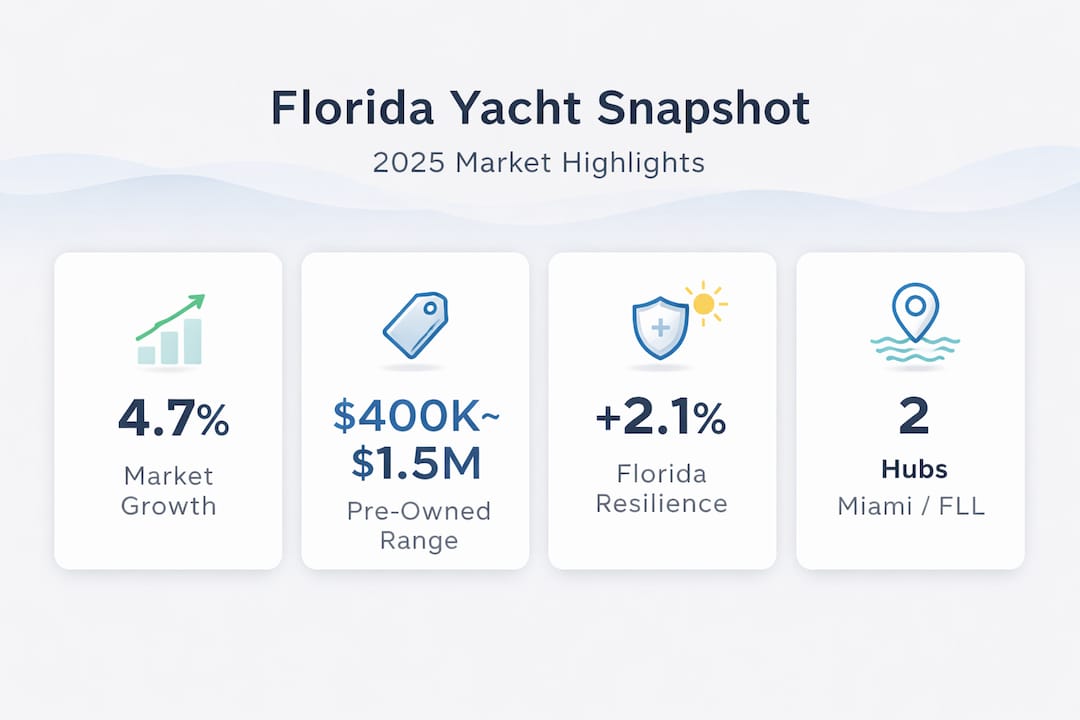
📊 Market callout: South Florida’s GDP contribution from boating is substantial, with Fort Lauderdale and Miami leading the nation in brokerage value and marine-related tax revenue.
Here’s a breakdown of how different market segments are performing:
| Segment | National performance | Florida performance | Opportunity level |
|---|---|---|---|
| Premium yachts (>$1M) | Stable | Strong | High |
| Late-model pre-owned | Strong | Very strong | Very high |
| Entry-level powerboats | Declining | Soft | Moderate |
| Eco-efficient/hybrid vessels | Growing | Growing rapidly | Emerging |
| Charter-ready yachts | Moderate | Strong | High |
Two segments deserve special attention right now. First, late-model pre-owned yachts in the $400,000 to $1.5 million range are seeing exceptional demand because they offer modern amenities without new-boat pricing, and buyers who are rate-conscious can still find value. Second, eco-efficient vessels are moving from niche to mainstream faster than many expected. Buyers are increasingly asking about fuel consumption, range efficiency, and hybrid capability.
For anyone considering a Florida yacht investment, this is a meaningful signal. Yachts built with fuel efficiency and modern systems will hold value better in the years ahead than older, less efficient models.
Miami and Fort Lauderdale deserve a specific mention as opportunity hubs. The Fort Lauderdale show alone generates direct sales activity that rivals entire annual markets in other regions. International buyers, particularly from Brazil, Colombia, and Europe, often time their US purchases around these events. If you’re selling, being market-ready before and during these windows is a genuine competitive advantage.
Why market trend guidance is your true competitive edge
Here’s something we’ve seen consistently across hundreds of transactions: most buyers and sellers don’t act on market information until it’s already too late to benefit from it. They read about rising rates after rates have peaked. They decide to sell after the best pricing window has closed. They wait for certainty in a market that never delivers it cleanly.
The sellers who got exceptional results in 2024 and early 2025 were not lucky. They were watching the signals early. They saw that inventory was building before it became widely reported. They priced aggressively when buyers were still willing to move quickly, and they closed before the market fully softened. That’s proactive planning, not luck.
The same principle applies to buyers. The clients who secured the best value in the current environment moved while others were paralyzed by rate anxiety. They understood that a 7.8% rate on a well-priced yacht they love is still a better outcome than waiting indefinitely for rates to drop while prices stay flat or inventory tightens again. The NMMA market data consistently shows that timing decisions around rate trends, insurance cycles, and seasonal Florida demand patterns makes a measurable difference in transaction outcomes.
We’ll be direct with you: ignoring market trends in a transaction of this size is one of the costliest mistakes a yacht owner can make. Understanding your full Florida ownership costs in the context of current market conditions is what separates informed decisions from expensive guesses. The clients who lean into trend awareness consistently close faster, get better prices, and feel more confident throughout the process.
Ready to navigate Florida’s yacht market with confidence?
Understanding the market is step one. Executing on that understanding is where we come in. At Yachting Experts, we bring personalized, hands-on guidance to every transaction, whether you’re stepping aboard your first yacht or trading up to something exceptional.

Our team walks you through the full Florida yacht sales process from first conversation to final signature, making sure no detail is missed and no opportunity is left on the table. If you’re ready to sell, our step-by-step selling guide and boat selling best practices approach ensures your vessel is positioned to attract motivated, qualified buyers and achieve the strongest possible return. Whether market conditions are in your favor or require creative strategy, we have the tools, the network, and the passion to deliver results. Reach out to our team today and let’s talk about what the current market means for your specific situation.
Frequently asked questions
How do rising interest rates affect my ability to buy a yacht in Florida?
Higher interest rates increase borrowing costs, meaning larger monthly payments that can reduce how much vessel you qualify for or push you toward a pre-owned option with a lower purchase price. Rising rates lengthen buying cycles and often make buyers more aggressive on price negotiation to offset financing costs.
Why are luxury yachts less affected by national declines in boat sales?
Affluent buyers rely less on financing and are far less sensitive to interest rate changes, which is why premium yacht sales dropped only 2.6% compared to a greater than 10% decline in mass-market powerboats. The premium segment is driven more by lifestyle decisions and wealth levels than by borrowing conditions.
Is now a good time to sell my yacht in Florida?
Yes, particularly if your vessel is late-model and well-maintained, because strong pre-owned demand persists in Florida even as national markets soften. Pricing it accurately from day one and having your documentation in order gives you the best shot at a fast, profitable transaction.
What are the most important market trends for buyers to monitor in 2026?
Track interest rates, insurance costs, Florida inventory levels, and the timing of major boating events like the Fort Lauderdale show, as consumer confidence and operational costs all influence when and how the best deals become available. Staying ahead of these signals is what separates buyers who get great value from those who settle.
Recommended
Request A Call
Featured Listings

2027 Canados
100
Miami Florida

2015 Maiora
$3,750,000
90
Miami Florida

2027 Canados
57
Miami Florida

2019 Silent-Yachts Fair Dinkum
$1,599,000
55
Fort Lauderdale Florida

2026 Canados
49
Miami Florida

2026 Buddy Davis
47
Miami Florida

2020 Grady-White No Name
$610,000
45
Hallandale Beach Florida

2020 Viking Huckleberry
$1,495,000
44
Fort Lauderdale Florida

2027 Canados
43
Miami Florida

2021 Intrepid Dream Faster
$730,000
40
Coral Gables Florida

2016 Edgewater
$299,000
37
Miami, Florida

2022 Avid
$56,900
23
Stuart Florida
Get your yacht value Estimate
"*" indicates required fields