

Florida yacht ownership looks straightforward from the outside. You find a boat you love, sign some papers, and sail into the sunset. The reality is far more layered. Between title transfers, Hull Identification Number (HIN) verification, annual cost benchmarks, and resale strategies, there is a lot to navigate before you ever leave the dock. We put together this guide to cut through the noise and give you a clear, actionable roadmap. Whether you are buying your first yacht or planning your next trade-up, understanding the legal, financial, and investment dimensions of ownership will save you time, money, and frustration.
Table of Contents
- Understanding legal boat ownership in Florida
- Costs and financial realities of yacht ownership
- Maximizing investment returns through strategic ownership
- Selling your yacht: transferring ownership and maximizing resale
- A realistic view: yachts as assets, not just adventures
- Take the next step with expert guidance
- Frequently asked questions
Key Takeaways
| Point | Details |
|---|---|
| Legal proof required | A Certificate of Title and proper documentation are mandatory for boat ownership in Florida. |
| Annual costs are high | Typical yacht ownership costs run about 10% of the vessel’s value each year. |
| Investment returns are nuanced | Yachts rarely deliver strong ROI, but tax and charter strategies can help offset costs. |
| Resale demands preparation | Proper documents, timely transfer, and expert support are essential for maximizing resale value. |
| Expert advice saves money | Professional guidance helps navigate legal, tax, and management pitfalls in yacht ownership. |
Understanding legal boat ownership in Florida
Having set the stage for why clarity is so important, we now break down exactly how Florida law defines ownership. The answer is more specific than most buyers expect, and getting it right from day one protects you from costly disputes down the road.
Boat ownership in Florida is legally defined by obtaining a Certificate of Title from the Florida Department of Highway Safety and Motor Vehicles (FLHSMV) for all motorized vessels and sailboats 16 feet or longer operating on public waters. That title is your proof of ownership. Without it, you do not legally own the vessel, regardless of what any informal agreement says.
Here is what the legal transfer process involves, step by step:
- Verify the HIN. Every vessel has a Hull Identification Number, a unique 12-character code. Confirm it matches the title and the physical plate on the hull before signing anything.
- Obtain a notarized bill of sale. This document records the agreed purchase price, buyer and seller details, and the vessel description. Notarization is required in Florida.
- Complete the title transfer application. Use Form HSMV 82040, available through the FLHSMV. Both buyer and seller must sign.
- Submit within 30 days. Florida law requires you to complete the title transfer within 30 days of purchase. Missing this deadline triggers fines and can complicate future resale.
- Pay applicable fees and taxes. Sales tax and title fees are due at the time of transfer. Rates vary by county, so confirm with your local tax collector.
Important: Vessels under 16 feet that are non-motorized are generally exempt from titling requirements, but registration may still apply. Always verify with the FLHSMV or a qualified broker before assuming exemption.
Skipping or rushing any of these steps is one of the most common mistakes we see first-time buyers make. A missing signature, an unverified HIN, or a late filing can freeze your ownership status and expose you to liability for the previous owner’s debts or incidents. Our Florida yacht sales process guide walks through each step in even greater detail so you go in fully prepared.
Costs and financial realities of yacht ownership
Once you know the legal requirements, understanding costs helps you plan realistically for yacht ownership. The purchase price is just the beginning. What you spend every year afterward is where most buyers get surprised.

A widely used industry benchmark puts annual ownership costs at roughly 10% of the vessel’s value. On a $500,000 yacht, that is approximately $50,000 per year before you even leave the marina. Here is how that typically breaks down:
| Cost category | Estimated annual range |
|---|---|
| Dockage and marina fees | $10,000 to $20,000 |
| Insurance | $5,000 to $15,000 |
| Routine maintenance | $10,000 to $20,000 |
| Fuel | $3,000 to $10,000 |
| Crew (if applicable) | $15,000 to $60,000+ |
| Taxes and registration | $1,000 to $5,000 |
These figures are estimates for a mid-range yacht in Florida’s market. Larger vessels or those with crew requirements will see costs rise significantly.
Now, here is the honest truth about returns. Pure financial ROI on a yacht is almost always negative. Depreciation alone runs at an estimated 4 to 7% annually, and that does not account for opportunity cost. However, strategic owners use several tools to shift the equation:
- Charter income: Placing your yacht in a charter program generates revenue that offsets operating costs, sometimes dramatically.
- Tax deductions: Business use, charter activity, and certain ownership structures may qualify for deductions. Consult a maritime tax specialist.
- LLC or trust ownership: These structures offer liability protection and can simplify estate planning. Our guide on Florida yacht ownership costs covers these scenarios in depth.
Pro Tip: Never evaluate a yacht purchase on purchase price alone. Build a five-year cost model that includes depreciation, charter potential, and tax position before you commit. Understanding yacht management value early in the process can dramatically change your long-term financial picture.
Maximizing investment returns through strategic ownership
With a handle on costs, you can now focus on smart strategies to protect your investment and enhance returns. The owners who come out ahead financially are not the ones who spend the most. They are the ones who plan the most.
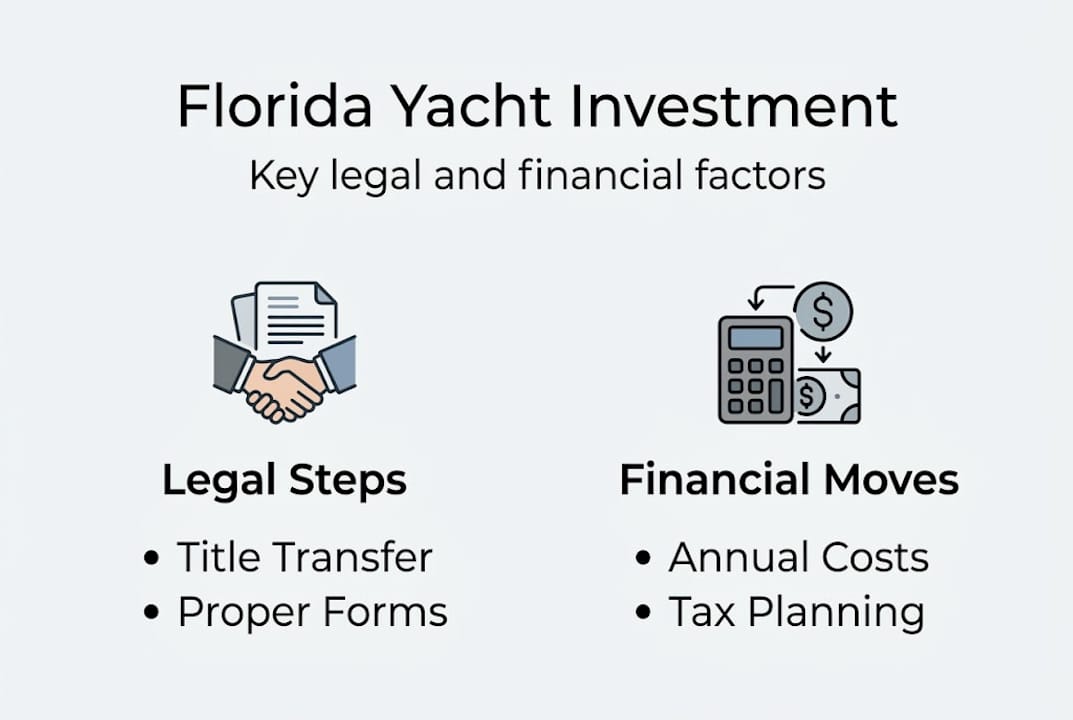
Charter programs are one of the most powerful tools available to Florida yacht owners. When structured correctly, charter income can cover 30 to 60% of annual operating costs, turning what feels like a pure expense into a cash-flow-neutral asset. The key is choosing the right program and the right management team to handle bookings, maintenance coordination, and compliance.
Here are the strategies we consistently recommend to our clients:
- Structure ownership through an LLC or trust. This limits personal liability and may offer tax advantages depending on your overall financial picture.
- Maintain meticulous service records. Documented maintenance history directly supports resale value. Buyers and brokers trust vessels with clear records.
- Plan your exit from day one. Knowing your target resale timeline helps you make smarter decisions about upgrades, charter use, and maintenance investment.
- Work with a broker who specializes in your vessel type. Generic brokers handle transactions. Specialized brokers customize strategies. The difference in outcome can be significant.
Pro Tip: Review our yacht ROI guide before signing any purchase agreement. Understanding your expected return profile upfront changes how you negotiate price, structure the deal, and plan ongoing management.
One area many buyers overlook is the Florida yacht tax guide, which outlines deduction opportunities specific to Florida’s regulatory environment. Pairing smart tax planning with charter income is the most reliable path to maximizing Florida yacht ROI without sacrificing the enjoyment that made you want a yacht in the first place.
Selling your yacht: transferring ownership and maximizing resale
After years of ownership, selling your vessel calls for careful planning. Here is how to get it right and avoid the documentation mistakes that cost sellers thousands.
The legal transfer requirements mirror the purchase process: you must provide the Certificate of Title, a completed HSMV 82040 form, a notarized bill of sale, and verified HIN documentation. The buyer then has 30 days to complete registration. As the seller, ensuring your paperwork is clean protects you from post-sale liability.
Here is a step-by-step breakdown of a successful sale:
- Gather all ownership documents. Title, bill of sale, service records, and any warranty documentation.
- Verify HIN accuracy. Confirm the number on the hull matches the title before listing.
- Determine fair market value. Use a professional appraisal or broker comparative market analysis.
- List strategically. Timing, presentation, and pricing all affect how quickly you sell and at what price.
- Complete the HSMV 82040 form. Both parties sign. Have it notarized.
- Transfer the title. Hand over the signed title to the buyer at closing.
Seller’s note: Do not release the vessel until all funds have cleared and all documents are signed. Post-sale liability disputes are far more common when sellers rush the closing process.
Now, should you sell on your own or use a broker? Here is a quick comparison:
| Factor | DIY sale | Broker-assisted sale |
|---|---|---|
| Price achieved | Often below market | Typically at or above market |
| Time to sell | Longer | Shorter |
| Documentation risk | Higher | Lower |
| Negotiation support | None | Full |
| Legal compliance | Your responsibility | Managed by broker |
Our team helps you boost Florida boat sale value through targeted preparation and expert positioning. Understanding the yacht broker role in Florida transactions is especially important for larger vessels where documentation complexity and negotiation stakes are higher.
A realistic view: yachts as assets, not just adventures
Now that you know the transactional steps, let us consider what truly differentiates successful owners from disappointed ones. In our experience, the gap almost always comes down to mindset.
Many buyers approach yacht ownership as a pure lifestyle purchase. That is understandable. Yachts are exciting, aspirational, and genuinely joyful. But treating a yacht solely as a luxury toy leads to financial surprises and, eventually, regret. The owners who get the most out of their investment, both financially and experientially, are the ones who treat the vessel as an asset from day one.
That means understanding that yachts carry negative carry and opportunity cost of 4 to 7% annually. It means building a cost model before buying. It means choosing the right ownership structure, the right management approach, and the right exit strategy. None of this takes away from the joy of ownership. It actually enhances it, because you are never blindsided by a bill or a legal complication.
Our expert yacht management team exists precisely to bridge that gap between passion and pragmatism. When both are working together, yacht ownership in Florida is genuinely exceptional.
Take the next step with expert guidance
If you want to ensure your yacht journey in Florida is as profitable and enjoyable as possible, we are here to help make that happen.

At Yachting Experts, we offer personalized, hands-on support through every phase of ownership. From vessel sourcing and title management to charter strategy and eventual resale, our team holds your hand through the entire process. Explore our Florida yacht management services to see how we protect and grow your investment. Ready to plan your purchase or trade-up? Our ownership maximization guide and Florida yacht appraisal guide are the perfect starting points. Let us help you make this one of the best financial decisions you have ever made.
Frequently asked questions
What documents are essential to prove boat ownership in Florida?
You need a Certificate of Title, notarized bill of sale, HIN verification, and completed HSMV 82040 form for legal proof of boat ownership in Florida.
How quickly must you transfer the title after buying a boat in Florida?
You must complete the boat title transfer within 30 days of purchase to avoid penalties and protect your legal ownership status.
Are yachts a profitable investment in Florida?
Yachts rarely deliver strong pure ROI, but tax deductions and charter income strategies may significantly offset annual costs, making them a rewarding lifestyle asset with managed financial exposure.
What strategies help maximize yacht resale value?
Using a broker, keeping detailed maintenance records, and ensuring clean documentation help you achieve the best resale price and a smooth title transfer in Florida.
What common mistakes do first-time Florida yacht owners make?
New owners often underestimate ongoing costs, miss titling deadlines, and skip professional guidance, which leads to legal complications and avoidable financial losses.
Recommended
Request A Call
Featured Listings

2027 Canados
100
Miami Florida

2015 Maiora
$3,750,000
90
Miami Florida

2027 Canados
57
Miami Florida

2019 Silent-Yachts Fair Dinkum
$1,599,000
55
Fort Lauderdale Florida

2026 Canados
49
Miami Florida

2026 Buddy Davis
47
Miami Florida

2020 Grady-White No Name
$610,000
45
Hallandale Beach Florida

2020 Viking Huckleberry
$1,495,000
44
Fort Lauderdale Florida

2027 Canados
43
Miami Florida

2021 Intrepid Dream Faster
$730,000
40
Coral Gables Florida

2016 Edgewater
$299,000
37
Miami, Florida

2022 Avid
$56,900
23
Stuart Florida
Get your yacht value Estimate
"*" indicates required fields