

Buying a yacht is one of the most exciting financial decisions you will ever make. But wire-transfer a six-figure sum to a seller you barely know, and excitement can quickly turn to anxiety. That is precisely why explaining yacht escrow matters so much. Escrow is the neutral financial mechanism that holds your deposit, or even the full purchase price, until every agreed condition is satisfied. First-time buyers often assume yacht transactions work like buying a car. They do not. The sums are larger, the paperwork is more complex, and the legal exposure is real. Understanding how yacht escrow works protects you from the start.
Table of Contents
- Key Takeaways
- Explaining yacht escrow: the core concept
- Legal compliance and the SALEFORM 2025 update
- Conditional release provisions: how funds actually get released
- Practical tips for navigating yacht escrow
- My honest take on why escrow knowledge matters more than ever
- How Yachtingexperts makes escrow feel manageable
- FAQ
Key Takeaways
| Point | Details |
|---|---|
| Escrow protects both parties | A neutral escrow agent holds funds until all agreed conditions are met, reducing financial risk for buyers and sellers. |
| SALEFORM 2025 changed the rules | The MOA and escrow agreement must now be signed simultaneously, not sequentially, before any deposit is lodged. |
| KYC and AML are contractual | Failing to submit compliance documents can legally block your escrow account from opening and delay the entire deal. |
| Conditional release is precise | Fund releases are tied to specific, measurable triggers like inspection certificates and delivery confirmations, not goodwill. |
| Professional guidance saves deals | Working with a licensed yacht broker and a qualified escrow professional is the single most effective way to avoid costly mistakes. |
Explaining yacht escrow: the core concept
At its most basic, yacht escrow is a three-party arrangement. You have the buyer, the seller, and a neutral escrow agent, typically a licensed attorney or specialist financial institution. The buyer deposits funds into a dedicated escrow account. Those funds sit there, untouched by the seller, until every pre-agreed condition in the escrow agreement is satisfied. Only then does the agent release the money.
Think of it this way. If you were handing a stranger $500,000, you would want a referee in the room making sure the exchange was fair. That referee is your escrow agent.
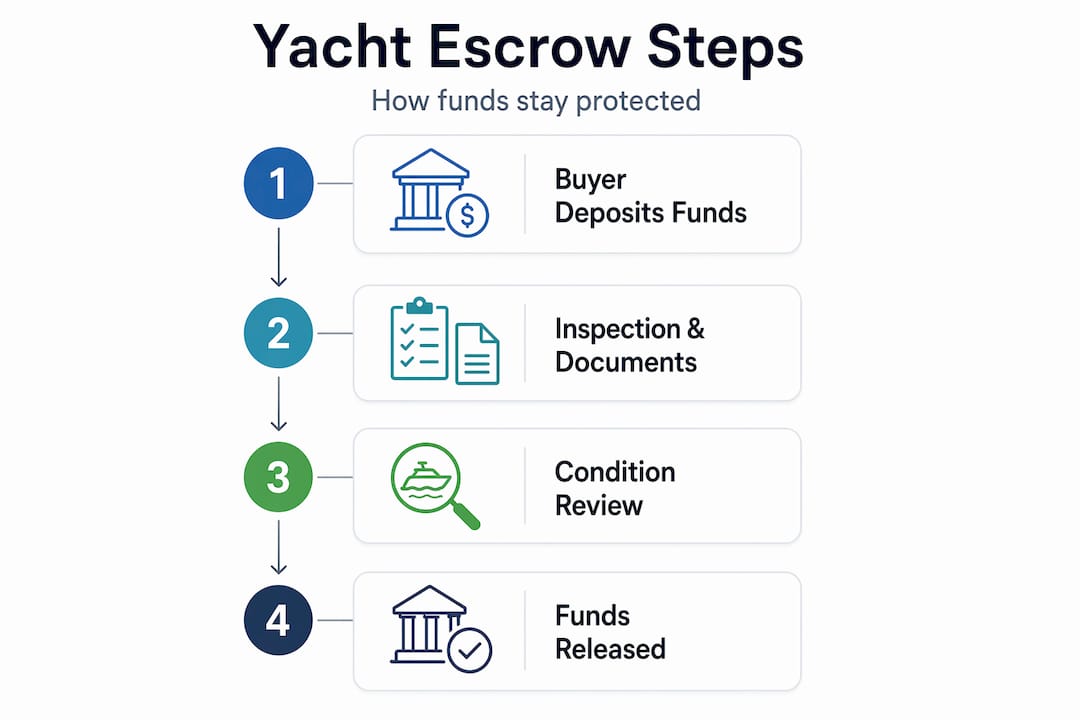
Here is how the typical flow works in a yacht transaction:
- Memorandum of Agreement (MOA) signed: Buyer and seller agree to terms.
- Escrow agreement executed: This happens at the same time as the MOA under modern standards.
- Deposit lodged: Buyer transfers the deposit, usually 10% of the purchase price, into the escrow account.
- Survey and sea trial conducted: Independent inspection confirms the vessel’s condition.
- Delivery and closing: All conditions met, funds released to seller, title transferred to buyer.
Unlike real estate escrow, which follows fairly standardized state-regulated processes, yacht escrow can involve international jurisdictions, offshore registries, and varying legal frameworks. That complexity is exactly why you want a professional guiding the process from day one.
Pro Tip: Ask your escrow agent upfront whether they hold a separate, dedicated account for your transaction or pool client funds. A dedicated account gives you cleaner audit trails and faster dispute resolution if anything goes sideways.
Legal compliance and the SALEFORM 2025 update
If you have been researching yacht purchases recently, you may have come across the term SALEFORM 2025. This is the updated industry-standard contract for vessel sales and purchase transactions, and it made significant changes to how escrow is handled.
The most critical update is timing. SALEFORM 2025 requires that the escrow agreement and the MOA be signed before the deposit is lodged. That means you cannot finalize the main contract and then worry about escrow terms later. The two documents go hand in hand, signed simultaneously. Deferring escrow negotiations to closing is no longer acceptable under this standard.
Here is what the compliance sequence looks like under SALEFORM 2025:
- Negotiate and finalize both the MOA and escrow agreement together. Do not let either side rush you into signing the MOA without the escrow terms locked in.
- Submit KYC and AML documentation. KYC and AML are now contractual obligations that directly affect when the escrow account can be opened. Without these documents, the account cannot open, and the deposit cannot legally be lodged.
- Await written escrow agent confirmation. The agent must confirm in writing that the account is ready before funds are transferred.
- Lodge the deposit. Only after steps one through three are complete.
The real-world consequences of getting this wrong are serious. In The King Crude Carriers case, delayed KYC documentation meant the deposit was not legally payable, leaving the seller with a damages claim rather than the deposit itself. That is a painful outcome for both sides.
SALEFORM 2025 also introduced an optional longstop termination mechanism. If the escrow agent is not ready within an agreed number of days, either party can exit the deal. This protects buyers and sellers from being locked into a stalled transaction with no clear way out.
“KYC and AML compliance are no longer just administrative boxes to tick. They are genuine contractual milestones that can delay or completely halt a yacht transaction if not completed promptly.”
Conditional release provisions: how funds actually get released
Understanding yacht escrow means understanding one of its most important mechanisms: conditional release. This is the specific set of rules inside your escrow agreement that tells the agent exactly when and how to release the funds.
Here is a comparison of the three main conditional release structures used in yacht deals:
| Release Type | How it works | Best for |
|---|---|---|
| Documentary release | Funds released upon delivery of specific documents (inspection certificate, title transfer, bill of sale) | Most standard yacht purchases |
| Milestone-based release | Funds released in stages as defined events occur (survey passed, delivery accepted) | Complex or multi-phase transactions |
| Third-party verification | A named third party, such as a surveyor or classification society, confirms a condition is met before release | High-value or commercially registered vessels |
Poorly drafted conditions cause disputes. Well-drafted conditions reduce conflicts dramatically. The difference usually comes down to specificity. A condition that says “buyer is satisfied with the survey” is dangerously vague. A condition that says “independent marine surveyor certifies the vessel meets ABYC standards with no deficiencies rated Category A or above” is objective and verifiable.
The escrow agent’s role in all of this is deliberately narrow. The agent confirms fulfillment of predefined conditions. That is it. The agent is not a judge, not a mediator, and not a decision-maker in disputes between buyer and seller. That neutrality is what makes the entire system trustworthy. But it also means the quality of your escrow agreement is everything. Garbage in, garbage out.

Escrow agreements often include documentary release provisions tying fund releases to delivery confirmations, inspection certificates, or title transfers. These are your practical safeguards as a buyer. Make sure every one of them is clearly defined in writing before you transfer a single dollar.
Pro Tip: Request a draft of the conditional release provisions before signing anything. Run it by your yacht broker and, if the deal is large, a maritime attorney. The cost of that review is trivial compared to the cost of a disputed release.
Practical tips for navigating yacht escrow
Now that you understand the structure, let us get into the practical side of making it work smoothly for you. These yacht purchase escrow tips come from real transactions, not textbooks.
- Start KYC early. Gather your passport, proof of address, source of funds documentation, and any corporate structure documents before you find the yacht you want. Most escrow agents will ask for all of it, and being ready saves days or even weeks.
- Coordinate your MOA and escrow agreement signing. Under SALEFORM 2025, these must happen together. Work with your broker to schedule both signings on the same day. Never sign the MOA without having the escrow terms agreed first.
- Choose your funding structure carefully. Escrow structures vary widely: deposit only, deposit plus balance held in escrow, or balance paid via conditional SWIFT instructions. Each carries different levels of protection and timing implications. Talk to your broker about which structure best fits your deal.
- Build buffer time into your schedule. International wire transfers, KYC reviews, and survey scheduling all take time. Deals that feel rushed produce errors. Build at least two to three extra business days into every deadline.
- Know what happens if things go wrong. If escrow is delayed and your deal has a longstop clause, understand your rights clearly before you need to exercise them. Your broker should walk you through this before you sign.
- Use a licensed yacht broker. The Florida yacht sales process and similar frameworks in other states provide clear guidance, but only experienced professionals know how to apply those frameworks to actual deals.
The yacht closing process in Florida is a great reference if you are buying domestically, because it outlines exactly what documents change hands, when, and in what order. Escrow is woven into every step.
Pro Tip: Never wire funds based on emailed instructions alone. Call the escrow agent directly on a verified phone number to confirm wire details before initiating any transfer. Wire fraud targeting yacht transactions is real and growing.
My honest take on why escrow knowledge matters more than ever
I have seen firsthand what happens when buyers skip over the escrow details because they trust the seller or are eager to close quickly. The yacht looks beautiful at the dock. Everyone is smiling. And then a document is missing, KYC is incomplete, and suddenly the deal is frozen while the vessel sits in a marina racking up fees.
What I have learned after working through dozens of transactions is that escrow is not a formality. It is the architecture of trust in every yacht deal. SALEFORM 2025 codified what experienced brokers already knew: you cannot treat escrow as an afterthought. The moment you sign an MOA without the escrow agreement locked in, you have created an asymmetry of risk that almost always favors the other side.
The buyers who come out of these transactions feeling great are the ones who showed up prepared. Their KYC documents were ready before they even started viewing vessels. They understood whether their deal used deposit-only escrow or a full balance hold. They asked questions that first-time buyers often do not know to ask. And they worked with professionals who had navigated this terrain before.
My genuine advice: treat your escrow education as part of your yacht-buying budget. The time you invest in understanding the process is time that protects your money. This is not a bureaucratic hurdle. It is the reason you can sleep at night while your deposit sits in an account waiting for delivery day.
— Jason
How Yachtingexperts makes escrow feel manageable
At Yachtingexperts, we are genuinely thrilled to walk you through every step of the escrow process. We know the paperwork can feel heavy when you are also excited about the vessel waiting for you. That is why our team handles the coordination, so you do not have to become an escrow expert overnight.

We work directly with licensed escrow agents and maritime attorneys who understand SALEFORM 2025 inside and out. From your first viewing to the moment title transfers to your name, our experienced yacht brokers are in your corner, making sure KYC documents are submitted on time, escrow agreements are airtight, and conditional release provisions actually protect your investment. Whether you are buying your first vessel or trading up to maximize your yacht investment returns, we bring the expertise and personal attention that turns a complex transaction into a genuinely exciting experience. Reach out to our team today and let us show you what hands-on guidance really looks like.
FAQ
What is yacht escrow in simple terms?
Yacht escrow is a secure arrangement where a neutral third-party agent holds the buyer’s funds until all agreed conditions in the purchase contract are met, then releases the money to the seller.
How does SALEFORM 2025 affect the escrow process?
Under SALEFORM 2025, the escrow agreement and the Memorandum of Agreement must be signed at the same time, before any deposit is lodged, and the escrow agent must confirm account readiness in writing.
Why can KYC documents block my escrow account from opening?
KYC and AML documentation are contractual conditions that must be satisfied before an escrow account can be opened. Without them, the deposit is not legally payable and the transaction cannot proceed.
What is a conditional release provision in yacht escrow?
A conditional release provision is a precise set of rules in the escrow agreement specifying the exact documents, milestones, or third-party verifications required before the escrow agent releases funds to either party.
Do I need a yacht broker to manage escrow?
Technically no, but practically yes. A licensed yacht broker coordinates the timing of documents, liaises with escrow agents, and helps you avoid the compliance mistakes that delay or derail transactions, especially under updated standards like SALEFORM 2025.
Recommended
Request A Call
Featured Listings

2027 Canados
100
Miami Florida

2015 Maiora
$3,750,000
90
Miami Florida

2027 Canados
57
Miami Florida

2019 Silent-Yachts Fair Dinkum
$1,599,000
55
Fort Lauderdale Florida

2026 Canados
49
Miami Florida

2026 Buddy Davis
47
Miami Florida

2020 Grady-White No Name
$610,000
45
Hallandale Beach Florida

2020 Viking Huckleberry
$1,495,000
44
Fort Lauderdale Florida

2027 Canados
43
Miami Florida

2021 Intrepid Dream Faster
$730,000
40
Coral Gables Florida

2016 Edgewater
$299,000
37
Miami, Florida

2022 Avid
$56,900
23
Stuart Florida
Get your yacht value Estimate
"*" indicates required fields