

TL;DR:
- Expedition yachts are built for long-range, off-grid adventures with reinforced hulls and high autonomy.
- Key features include extended fuel/water capacity, advanced navigation, and robust systems for remote travel.
- Proper ownership management and understanding mission needs are essential for maximizing investment and operational success.
Many prospective buyers walk into their first yacht search assuming that a bigger, more capable vessel is simply a larger version of a standard luxury yacht. That assumption can cost you time, money, and the wrong boat. Expedition yachts occupy a completely different category, built for long-range autonomy, remote destinations, and serious offshore capability. They also represent a compelling investment opportunity for owners who want more than a floating vacation home. In this guide, we break down what expedition yachts truly are, the core features that matter, how to choose the right one, and how to manage your investment for maximum return.
Table of Contents
- What makes an expedition yacht unique?
- Core features every expedition yacht needs
- How to choose the right expedition yacht for your goals
- Optimizing ownership: Maintenance, management, and investment value
- Our perspective: Beyond the brochure—What buyers really need to know
- Explore your expedition yacht opportunities with Yachting Experts
- Frequently asked questions
Key Takeaways
| Point | Details |
|---|---|
| Distinct design | Expedition yachts offer robust construction, autonomy, and unique capabilities for adventure travel. |
| Critical features | Long-range tanks, reinforced hulls, and advanced systems are essential for off-grid exploration. |
| Decision factors | Your yacht choice should align with your cruising goals, usage style, and future investment potential. |
| Ownership matters | Expert management and regular maintenance protect both enjoyment and financial value. |
What makes an expedition yacht unique?
With the basics in mind, let’s clarify what exactly distinguishes an expedition yacht from a traditional luxury vessel.
At their core, expedition yachts are designed for long-range travel and off-the-grid adventures. That single design philosophy changes everything, from the hull shape to the fuel tanks to the onboard systems. A standard luxury yacht is engineered for comfort in familiar waters, with emphasis on aesthetics and amenities. An expedition yacht is engineered to get you somewhere truly remote and keep you there safely.
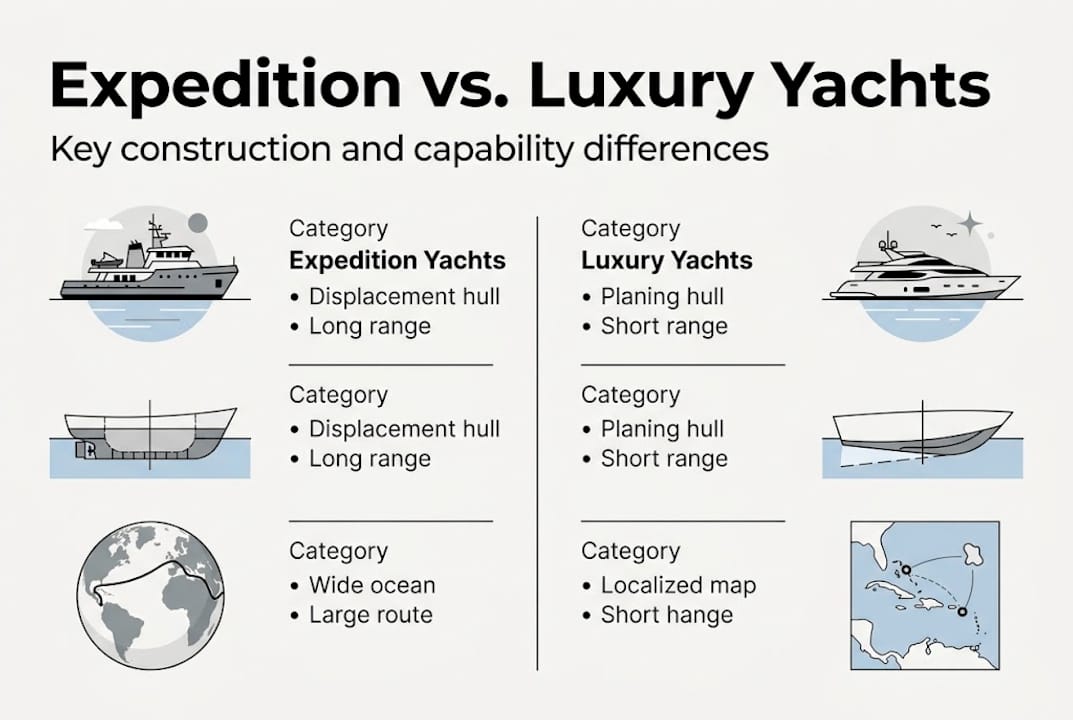
The hull is the most obvious difference. Expedition yachts typically feature a displacement or semi-displacement hull, which prioritizes fuel efficiency over speed. Many are built to ice-class standards, meaning the hull can handle contact with floating debris or light ice without damage. That kind of construction adds weight and cost, but it also adds resilience you simply cannot find on a typical motor yacht.
Autonomy is the other defining factor. These vessels carry significantly more fuel, fresh water, and provisions than standard yachts. Ranges of 3,000 to 6,000 nautical miles are common, and some purpose-built expedition yachts can cross entire oceans without a fuel stop. Compare that to a typical luxury motor yacht, which may have a range of 500 to 1,200 nautical miles.
| Feature | Expedition yacht | Standard luxury yacht |
|---|---|---|
| Hull type | Displacement/ice-class | Planing or semi-displacement |
| Range | 3,000 to 6,000+ nm | 500 to 1,200 nm |
| Fuel capacity | Very high | Moderate |
| Off-grid capability | Full autonomy | Limited |
| Build focus | Rugged, functional | Aesthetic, comfort |
| Navigation systems | Advanced, redundant | Standard |
According to Boat International, explorer and expedition yachts now account for a growing share of new superyacht launches, reflecting strong buyer demand for vessels that can go further and stay longer. This shift is not a trend. It is a fundamental change in what serious yacht owners want.
Key characteristics that define an expedition yacht include:
- Reinforced hull construction, often to Lloyd’s or Bureau Veritas ice-class standards
- Extended fuel and water tankage for true blue-water autonomy
- Advanced navigation and communication systems with full redundancy
- Heavy-duty stabilizers for comfort in open-ocean conditions
- Tender garages and expedition equipment storage for shore excursions
- Robust crew quarters designed for long passages
These features, combined with thoughtful yacht amenities, make expedition yachts the most capable and versatile vessels on the water.
Core features every expedition yacht needs
Now that you understand what sets expedition yachts apart, let’s dive into the core features to look for when evaluating one.
The fuel and water systems are your lifeline on extended passages. Long-range tanks should give you a minimum range of 3,000 nautical miles at cruising speed. Water makers, which convert seawater to fresh water through reverse osmosis, should produce enough daily output to sustain the full crew and guests without rationing. These are non-negotiable systems.
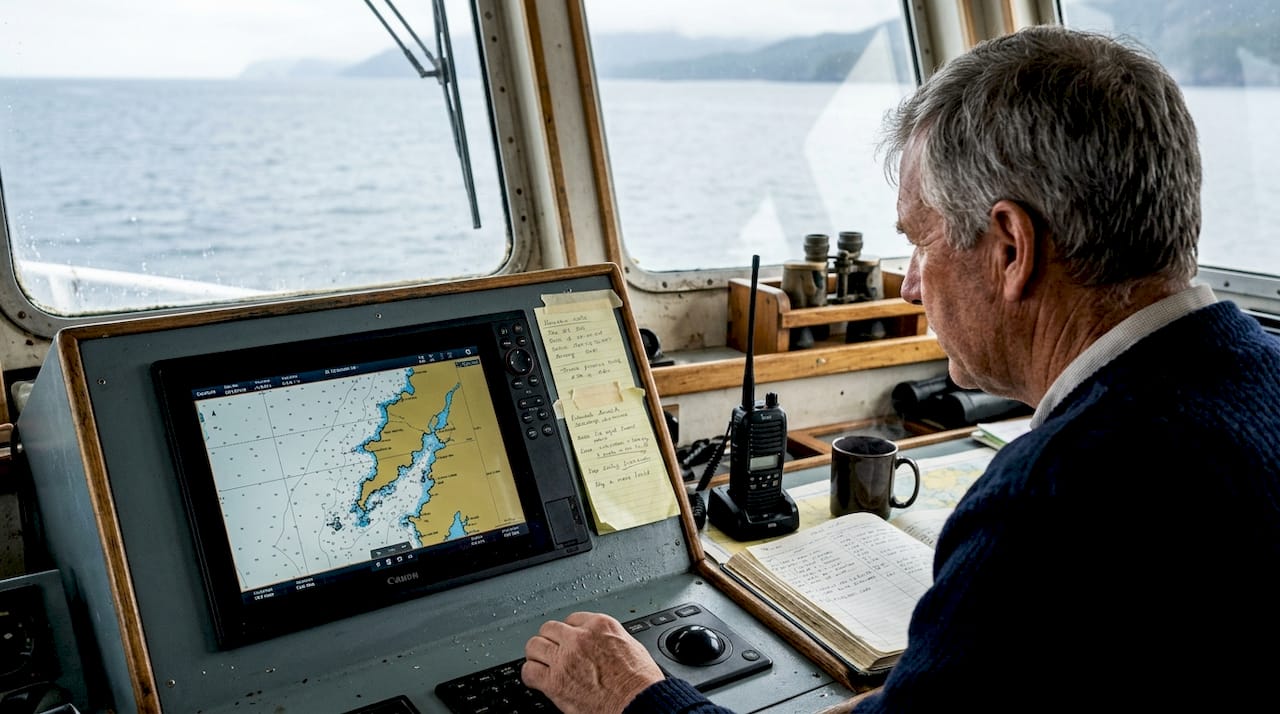
Expedition yachts prioritize autonomy, advanced tech, and rugged design for global travel. That means the navigation suite needs to be equally serious. Expect integrated radar, AIS (Automatic Identification System), satellite communications, and weather routing software. Redundancy matters here. If your primary navigation system fails 1,000 miles from the nearest port, your backup system is not optional.
According to Yachting Magazine, the distinction between explorer and expedition yachts often comes down to the level of systems redundancy and build specification. Buyers should pay close attention to this detail during any survey.
| Spec | Entry-level expedition | Mid-range expedition | High-spec expedition |
|---|---|---|---|
| Range (nm) | 2,500 to 3,500 | 3,500 to 5,000 | 5,000+ |
| Fuel capacity (liters) | 30,000 to 50,000 | 50,000 to 80,000 | 80,000+ |
| Build material | Steel/aluminum | Steel/aluminum | Ice-class steel |
| Autonomy (days) | 20 to 30 | 30 to 50 | 50+ |
The top three systems to inspect before buying any expedition yacht are:
- Propulsion and engineering spaces: Look for service access, maintenance records, and evidence of regular professional oversight.
- Navigation and communication suite: Verify redundancy, software currency, and satellite connectivity contracts.
- Water and waste management systems: Confirm water maker output, holding tank capacity, and compliance with international maritime regulations.
Pro Tip: Many buyers focus on the master suite and overlook the tender garage and equipment storage. A well-designed tender garage with crane capacity and secure storage for dive gear, kayaks, and expedition equipment dramatically boosts both owner satisfaction and future resale value. Check the yacht market trends to understand which features buyers are prioritizing right now.
How to choose the right expedition yacht for your goals
Understanding the core features leads directly to the next challenge: how to match those to your personal mission and investment plans.
Start with your mission profile. Are you planning polar expeditions to Svalbard or Antarctica? Tropical island hopping in the Pacific? Extended Atlantic crossings? Each scenario demands a different configuration. Polar routes require ice-class certification and heating systems. Tropical cruising prioritizes air conditioning capacity and shallow draft for reef navigation. Your intended routes should drive every specification decision.
Market demand and intended routes should drive your expedition yacht purchase, not the other way around. Buyers who fall in love with a vessel and then try to adapt their plans to fit it often end up frustrated or undersupplied for their actual adventures.
Critical decision factors to evaluate before committing include:
- Size and crew requirements: Larger vessels offer more range and comfort but require larger professional crews, which increases operating costs significantly
- Autonomy rating: Match the vessel’s range and self-sufficiency to your longest planned passage
- Technology and systems: Prioritize vessels with modern, serviceable systems rather than custom one-off solutions that are difficult to maintain
- Charter potential: If you plan to offset costs through chartering, verify the layout and amenities appeal to the charter market in your target region
- Survey history and build pedigree: Reputable builders like Damen, Lurssen, and Feadship carry stronger resale value and better parts availability
Investment considerations matter just as much as adventure capability. Understanding yacht insurance trends for expedition-class vessels will also affect your total cost of ownership significantly.
According to Superyacht News, buyers who align their vessel selection with a clearly defined mission profile report significantly higher satisfaction levels than those who prioritize aesthetics first.
Pro Tip: When evaluating resale potential, look at what features are appearing most frequently in new builds. Hybrid propulsion systems, expanded medical suites, and integrated drone storage are becoming standard on new expedition yachts. Buying a vessel that already includes these features, or can be retrofitted affordably, protects your investment as buyer expectations evolve.
Optimizing ownership: Maintenance, management, and investment value
Even the best expedition yacht is only as strong as the ownership and management practices behind it.
Professional management and maintenance directly affect a yacht’s long-term value and owner satisfaction. Expedition yachts operate complex systems under demanding conditions, which means deferred maintenance is never a minor issue. A failed water maker in a remote anchorage is not an inconvenience. It is a safety problem.
Effective ownership management follows a clear sequence:
- Establish a structured maintenance plan: Schedule all major service intervals before the season begins, including engine overhauls, stabilizer servicing, and navigation system updates.
- Hire and retain experienced crew: Long-range expedition yachts require crew with offshore certification and genuine blue-water experience, not just coastal qualifications.
- Engage professional yacht management oversight: A qualified management company monitors compliance, insurance, crew contracts, and maintenance scheduling so nothing falls through the cracks.
- Track all upgrades and work orders: Detailed records of every repair and upgrade are essential for insurance claims, charter certification, and future resale negotiations.
- Evaluate charter opportunities annually: Even occasional chartering can offset substantial operating costs and keeps the vessel active, which is better for systems longevity than extended layup.
“Owners who invest in professional management from day one consistently report higher resale values and lower unexpected repair costs over the vessel’s ownership lifecycle.” This reflects the reality that yacht management strategies are not an optional luxury. They are a financial necessity for expedition-class vessels.
According to YachtWorld, well-managed yachts command premium prices on resale and attract higher-quality charter clients. The return on professional management investment is measurable and consistent.
Depreciation is real, but it is manageable. Expedition yachts that are actively maintained, regularly upgraded, and properly documented depreciate far more slowly than neglected vessels. Chartering in premium destinations like Antarctica, the Northwest Passage, or the Galapagos also positions your vessel as a specialized asset with a defined and loyal market.
Our perspective: Beyond the brochure—What buyers really need to know
We have worked with enough expedition yacht buyers to know that the biggest mistakes rarely happen because someone chose the wrong engine room layout. They happen because buyers focus entirely on specifications and completely miss the lifestyle and operational reality of owning a vessel like this.
The glossy brochure will show you pristine anchorages and smiling crew. It will not show you the complexity of managing a 24-meter steel vessel in a remote location with a crew of six and a mechanical issue that requires a part flown in from Europe. That is the real expedition yacht experience, and it is genuinely extraordinary when you are prepared for it.
We always encourage buyers to look at market trends 2026 alongside owner case studies from people who have actually completed the passages they are planning. The gap between expectation and reality closes fast when you hear directly from owners who have done it.
Pro Tip: Before signing anything, engage an independent yacht consultant who has no financial stake in the transaction. Their job is to protect your interests, not close a deal. Pair that with real owner testimonials, and you will make a far better decision than any brochure could guide you toward.
Explore your expedition yacht opportunities with Yachting Experts
Ready to move from insight to action? Here’s how Yachting Experts can support your next step.
We are passionate about connecting serious buyers with the right expedition yachts, and we do it with the kind of personalized, hands-on guidance that makes a genuinely complex process feel seamless. Whether you are ready to browse exclusive expedition yacht listings, need help structuring your ownership and professional yacht management plan, or want to explore how chartering fits into your ownership strategy through our complete chartering guide, our team is here for every step.

Your expedition yacht journey deserves expert guidance from people who genuinely love what they do. Reach out to our team today and let’s find the vessel that matches your vision, your mission, and your investment goals.
Frequently asked questions
What is an expedition yacht?
An expedition yacht is built for long-range autonomy and remote adventure, with reinforced construction and advanced systems that standard luxury yachts simply do not carry. Think of it as the difference between a luxury sedan and a fully equipped expedition vehicle.
Are expedition yachts a good investment?
Yes, when properly selected and managed. Their niche appeal and global market demand support stronger resale values and consistent charter income compared to standard motor yachts.
How does maintenance differ for expedition yachts?
Maintenance is more intensive because the systems are more complex and must perform reliably in remote conditions. Professional management is essential, not optional, for keeping an expedition yacht in peak condition.
Can expedition yachts be chartered?
Absolutely. Many owners use chartering to offset operating costs, and expedition yachts command premium rates for unique destinations. Our complete chartering guide covers everything you need to know about making chartering work for your ownership model.
Recommended
Request A Call
Featured Listings

2027 Canados
100
Miami Florida

2015 Maiora
$3,750,000
90
Miami Florida

2027 Canados
57
Miami Florida

2019 Silent-Yachts Fair Dinkum
$1,599,000
55
Fort Lauderdale Florida

2026 Canados
49
Miami Florida

2026 Buddy Davis
47
Miami Florida

2020 Grady-White No Name
$610,000
45
Hallandale Beach Florida

2020 Viking Huckleberry
$1,495,000
44
Fort Lauderdale Florida

2027 Canados
43
Miami Florida

2021 Intrepid Dream Faster
$730,000
40
Coral Gables Florida

2016 Edgewater
$299,000
37
Miami, Florida

2022 Avid
$56,900
23
Stuart Florida
Get your yacht value Estimate
"*" indicates required fields