

Owning a yacht in Florida is one of life’s great privileges, but keeping it in peak condition requires far more than an occasional rinse. The choices you make about maintenance directly affect your vessel’s safety, performance, and long-term value. Get it right, and you protect one of your most significant investments. Get it wrong, and you face costly repairs, dangerous breakdowns, and a deflated resale price. This guide walks you through every major maintenance category, practical cost comparisons, and expert recommendations so you can make confident, informed decisions for your yacht.
Table of Contents
- Hull and exterior maintenance
- Engine and mechanical system maintenance
- Electrical, electronics, and onboard technology maintenance
- Interior maintenance and comfort upgrades
- Yacht maintenance programs and professional services
- What most yacht owners overlook: Why customized maintenance pays off
- Connect with Florida’s premier yacht maintenance experts
- Frequently asked questions
Key Takeaways
| Point | Details |
|---|---|
| Hull care is vital | Regular hull and exterior maintenance prevent marine buildup and protect your investment. |
| Engine checks save money | Routine engine and mechanical maintenance lowers costly breakdowns and downtime. |
| Electronics and tech matter | Stay on top of electrical and technology maintenance to maximize safety and performance. |
| Choose professional programs | Opt for reputable maintenance services in Florida to preserve yacht value and minimize risk. |
| Tailor maintenance to your needs | Personalized schedules and climate-aware care outperform generic packages in Florida. |
Hull and exterior maintenance
Having previewed the breadth of yacht maintenance, let’s begin with foundational exterior care. The hull is your yacht’s first line of defense against Florida’s demanding marine environment. Saltwater, barnacles, algae, and UV rays work constantly against hull integrity and efficiency. Ignoring this area leads to fuel waste, structural damage, and expensive repairs that compound over time.
Core hull maintenance tasks include:
- Hull cleaning: Removing marine growth every 60 to 90 days is standard in Florida waters
- Anti-fouling paint: Applied during haulout to prevent barnacle buildup and protect the hull below the waterline
- Gelcoat repair and polishing: Restores appearance, prevents osmotic blistering, and seals surface cracks
- Bottom inspections: Divers or haulouts check for corrosion, blistering, and prop damage
- Waterline cleaning: Removes staining from tidal exposure and oxidation
Florida’s warm water accelerates marine growth dramatically compared to northern climates. A vessel left untreated for even one season can accumulate enough biofouling to reduce fuel efficiency by up to 20%. Proper yacht maintenance cycles are built around this reality, not ignored.
“Routine hull cleaning prevents marine growth and protects structural integrity.” Staying ahead of this is what separates well-maintained yachts from costly liabilities.
Budget expectations vary based on vessel size and material. Fiberglass hulls typically cost less to maintain than aluminum or steel. A 50-foot yacht in South Florida might see annual hull maintenance costs ranging from $3,000 to $8,000 depending on service frequency and anti-fouling product selection. Understanding your Florida yacht ownership costs from the start helps you plan without surprises.
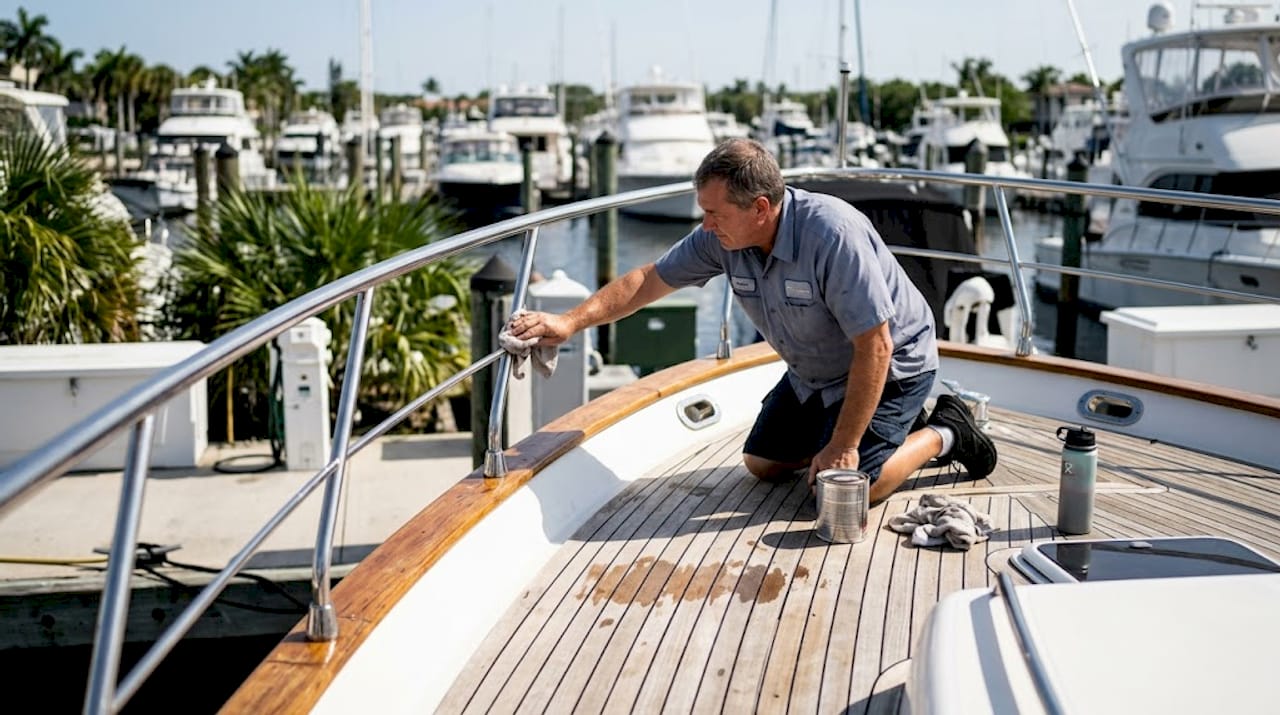
One often overlooked exterior task is stainless steel polishing and teak deck maintenance. Both are visual and structural. Salt residue accelerates oxidation on stainless fittings, while untreated teak warps, splinters, and becomes a liability on deck.
Engine and mechanical system maintenance
Once the exterior is secure, focus moves to the heart of performance, which is mechanical upkeep. Your engines are the most complex and expensive components on your yacht. In Florida’s heat and saltwater environment, mechanical systems face accelerated wear. A missed oil change or clogged raw water strainer can escalate from a minor inconvenience into a full engine replacement.
Standard mechanical maintenance intervals include:
- Engine oil and filter changes every 100 hours or annually
- Raw water impeller replacement every season
- Belt and hose inspections every 50 hours
- Fuel filter changes every 100 to 150 hours
- Transmission fluid checks at every major service
- Shaft seal and cutlass bearing inspections annually
Signs of neglected mechanical systems:
- Overheating or irregular temperature readings
- Excessive black or white exhaust smoke
- Vibration during acceleration
- Reduced fuel efficiency
- Difficulty starting engines
Pro Tip: Always log engine hours and service dates in a dedicated maintenance record. This documentation increases buyer confidence and resale value significantly when you decide to trade up.
Scheduled engine inspections and fluid changes are vital to avoid premature breakdowns. The cost difference between preventive mechanical service and emergency repair is dramatic. A routine service may cost $500 to $1,500 per engine annually, while a blown heat exchanger or seized engine can run $10,000 or more.
Always choose certified marine technicians in Florida. Look for ABYC (American Boat and Yacht Council) certified professionals who understand marine diesel and gasoline systems specific to Florida’s operating conditions. The yacht management advantages of working with vetted service providers include accountability, warranty protection, and peace of mind.
Electrical, electronics, and onboard technology maintenance
Beyond mechanics, technology and electronics now drive modern yacht utility. Here’s what matters most. Today’s yachts are floating technology platforms, and Florida’s saltwater environment is their worst enemy. Corrosion, moisture ingress, and power surges can disable navigation, communication, and safety systems with little warning.
Key electrical and electronics maintenance tasks:
- Battery bank testing and replacement every 2 to 4 years
- Shore power cord and inlet inspections for corrosion
- Bilge pump testing and wiring checks monthly
- Navigation light function tests before every trip
- VHF radio, GPS, and radar calibration annually
- EPIRB and flare kit expiration tracking
Pro Tip: Apply corrosion-inhibiting spray to all electrical connections twice per year. This simple step can extend the life of wiring, terminals, and connectors by years in Florida’s humid, salty air.
Regular inspection of yacht electronics minimizes safety risks and maximizes vessel performance. This is not optional for compliant, safe operation in Florida waters. Insurance providers increasingly require documented electronics inspections as part of coverage renewal.
Electronics maintenance quick reference:
| System | Inspection frequency | Estimated cost |
|---|---|---|
| Battery bank | Every 6 months | $50 to $200 |
| Navigation/GPS | Annually | $100 to $300 |
| VHF radio | Annually | $75 to $150 |
| EPIRB | Every 2 years | $150 to $400 |
| Wiring and connections | Every 6 months | $100 to $250 |
Understanding the full yacht ownership workflow means planning electronics inspections as part of your routine calendar, not as a reaction to failure.
Interior maintenance and comfort upgrades
After securing performance and tech, next comes the living comfort and aesthetics that set your yacht apart. The interior of your yacht is where guests form their lasting impressions. It’s also where neglect shows up fastest in resale negotiations. Florida’s humidity and heat create conditions that degrade soft surfaces, compromise air systems, and accelerate mold growth.
Interior maintenance essentials:
- Upholstery cleaning and UV protection treatment quarterly
- Teak interior polishing and conditioning seasonally
- HVAC filter replacement every 30 to 60 days
- Bilge dehumidification checks monthly
- Galley appliance cleaning and seal inspections regularly
- Safety equipment checks: fire extinguishers, flares, life jackets
Pro Tip: Run your air conditioning system year-round in Florida, even when the yacht is docked. Continuous airflow prevents mold and mildew buildup in cushions, carpet, and cabin walls, which are expensive to remediate once established.
Proper interior upkeep maintains resale value and guest satisfaction. Buyers scrutinize interiors closely, and a musty cabin or stained upholstery signals neglect across all systems.
Interior upgrade comparison:
| Upgrade type | Impact on comfort | Impact on resale value |
|---|---|---|
| Entertainment system | High | Moderate |
| Galley appliances | High | High |
| LED lighting upgrade | Moderate | Moderate |
| Custom upholstery | Very high | High |
| Climate control upgrade | Very high | Very high |
Luxury upgrades are smart investments when paired with solid maintenance. New entertainment systems and galley upgrades resonate with buyers, but only if the fundamentals are already sound. Tracking your yacht ownership costs across both maintenance and upgrades keeps your total investment optimized.
Yacht maintenance programs and professional services
As you’ve mastered individual maintenance tasks, see how holistic programs streamline care and add value. Florida yacht owners have three primary paths: DIY maintenance, scheduled professional service, or a full-service management program. Each has real trade-offs that affect your time, budget, and investment protection.
DIY maintenance pros:
- Lower direct labor costs
- Immediate familiarity with your vessel’s condition
- Flexibility in scheduling
DIY maintenance cons:
- Risk of missed technical issues
- No compliance guarantee for insurance or USCG standards
- Time-intensive for complex systems
Professional service advantages:
- Certified technicians with system-specific expertise
- Documented service records that support resale
- Proactive identification of developing problems
- Warranty protection on parts and labor
Professional maintenance ensures compliance with regulations and extends yacht lifespan. For most Florida owners, the ROI of professional programs far exceeds the cost of a single avoidable breakdown or insurance claim.
Maintenance program comparison:
| Program type | Annual cost range | Best for |
|---|---|---|
| DIY | $1,000 to $3,000 | Hands-on, experienced owners |
| Scheduled professional | $4,000 to $12,000 | Most yacht owners |
| Full-service management | $12,000 to $30,000+ | Frequent use, charter, or fleet |
When choosing a provider, verify ABYC certification, check references from Florida yacht owners, and confirm that service records are provided in a standardized format. Explore how yacht investment explained details how professional care directly protects your asset’s long-term market value.
What most yacht owners overlook: Why customized maintenance pays off
Here’s something we see often in Florida’s yachting community: owners applying the same generic maintenance schedule they read in a manufacturer’s manual, regardless of how they actually use the vessel. A yacht that spends 200 hours per year in Tampa Bay needs a completely different maintenance rhythm than one that logs 50 hours in the Bahamas.
Climate-specific and usage-specific planning is not a luxury. It’s the difference between a yacht that holds its value for a decade and one that surprises you with $40,000 in deferred repairs at trade-in. We’ve seen owners skip anti-fouling applications to save $800, only to spend $6,000 on hull repairs the following year.
The smartest Florida owners treat maintenance as a living strategy, adjusting for season, use, and emerging technology. Working with advisors who know optimizing maintenance cycles at the local level means your schedule is built around your yacht, not a generic template. That personalized approach is exactly what protects your investment and your peace of mind.
Connect with Florida’s premier yacht maintenance experts
You now have a clear picture of what exceptional yacht maintenance looks like across every system. The next step is connecting with professionals who can turn this knowledge into a personalized plan for your vessel.

At Yachting Experts, we make the entire process seamless. Whether you need yacht management solutions tailored to Florida’s unique conditions, guidance through the yacht sales process Florida guide, or want to set up a maintenance collaboration with our trusted network of certified professionals, we’re here to help. Reach out today and let’s build a maintenance strategy that protects your investment and keeps you on the water longer.
Frequently asked questions
What is the most critical type of yacht maintenance in Florida?
Hull and mechanical system maintenance are the top priorities in Florida due to accelerated marine growth in warm waters and heat-related engine stress. Routine hull cleaning prevents marine growth and protects structural integrity, making it non-negotiable for Florida owners.
How often should you schedule professional yacht maintenance?
Schedule professional maintenance at least quarterly, with additional checks before and after peak season. Professional maintenance ensures compliance with regulations and extends yacht lifespan, making quarterly service the smart standard.
Should yacht owners do maintenance themselves or hire professionals?
Hiring certified professionals is the recommended approach for complex systems, as it guarantees compliance, generates documented service records, and protects your investment. Professional maintenance ensures compliance with regulations and extends yacht lifespan beyond what most DIY approaches can achieve.
How does maintenance affect yacht resale value?
Comprehensive, documented maintenance is one of the strongest drivers of resale value, giving buyers confidence and reducing negotiation risk. Proper interior upkeep maintains resale value and guest satisfaction, and the same principle applies across all systems.
Recommended
Request A Call
Featured Listings

2027 Canados
100
Miami Florida

2015 Maiora
$3,750,000
90
Miami Florida

2027 Canados
57
Miami Florida

2019 Silent-Yachts Fair Dinkum
$1,599,000
55
Fort Lauderdale Florida

2026 Canados
49
Miami Florida

2026 Buddy Davis
47
Miami Florida

2020 Grady-White No Name
$610,000
45
Hallandale Beach Florida

2020 Viking Huckleberry
$1,495,000
44
Fort Lauderdale Florida

2027 Canados
43
Miami Florida

2021 Intrepid Dream Faster
$730,000
40
Coral Gables Florida

2016 Edgewater
$299,000
37
Miami, Florida

2022 Avid
$56,900
23
Stuart Florida
Get your yacht value Estimate
"*" indicates required fields