

A center console boat is defined as a powerboat with its helm station positioned centrally on an open, unobstructed deck, giving you 360-degree walk-around access from bow to stern. That single design decision shapes every piece of vocabulary you’ll encounter when shopping for, operating, or talking about these boats. Whether you’re stepping aboard a 17-foot inshore skiff or a 45-foot offshore center console boat, the terminology stays consistent. Knowing it cold makes you a safer, more confident boater and a far sharper buyer.
What is center console boat terminology?
Center console boat terminology is the specialized vocabulary used to describe the parts, layout, and features of this specific class of powerboat. It draws from the broader boat terminology glossary used across all vessel types, but several terms carry particular weight on a center console because of its open deck design. Here are the core center console boat parts you need to know:
- Helm: The helm is the control station where the captain steers and operates the boat. On a center console, it sits at the center of the vessel rather than to one side, which is the defining characteristic of the entire class.
- Console: The console is the fiberglass structure housing the helm, electronics, and often a small interior compartment. It is the physical cabinet that gives the boat its name.
- T-top or hardtop: A T-top is a metal or composite overhead structure mounted above the helm that provides shade and a mounting platform for antennas, rod holders, and lights. A hardtop is a fully enclosed version offering more weather protection.
- Gunwale: Pronounced “gunnel,” the gunwale is the upper edge running along both sides of the hull. On a center console, gunwales often double as rod holder mounts and grab rails for anglers moving around the deck.
- Transom: The transom is the flat vertical wall at the stern of the boat. It is where outboard engines mount, where livewells and fish boxes are often built in, and where swim platforms attach.
- Beam: The beam is the widest measurement of the hull. Experienced owners focus on beam-to-length ratio for stability and usable fishing space, not just overall length. A wider beam on a shorter boat often delivers more practical deck room.
- Draft: Draft is the depth of the hull below the waterline. Low draft is critical for inshore fishing in shallow flats and backcountry waters.
- Freeboard: Freeboard is the height of the hull side above the waterline. Higher freeboard means a drier, safer ride in rough offshore conditions.
Two directional terms complete the foundation. Bow is the front of the boat; stern is the rear. Port is the left side when facing forward; starboard is the right. These four words replace “front,” “back,” “left,” and “right” in every serious boating conversation.
Pro Tip: Memorize port and starboard with this trick: “port” and “left” both have four letters. Once that sticks, starboard is always the other side.
How do center console boats compare to other boat types?
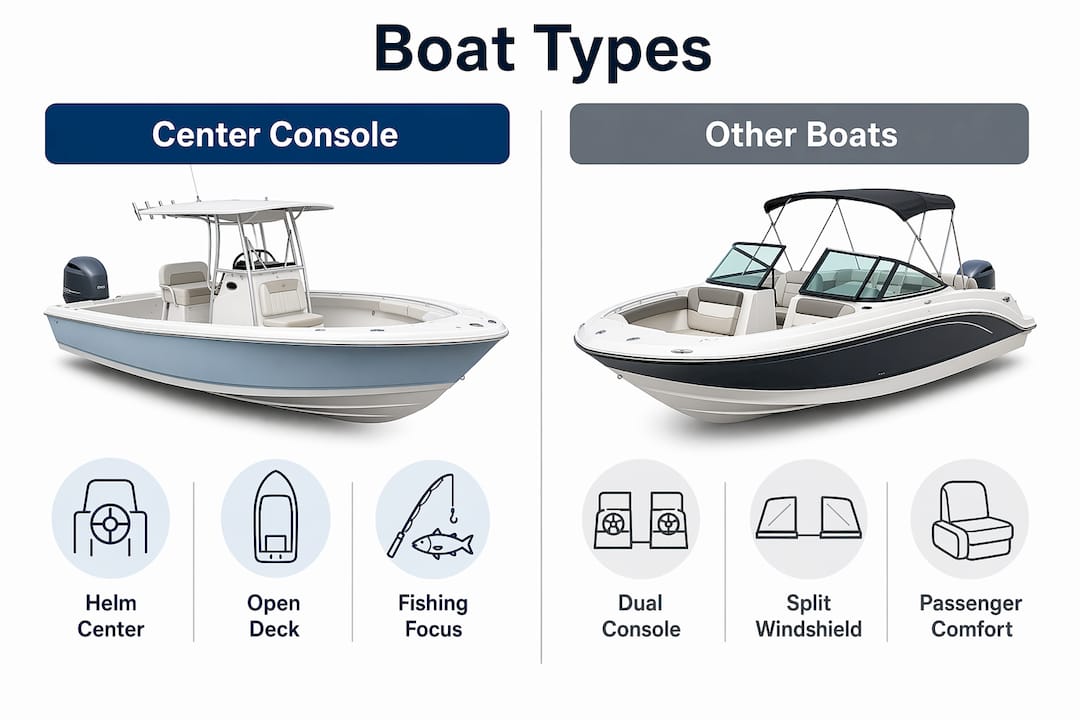
Understanding center console boat parts becomes clearer when you see how the design differs from alternatives. The table below compares the three most common configurations you’ll encounter.
| Feature | Center console | Dual console | Cuddy cabin |
|---|---|---|---|
| Helm position | Center of deck | Starboard side, split windshield | Forward, inside cabin |
| Deck access | Full 360-degree walk-around | Partial, passenger side blocked | Limited, cabin takes bow space |
| Weather protection | T-top or hardtop only | Split windshield standard | Enclosed forward cabin |
| Primary use | Fishing, offshore, inshore | Family recreation, light fishing | Overnight trips, cruising |
| Terminology signal | “Livewell,” “fish box,” “rod holder” | “Passenger seat,” “glove box” | “V-berth,” “cabin,” “portlight” |
Center consoles prioritize open deck mobility while dual consoles focus on passenger comfort with a split windshield. That design distinction is not cosmetic. It changes the entire vocabulary of the boat. When a listing mentions a “walk-around deck,” that is a center console signal. When it mentions a “V-berth,” you are looking at a cuddy cabin. Terminology shifts indicate a boat’s primary focus, whether fishing utility or comfort and family use.
A cuddy cabin adds an enclosed forward compartment, which introduces terms like “portlight” (a small window in the hull), “V-berth” (a sleeping area shaped by the hull’s V-bow), and “companionway” (the entry hatch into the cabin). None of those words appear in a center console conversation. Knowing this distinction saves you from touring the wrong boats entirely.
What features and upgrades define modern center consoles?
Modern center console features have expanded well beyond a bare fishing platform. Here is how the terminology maps to what you will actually find on boats built in the last decade:
- Livewell: A built-in aerated tank, usually at the transom, that keeps bait or caught fish alive. Size matters. Serious tournament anglers look for livewells with recirculating pumps and independent aeration systems.
- Fish box: An insulated storage compartment, often flush with the deck, used to store iced fish. Fish boxes are measured in gallons or cubic feet, and larger offshore models may carry 150 gallons or more.
- Rod holders: Flush-mounted or gunwale-mounted tubes that secure fishing rods while underway or while fighting fish. Count and placement are part of every serious fishing boat evaluation.
- Chartplotter and GPS: The electronics suite at the helm. Modern center consoles from builders like Grady-White, Regulator, and Boston Whaler integrate Garmin, Simrad, or Lowrance units into modular dash panels. Replacing factory dash panels with modular acrylic panels allows fully customized electronics and switch layouts suited to your specific fishing style.
- Head compartment: The “head” is nautical terminology for a toilet or bathroom. On a center console, it is typically a small enclosed space inside the console structure itself. The head compartment’s design and accessibility heavily influence family-friendly usability. A poorly designed head in a tight console can be a dealbreaker for buyers with kids.
- Engine configuration: Single, twin, and quad outboard setups each carry specific terminology. “Rigging” refers to the fuel, electrical, and steering connections between the engines and the console. Twin-engine boats use terms like “synchronizer” and “counter-rotating props” to describe how the two motors work together.
Pro Tip: When evaluating a used center console, ask specifically about the livewell pump, the fish box drain, and the head plumbing. These three systems are the most commonly neglected during ownership and the most expensive to repair after purchase.
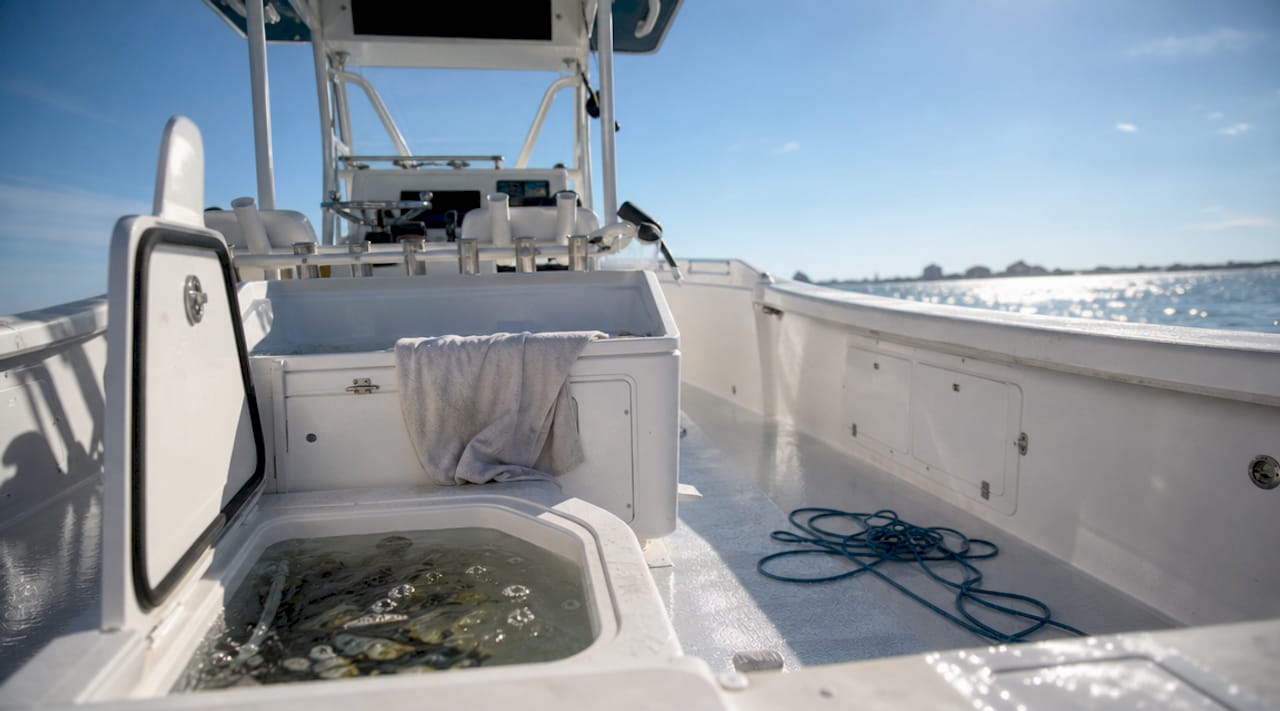
Modern center consoles feature livewells, fish boxes, and upgraded dash electronics that reflect both fishing utility and family-friendly amenities. This dual purpose is why the category has grown so dramatically over the past 15 years.
Why does knowing boat terminology matter for safety?
Knowing proper boating terms enhances safety by enabling clear, unambiguous communication during emergencies and normal operations. This is not an abstract benefit. It is the difference between a Coast Guard crew understanding your distress call immediately and wasting critical minutes on clarification.
“Use of terms ‘bow’ and ‘stern’ instead of ‘front’ and ‘back’ improves clarity” in stressful boating situations, according to boating terminology basics published by YachtWorld. When every second counts, precision matters.
Consider a real scenario: your boat takes on water at the transom. Telling the Coast Guard “water is coming in at the back” is vague. Saying “we have flooding at the transom near the starboard engine” gives responders an immediate picture of the situation, the location, and the likely cause. Terms like “transom,” “gunwale,” and “helm” are vital in distress calls and maneuvering instructions. The same precision applies when docking. Telling a crew member to “grab the cleat on the port gunwale” is faster and clearer than pointing and hoping.
Boating education programs like the U.S. Coast Guard Auxiliary courses and BoatUS Foundation safety classes build terminology into their core curriculum for exactly this reason. If you are new to center consoles, pairing hands-on time on the water with a structured course accelerates both your vocabulary and your confidence.
Key takeaways
Mastering center console boat terminology is the foundation of safe, effective boating because precise language prevents confusion during emergencies, improves purchasing decisions, and signals your level of experience to everyone on the water.
| Point | Details |
|---|---|
| Helm position defines the class | A centrally located helm is what makes a center console distinct from dual console and cuddy cabin designs. |
| Beam matters more than length | Beam-to-length ratio determines stability and usable deck space, making it a smarter spec to evaluate than overall length alone. |
| Terminology signals boat purpose | Words like “livewell” and “fish box” indicate a fishing-focused build; “V-berth” and “companionway” point to a cruising or cabin boat. |
| Head design affects family appeal | The console’s head compartment is small by nature, and poor design in that space reduces comfort and resale value significantly. |
| Precise terms improve safety | Using “transom,” “port,” and “gunwale” instead of vague directions prevents miscommunication in emergencies and during docking. |
Why I think most boaters learn terminology backwards
I have spent years working alongside buyers who walk onto a center console for the first time and immediately ask about horsepower and top speed. Those are fine questions. But they are the last questions, not the first. The buyers who get the best boats are the ones who walk the deck and ask about beam, draft, and freeboard before they ever turn a key.
Here is what I have found: terminology is not just vocabulary. It is a framework for evaluation. When you know what a transom is, you inspect it for stress cracks and corrosion before you fall in love with the paint job. When you understand freeboard, you can look at two boats of identical length and immediately tell which one will keep you dry on a 3-foot chop offshore. That kind of knowledge is worth more than any spec sheet.
The other thing most guides get wrong is treating terminology as a one-time lesson. It is not. Every time you fish a new style of water, inshore flats versus offshore canyons, you encounter new terms. “Poling platform,” “jack plate,” “T-top rocket launchers.” The vocabulary grows with your experience. Embrace that. The anglers and boaters who stay curious about the language of their sport are almost always the ones having the most fun and making the smartest investments.
If you are buying your first center console or trading up to something bigger, take the time to learn the yacht sales terminology that governs the transaction side too. Knowing what “survey,” “sea trial,” and “title clear” mean protects you just as much as knowing your bow from your stern.
— Jason
Ready to find your perfect center console?
At Yachtingexperts, we work with buyers and anglers every day who are at exactly this stage: excited, informed, and ready to make a move. Our team knows center console boats inside and out, from 17-foot inshore skiffs to 45-foot offshore platforms, and we match you with the right vessel based on how you actually fish and where you actually boat.

Whether you are buying your first center console or looking to sell your center console for top dollar before trading up, Yachtingexperts delivers the personalized guidance and market insight that turns a complicated process into an exciting one. Browse our dedicated center console listings and resources to see current inventory, detailed specs, and expert advice tailored to your budget and fishing style. Your next boat is out there. Let us help you find it.
FAQ
What is a center console boat?
A center console boat is a powerboat with its helm station positioned at the center of an open deck, allowing 360-degree walk-around access from bow to stern. Models range from 17-foot inshore skiffs to 45-foot offshore platforms.
What are the most important center console boat parts to know?
The most critical parts are the helm, console, transom, gunwale, beam, draft, freeboard, and T-top. Each term describes a structural or functional element that affects how the boat performs and how you communicate about it.
What is the difference between beam and draft?
Beam is the widest horizontal measurement of the hull, which determines stability and deck space. Draft is the depth of the hull below the waterline, which determines how shallow a body of water the boat can safely operate in.
What does “head” mean on a center console boat?
The head is the nautical term for the toilet or bathroom compartment, typically located inside the console structure. Its design and accessibility are key factors for family buyers evaluating comfort on longer trips.
Why do boaters use port and starboard instead of left and right?
Using precise nautical terms like port and starboard prevents ambiguity because left and right change depending on which direction you are facing. Port always means the left side of the boat when facing forward, and starboard always means the right, regardless of orientation.
Recommended
Request A Call
Featured Listings

2027 Canados
100
Miami Florida

2015 Maiora
$3,750,000
90
Miami Florida

2027 Canados
57
Miami Florida

2019 Silent-Yachts Fair Dinkum
$1,599,000
55
Fort Lauderdale Florida

2026 Canados
49
Miami Florida

2026 Buddy Davis
47
Miami Florida

2020 Grady-White No Name
$610,000
45
Hallandale Beach Florida

2020 Viking Huckleberry
$1,495,000
44
Fort Lauderdale Florida

2027 Canados
43
Miami Florida

2021 Intrepid Dream Faster
$730,000
40
Coral Gables Florida

2016 Edgewater
$299,000
37
Miami, Florida

2022 Avid
$56,900
23
Stuart Florida
Get your yacht value Estimate
"*" indicates required fields