

Boat valuation is the professional process of estimating a vessel’s current worth for buying, selling, financing, or insurance purposes. The industry standard term is marine appraisal, though “boat valuation” is widely used to describe both formal and informal assessments. Whether you’re listing a 30-foot cruiser on the Florida market, renewing your insurance policy, or applying for a marine loan, understanding how your boat’s value is calculated puts you in control of every conversation. Tools like NADA Guides and JD Power Boat Values give quick digital estimates, but a certified marine surveyor delivers the documented figure that banks and insurers actually accept.
What boat valuation methods are used to determine worth?
Marine valuations use three recognized approaches: the market approach, the cost approach, and the income approach. Recreational boats almost exclusively rely on the first two, while commercial vessels may use income-based calculations tied to charter revenue.
The market approach compares your boat to recent sales of similar vessels in the same region. A marine surveyor pulls comparable sales data from listings, dealer records, and auction results to establish a realistic price range. This is the method most relevant when you’re buying or selling.

The cost approach calculates what it would cost to replace the vessel with a comparable one, then subtracts depreciation. Insurers favor this method because it reflects the actual financial exposure they’re covering.
Professional marine appraisals involve an in-person inspection by a certified marine surveyor who examines the hull, engine, electronics, safety equipment, and overall condition. The result is a written report accepted by lenders, insurers, and courts. Online boat valuations provide fast digital estimates without any onboard inspection and should be treated as preliminary figures only.
Here’s how the two main options compare:
- Online valuation tools (NADA Guides, JD Power, BUC Used Boat Price Guide): Fast, free or low-cost, useful for a ballpark figure before a negotiation.
- Professional marine surveyor appraisal: Takes 2 to 4 hours onboard, costs $20 to $25 per foot on average, and produces a legally defensible document.
- Broker comparative market analysis: A hybrid approach where an experienced broker reviews current listings and recent sales to suggest a competitive asking price.
Pro Tip: Before paying for a full marine survey, run the numbers through NADA Guides or BUC first. If the online estimate and your asking price are already far apart, you’ll know what questions to bring to the surveyor.
What factors affect boat value and resale value the most?
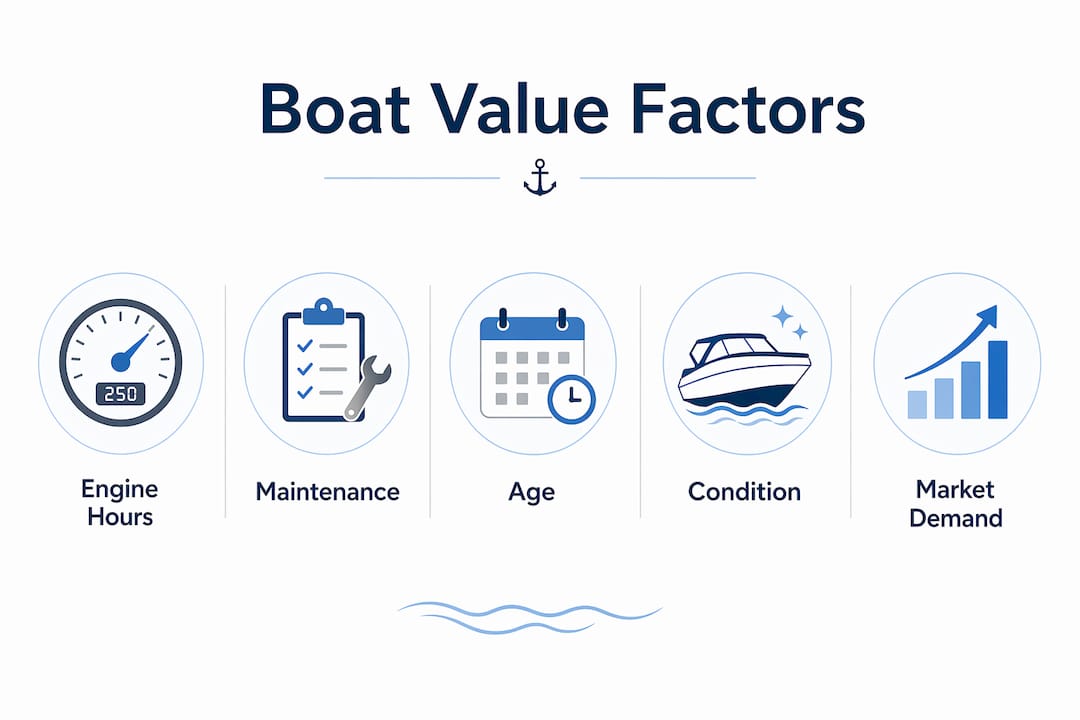
Condition consistently outweighs age as the single biggest driver of resale value. A well-maintained 2015 center console with full service records will outsell a neglected 2020 model of the same make almost every time. Documented maintenance and recent photos significantly affect valuation outcomes, often more than the model year alone.
The core factors a professional appraisal weighs include:
- Make, model, and year: Brands like Grady-White, Boston Whaler, and Sea Ray hold value better than lesser-known manufacturers due to build quality and buyer demand.
- Engine hours and mechanical condition: Low hours on a well-serviced engine add measurable value. High hours on a neglected powerplant can drop a price by thousands.
- Equipment and upgrades: Garmin chartplotters, Simrad electronics, upgraded outboards, and bow thrusters all add to assessed value when properly documented.
- Storage environment: Freshwater-stored boats depreciate more slowly than saltwater vessels because hull corrosion and osmotic blistering are far less common.
- Damage and repair history: A clean title with no major repairs is worth more than a boat with a repaired collision, even if the work was done correctly.
- Local market trends: A 40-foot sportfisher commands a premium in South Florida but may sit longer on the market in landlocked states.
Depreciation follows a predictable curve. Most new boats lose 10% to 20% of their value in year one, then roughly 5% to 10% per year after that. By year five, a well-maintained vessel typically retains 50% to 70% of its original purchase price. That means a $100,000 boat bought new could realistically be worth $55,000 to $70,000 five years later, assuming good condition. Understanding this curve helps you time a sale strategically. Check out our boat depreciation buyer’s guide for a deeper breakdown of how these rates vary by vessel type.
| Factor | Impact on value |
|---|---|
| Engine hours (low, well-serviced) | Positive: can add 5%–15% above average market price |
| Saltwater storage vs. freshwater | Negative: saltwater vessels typically valued 10%–20% lower |
| Major damage history | Negative: can reduce value by 15%–30% depending on severity |
| Premium brand (Grady-White, Boston Whaler) | Positive: slower depreciation, stronger buyer demand |
| Documented maintenance records | Positive: supports higher asking price and faster sale |
Pro Tip: Keep a physical and digital maintenance log from day one. A binder with service receipts, engine records, and dated photos is one of the most cost-effective investments you can make in your boat’s resale value.
Fair market value vs. replacement cost value: what’s the difference?
Fair market value (FMV) and replacement cost value (RCV) serve different stakeholders and different purposes, which explains why buyers, sellers, and insurers often quote very different numbers for the same boat. FMV is the price a willing buyer and a willing seller would agree on in an open market with no pressure on either side. RCV is the cost to replace the vessel with a comparable one, typically higher than FMV because it reflects current retail pricing rather than the used market.
| Valuation type | Definition | Who uses it |
|---|---|---|
| Fair market value (FMV) | Price agreed between willing buyer and seller in open market | Buyers, sellers, brokers |
| Replacement cost value (RCV) | Cost to replace vessel with comparable new or like-kind boat | Insurers, estate planners |
| Agreed value | Fixed payout amount locked in at policy inception | Insurance policyholders |
| Actual cash value (ACV) | Depreciated replacement cost at time of loss | Budget insurance policies |
Agreed Value insurance policies lock in a set payout amount, eliminating depreciation disputes at claim time. ACV policies pay the depreciated value of the boat at the moment of loss, which can leave you significantly short if your vessel has held its value well. For a $200,000 yacht, the difference between an Agreed Value and ACV payout after five years could easily exceed $40,000. Owners must clarify which value type a report provides before signing any insurance or financing agreement to avoid costly surprises.
How to use boat valuation for insurance, selling, and financing
Applying a valuation correctly is where most boat owners leave money on the table or create problems for themselves. Here’s how to use it across the three most common scenarios:
-
Insurance coverage: Many insurers require Condition and Valuation marine surveys on boats over 10 years old or high-value vessels, typically renewed every 3 to 5 years. Submitting a survey formatted to your insurer’s specifications reduces underwriting delays and gets your coverage approved faster. Surveys aligned with insurer format improve acceptance by banks and reduce delays in the underwriting process.
-
Setting a selling price: Use a professional appraisal or a broker’s comparative market analysis to set your asking price. Overpricing by even 10% to 15% above market value dramatically extends time on the market. Our boat resale value guide walks through exactly how to price for a fast, profitable sale.
-
Securing financing: Lenders use loan-to-value (LTV) ratios to determine how much they’ll finance. Most marine lenders cap loans at 80% to 90% of appraised value. Online tools are rough ballparks; professional surveyor inspections produce values accepted by lenders. If your appraisal comes in lower than expected, you’ll need to cover the gap with a larger down payment.
-
Legal and estate matters: In divorce proceedings, estate settlements, or partnership disputes, a certified marine appraisal is the only figure a court will accept. A broker’s opinion or an online estimate carries no legal weight in these contexts.
-
Preparing for the appraisal: Gather your vessel documentation (USCG documentation or state title), engine service records, recent repair receipts, equipment lists, and any warranty documentation. A clean, well-organized boat with complete paperwork consistently appraises higher than an identical vessel with missing records.
Key takeaways
Accurate boat valuation requires matching the right method and value type to your specific purpose, whether that’s insurance, a sale, or financing.
| Point | Details |
|---|---|
| Use the right method for the purpose | Professional appraisals for insurance and financing; online tools for preliminary estimates only. |
| Condition beats age | A well-maintained older boat consistently appraises higher than a neglected newer model. |
| Know FMV vs. RCV | FMV drives sales negotiations; RCV and Agreed Value drive insurance payouts. |
| Document everything | Maintenance records and photos directly increase appraised value and speed up transactions. |
| Depreciation is predictable | Most boats lose 10%–20% in year one, then 5%–10% annually; plan your sale timing accordingly. |
What I’ve learned about boat valuation after years in the market
Here’s something most owners don’t realize until it costs them: the valuation method matters as much as the number itself. I’ve seen sellers walk into negotiations armed with an NADA estimate, only to have a buyer’s surveyor come back with a figure 20% lower because the online tool couldn’t account for osmotic blistering on the hull or worn upholstery below deck. The number on the screen felt real until someone actually looked at the boat.
The other mistake I see constantly is owners treating valuation as a one-time event. Your boat’s value shifts with the market, with your maintenance habits, and with the condition of comparable vessels for sale right now. If you insured your boat at $150,000 three years ago and haven’t updated the survey, you may be significantly underinsured today, especially if the used boat market has moved in your favor.
My honest advice: get a professional appraisal before any major transaction, keep your maintenance records like they’re financial documents, and revisit your insurance valuation every three years at minimum. The cost of a marine survey is trivial compared to the cost of a disputed claim or a sale that falls through at the dock. For owners looking to maximize what they get at sale time, our yacht valuation guide for Florida owners is a great next step.
— Jason
Get expert boat valuation and selling support with Yachtingexperts
At Yachtingexperts, we’ve guided hundreds of boat owners through the valuation and selling process, and we know exactly what it takes to get the number you deserve.

Whether you need a referral to a trusted marine surveyor, a professional broker’s market analysis, or a full step-by-step selling plan, our team is ready to hold your hand through every step. We combine local market knowledge with personalized service to make sure your valuation works for you, not against you. Ready to find out what your boat is really worth? Connect with our team today and let’s get started.
FAQ
What is boat valuation and why does it matter?
Boat valuation is the process of estimating a vessel’s current worth based on condition, market data, and comparable sales. It matters because it drives insurance coverage amounts, sale prices, and financing terms.
How accurate are online boat valuation tools?
Online tools like NADA Guides provide fast preliminary estimates but cannot account for specific condition, engine hours, or equipment. A certified marine surveyor inspection is required for values accepted by lenders and insurers.
How often should I get my boat appraised?
Most insurers require a Condition and Valuation survey every 3 to 5 years for older or high-value vessels. Owners should also get a fresh appraisal before any sale, refinancing, or significant insurance change.
What is the difference between fair market value and agreed value?
Fair market value is the price a willing buyer and seller agree on in the open market. Agreed Value is a fixed insurance payout locked in at policy inception, which eliminates depreciation disputes at claim time.
What documents should I prepare before a boat appraisal?
Gather your vessel title or USCG documentation, engine service records, repair receipts, equipment lists, and recent photos. Complete documentation consistently results in higher appraised values and faster transaction approvals.
Recommended
Request A Call
Featured Listings

2027 Canados
100
Miami Florida

2015 Maiora
$3,750,000
90
Miami Florida

2027 Canados
57
Miami Florida

2019 Silent-Yachts Fair Dinkum
$1,599,000
55
Fort Lauderdale Florida

2026 Canados
49
Miami Florida

2026 Buddy Davis
47
Miami Florida

2020 Grady-White No Name
$610,000
45
Hallandale Beach Florida

2020 Viking Huckleberry
$1,495,000
44
Fort Lauderdale Florida

2027 Canados
43
Miami Florida

2021 Intrepid Dream Faster
$730,000
40
Coral Gables Florida

2016 Edgewater
$299,000
37
Miami, Florida

2022 Avid
$56,900
23
Stuart Florida
Get your yacht value Estimate
"*" indicates required fields