

Boat safety requirements in 2026 are defined by a combination of U.S. Coast Guard federal mandates and state-specific regulations that every vessel operator must meet to legally and safely operate on American waters. The rules cover everything from personal flotation devices and fire extinguisher ratings to brand-new boater certification deadlines in states like Massachusetts and Minnesota. Getting this wrong is not just a fine risk. It is a genuine safety hazard for everyone aboard. Whether you own a 16-foot runabout or a 50-foot cruiser, the 2026 vessel safety standards apply to you, and the details matter more than most boaters realize.
What are the federal boat safety requirements in 2026?
Federal 2026 vessel safety standards are set by the U.S. Coast Guard and apply to every recreational vessel on U.S. navigable waters, regardless of state. These are your baseline. States can add to them, but they cannot subtract from them.
Personal Flotation Devices (PFDs)
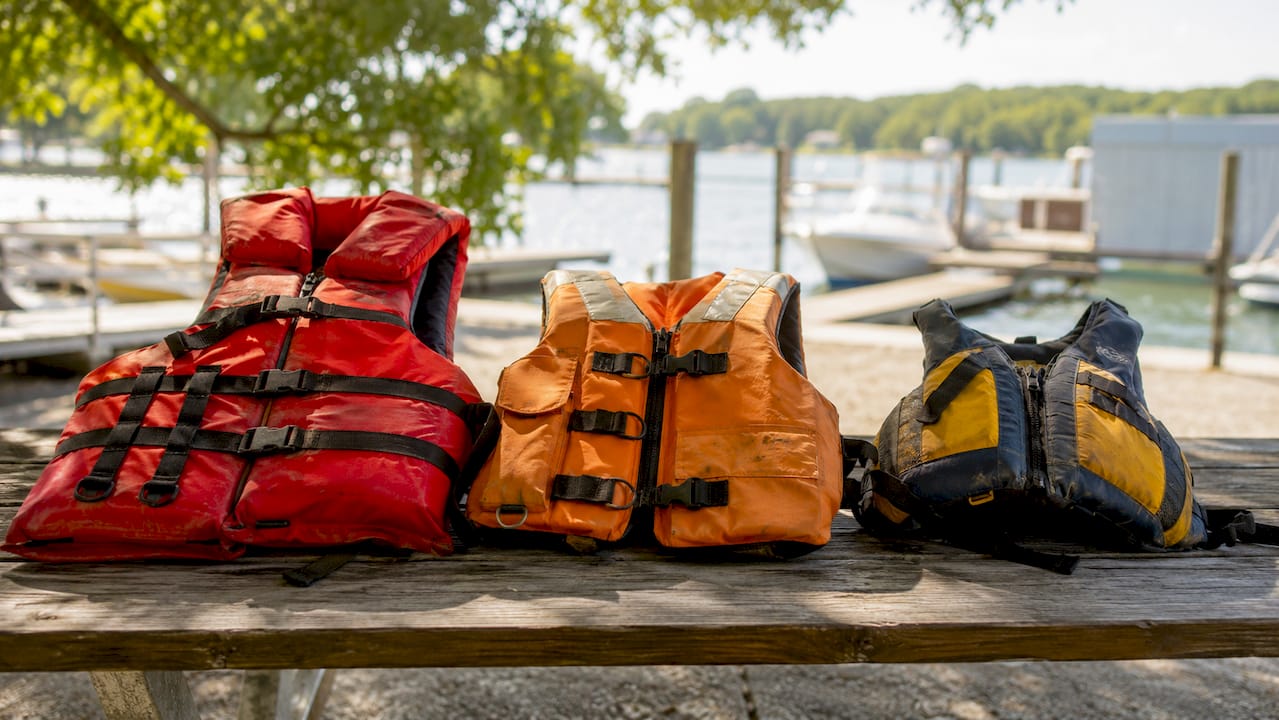
Every vessel must carry one U.S. Coast Guard-approved Type I, II, or III PFD for each person on board. Children under 13 must wear a properly fitted PFD at all times while underway on most state waters. All boats 16 feet or longer must also carry a throwable Type IV device in addition to wearable PFDs. That throwable requirement catches a lot of boat owners off guard, especially those upgrading from smaller vessels.
Fire Extinguishers
Vessels built in 2018 or newer must carry UL-rated 5-B or 20-B fire extinguishers. This is a critical detail. An older extinguisher that is still within its expiration date may still fail a Coast Guard inspection if it does not carry the correct UL rating. The 2018 rule change invalidated a large number of extinguishers that were previously considered compliant.
Pro Tip: Check the UL rating label on your fire extinguisher right now, not the expiration date. If it does not show a 5-B or 20-B rating and your boat was built after 2018, replace it before your first trip of the season.
Sound-Producing Devices and Navigation Lights
Motorboats 16 feet or longer must carry a whistle or horn audible at required distances. Vessels over 65.6 feet must also carry a bell. Navigation lights are required for all vessels operating between sunset and sunrise or in restricted visibility.
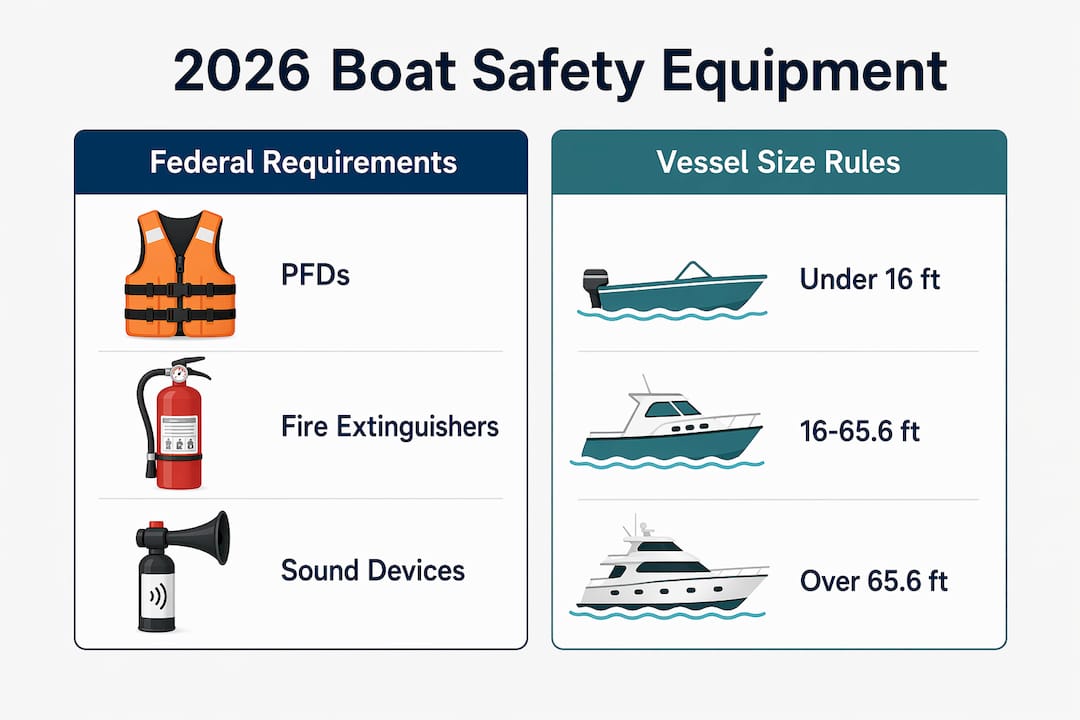
Here is a quick reference for required safety equipment by vessel size:
| Vessel Length | PFDs | Throwable Device | Fire Extinguisher | Sound Device |
|---|---|---|---|---|
| Under 16 ft | 1 per person | Not required | 1 (if enclosed engine) | Whistle or horn |
| 16–26 ft | 1 per person | Required | 1 minimum | Whistle or horn |
| 26–40 ft | 1 per person | Required | 2 minimum | Whistle or horn |
| Over 65.6 ft | 1 per person | Required | 3 minimum | Horn and bell |
How do state-specific 2026 boating laws affect safety compliance?
Boating safety requirements are increasingly state-specific, and relying only on federal rules is one of the most common ways boaters end up non-compliant. Three states illustrate this well in 2026: Massachusetts, Minnesota, and Oklahoma.
-
Massachusetts: The Hanson-Milone Act Deadlines
Massachusetts now requires individuals born after January 1, 1989 to hold a boater safety certificate by april 1, 2026. Those born before that date have until april 1, 2028. Enforcement carries a grace period until september 1, 2026, which gives newer boaters a window to complete their certification without penalty. After that date, operating without the certificate is a citable offense. If you boat in Massachusetts waters, this is not optional. -
Minnesota: Phased Watercraft Operator Permits
Minnesota’s rollout is structured by birth year. Operators born after June 30, 2000 must hold a watercraft operator permit starting July 1, 2026. The phase-in continues through 2028, gradually expanding the requirement to older age groups. This approach gives the boating community time to adapt, but if you fall in the first wave, the deadline is now. -
Oklahoma: Engine Cut-Off Switches and BAC Limits
Oklahoma mandates engine cut-off switches on vessels with motors of 115 HP or more built after 2020. The state also enforces a blood alcohol content limit of 0.08%, the same standard applied to highway driving. These rules reflect a broader national trend toward treating water operation with the same legal seriousness as road operation. -
Local Ordinances Add Another Layer
Beyond state laws, local lake and harbor ordinances including horsepower limits and wake zone restrictions can change year to year. Always verify current local rules before heading out, especially on lakes you do not regularly visit.
Pro Tip: Before any trip to a new body of water, check the state DNR website and the specific lake or harbor authority page. Rules at the local level can be stricter than state law, and “I didn’t know” is not a defense.
What common misunderstandings do boaters have about 2026 safety rules?
The most expensive compliance mistakes come from misreading the specifics. Here are the misconceptions that show up most often:
-
“Any fire extinguisher will do.” This is false. UL 5-B or 20-B ratings are required for boats built in 2018 or newer. An extinguisher with a different rating or an older classification system will fail inspection even if it is fully charged and within its service date.
-
“I don’t need visual distress signals on my lake.” Visual distress signals are required on coastal waters, the Great Lakes, and waterways over two nautical miles wide, particularly at night. Smaller inland vessels may have limited or no VDS requirements, but the requirement depends on operational zone, not just vessel size. Many boaters carry too many signals for their actual operating area, or worse, not enough for overnight coastal trips.
-
“My gear is fine because it’s not expired.” Expiration dates are not the only compliance standard. Equipment must be in serviceable condition and readily accessible during inspections. A PFD with a broken buckle or a flare that has been stored improperly fails on condition, not just date.
-
“Grace periods mean I have more time to ignore the rule.” Grace periods, like Massachusetts’ enforcement window through september 1, 2026, are transition tools. They are not extensions of the deadline. Enforcement grace periods exist to help boaters complete certification, not to delay compliance indefinitely.
The most overlooked compliance issue we see is gear condition. A fire extinguisher that looks fine may have a corroded pin or a pressure gauge in the red zone. Visual distress signals stored in a wet compartment for three seasons may be unusable. The rule is not just “have it.” The rule is “have it ready.”
How can boat owners stay compliant with 2026 safety requirements?
Compliance is not a one-time task. It is a seasonal practice. Here is how to build it into your boating routine:
-
Run a pre-season inspection every year. Go through your boat inspection checklist before the first trip of the year. Check PFD condition, fire extinguisher ratings, flare expiration dates, and navigation light function. Do not wait until you are at the dock.
-
Keep documentation accessible onboard. Your vessel registration, any required boater safety certificates, and your state-issued operator permit should be physically present on the boat. Digital copies are useful, but many states require the original or a certified copy.
-
Check state and local rules before every new destination. Use your state’s DNR website, the U.S. Coast Guard’s official boating safety resources, and local harbor authority pages. Local regulations can include speed limits, no-wake zones, and equipment rules that go beyond state law.
-
Store safety gear where it can be reached fast. A PFD locked in a forward berth does not meet the “readily accessible” standard. Mount fire extinguishers in visible, reachable locations. Keep throwable devices near the helm or cockpit.
-
Complete a boating safety course and refresh it periodically. Boating safety courses in 2026 are available through the U.S. Coast Guard Auxiliary, the American Red Cross, and BoatUS Foundation. Many states now require them, and even where they are not mandatory, they cover the equipment and rule updates that change year to year.
Pro Tip: Use the yacht prep guide for 2026 from Yachtingexperts as a structured seasonal checklist. It covers both federal and state-level requirements in a format you can work through before each season.
Key takeaways
Staying compliant with boat safety requirements in 2026 means meeting both federal U.S. Coast Guard standards and your state’s specific rules, with no exceptions for either layer.
| Point | Details |
|---|---|
| Federal rules are the floor | U.S. Coast Guard mandates apply to every vessel; states add requirements on top of them. |
| Fire extinguisher ratings matter | Boats built in 2018 or newer must carry UL-rated 5-B or 20-B extinguishers, regardless of expiration date. |
| State deadlines are real | Massachusetts and Minnesota have active certification deadlines in 2026 with enforcement dates that will not move. |
| Condition counts as much as presence | Safety gear must be serviceable and accessible, not just present on the vessel. |
| Local rules change annually | Verify lake and harbor ordinances before each trip to a new destination. |
What i’ve learned advising boat owners through regulatory changes
Every spring, I see the same pattern. Boat owners who spent the winter assuming nothing changed come to the dock and discover their fire extinguisher is the wrong rating, their flares expired in October, or they are now required to hold a boater safety certificate in their state. The frustration is real, and it is completely avoidable.
The hardest thing to communicate is that federal and state rules are not the same document. I have worked with experienced boaters who have been on the water for 20 years and genuinely did not know that Massachusetts had passed the Hanson-Milone Act, or that Minnesota’s permit rollout was already in motion. They were not careless people. They just assumed the rules they learned years ago were still current.
My honest advice: treat your boat like a car. You would not skip your annual registration renewal or drive with a broken taillight. The same discipline applies here. Seasonal gear checks, updated documentation, and a quick review of your state’s current regulations take less than two hours a year. That investment protects your passengers, your vessel, and your ability to keep doing what you love on the water.
Safety compliance is not a bureaucratic burden. It is the foundation of a great day on the water.
— Jason
How Yachtingexperts helps you stay ahead of 2026 regulations
Staying on top of 2026 boating regulations across federal and state lines is a lot to manage, especially when you are also focused on getting the most from your vessel as an investment.

At Yachtingexperts, we work directly with boat owners to make this process straightforward and personal. From reviewing your current safety equipment against the latest 2026 vessel safety standards to walking you through state-specific requirements in Massachusetts, Minnesota, Florida, and beyond, our team is here to help. Whether you are preparing for your first inspection or looking to protect your vessel’s value before a sale, we bring the detail-oriented guidance that turns a complicated compliance process into a confident, well-prepared boating season. Reach out to our team and let us handle the details so you can focus on the water.
FAQ
What safety equipment is federally required on all u.s. boats in 2026?
Every recreational vessel must carry one U.S. Coast Guard-approved PFD per person, a fire extinguisher meeting current UL ratings, sound-producing devices, and navigation lights for nighttime operation. Boats 16 feet or longer must also carry a throwable Type IV PFD.
Do i need a boater safety certificate to operate in 2026?
It depends on your state. Massachusetts requires a boater safety certificate for individuals born after January 1, 1989, with enforcement beginning september 1, 2026. Minnesota requires watercraft operator permits for those born after June 30, 2000, starting July 1, 2026.
Are visual distress signals required on all boats?
Visual distress signals are required on coastal waters, the Great Lakes, and waterways over two nautical miles wide, especially at night. Smaller inland vessels may have limited or no VDS requirements, but the rule depends on your operating zone, not just your boat’s size.
What fire extinguisher rating is required for newer boats?
Vessels built in 2018 or newer must carry UL-rated 5-B or 20-B fire extinguishers. An older extinguisher that does not carry this specific UL rating will fail a Coast Guard inspection, even if it is not expired.
How often should i review my boat’s safety gear?
Experts recommend a full seasonal inspection before your first trip each year, plus a pre-departure check before every outing. Safety gear must be in serviceable condition and readily accessible, not just present on the vessel.
Recommended
Request A Call
Featured Listings

2027 Canados
100
Miami Florida

2015 Maiora
$3,750,000
90
Miami Florida

2027 Canados
57
Miami Florida

2019 Silent-Yachts Fair Dinkum
$1,599,000
55
Fort Lauderdale Florida

2026 Canados
49
Miami Florida

2026 Buddy Davis
47
Miami Florida

2020 Grady-White No Name
$610,000
45
Hallandale Beach Florida

2020 Viking Huckleberry
$1,495,000
44
Fort Lauderdale Florida

2027 Canados
43
Miami Florida

2021 Intrepid Dream Faster
$730,000
40
Coral Gables Florida

2016 Edgewater
$299,000
37
Miami, Florida

2022 Avid
$56,900
23
Stuart Florida
Get your yacht value Estimate
"*" indicates required fields