

Boat pricing in 2026 is defined by the intersection of market normalization, tariff-driven cost increases, and segment-specific depreciation curves that every buyer and seller must understand before signing anything. The 2026 marine market has shifted from supply-constrained to buyer-friendly, meaning you now have real negotiating power if you know where to look. This boat pricing guide 2026 covers everything from fair market valuation tools like BoatValue and NADA to the seasonal windows that can save you thousands. Whether you are buying your first vessel or trading up to a larger yacht, the numbers in this guide will change how you approach every conversation with a seller or dealer.
What factors affect boat prices in 2026?
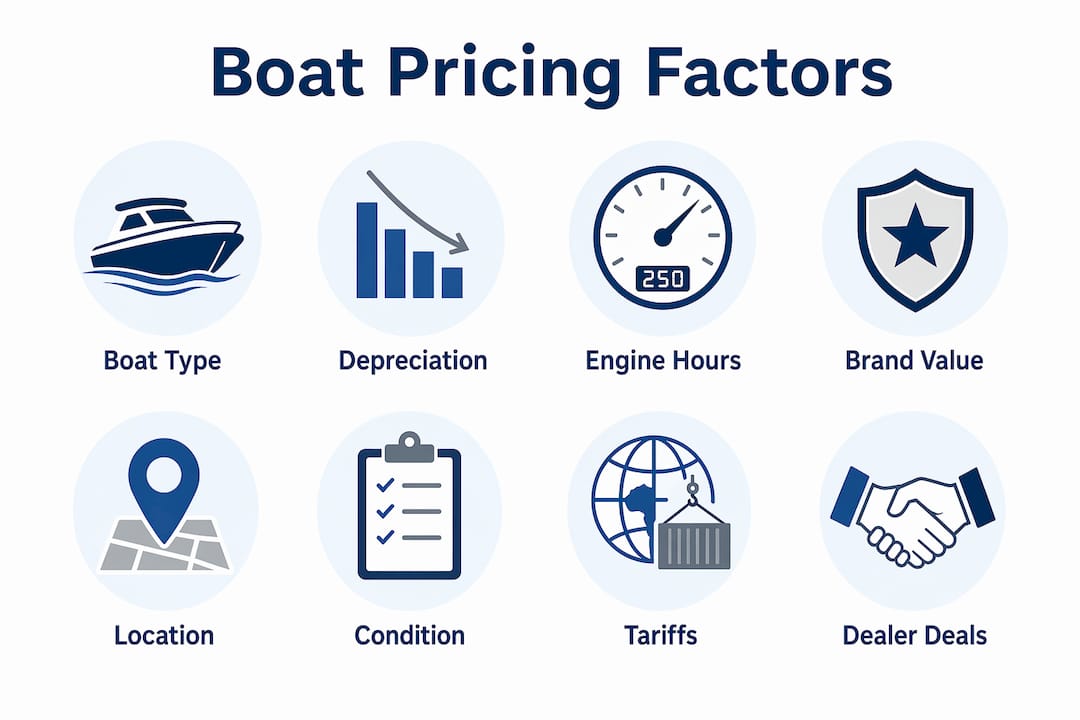
Boat pricing is not a single number. It is the sum of at least eight variables that interact in ways most buyers never anticipate.
Boat type and size set the floor and ceiling immediately. A 20-foot pontoon boat and a 45-foot sport yacht occupy completely different pricing universes, even if both are “used boats” from the same year. Size drives not just purchase price but also slip fees, insurance, and fuel costs.
Age and depreciation follow a predictable but punishing curve. Boat depreciation is steepest in year one, with an 8 to 10 percent drop from purchase price, then settles to 6 to 8 percent annually through years two to five, and flattens to 3 to 5 percent per year after the ten-year mark. This means a nearly-new two-year-old boat often represents the worst value proposition, while a well-maintained ten-year-old vessel can be a genuine bargain.
Engine hours are the single most negotiable data point on any listing. Engine hours over 500 typically trigger a 15 to 25 percent valuation reduction, while boats with under 200 hours may command a 10 percent premium over comparable listings. Always ask for the engine log before making an offer.
Brand reputation and model rarity matter more than most buyers expect. Brands like Grady-White, Boston Whaler, and Sea Ray hold value differently across segments. Limited-production models or discontinued lines can appreciate simply due to parts scarcity and collector demand.
Geographic location creates real price disparities. South Florida prices run about 12 percent above national averages, and Southern California commands roughly 10 percent more, driven by year-round boating demand. If you are flexible on where you buy, searching in the Midwest or Great Lakes region can yield the same boat for meaningfully less.
Condition-sensitive components like propellers deserve specific attention. Damaged propellers with bent blades or stress cracks can reduce a boat’s value by 5 to 10 percent, while upgraded propellers add 5 to 15 percent. This is a negotiation lever most buyers overlook entirely.
Tariffs and supply chain pressure are pushing new boat prices up 4 percent in 2026, driven largely by aluminum tariff pressures and geopolitical shipping costs affecting imported components. Used boats are now selling 20 to 40 percent below their original peak prices, making the pre-owned market exceptionally attractive right now.
Pro Tip: Manufacturers are protecting MSRP to preserve resale values, so the real deals on new boats come through dealer incentives and financing packages rather than sticker price cuts. Ask specifically about bundled service contracts and extended warranties before walking away from a new boat deal.
How do 2026 boat pricing trends vary by boat type?
The average used boat price in 2026 sits at approximately $352,533 across all categories, but that number is almost meaningless without segment context. Fishing boats are appreciating at 3.5 to 4.2 percent, while yachts are softening by 1.8 to 3.1 percent. This divergence tells you a lot about where demand is concentrated right now.
Here is how the major segments break down in the current market:
| Boat type | Average price range | Value retention | Market demand |
|---|---|---|---|
| Pontoon boats | $18,000 to $65,000 | Moderate (depreciates steadily) | Strong, family-use driven |
| Fishing boats | $25,000 to $120,000 | High (appreciating 3.5 to 4.2%) | Very strong, growing |
| Ski and wakeboard boats | $45,000 to $95,000 | Moderate to high | Stable, lifestyle-driven |
| Cruisers and express boats | $80,000 to $350,000 | Moderate | Steady |
| Yachts (50 ft+) | $300,000 to $2M+ | Softening (down 1.8 to 3.1%) | Cooling slightly |
Pontoon boats remain the entry point for most first-time buyers, with strong resale liquidity because the buyer pool is wide. Fishing boats are the standout story of 2026. Demand from recreational anglers and charter operators has pushed values up consistently, and well-maintained center consoles from brands like Mako, Robalo, and Contender are selling quickly. Ski and wakeboard boats from MasterCraft and Nautique hold value well because their buyer base is passionate and brand-loyal. The yacht segment is the one area where buyers currently hold the most leverage, with motivated sellers and a broader selection than we have seen in several years.
How to accurately assess a boat’s fair market value in 2026
Fair market value is the price a willing buyer and willing seller agree on when neither is under pressure. Getting to that number requires more than a single online search.
Follow these steps to build a defensible valuation before you make an offer:
-
Start with BoatValue or NADA. Both tools pull comparable sales data and adjust for year, make, model, and condition. BoatValue tends to reflect real-time market conditions more dynamically, while NADA provides a standardized baseline that lenders and insurers recognize. Run both and note where they diverge.
-
Cross-check with active listings. Search Boat Trader, YachtWorld, and local dealer inventories for comparable boats listed right now. Pay attention to how long listings have been active. A boat sitting for 90 days at a given price is telling you the market disagrees with that number.
-
Adjust for engine hours. Apply the 15 to 25 percent reduction for boats over 500 hours, or the 10 percent premium for boats under 200 hours. This single adjustment often moves the number more than any other factor.
-
Inspect condition-sensitive components. Propellers, upholstery, electronics, and bilge condition all feed into the final number. A surveyor from the Society of Accredited Marine Surveyors (SAMS) or the National Association of Marine Surveyors (NAMS) will quantify these factors in a written report that you can use directly in negotiation.
-
Factor in seasonal timing. Spring pricing averages about 4.2 percent higher than the annual mean, with the market sitting around $211,500 during peak spring demand. If you are buying, late fall or winter gives you real pricing power. If you are selling, list in late winter to catch the spring surge.
-
Account for geographic premiums. If you are buying in South Florida or Southern California, build in that 10 to 12 percent regional premium when comparing to national averages. Conversely, buying in a lower-demand region and transporting the boat can be a legitimate cost-saving strategy for larger vessels.
Pro Tip: First-year ownership costs including insurance, storage, and maintenance can reach 10 to 15 percent of the boat’s purchase price annually. Factor this into your total budget before you fall in love with a listing. Understanding your boat ownership costs upfront prevents the most common post-purchase regret in this market.
When and how to buy or sell to optimize boat pricing in 2026
Timing a boat transaction well is one of the highest-leverage decisions you can make. The difference between buying in April versus November on the same boat can be 8 to 12 percent of the purchase price.
For buyers, the best windows are:
- Late fall (October to November): Sellers are motivated to avoid winter storage costs, and dealer lots are clearing inventory. This is when you find the most negotiating room.
- January to February: The off-season trough. Listings sit longer, and sellers who have been on the market since fall are often ready to deal.
- Avoid April through June unless you have a specific reason. Spring demand pushes prices up and compresses your negotiating position.
For sellers, the calculus flips:
- List in late February or early March to capture buyers who are planning their season and willing to pay spring prices.
- Price competitively from day one. Boats that sit for 60-plus days develop a stigma in the market. Buyers assume something is wrong, even when there is not.
- Choose your selling method deliberately. Private sales yield 15 to 25 percent more than dealer trade-ins but require 2 to 4 months of active effort. Trade-ins offer instant turnaround at a significant cost. Consignment through a broker like Yachtingexperts sits in the middle: professional marketing and negotiation support with better net proceeds than a trade-in.
Expand your geographic search. Buyers who limit themselves to their home market leave money on the table. A boat in the Great Lakes region priced 15 percent below a comparable Florida listing may be worth the transport cost. For yachts, transatlantic and Caribbean listings are worth evaluating against domestic prices, especially given the current softness in the large-vessel segment. Understanding boat depreciation factors by region helps you identify where the real value sits before you start traveling to viewings.
Key takeaways
Accurate boat pricing in 2026 requires combining valuation tools, depreciation knowledge, seasonal timing, and regional data rather than relying on any single source.
| Point | Details |
|---|---|
| Depreciation curve matters | Year-one drops of 8 to 10 percent make nearly-new boats poor value; ten-plus-year boats often represent the best deals. |
| Fishing boats are appreciating | Values are up 3.5 to 4.2 percent in 2026, making them the strongest-performing used boat segment. |
| Timing saves real money | Spring prices run 4.2 percent above average; buying in fall or winter delivers measurable savings. |
| Engine hours drive negotiation | Over 500 hours triggers a 15 to 25 percent reduction; use this as your primary negotiation lever. |
| Ownership costs are underestimated | Annual costs can reach 10 to 15 percent of purchase price. Budget for them before you commit. |
What I have learned after years of watching buyers get this wrong
The most consistent mistake I see from buyers is treating the purchase price as the only number that matters. They negotiate hard on the sticker, then get blindsided by marina fees, insurance premiums, and the first round of maintenance. Offshore fishing vessels can cost up to $150,000 annually to operate. Even a modest 30-foot cruiser will run $15,000 to $25,000 per year in carrying costs. The purchase price is the entry fee. The real cost of ownership is the ongoing commitment.
The second thing I have noticed is that buyers underuse depreciation as a negotiating tool. If you know a boat dropped 8 to 10 percent in its first year and another 6 to 8 percent in year two, you can walk into a negotiation with a defensible counter-offer backed by data. Sellers respect buyers who know the numbers. It changes the entire dynamic of the conversation.
Regional pricing disparities are also more exploitable than most people realize. I have watched clients save $30,000 to $50,000 on mid-range yachts simply by expanding their search radius and budgeting for delivery. The boat market is national, even if your boating life is local.
Finally, watch your emotional bias. The moment you fall in love with a specific boat, you lose negotiating leverage. Keep two or three comparable options in play simultaneously. It keeps you honest and keeps sellers competitive.
— Jason
Ready to buy or sell with confidence in 2026?
At Yachtingexperts, we work with buyers and sellers every day who are navigating exactly the kind of market complexity this guide describes. We bring real-time pricing data, hands-on inspection experience, and a network of qualified buyers and sellers to every transaction we touch.

Whether you are preparing to list your current vessel or searching for your next one, our team is ready to help you get the most from your investment. Explore our step-by-step selling workflow to see exactly how we position boats for maximum return in the current market. If you are focused on maximizing what you walk away with, our resale value guide covers every preparation step in detail. This is your moment to move with confidence. Let us make it a great one.
FAQ
What is the average used boat price in 2026?
The average used boat price in 2026 is approximately $352,533 across all categories, though prices vary significantly by boat type, condition, and region.
Which boat types are increasing in value in 2026?
Fishing boats are the strongest-performing segment, appreciating 3.5 to 4.2 percent in 2026, while yachts have softened by 1.8 to 3.1 percent.
When is the best time to buy a boat in 2026?
Late fall and winter offer the best buying conditions. Spring pricing runs about 4.2 percent above the annual average due to seasonal demand.
How do engine hours affect a boat’s resale value?
Engine hours over 500 typically reduce a boat’s value by 15 to 25 percent, while boats with under 200 hours may command a 10 percent premium over comparable listings.
Is it better to sell privately or through a dealer in 2026?
Private sales yield 15 to 25 percent more than dealer trade-ins but require 2 to 4 months of active effort. Broker consignment through a firm like Yachtingexperts offers a strong middle ground with professional support and better net proceeds than a trade-in.
Recommended
Request A Call
Featured Listings

2027 Canados
100
Miami Florida

2015 Maiora
$3,750,000
90
Miami Florida

2027 Canados
57
Miami Florida

2019 Silent-Yachts Fair Dinkum
$1,599,000
55
Fort Lauderdale Florida

2026 Canados
49
Miami Florida

2026 Buddy Davis
47
Miami Florida

2020 Grady-White No Name
$610,000
45
Hallandale Beach Florida

2020 Viking Huckleberry
$1,495,000
44
Fort Lauderdale Florida

2027 Canados
43
Miami Florida

2021 Intrepid Dream Faster
$730,000
40
Coral Gables Florida

2016 Edgewater
$299,000
37
Miami, Florida

2022 Avid
$56,900
23
Stuart Florida
Get your yacht value Estimate
"*" indicates required fields