

The purchase price of a boat gets all the attention. The marina bill, the fuel card, the haul-out invoice — those are the numbers that quietly shape your life as a boat owner. A proper boat ownership costs breakdown reveals something most first-timers don’t expect: annual ownership costs for a 28-foot center-console alone can run $15,000 to $45,000, and that’s before a single weekend cruise. If you’re thinking about buying, or already own a boat and wonder where the money goes, this guide lays it all out, category by category, with real numbers.
Table of Contents
- Key Takeaways
- How purchase price shapes your total costs
- Storage and docking costs
- Maintenance, repairs, and realistic budgeting
- Insurance, registration, and legal fees
- Fuel, supplies, and incidental costs
- My honest take on planning for boat ownership costs
- How Yachtingexperts can simplify your ownership journey
- FAQ
Key Takeaways
| Point | Details |
|---|---|
| Purchase price is just the start | Ongoing expenses like storage, insurance, and maintenance often exceed the original purchase cost over time. |
| Storage choice drives variability | Wet slips and dry stacks can cost up to $24,000 per year, making storage your most impactful budget decision. |
| Use the 10% rule for maintenance | Budget roughly 10% of your boat’s purchase price annually for maintenance, adjusting upward for older vessels. |
| Insurance varies by geography | Florida boat owners pay significantly more for marine insurance than owners in the Pacific Northwest. |
| Financing multiplies total cost | Financing a $150,000 boat at 8% over 15 years can add more than $17,000 in annual payments. |
How purchase price shapes your total costs
Most buyers obsess over the sticker price and underestimate everything that comes after. The truth is, the cost of owning a boat compounds quickly once you factor in financing, insurance, storage, and maintenance.
Boat prices range dramatically by type and size:
- Small runabouts and fishing boats: $10,000 to $40,000
- Mid-size cruisers and center-consoles: $50,000 to $200,000
- Large offshore and luxury yachts: $300,000 and above
Financing changes the math more than most buyers realize. Financing $150,000 at 8% over 15 years adds more than $17,000 per year in loan payments, and total interest over the life of the loan can exceed $100,000. That means your boat ownership budget must account for the loan structure before you ever consider fuel or repairs.
This is where the 10% rule enters the picture. Financial planners and experienced captains alike recommend budgeting 10% annually of your boat’s purchase price for maintenance. A $50,000 boat implies roughly $5,000 per year just to keep it in good working order. Newer boats might land closer to 2 to 5 percent, while older vessels with deferred maintenance history can exceed 10 percent quickly.
Pro Tip: Before financing, run a full monthly boat expenses simulation that includes loan payments, insurance, dockage, and a maintenance reserve. Many buyers qualify for a loan but haven’t pressure-tested the full monthly picture.
Storage and docking costs
Storage is the sleeper expense in every boat ownership costs breakdown. Owners who focus only on fuel and maintenance are often blindsided when the first marina bill arrives. Storage choice dominates annual ownership cost variability more than any other single factor.

Here’s how the options compare:
| Storage type | Monthly cost | Annual estimate |
|---|---|---|
| Trailer at home | $0 to $100 | $0 to $1,200 |
| Dry stack storage | $300 to $700 | $3,600 to $8,400 |
| Wet slip (inland) | $200 to $600 | $2,400 to $7,200 |
| Wet slip (coastal/marina) | $600 to $2,000 | $7,200 to $24,000 |
Geography plays a massive role in these numbers. South Florida marinas in premium locations charge rates that would shock a boat owner in Tennessee. The Gulf Coast tends to offer more affordable wet slip options than Miami or Fort Lauderdale, but those prices are rising. Understanding Florida yacht ownership costs specifically is worth a deep read before committing to any slip.
Seasonality adds another layer of complexity. If you’re in a northern climate, your boat may sit on land for four to five months per year, which can reduce wet slip fees but introduces land storage, shrink-wrap, and spring launch costs. Year-round boaters in warm climates avoid those fees but pay for slip space 12 months straight.
Pro Tip: If you’re within 30 minutes of your home port, a dry stack facility often delivers the best balance of convenience and cost. You call ahead, they launch your boat, and you avoid the corrosion risk of a permanent wet slip.
Maintenance, repairs, and realistic budgeting
Routine boat maintenance costs are predictable. Unplanned repairs are not. A solid boat ownership budget plans for both, because the ocean or lake doesn’t care about your schedule.
Here’s what routine annual maintenance typically covers:
- Engine service and oil changes: $500 to $2,000
- Bottom paint (antifouling): $800 to $3,000 depending on hull size
- Zincs, impellers, and raw-water flush: $200 to $600
- Electrical systems check: $300 to $1,000
- Detailing and gel coat care: $400 to $2,500
Saltwater environments accelerate wear on almost every system. A boat used in Tampa Bay will need more frequent zinc replacements and corrosion inspections than the same hull used on a freshwater lake in Minnesota. That regional reality should factor directly into your annual maintenance reserve.
DIY boat owners can trim 30 to 50 percent off their service bills, but only on tasks they’re genuinely equipped to handle. Electrical work, engine rebuilds, and fiberglass repairs are areas where amateur mistakes get expensive fast. Know your limits, and for everything else, optimizing your maintenance cycles upfront will pay dividends for years.
| Boat age | Typical annual maintenance cost |
|---|---|
| 1 to 5 years old | 2% to 5% of purchase price |
| 5 to 15 years old | 5% to 10% of purchase price |
| 15+ years old | 10% or more of purchase price |
One critical nuance: the 10% rule is a baseline, not a ceiling. Boats with a history of deferred maintenance will blow past that figure in year one. Always request full service records before purchasing a used vessel. Seasonal owners should also budget for winterization and commissioning, which together run $650 to $7,500 annually depending on location and boat size.
Insurance, registration, and legal fees
These expenses feel minor compared to storage and maintenance, but they’re mandatory, recurring, and easy to miscalculate. Getting them wrong creates legal exposure and nasty surprises at renewal time.
Marine insurance varies significantly by geography and vessel type:
- Typical annual range for center-console boats: $800 to $4,000
- Florida (hurricane zone): $3,500 to $6,000 per year
- Pacific Northwest: approximately $1,500 per year
- Factors that raise premiums: offshore use, liveaboard status, high-value electronics, prior claims
For registration, two pathways exist for most U.S. boat owners. USCG documentation costs $26 initially and $26 annually for recreational vessels, with multi-year renewals available at reduced per-year cost. State registration fees vary more than most owners expect, ranging from $5.50 in Florida to $95.20 in Oregon. States like Washington add a 0.5% annual watercraft excise tax calculated on fair market value, which can surprise owners of higher-value boats.
One thing many new owners miss: USCG documentation doesn’t replace state registration in most states. You may need to budget and renew both, depending on where you keep and operate your vessel. Missing a renewal triggers late fees and, in some cases, fines for operating without valid documentation.
Pro Tip: Opt for multi-year USCG renewals when your budget allows. A 5-year renewal runs $130 total versus $130 spread across 5 separate renewal cycles, and it removes one annual task from your ownership checklist.
Fuel, supplies, and incidental costs
Once you own a boat, these costs show up every single time you use it. They’re not optional, and they add up faster than most new owners anticipate.
Fuel consumption depends entirely on how often you go out and how fast you run. A typical center-console with twin outboards burns 20 to 30 gallons per hour at cruising speed. Annual fuel costs range from $3,000 to $15,000 depending on usage frequency and local fuel prices.
Beyond fuel, your monthly boat expenses will include:
- Safety equipment: life jackets, flares, fire extinguisher replacements ($100 to $500/year)
- Cleaning supplies and protectants: $200 to $600/year
- Docking lines, fenders, and hardware: $150 to $400/year
- Tools and spare parts: $200 to $800/year
- Miscellaneous: dock fees away from home, launch ramp fees, fishing licenses ($500 to $1,500/year)
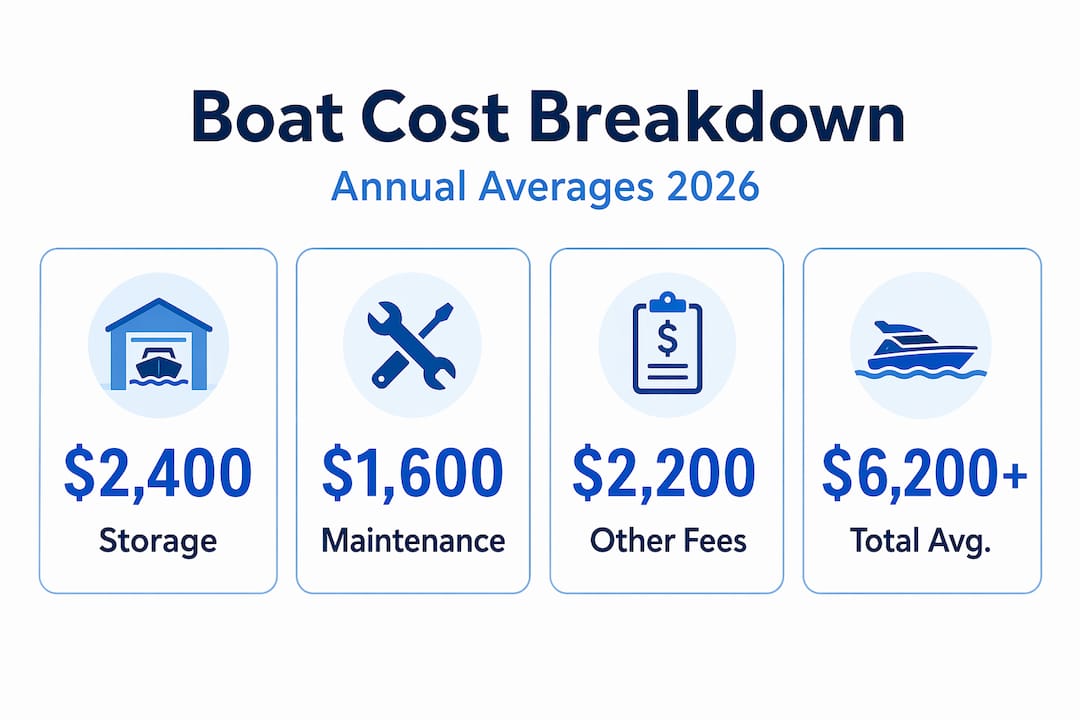
For a beginner-level ownership picture, total annual costs for a small-to-mid-size boat can reach approximately $6,200 when combining storage, maintenance, insurance, fuel, registration, and supplies. That’s the floor. Scale up boat size or marina location, and that number climbs quickly.
The cleanest way to manage this is to convert all variable costs to annual totals first, then divide to get monthly estimates. Don’t try to monthly-budget a cost that only hits once or twice a year. You’ll always undercount it.
My honest take on planning for boat ownership costs
I’ve worked with enough first-time boat buyers to know where the financial surprises hide. It’s almost never the purchase price. It’s the slip fee that went up 15% after year one. It’s the water pump that quit in July. It’s the bottom paint job that cost twice what the marina quoted because the hull was in worse shape than the survey suggested.
What I’ve learned is that the owners who enjoy boat ownership the most aren’t the ones with the most money. They’re the ones who planned honestly before signing anything. They read the boat rental vs ownership comparison and decided ownership still made sense for their lifestyle. They built a real boat ownership budget that included a 15% buffer for surprises. They chose their storage situation based on actual usage frequency, not convenience fantasy.
My strongest piece of advice: pick your marina before you pick your boat. The slip dictates your storage cost, influences your maintenance access, and shapes how often you actually use the vessel. A $200,000 boat sitting in a $24,000-per-year wet slip in South Florida might still make financial sense. But only if you’re honest about the full picture before you buy.
Boat ownership is genuinely rewarding. Get the numbers right first, and it stays that way.
— Jason
How Yachtingexperts can simplify your ownership journey
At Yachtingexperts, we’ve guided hundreds of buyers through the full financial reality of boat ownership, not just the exciting part where you pick out the hull color. Our team breaks down every cost category specific to your vessel type, usage pattern, and home port so you walk in with eyes wide open.

Whether you’re ready to buy your first boat or looking to maximize your yacht’s investment value, we offer personalized guidance at every stage. From expert yacht management in Florida to resale strategy and cost optimization, our team is with you through the whole process. When you’re ready to talk real numbers and real plans, connect with our team and let’s build your ownership budget together.
FAQ
What is the average annual cost of owning a boat?
For a 28-foot center-console, annual ownership costs typically range from $15,000 to $45,000 when factoring in storage, insurance, fuel, maintenance, and miscellaneous expenses. Smaller boats can come in around $6,200 per year at the entry level.
What are the biggest hidden costs of boat ownership?
Storage and docking fees are the most frequently underestimated expense, with wet slip costs ranging from $200 to $2,000 per month depending on location. Winterization, spring commissioning, and unexpected repairs also catch new owners off guard.
How much should I budget for boat maintenance each year?
A widely used rule is to budget 10% annually of the boat’s purchase price for maintenance. Newer boats may land closer to 2 to 5%, while older boats or those with deferred maintenance history can exceed 10%.
Does financing a boat significantly increase my total costs?
Yes. Financing at 8% over 15 years on a $150,000 boat adds more than $17,000 per year in payments, and total interest can exceed $100,000 over the loan term. Always calculate the financed total cost before committing to a purchase.
Is boat ownership worth it financially?
It depends on how honestly you plan. Owners who budget thoroughly for all recurring costs, including storage, insurance, fuel, and maintenance, consistently report greater satisfaction. Those who underestimate ongoing expenses often struggle with the financial reality within the first two years.
Recommended
Request A Call
Featured Listings

2027 Canados
100
Miami Florida

2015 Maiora
$3,750,000
90
Miami Florida

2027 Canados
57
Miami Florida
2019 Silent-Yachts Fair Dinkum
$1,599,000
55
Fort Lauderdale Florida

2026 Canados
49
Miami Florida

2026 Buddy Davis
47
Miami Florida
2020 Grady-White No Name
$610,000
45
Hallandale Beach Florida
2020 Viking Huckleberry
$1,495,000
44
Fort Lauderdale Florida

2027 Canados
43
Miami Florida
2021 Intrepid Dream Faster
$730,000
40
Coral Gables Florida

2016 Edgewater
$299,000
37
Miami, Florida

2022 Avid
$56,900
23
Stuart Florida
Get your yacht value Estimate
"*" indicates required fields