

Boat insurance is defined as a specialized marine policy that protects your vessel against physical damage, liability claims, medical costs, and environmental risks. Unlike standard auto or home policies, marine coverage is built around the unique hazards of life on the water. Most U.S. states do not legally require it, yet lenders and marinas typically mandate liability coverage between $100,000 and $300,000 for financed boats and slip rentals. Whether you own a jet ski or a 50-foot yacht, understanding boat insurance is the first step toward protecting one of your biggest investments.
What are the main types of boat insurance coverage?
A standard recreational policy covers six core areas: hull damage, liability, medical payments, uninsured boater protection, fuel spill liability, and personal property. Each one addresses a different risk, and skipping any of them can leave you exposed in ways that are expensive to fix after the fact.
- Hull coverage pays for physical damage to your boat from collisions, storms, fire, theft, and sinking. This is the foundation of any marine policy.
- Liability coverage pays for property damage or bodily injury you cause to others on the water. Marinas and lenders require this most often.
- Medical payments coverage covers injury treatment for you and your passengers, regardless of fault. It acts like a mini health policy for onboard accidents.
- Uninsured/underinsured boater protection steps in when the at-fault boater carries no insurance. This coverage matters more than most owners realize, since boat insurance is not universally required.
- Fuel spill liability covers the cost of cleaning up accidental fuel releases. Environmental cleanup costs can reach tens of thousands of dollars without it.
- Personal property coverage protects gear, electronics, and equipment stored on the boat. Fishing tackle, navigation systems, and safety equipment all qualify.
Agreed value vs. actual cash value
The settlement method your policy uses for hull losses is one of the most consequential decisions you will make. Agreed value policies pay a predetermined amount on a total loss, while actual cash value (ACV) policies pay the depreciated market value at the time of the claim. On a $100,000 boat, that difference can mean receiving $75,000 under ACV versus the full $100,000 under an agreed value policy, minus your deductible. Agreed value coverage is the right choice for newer or higher-value vessels where depreciation would create a painful gap.
Pro Tip: Ask your insurer explicitly whether your hull policy settles on agreed value or ACV before you sign. The difference rarely shows up in the marketing materials but always shows up at claim time.
How much does boat insurance cost?
The national average for a $25,000 recreational boat runs approximately $300 per year, with a typical range of $200 to $500 depending on vessel type. Smaller watercraft sit at the low end, while larger yachts carry significantly higher premiums.
| Vessel Type | Typical Annual Premium |
|---|---|
| PWC / Jet Ski | $150–$400 |
| Sailboat | $300–$800 |
| Recreational powerboat ($25K value) | $200–$500 |
| Yacht 40ft+ | $1,000–$5,000+ |
Premiums for many standard boats run 1% to 1.5% of the insured boat value annually. That formula gives you a quick estimate: a $60,000 boat typically costs $600 to $900 per year to insure.
What factors drive your premium up or down?
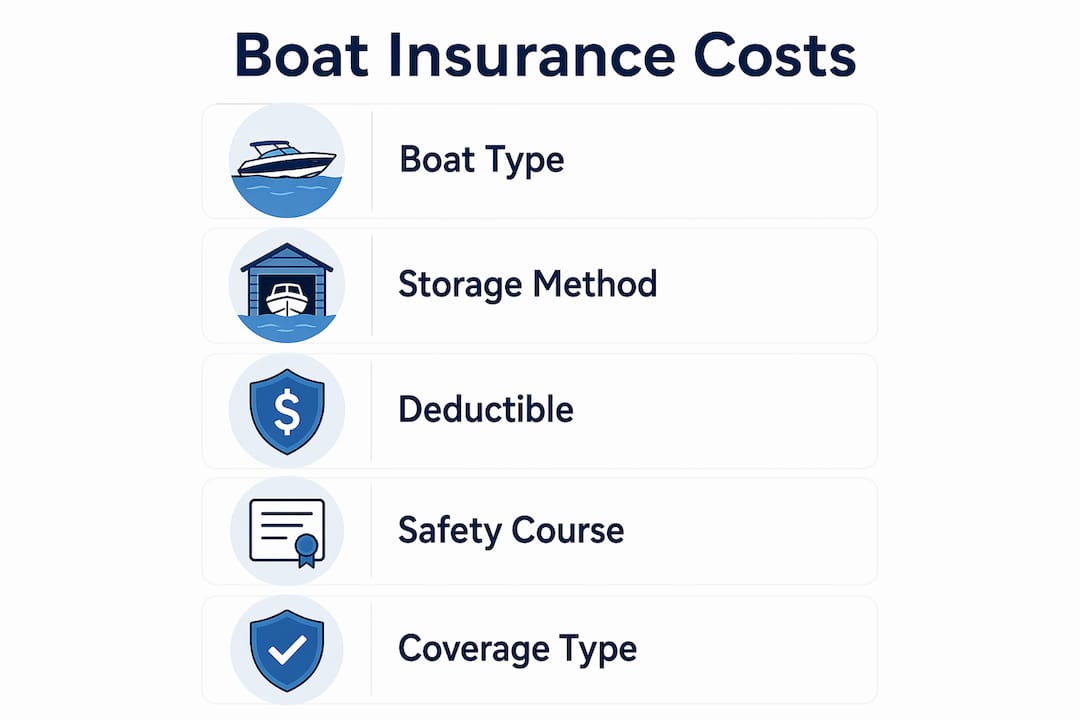
Storage method and location are two of the biggest variables most owners overlook. Wet slips carry higher premiums than dry storage because the boat faces constant exposure to water, weather, and dock traffic. Two identical boats stored differently can face vastly different annual costs. Hurricane exposure in coastal states like Florida adds another layer of risk that underwriters price carefully.
Deductible choices also move the needle. Choosing a higher deductible can lower your premium by 15%–25%, but you need to be confident you can cover that out-of-pocket amount if a claim hits. Named storm deductibles are a separate consideration entirely. In hurricane-prone areas, named storm deductibles can equal 10% of the hull value, which means a $200,000 yacht carries a $20,000 out-of-pocket exposure after a major storm. That number surprises a lot of owners who assumed their standard deductible applied to everything.
Completing a U.S. Coast Guard boating safety course can reduce premiums by 5%–15%. That discount is real money every year, and most courses take only a weekend to finish. Florida yacht owners can find additional cost and risk insights through Yachtingexperts’ Florida insurance market guide.
What steps are involved in obtaining boat insurance?
Getting covered is straightforward when you arrive prepared. The application process typically takes 15–30 minutes with the right documents in hand. Disorganized paperwork is the most common reason applications stall or coverage gaps appear.
- Gather your documents. You need the Hull Identification Number (HIN), proof of ownership, photos of the hull and interior, and your boating license or safety course certificate.
- Define your intended use. Underwriters ask whether you use the boat for recreation, fishing, chartering, or commercial purposes. Misrepresenting use is a fast path to a denied claim.
- Declare your storage location. Wet slip, dry storage, or trailered at home each carry different risk profiles. Be specific and accurate.
- Set your navigational territory. Your policy covers a defined geographic area. Operating outside that zone can void your coverage entirely, even if you have been doing it for years.
- Choose your deductible and coverage limits. Higher deductibles lower your premium but raise your risk. Match your deductible to what you can realistically pay out of pocket.
- Ask about discounts. Safety course completion, claim-free history, and multi-policy bundling all qualify for premium reductions at most carriers. Ask explicitly. Insurers rarely volunteer every discount available.
- Read the exclusions before you sign. Wear and tear, gradual damage, manufacturer defects, and damage outside your navigation territory are standard exclusions. Knowing them before a loss is far better than learning about them after.
Pro Tip: Take dated photos of your boat’s hull, interior, and all onboard equipment before you apply. Those photos become your best evidence if a claim is disputed.
What are common misconceptions about boat insurance?
The biggest misconception is that homeowners insurance covers your boat. Most homeowners policies restrict or exclude boat liability while the vessel is on the water. A standalone marine policy is the only way to get full protection.
- “My homeowners policy has me covered.” It does not. Homeowners policies may cover a small rowboat stored on your property, but they exclude liability and physical damage for motorized vessels in use on the water.
- “I can take my boat anywhere and still be covered.” Navigational territory clauses restrict coverage to specific geographic areas. Claims outside these areas can be denied even if you have operated there for years without incident.
- “Boat insurance is legally required.” Most states do not mandate it. Utah requires liability for motorboats over 50 horsepower, but that is the exception. Lenders and marinas create the practical mandate through their own requirements.
- “ACV is fine for any boat.” Actual cash value works for older, lower-value vessels where depreciation is already baked into your expectations. For a newer or high-value boat, ACV can leave you tens of thousands short of replacement cost.
- “Wear and tear is covered.” Standard policies exclude wear and tear, gradual damage, and manufacturer defects. Marine insurance covers sudden, accidental losses, not deferred maintenance.
Sportfishing boat owners face a few additional nuances worth reviewing. Yachtingexperts covers those specifics in detail in their sportfishing boat coverage guide. For high-value vessels, the Florida yacht insurance overview from Yachtingexperts is also worth a read before you commit to a policy.
Key Takeaways
Boat insurance is a specialized marine policy, and choosing the right coverage type, settlement method, and deductible is what separates owners who recover fully from a loss and those who do not.
| Point | Details |
|---|---|
| Agreed value beats ACV for new boats | Agreed value pays the full insured amount at total loss; ACV pays depreciated value, which can be far less. |
| Storage location affects your premium | Wet slips cost more to insure than dry storage; location and hurricane exposure both move the price. |
| Navigational limits are binding | Operating outside your policy’s territory can void your claim, regardless of how long you have used that area. |
| Homeowners insurance does not cover boats on water | A standalone marine policy is required for liability and physical damage protection while underway. |
| Safety courses cut your premium | Completing a USCG boating safety course can reduce annual premiums by 5%–15%. |
What I have learned after years of watching owners get this wrong
The most expensive mistake I see is owners choosing actual cash value coverage to save $100 a year on premiums, then discovering after a total loss that their $80,000 boat pays out $52,000. That gap does not feel like a bargain anymore. Agreed value coverage costs a bit more upfront, but it is the only option that makes financial sense for any vessel you would genuinely miss.
The second mistake is treating the navigational territory clause as fine print. I have seen claims denied on boats that had been running the same route for three seasons, simply because the policy territory ended at the state line and nobody noticed. Read that section of your policy out loud if you have to. It matters.
The third thing I would tell any owner: complete the USCG boating safety course before you apply, not after. The discount is real, the knowledge is genuinely useful, and underwriters view certified boaters as lower-risk clients. That perception translates into better terms across the board, not just a percentage off the premium.
Finally, review your policy every year. Your boat’s value changes, your usage patterns change, and your navigational territory may expand as you get more confident on the water. A policy that fit perfectly when you bought a 25-foot center console may leave you dangerously underinsured after you upgrade to a 45-foot cruiser. Annual reviews are not optional for serious owners. They are part of responsible ownership.
— Jason
How Yachtingexperts helps you get the right coverage
Getting boat insurance right the first time requires more than filling out an online form. At Yachtingexperts, we bring the same hands-on, personalized approach to insurance planning that we apply to every vessel transaction we handle.

Our team walks you through coverage types, settlement options, and deductible decisions with the same care we give to vessel sourcing and private viewings. We know which questions to ask and which policy details to scrutinize before you sign. Whether you are insuring your first boat or protecting a high-value yacht, our marine insurance planning service connects you with the right coverage for your specific situation. Reach out to our team and let us make this part of ownership as straightforward as the rest of your yachting experience.
FAQ
What does boat insurance typically cover?
A standard boat insurance policy covers hull damage, liability, medical payments, uninsured boater protection, fuel spill liability, and personal property. Coverage specifics vary by policy, so always review the declarations page carefully.
Is boat insurance legally required in the U.S.?
Boat insurance is not legally required in most U.S. states, though Utah mandates liability coverage for motorboats over 50 horsepower. Lenders and marinas commonly require liability limits between $100,000 and $300,000 as a condition of financing or slip rental.
What is the difference between agreed value and actual cash value?
Agreed value pays the full insured amount on a total loss, while actual cash value pays the depreciated market value at the time of the claim. For a $100,000 boat, ACV could pay as little as $75,000, making agreed value the better choice for newer or higher-value vessels.
How can I lower my boat insurance premium?
Completing a USCG boating safety course, choosing a higher deductible, storing your boat in dry storage rather than a wet slip, and maintaining a clean claims history all reduce premiums. Safety course discounts alone can cut your annual cost by 5%–15%.
Does homeowners insurance cover my boat?
Homeowners insurance typically does not cover boat liability or physical damage while the vessel is on the water. A standalone marine policy is required for full protection, including liability coverage during active use.
Recommended
Request A Call
Featured Listings

2027 Canados
100
Miami Florida

2015 Maiora
$3,750,000
90
Miami Florida

2027 Canados
57
Miami Florida

2019 Silent-Yachts Fair Dinkum
$1,599,000
55
Fort Lauderdale Florida

2026 Canados
49
Miami Florida

2026 Buddy Davis
47
Miami Florida

2020 Grady-White No Name
$610,000
45
Hallandale Beach Florida

2020 Viking Huckleberry
$1,495,000
44
Fort Lauderdale Florida

2027 Canados
43
Miami Florida

2021 Intrepid Dream Faster
$730,000
40
Coral Gables Florida

2016 Edgewater
$299,000
37
Miami, Florida

2022 Avid
$56,900
23
Stuart Florida
Get your yacht value Estimate
"*" indicates required fields